
Breaking news: there’s an earlier “first-known” mention of condom usage in contemporary romance. (Maybe “first-known” abortion mention on page as well!)
The current story is that Elda Minger’s Untamed Heart, published in 1983, was the “First contemporary romance with a condom on page.” This was publicized widely during the 2019 RWA RITA Award Ceremony in a presentation about “Romance Trailblazers.” (More on this later.)
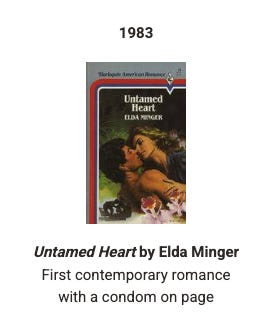
Without meaning to, I recently ended up finding an earlier condom “on page.”
I’ll walk you through my process of validating this and then zoom up to a larger conversation about tracking and talking about “firsts” in the romance genre.
I collect vintage romances and my current collection is straining my bookshelves at 2,000. I have a particular interest in transitional periods of the genre, and that includes the contemporary romance boom of the early 1980s.
I’ve previously dug into the history of the Candlelight Ecstasy line, its role in publishing sexier contemporaries, and reported back on just how sexy and readable they are after reading 14 of them. On April 12, 2026, I pulled down several more to dig into1, including Affair of Risk by Jayne Castle (aka Jayne Ann Krentz).
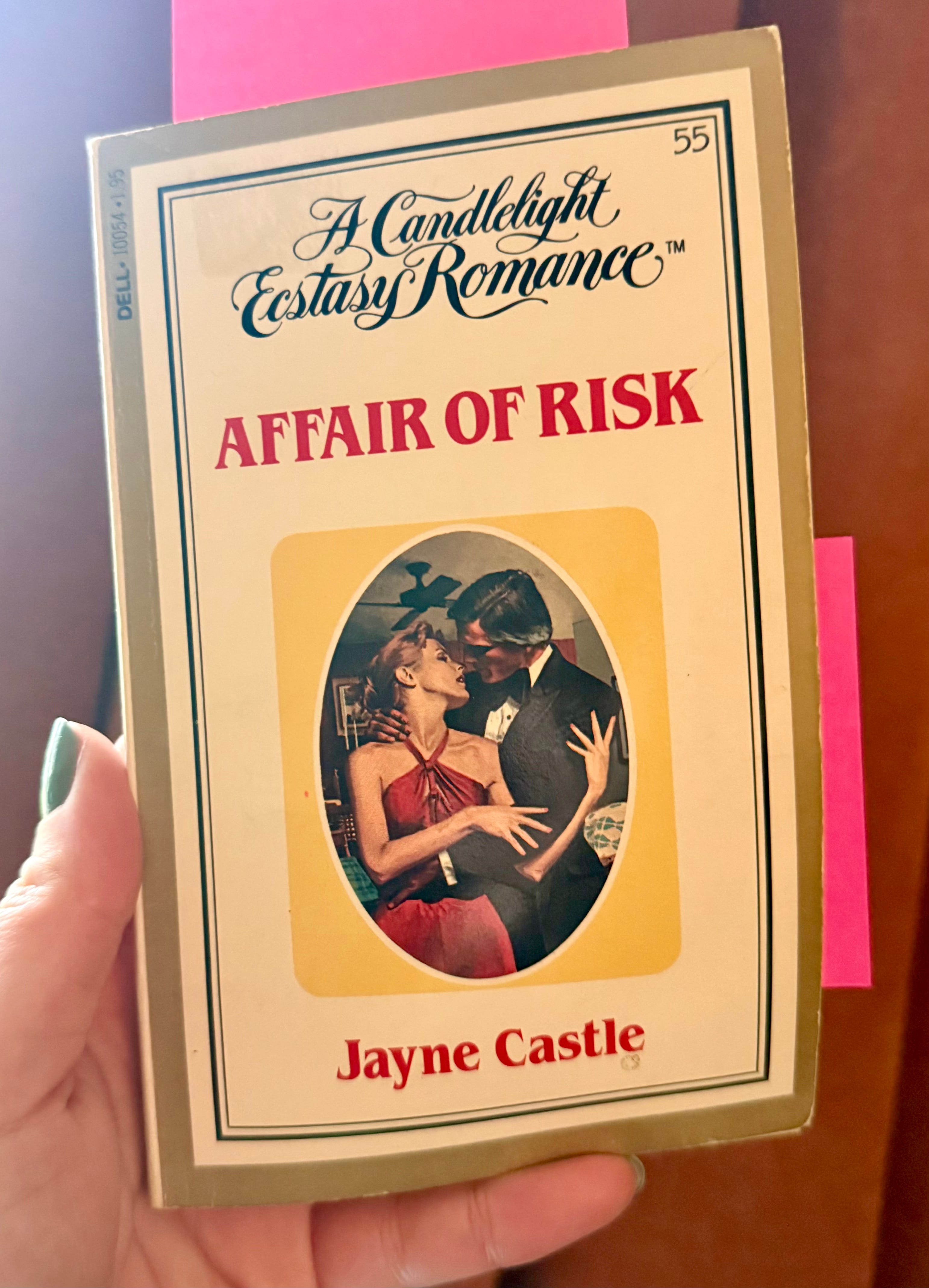
Imagine my surprise when the hero and heroine have an explicit conversation about pregnancy and precautions! And then he “fumbled for a moment longer in the shadows” before he “pulled her up into his heat and passion.” (page 115)
In their pre-lovemaking conversation, the heroine notes she hasn’t been with anyone (in the biblical sense) in two years. “I’m not prepared.” He points out their previous penetrative positions and posits that she could be pregnant already, which provokes a panic.2
He soothes her saying, “What happened the other night is past. Tonight I’ll take precautions.”
“And what happens if it’s too late?”
“Then…I’ll take care of you.” …
Kendra was so stunned by his cool words, she couldn’t find the courage to ask if he meant by taking care of her that he’d pay for an abortion.
Affair of Risk by Jayne Castle, page 112
I flipped to the copyright page: 19823. I quickly searched the internet to find the details I vaguely remembered about Elda Minger’s book being the first to mention condoms: it was published in 1983.
I was cautiously optimistic that I just made a discovery of some kind. This book was clearly earlier than Minger’s book, but the text didn’t mention the word “condom.” I needed to confirm the specifics of the claim to see if Affair of Risk fit the criteria. Also, was this an early abortion mention as well?
Claims are tricky. A good claim is precise, and therefore defensible. For example, if I claim that I am the biggest romance nerd on earth, how could I possibly prove that? What even is a romance nerd? How is it measured or recorded? You get the picture.
This is the challenge I had with the “First contemporary romance with a condom on page” claim. Crucially, what does it mean by “condom on page”?
I found references to a now-inaccessible tweet from Steve Ammidown4 on Teach Me Tonight5:
 June 26, 2022 Minger's novel was published in 1983. Steve's careful wording here reminds me that it's hard to keep track of "firsts" in the genre: since there are so many romances, and many of the earlier novels are somewhat difficult to access, their plots may not be known to current scholars. "")
Laura explicitly calls this out, so I left it in the screenshot — Steve was very careful to word this particular claim as “the first mainstream contemporary romance to include condoms that I know of.” This was much more cautious than the bold claim on the RWA site, but I still wasn’t sure if “including” condoms meant the word was used explicitly, or if it was just alluded to.
(I’m going to mostly focus on the condom claims, but Steve also mentions “the first contemporary to discuss abortion” that he’d seen. Sandra Brown’s A Treasure Worth Keeping was published in September 1982, 4 months after Affair of Risk, potentially making Castle’s book an earlier first-known for abortion discussion as well.)
Unfortunately, I don’t know if there was an image in the original tweet, or follow up posts with more details, so I reached out to Steve directly to get more information about the condom claim.6
Steve confirmed that Sarah MacLean asked for his help when she and other authors were collaborating on the Trailblazers list in 2019 and told me that his source for that project and his 2022 tweet was an article Elda Minger wrote in Romance Writer Report (RWA’s member newsletter) in July 1987, where she wrote about putting condoms on page, and he emailed a PDF.
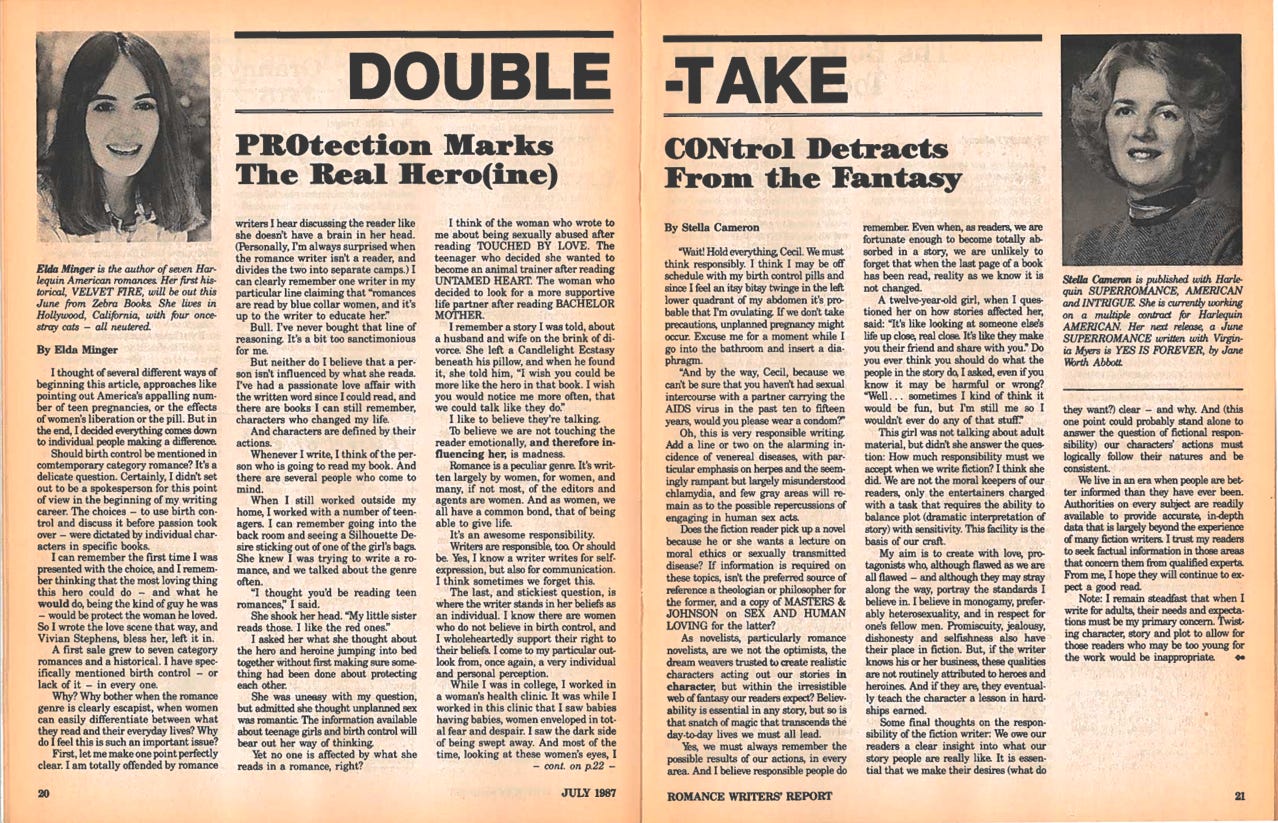
The article is a debate-style forum where two authors take opposite sides on a topic. In this case: is it necessary to mention “protection” in romance novels?
Minger was “PROtection.7” She writes that she she was being true to a hero who would “protect the woman he loves,” and that she wrote the love scene that way and “Vivian Stephens, bless her, left it in.”
At the end of the article she writes about a conversation with a reader at a conference who enjoyed the hero in Untamed Heart: “‘Especially the part… when he reached into that drawer. I think every woman knew what he was reaching for.’”
My conclusion? Minger never claims to be the first to put condoms on page, although she’s clear that she was intentionally incorporating some sort of “protection”8 and implies this was rare or surprising at the time. The anecdote at the end is meant to show how her 1983 book references condom usage in a way that was alluded to but clear to readers.
I first focused on figuring out the specifics of the claim because if the claim was that Minger’s book actually used the word “condom,” Castle’s book wouldn’t actually meet the criteria. However, the claim so far seemed to be about implying some sort of birth control. It was finally time for me to actually look at Minger’s book, which I happened to have on hand.9
Ryan kissed her again, then turned away for just an instant. She heard the drawer in the bedside table open, then shut. She kept her hand on Ryan’s shoulder as he sat turned away from her, but it was only for an instant. Then he was back against her, pushing her into the mattress with his hot, insistent body.
Untamed Heart by Elda Minger, page 200
We now have confirmation that Minger did NOT mention condoms explicitly!
The Trailblazer entry overstates the case: a more accurate formulation, based on what was known, would be “first-known implied condom use in a contemporary category romance.” Under that definition, Affair of Risk by Jayne Castle is now the earliest-known instance.
It’s worth pausing here, because this kind of discovery can read as an attempt to knock someone off a pedestal and that’s not the point.
Elda Minger should be credited for what she actually did: writing a scene that intentionally incorporated “protection” at a time when that was unusual, and at a time when she likely hadn’t seen a published example of someone else doing so, and then continuing to speak publicly about that choice. That matters and it shaped how readers and writers thought about what could appear on the page.
But “firsts” don’t function as permanent titles. They function as provisional markers for what we’ve been able to find, access, and verify.
Pushing that line back doesn’t erase the work that came after: it clarifies the context it emerged from.
As Laura Vivanco said when she quoted Steve’s tweet: “…it's hard to keep track of ‘firsts’ in the genre: since there are so many romances, and many of the earlier novels are somewhat difficult to access.”
This is why I collect physical copies of older romance. I seek out books that others have flagged as notable, to have a baseline, but I also try to collect representative samples of what hasn’t been flagged as notable. There simply are not enough people reading older romances, and there are even fewer who are doing so with the intent of publishing about them.
The example I’ve just taken you through shows the game of telephone that can happen with claims. “First known example Steve Ammidown has heard of” becomes “First” and the source material is inaccessible (to people who don’t have Steve on speed dial) because a billionaire bought a social media platform.
As a result of the limited access most people have to earlier romance novels that weren’t institutionalized as “classics,” “Romancelandia” depends on pieces of information that can sometimes get inflated beyond their original intent.
This is the blessing and the curse of institutionalization, and here’s where I will return to “Trailblazer” as a concept.
The intention behind honoring trailblazers is noble. The 2019 RITA Awards committee seemed to have an intentional restorative justice project in mind for a confluence of reasons. Even though RWA’s implosion due to its dodgy handling of DEI was a year in the future, the organization’s lack of support for equitable inclusion of people of color, queer people, and stories and business practices that pushed the boundaries of the genre had been bubbling since its very inception.
Perhaps there was a sense that this tension had come to a head, given that 2019 was the first time in the 37 years they issued awards that they honored a Black author or South Asian author.

In any case, I am not knocking the RWA project from 2019. It’s necessary to “spotlight” older books and provide a guided journey into the history of the genre. I think part of the danger in not doing so is recency bias, which is evident when current readers act like older romance was universally regressive without considering the context of the past but also without any evidence or exposure to the texts they’re painting with a broad brush.
The RWA Trailblazer page itself acknowledges the limits of a list of “firsts”10 and invites updates and evolution.
Did the Trailblazer list capture every meaningful first? No. It couldn’t. There’s no stable definition of what counts as notable, and there are far more books than anyone has read, let alone documented. Any list of “firsts” is necessarily incomplete.
The problem is when these lists stop functioning as entry points and start functioning as endpoint. When “first-known” becomes “first,” and then becomes accepted fact, the work of inquiry sputters out. The archive flattens and the genre’s past starts to look cleaner, more linear, and more settled than it actually is.
The slice of older romance that circulates in Romancelandia is extremely small relative to all that exists, and the books that get institutionalized as “classics” often reflect current tastes more than they reflect the full range of what was being written and read at the time.
Even when knowledge exists, it doesn’t reliably surface. Three years before the RITA Trailblazers presentation, on Facebook Linda Howard11 casually referenced reading condom usage in a Jayne Ann Krentz book. She was pointing, more or less, in the direction of what I stumbled upon by luck. That information, though technically available, didn’t enter the record in a way that could shape the Trailblazer project just a few years later.
Nobody is deliberately obscuring the past, but the system for preserving and circulating knowledge is uneven, fragmented, and dependent on what is accessible.
The line we draw around “firsts” will always be provisional. There will always be an earlier book, a forgotten line, a reader who remembers something no one bothered to record.
If we treat “firsts” as endpoints, we stop looking. If we treat them as starting points, we keep the history of the genre open, as something that can be expanded, challenged, and revised.
The archive is still there12. The only real question is whether we keep looking.
I have 120 of the total 533 Candlelight Ecstasy books published: 22.5%!
Alliteration is my passion.
Steve has made a few visits to the podcast, including a discussion about Where the Heart Roams, the 1980s documentary that was filmed around the time condoms were being mentioned on page (whatever that means): https://shelflovepodcast.com/guest/b14529fe-dc12-4603-b9d6-475763d914db
Laura Vivanco is a tireless archiver of romance scholarship knowledge! If you’re interested in romance scholarship, you should definitely scroll through the Teach Me Tonight blog, as well as the Romance Scholarship Database she maintains: https://www.vivanco.me.uk/popular-romance-scholarship/introduction-romance-scholarship-database
Romance scholarship is an incredibly small world. :)
The “CON” side was NOT entitled “CONdoms detract from the fantasy,” and instead was “CONtrol Detracts From the Fantasy,” which I think is a missed (period) opportunity.
It’s a bit maddening how even in the RWR, the phrasing is still very opaque. I reread the article and I don’t think the word “condom” even appears in the article! in 1987!
Obviously (pushes glasses up nose), I had previously sought out many of the Trailblazer texts to have in my collection, for exactly this purpose. (Wait…AM I the biggest romance nerd on earth?)
“A note on this list: Firsts are a challenge in any medium—there is often someone who came before, lesser known, and less celebrated. If you have additions or corrections to this list of romance trailblazers, please let us know. Our genre’s history is vast and varied, and your knowledge is essential to ensuring it is remembered.”
Did Linda Howard scoop all of us in identifying the first contemporary romance author who included condoms?! (In case it must be said, no.)

Say what you want about LH (I certainly have): she was there at the beginning of RWA and the emergence of the sexy contemporary and has a lot of lore stored up. Howard publicly bounced from RWA around 2017 due to her objection to “social issues” being prioritized in the organization, so I am guessing they didn’t call her up to ask for her recommendations for Trailblazers.
Comments
Nothing yet. Say the first thing.
Sign in to join the conversation.