
About 18 months ago, I introduced “Romance Novel Collection,” a sub-channel within Shelf Love:
Romance Novel Collection will focus on the what, why, and how of romance collections — the goal of this sub-publication is to build a community of like-minded people who are interested in learning about collecting romance from each other.
I then proceeded to take up carpentry, and got distracted.
After building anticipation, waiting for that anticipation to fully wane, waiting for the project to be totally forgotten: I’M BACK, BABY!
Thank you to those of you who jumped in with sharing your collections. I will be scheduling posts featuring others’ collections soon!
One last note: if you’re subscribed to Shelf Love for reasons other than romance collecting, you can opt out of the “Romance Novel Collection” sub-channel and continue to get classic Shelf Love posts.
Instructions to do that can be found in this post.
I’m revisiting Janice Radway’s 1984 classic romance scholarship: Reading the Romance. RtT was a groundbreaking ethnography of romance readers in “Smithton” centered on an influencer called Dot.
While so much amazing romance scholarship has been published in the last 50 years and we’ve (mostly) moved past the need to defend the legitimacy of studying romance novels at all, Radway’s work still stands out for its methodology.
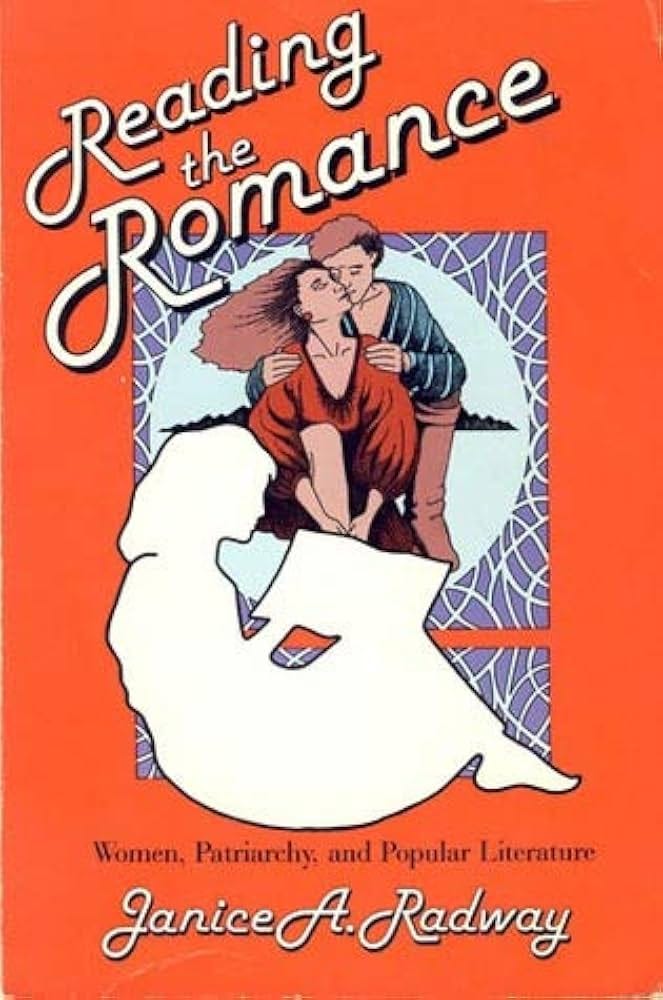
As part of her larger project, Radway compiled a list of 20 “ideal” and 20 “failed” romances based on the perspectives of the Smithton readers and Dot, thus generating the qualification criteria from within the community of readers themselves. It wasn’t about what publishers or editors thought was good, what sold the best, what won prizes, what was catalogued as romance, or based on criteria from within an academic discipline: it was about the readers’ criteria.
This list of 40 books is the jumping off point for Radway to build her understanding of how the readers in this community conceptualized what defined romance, and what drew them in or repelled them. While Radway is the first to point out the limitations of this small sample size, the intimate sampling allowed an intimacy and depth that will always be lost from large-scale survey research.
Reading the Romance is discussed often in scholarly romance circles, and the methodology and analysis is often picked apart with varying degrees of fairness. While some of the texts Radway incorporates are still well-known and read (such as The Flame and the Flower), most of them are not.
I’m curious if anyone else has ever endeavored to read all of these books in the 40+ years since Radway published RtT?
If I had a time machine, I’d go back to 1982 and replicate Radway’s methodology with a different community of romance readers to see how different the list looked (and how the reader preferences/definitions differed). That would help us understand how universal the preferences were, time stamped at a particular point in history.
But now, 40+ years later, one must grapple not just with different subsets of the reader population and their preferences, but the massive changes in society, pop culture, and technology that have influenced what romance looks like today and how that shapes reader preferences. Attempting to interpret Radway’s corpus (body of texts) and her 1984 analysis from the perspective of 2026 is likely corrupted by presentism and hindsight-ism to an absurd degree.
What, then, would be the point in collecting and reading the books Radway analyzed as “ideal” and “failed” romances?
…because that’s what I’m trying to do.
First, I think it’s important to preserve the primary texts Radway discusses so that modern-day and future scholars are able to actually engage with the texts and not just secondary analysis.
After I recorded the video, I searched the two most likely places to have a full collection of these texts (the BGSU Browne Pop Culture Library and the Lilly Library and Indiana University, which purchased Rebecca Romney’s romance collection) and it doesn’t look like either has the full corpus. That’s not to say it doesn’t exist in a private collection or other specialty library collections — I’d love to find out if anyone or any institution has the complete collection.
Second, I am curious how the Smithton readers’ preferences and sense of what defines romance aligns with my own understanding, as an anecdotal investigation into how much romance has (or has not) changed since the early 1980s.
I cut my teeth on Woodiwiss when I first started reading romance in the late ‘90s and continue to read a significant amount of vintage romance. I humbly submit that I may be in a good position to contextualize the past of the genre sympathetically and fairly, and recognize similarities and echoes in more modern romance and where it’s diverging more significantly.
Third, I’m always looking for excuses to build micro-collections in my macro-romance collection. :)
Hope you enjoy this video, and I will be back with updates on finalizing the collection of books (hopefully?! or getting close to it), and beginning my read through.
The Journal of Popular Romance Studies did a special issue revisiting Reading the Romance on its 30th anniversary. If you’re interested in how contemporary romance scholars were interpreting and engaging with Radway’s work 12 years ago, this is a great place to start.
This channel is not just supposed to feature my own romance novel collection: submit yours via the Google form link below:
Comments
Nothing yet. Say the first thing.
Sign in to join the conversation.