
Democracy is either growing or shrinking. It is never still.
Right now, on a carrier deck in the Arabian Sea, sailors are standing watch after 260 straight days at sea, the longest continuous deployment of the modern era. Their families sat across from the Navy’s acting secretary in a San Diego meeting hall last week and read him a text message: “he hopes he doesn’t wake up tomorrow.” That is not a talking point. That is a service member’s wife, in a room, saying the words out loud.
This is what it looks like when institutional accountability erodes one firing, one shortage, one unanswered question at a time. The story is not partisan theater. It is a structural one, and it belongs to every American who has ever been told to trust the chain of command.
Since taking office, Defense Secretary Pete Hegseth has removed or sidelined more than two dozen senior generals and admirals, according to The Hill and ABC News. The pace accelerated through the spring and summer of 2026, in the middle of the active war with Iran.
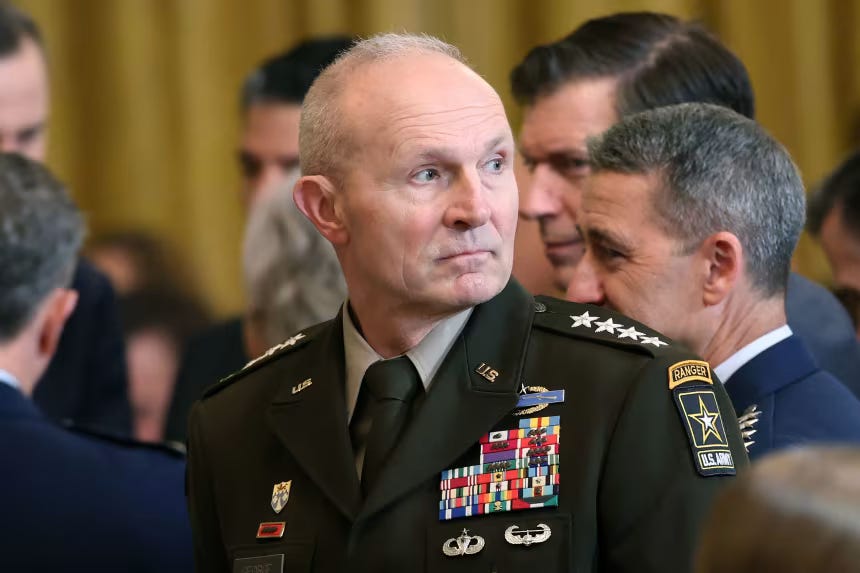
In April, Hegseth ousted Army Chief of Staff Gen. Randy George, along with Maj. Gen. William Green Jr., the Army’s chief of chaplains, and Gen. David Hodne, who led the Army’s Transformation and Training Command. CNN reported the moves came a day after President Trump addressed the nation on the Iran war, and Pentagon officials gave no public reason for any of the three departures.
In July, Gen. Christopher Donahue, commander of U.S. Army Europe and Africa and the officer famously photographed boarding the last flight out of Kabul in 2021, relinquished command after just 18 months, with his post downgraded from a four-star to a three-star command. NBC News reported the Army gave no official explanation, though Sen. Thom Tillis had publicly warned weeks earlier that sidelining Donahue would be “a dangerous path.”
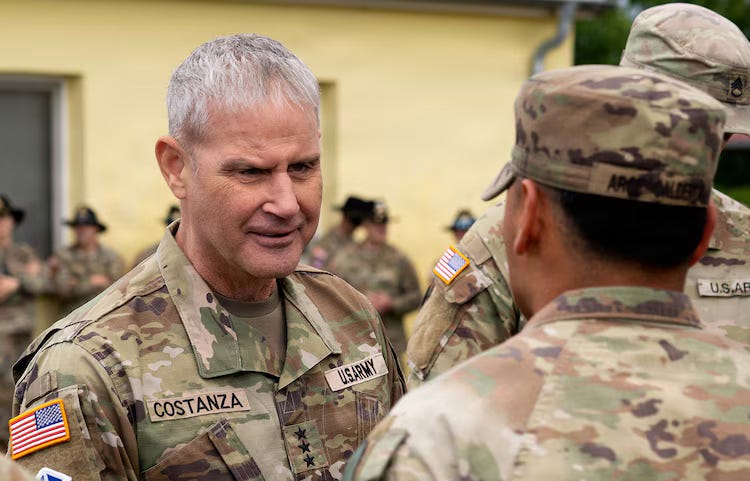
In August, Lt. Gen. Charles Costanza, commander of the Army’s V Corps and the officer overseeing U.S. coordination with Ukraine along NATO’s eastern flank, was abruptly relieved with two months left in his term. Stars and Stripes confirmed the Army has not disclosed why. That same week, the Pentagon revoked the security clearance of former Air Force Secretary Frank Kendall, citing an “unauthorized disclosure” after Kendall was quoted in the Wall Street Journal questioning whether the Qatari-donated jet used as a temporary Air Force One had the same defensive capabilities as the aircraft it replaced. Kendall has said he intends to sue, according to Military.com.
None of these officers has been accused of wrongdoing in relation to their removals, with one narrow exception: officials told The Hill that Costanza’s dismissal, unlike the others, followed conduct that would “get a commander relieved at any level,” though no further detail was released.
The pattern that remains, regardless of individual explanations, is one where senior military judgment keeps disappearing from the room precisely when the stakes rise. That is a structural accountability problem, not a personnel footnote.
While the leadership churns at the top, the human cost is landing on the enlisted sailors holding the line at sea.
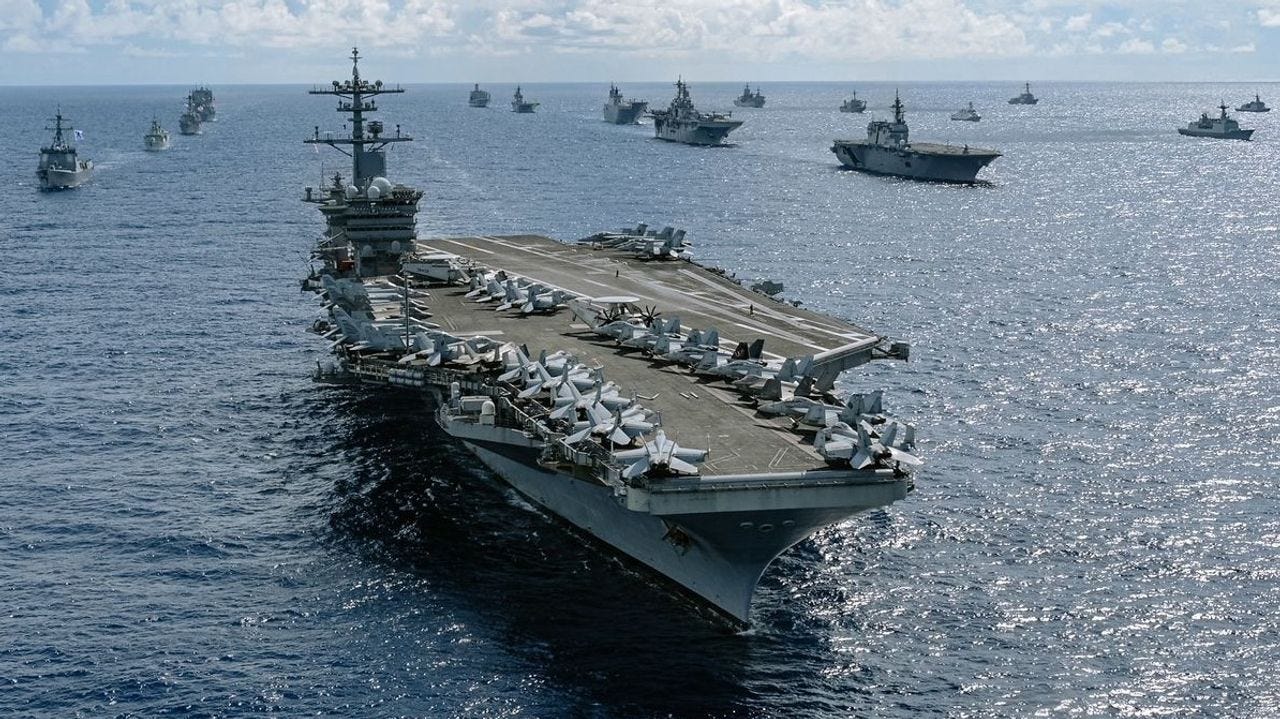
The USS Abraham Lincoln has now spent more than 260 continuous days deployed, a modern-day record, according to Stars and Stripes. Roughly 5,000 sailors and Marines aboard have received only two days off the ship since departing San Diego, the World Socialist Web Site reported, citing family accounts relayed to MS NOW.
Last Thursday, the Navy held an in-person listening session at Naval Air Station North Island in San Diego, followed by a virtual session for families elsewhere. Roughly 200 people attended in person. Families described moldy showers, broken toilets, food shortages, contaminated water, and a mail system so disrupted that care packages have been lost for months, according to MS NOW’s reporting, corroborated by Stars and Stripes and NBC 7 San Diego.
One spouse told officials she had just received a message from her husband saying he hoped he wouldn’t wake up the next day. Navy leadership, including Acting Secretary of the Navy Hung Cao, did not directly respond to that statement in the room, though officials pointed to available counselors, chaplains, and medical staff, according to the spouse’s account relayed to Stars and Stripes.
Navy leaders told families that the USS Theodore Roosevelt is being prepared to relieve the Lincoln, but offered no firm date, with a target as late as December 31 discussed for even beginning the process, per MS NOW. Families were also told the Lincoln’s home port is shifting from San Diego to Bremerton, Washington, once the deployment ends, adding a housing displacement question on top of everything else.
These are not isolated grievances. They are the downstream effect of a strained fleet stretched across a war with no announced end point, and of a chain of command whose most experienced senior officers keep being replaced mid-crisis.
The reason the fleet is stretched this thin traces back to a resource problem that outside analysts have now confirmed independently of anything leaked to a family member.
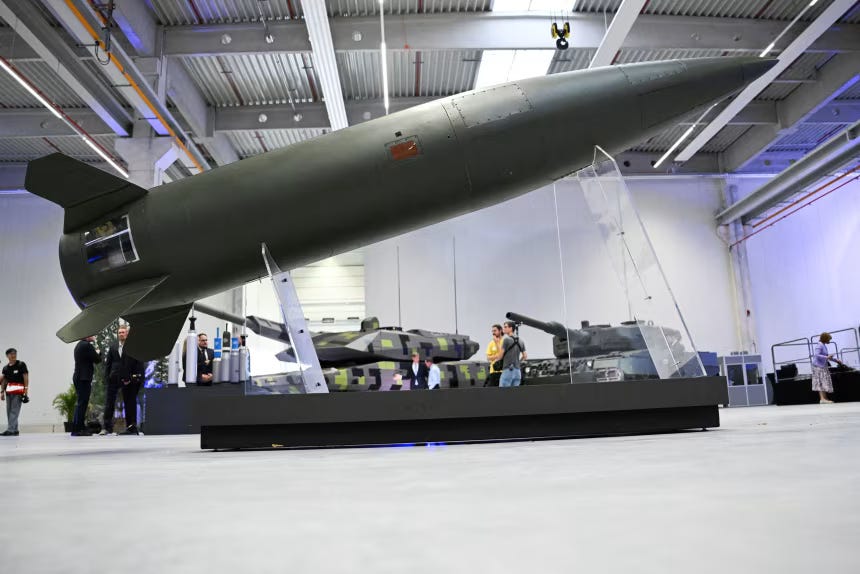
The Center for Strategic and International Studies estimates that the war with Iran, which began February 28, 2026, has consumed roughly two-thirds of the U.S. Patriot interceptor stockpile and as much as 80 percent of the THAAD interceptor inventory, according to CNN and ABC News. A U.S. official told ABC News both stockpiles “are extremely low.” CSIS estimates it will take three or more years to rebuild THAAD inventories to pre-war levels, and current replenishment is running at roughly 20 new Patriot missiles a month, according to CNN.
This is not a fringe claim. It is the same conclusion reached by a nonpartisan Washington think tank, confirmed by three independent sources briefed on internal government figures.
Against that backdrop, CNN’s Zachary Cohen reported that Chairman of the Joint Chiefs Gen. Dan Caine has privately told senior Trump advisers, including CIA Director John Ratcliffe, Secretary of State Marco Rubio, and Vice President JD Vance, that the United States needs an off-ramp from the war, because further air escalation is unlikely to achieve the administration’s stated objectives and carries real risk given the depleted stockpiles.
The allies who depend on that same U.S. security umbrella have noticed. Saudi Arabia, which has absorbed repeated Iranian and Houthi strikes since the war began, signed a new mutual defense pact with Turkey and Pakistan on August 7, declaring that an attack on any one member is an attack on all three, according to Al Jazeera. The agreement builds on an existing Saudi-Pakistan pact and formalizes a hedge against the reliability of American protection, in real time, while the war is still active.
That is the evidence. Here is what it means, and what you can actually do about it.
I don’t love putting up a paywall. I’d rather every reader get the whole picture for free. But The Digital Democracy Watch has no corporate backer, no hedge fund, no network deal behind it. It’s one independent journalist and readers like you. If that’s a trade you’re willing to make so this reporting can keep existing, here’s how to keep going.
Comments
Nothing yet. Say the first thing.
Sign in to join the conversation.