
Last week, after much peer-pressure, I finally succumbed. I tried out one of the shiny “agentic AI productivity” apps to help me manage my inbox, calendar and meetings.
A few days later, I’m already finding that it’s utter gibberish. The inbox classifications are positively unhelpful; the email reply suggestions misguided; and there’s no sense of “me” in any of the interaction suggestions. To add insult to injury, I just received an automated email celebrating how much “productivity I had saved”. Seriously, WTF.
I fully accept that the LLM needs to be fully “trained” on my preferences, and that the technology overall will improve. But the whole experience made me feel pretty queasy.
Reading Jenny Anderson & Rebecca Winthrop ‘s New York Times op-ed on how AI threatens to “short circuit” our kids’ critical thinking skills (link at end), made me angrier. Yet again, just like social media, it’ll be entirely thrown on us as parents to prevent over-use. Big (and little and mid Tech) will, entirely predictably, wash their hands off any responsibility, and our Regulators threaten to let them.
I’m a warrior of the first internet gold rush (the late 90s dot.com boom) and I remember a similar prophecy: that the internet would revolutionise everything. The reality, as we know, is much more nuanced; a small number of the thousands of companies founded, actually survived. And while there were good and bad impacts (from democratising information to the hacking of our attention), overall the impact of the world was much more incremental than we thought.
There’s much about this current AI bravado (aka BS) that reminds me of those heady days. Here are my four fundamental concerns with it’s all heading:
Confusing the Transactional with Relational.
I use Gemini as much as the next person for transactional stuff - a first list of ideas for a holiday, for instance. But when I’m interacting with someone who matters to me (in a professional or personal capacity), I want my voice and my unique knowledge of that person to be infused. Whether in terms of humour, a personal anecdote, or remembering something important going in their lives. It’s the authenticity that really matters; and that just can’t be “cloned”. (If it can be cloned, it can’t, by definition, be human - “my AI agent will talk to your AI agent” just doesn’t do it for me).
Confusing Short-Term and Long-Term Gain.
So much about life success is about the “struggle”, the journey of stumbling and gradually developing mastery in something. It’s about sacrificing short-term pain for long-term development and success. When we take the tempting short-cuts that AI now often provides, we dilute the struggle and the progress journey. The reason why so many dot.coms failed, is that founders like me tried to the collapse the business practices, culture and habits that successful companies had built over decades, into a matter of months. It just doesn’t work that way; the best things in life, like a fine wine, take time to mature.
Confusing Productivity with Impact.
If we’re convening a meeting, one of the most impactful things we can do is to write up really powerful summaries and actions. These can account for the human zeitgeist of the room - the said and the un-said; key tensions and controversies; the need to nudge people who don’t really want to collaborate. Reading these AI-generated “meeting summaries” was deeply underwhelming. If we master the art of synthesis, we develop a powerful alignment and commitment tool - for ourselves and others. (If we are feeling meeting meeting-overwhelm, anti-productivity author Oliver Burkeman points out, why not try and have fewer meetings? Link to his great book at end).
4. Confusing Power with Trust.
The fourth is about Power. If the AI hype-boom was all being pushed by a benevolent divine figure from above, I’d be more sanguine. But there was something quite sinister about sharing all my valued client emails (which I don’t share with my own wife) with a company partly owned and pressured by a VC, that could shift its privacy gears with the drop of a T&C hat. I’m sorry; when I thought about what I was really doing, I just didn’t feel comfortable. It didn’t help that why I tried to switch off the AI Application, I actually found no easy way to do so.
To re-state, I’m NOT suggesting that there will no value created for society through this AI boom. But I think that the way that AI is currently being constructed - mostly by engineers and tech utopists - is deeply misguided.
In the irony of ironies, the way that AI is being pushed on us is preventing us - and our kids - from actually developing human relational skills, authenticity and connection. Skills that will be absolutely critical for us to thrive and flourish in a post-AI world.
So if you’re a Leader, don’t throw away a lifetime of positive mindsets and practices that have brought you success. Use AI smartly and selectively - where it doesn’t undermine anything relational, long-term, or deeply impactful in what you do. And don’t give away your Power.
And if you’re also a Parent, there’s an even deeper irony:
That the best way for your kid to flourish in a post-AI world is to encourage them, like smart-phones, to use them in only limited and focused ways. And with your active supervision.
Don’t worry what your friends or colleagues think. There’s very little risk your kids won’t be “AI native” enough. Trust your judgement - and really watch out for the “short-circuity” risk of your child’s critical, human or relational skills.
Remember in that every Gold Rush - just like that 90s “internet will change everything” mantra - for every ounce of real gold, there are many ounces of Fool’s Gold.
Get caught up with the AI Fool’s Gold, and - years later - there’s a real risk that we and our kids will end up feeling very foolish indeed.
Jenny and Rebecca’s NYT Op-Ed: https://www.nytimes.com/2025/09/11/opinion/parents-children-ai-learning.html
Oliver’s book “Four Thousand Weeks”: https://www.oliverburkeman.com/fourthousandweeks
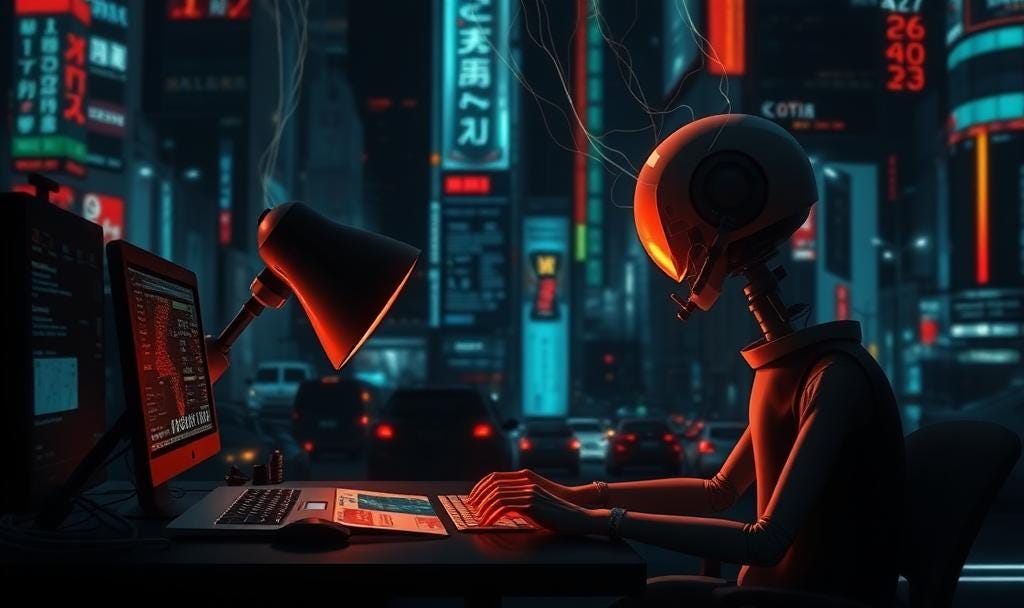
PS - I’m deep into studying for my Level 3 WSET Wine Exams at the moment, and I thought this image was so telling. The love, care and personality that a great winemaker takes to futureproof the authenticity and complexity of a wine is immense - so much more art than science. Contrast it to the blandness of the generic AI-generated image below!


No posts
Comments
Nothing yet. Say the first thing.
Sign in to join the conversation.