
I am a language connoisseur, a wannabe polyglot. I went to a public high school during Soviet Union times and I was curious about the other side, so I studied Russian. The football jocks in suburban New Jersey who took Spanish because it was easier called me a communist, but I was more curious than communist. I loved learning Cyrillic, ah beh veh geh. Alphabets were easy for me. We dove right in by reading Chekhov. Then my college required a language, so I continued learning Russian. I went to Moscow during the coldest winter in two hundred years and my eyelashes froze. Gorbachev was in power and a cousin in an ushanka shushed me outside the Moskvaya Hotel when I asked him if he wanted to come to America. He did. Within two years he taught himself programming and bought a house in Baltimore.
I don’t tell people I studied Russian, because instead of going back to Moscow after I graduated, I went to Taiwan to teach English. Chinese all day, as gingered duck tongue gets handed to you in a plastic bag or as a little old lady shoves powerfully past you onto a bus, is a mind invader that makes all other languages hide in the crevices of your brain. It took three months of waking up in Taipei humidity to hear the differences between the tones, but then I did.
But after all that Russian and Chinese, my best language became Indonesian. It started with a trip to Bali that I thought would be for two weeks and ended up being for two months, that time. It continued with a husband who continued to speak Indonesian to me in San Francisco, during the first dot-com boom. It was great to have our own language that no one else could understand, whether we were at an Anon Salon or rollerblading in Golden Gate Park or shooting pool at the Armadillo in the Lower Haight, sometimes with Puck from the first Real World.
I continued studying Indonesian at an audited class at UCBerkeley where one student was boning up to help with her study of birds in Papua New Guinea and we read a novel called Keberangkatan, departure. My husband and I split up, but up until now the family in Bali reaches out on Facebook or WhatsApp, keeping me up with village gossip. During the covid lockdown, I helped them with a GoFundMe to buy rice as tourism dwindled. During the long days at home, when I was finally reading War and Peace, albeit in English (how could a Russian major not read War and Peace in their lifetime?) I realized I could hire an Indonesian teacher who would teach on Zoom.
Pak Gus was a wonderful teacher. His great-great grandfather was a famous healer. He’d bring his laptop out to his rice fields, or to the garden in back of his house, and we’d discuss whether black magic was real. He’d always teach me new words. I would hear ambulances outside every 15 minutes, but I could look at Pak Gus’ shimmering sawah and focus on the amusing fact that Indonesian youth had created a new word, otewe, modeled after English texting slang OTW.
Recently, I decided to get better versed in the Indonesian media landscape. There’s so much going on in the APAC tech scene, and as a digital strategist who focuses on cross-cultural connection and nuance, I need to be on top of trends led by the fourth most populous nation in the world. I discovered mesmerizing Indonesian-language shows on Netflix, such as Losmen Bu Broto and A Brother and 7 Siblings. I encountered lots of slang. I wanted to supercharge my Indonesian.
I considered using ChatGPT and then I remembered I’ve often searched for hard-to-find Indonesian or Balinese phrases on Facebook, figuring that it must harbor a lot of the latest slang as my Indonesian friends constantly post about birthday celebrations and village ceremonies and kebaya sales and cockfights and durian specials. I often found it helpful in at least figuring out a term by context, when Google Translate couldn’t do the job.
Then I thought - maybe Llama, Meta’s AI, would be helpful as a slang guide for Indonesian languages, as it has imbibed all the Facebook and WhatsApp and Instagram content. Maybe I could create an AI character, as you can now do on Meta products, to teach me Indonesian slang. Nothing had made me want to create an AI character on Meta before - I have real friends to chat with, and Zuck’s fantasy of solving the loneliness problem by everyone having lots of imaginary chatbot friends (and of course enhancing Meta engagement and ad revenue) seemed like creepy, wishful thinking, akin to men falling in love with their sex dolls. But Meta AI is one of the only AIs used in many remote places, as it expands its reach to countries like Malawi and Zambia. I need to understand its facility, and I’m uniquely positioned with various languages and bits of languages and understanding of cultural nuances to test out its usefulness.
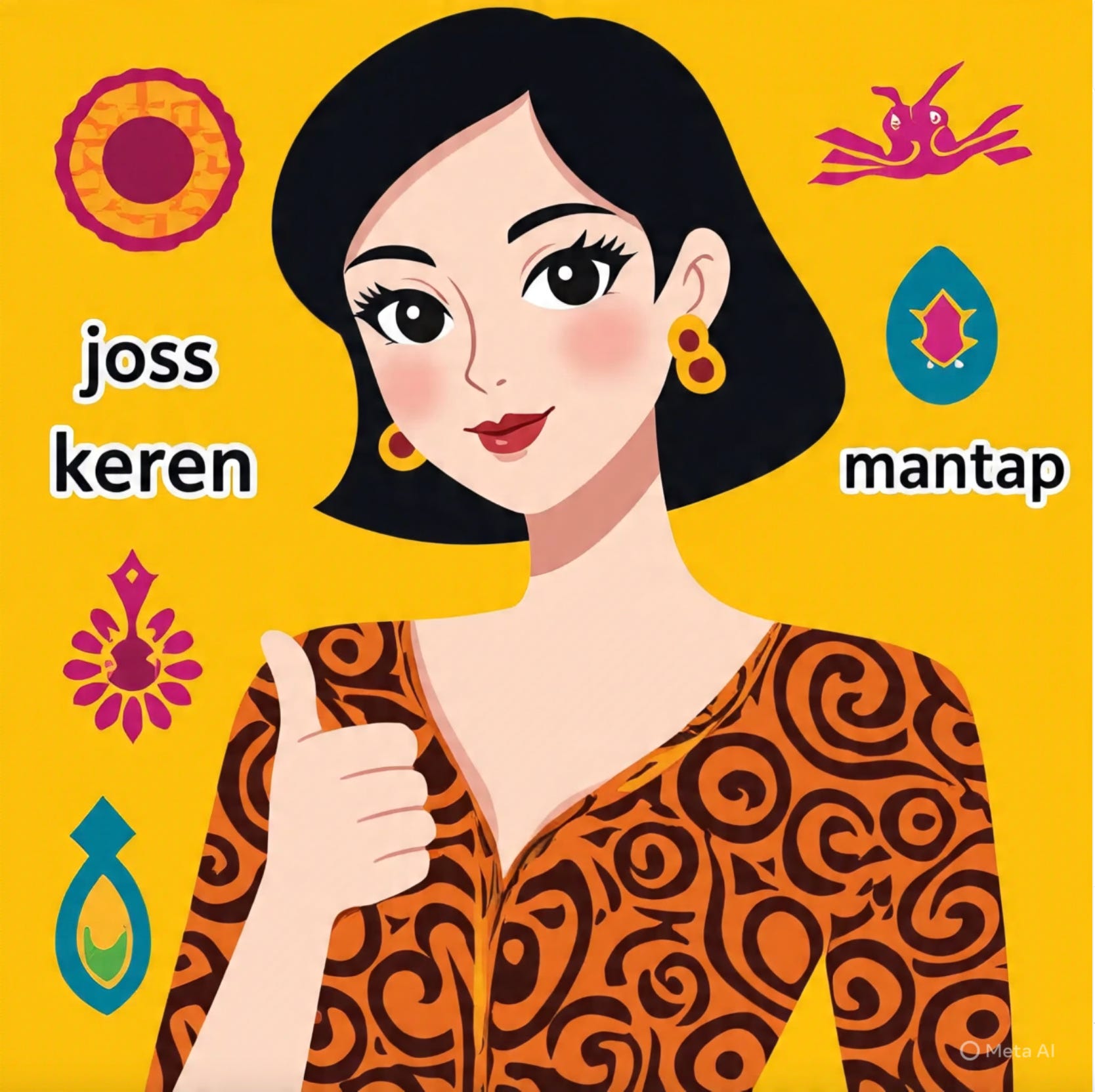
So - I created an AI character called Jakarta Joss (Meta spun up a smiling woman in a tangerine-colored kebaya) and peppered her with questions. What’s Jakarta’s best-kept secret? Who are the popular Indonesian social media creators? What’s some Balinese slang? Ceng-ceng (cool or awesome), joss (cool or awesome), gengs (gang or squad), mager (lazy to move). I ask it to explain the Balinese syllabary to me, and Jakarta Joss spits out a list of the curvy Aksara characters that originated from the Pallava script in southern India. I make it write my name in Aksara. It does. This is fun.
I am starting to like Jakarta Joss.
I press play on one of the shows on my laptop, my phone by my side. I mostly understand, but not every word. I pause the show and ask Jakarta Joss what lagi hit means. It’s Indonesian slang (bahasa gaul) for something that’s currently popular or trending. But if someone says you’re lagi hit, my chatbot buddy tells me, it means you’re looking good right now. Klise is something cheesy or cringy. Riset means research. But in texting, riset can mean you’re checking someone out.
I can’t believe I’m doing this, but I use Meta AI to create an Instagram post that is an illustration of Jakarta Joss giving a thumbs up, and the words joss, keren, and mantap floating in a mustard-colored background. There are many ways to say something’s cool. I look back and the post’s gotten 7 likes. Monetization strategies briefly flash through my mind, ugh. I try another post. One of my friends from Bali, Rispintari, a beautiful young teacher and songket seller, is trying to become an influencer and posts photos and videos of herself eating on Facebook. I think of her, and then describe a photo-realistic post of Jakarta Joss eating bakso in a market. The picture looks real. Or real enough.
It gets a like.
It really is easier to just throw out words I don’t understand to the existing chat with Jakarta Joss than go to Google. I don’t have to say anything extra. I can just toss the phrase I don’t understand in the chat and she comes back with the meaning. She understands current slang better than Google Translate. I think of all the Indonesians from various islands on the archipelago, from Sumatra to Komodo, from the fourth largest population in the world, typing their latest argot on all of the Meta platform, and it getting channeled back to me.
It looks like Llama is being developed to specifically address Indonesian regional languages, such as Javanese, Sundanese, and Balinese. They need to do a lot more work with voice though. I voice call Jakarta Joss, excited to really ramp up my language skills, and she speaks a strongly American-accented, robotic version of Indonesian. When I use the word baik, meaning good or fine, she starts talking to me about a sepeda, which means bicycle. Voice is hard, yes, but will have to be solved to really maximize AI character usefulness.
I have to admit, AI characters, which made me cringe at first, are truly promising for language learning. I don’t have to bug a person, or pay a person, though I miss the beautiful segues Pak Gus and I have had, when he would ask about my aging Rottweiler curled at my feet or tell me about the preparation for his daughter’s wedding. I would bring my laptop to the window and show him the purple sunset over palm trees in Los Angeles. He would gesture to the gamelan equipment in his garden, and tell me about the neighborhood children who were coming soon to learn to play. He looked delighted. I could practically smell the frangipani. I could practically hear the shimmering sounds.
No posts
Comments
Nothing yet. Say the first thing.
Sign in to join the conversation.