
I have long fantasized about running away to a rugged island full of wild beauty and not much else. When today’s headlines go heavy on impending doom or the revival of fascism, I start googling “remote island — caretaker jobs.”
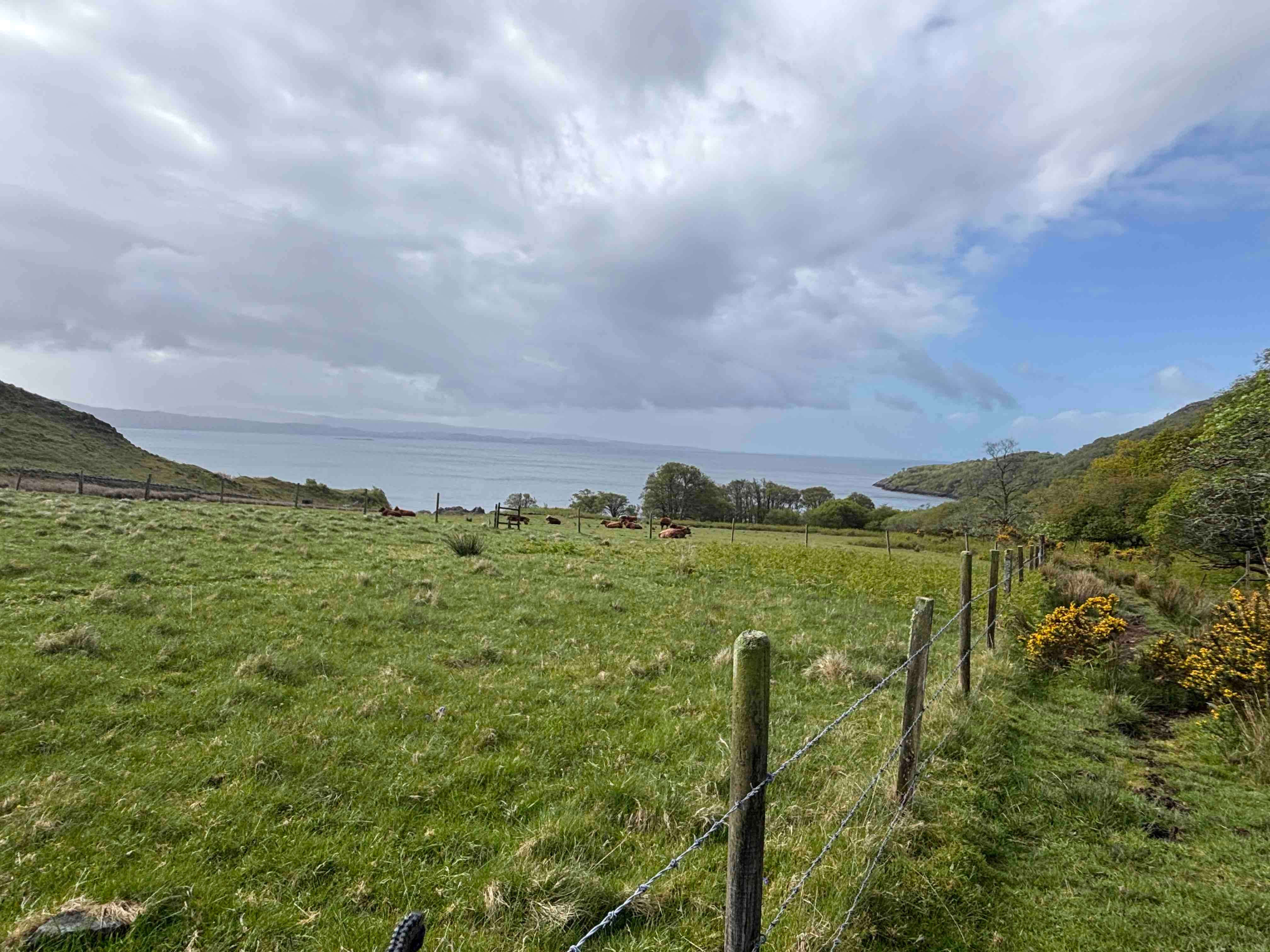
In 1946, George Orwell (né Eric Arthur Blair) ran away to a craggy corner of the isle of Jura, in Scotland’s Inner Hebrides, what he called, “un extremely un-get-at-able place.” Still, I accidentally got there. This spring, I was on a traditional ship for a working vacation (what we call fieldwork). One afternoon we pulled into a protected curve of coast on the northeastern tip of the island. Some of us took the dingy to the rocky shore and made our way up a cow path that curved around a hill. Within 15 minutes, we came upon a squat, whitewashed stone house nestled in the crotch of two green slopes, facing a stunning private cove. We had arrived through a backdoor shortcut. Most people making a pilgrimage to the house (called Barnhill) have to take two ferries and then hitch a ride on a bumpy 24-mile track.
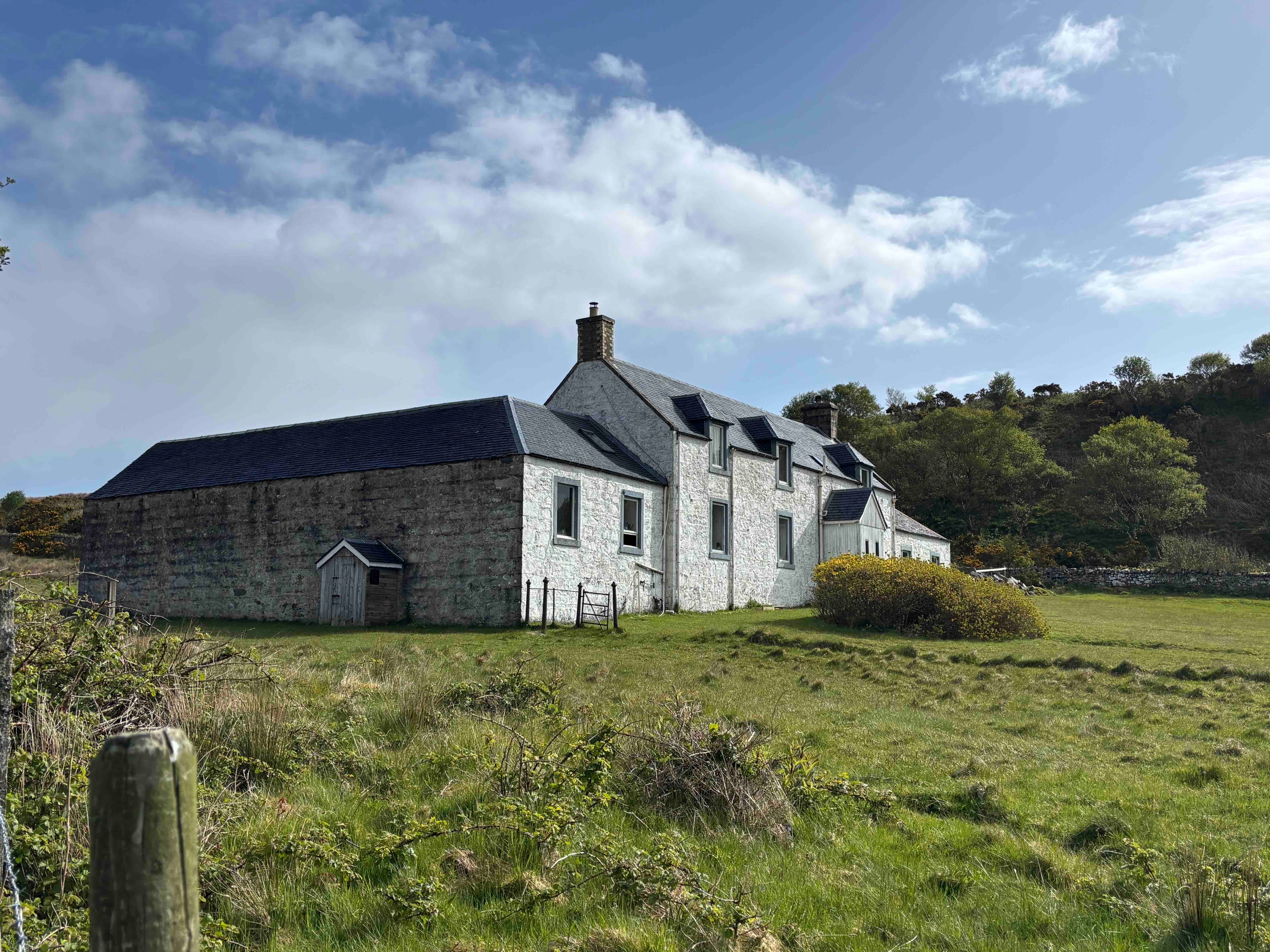
Months after his wife Eileen died and critics started raving about Animal Farm, Orwell ran away from London with his young adopted son, a nanny, and his sister. They rented Barnhill for the next three years during which he wrote 1984 on a glitchy typewriter in a race against tuberculosis.1
I learned these details after I returned to the mainland, but that day in May, with the sun casting moody rainbows over the deep green grass and golden eagles flying overhead, my first thought was: “How could someone live in such a beautiful place and write such a dystopian novel?” My second thought was: “What would the archaeology of this place tell us about Orwell?”
Orwell kept a diary for the three years he lived on Jura. He worked in the garden, hunted rabbit, deer, and geese, and procured fish, crabs and lobsters. He also dried the fish, built a chicken coop, planted flowers and fruit trees, tinkered with his motorcycle, and attempted to make a jigsaw puzzle for his son. An animal lover and confessed Beatrix Potter fan, he still battled rabbits in the garden with the determination of mean Mr. McGregor. He kept himself so busy, it’s remarkable he had any time to write. Does someone without hope for the future plant an orchard?2
According to local history, the house stands near the site of a 15th-century settlement called Cnoc an t-Sabhail (knoll-of-the-barn), but as far as I could tell, this identification has not been groundtruthed. Orwell’s diary demonstrates little interest in the history of the isles, or even Scottish life. It’s quite possible that while tilling the garden he churned up artifacts from Jura’s 11,000 years of human history. If so, he didn’t seem to notice.
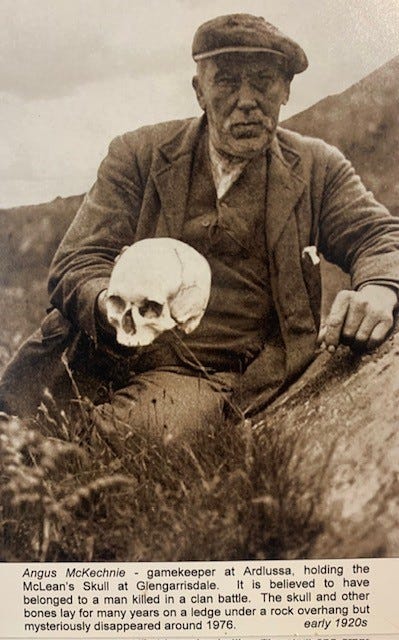
The only entry that reflects any archaeological curiosity comes from June 1946, when he went on an excursion to the west side of the island: “Old human skull, with some other bones, lying on beach at Glengarrisdale. Said to be survivor from massacre of the McCleans by the Campbells, & probably at any rate 200 years old. Two teeth (back) still in it… Quite undecayed.” This skull was, until some thief removed it in 1976, well-known to locals who called it “Maclean’s Skull.” They identified the remains with a victim of a 1647 attack by the bellicose Campbells against local clans, citing as evidence a crease in the bone that looked like a sword cut. It’s a good a story. But it didn’t interest Orwell much. Nor did he seem to know that back at Barnhill, prehistory was staring down at him.
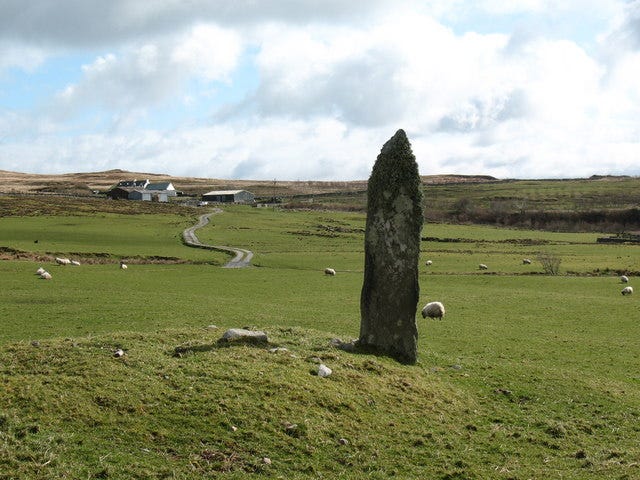
According to a government monument survey, a stony mound measuring 5.5 meters across sits next to Barnhill. It appears to be a prehistoric burial cairn, probably from the Bronze Age (~2000-750 BCE). At some point, the ancient resident was evicted and the tomb repurposed as a sheep hut. It might even be the ‘barn’ in Barnhill.3
Jura is littered with archaeological sites, from Mesolithic camps and Neolithic standing stones to hilltop forts from the Iron Age. There may be remains from the Middle Ages as well, when Norse Vikings ruled the Hebrides (1079–1493), but any evidence of their presence or that of the Gaelic clans they attempted to control, lies buried under the turf. The island’s recorded population peaked in the early 19th century at 1300 farmers and fishers, but then dropped precipitously during the clearances when private landholders evicted rural tenants throughout Scotland. When Orwell arrived, there were less than 400 people living on Jura. Today there are only 200.
Most of Orwell’s political and literary friends were bewildered by his decision to trade London for an unheated farmhouse lacking electricity, much less a walkable pub or grocer. According to Orwell lore Jura was, “a place so brutal and bleak that it contributed to his early demise.” But that’s not what comes across in Orwell’s diaries, which read more like a contented farmer’s almanac.
Orwell, who took a bullet in the neck during the Spanish Civil War, wasn’t the only wounded soldier who moved to Jura to get away from “civilization” after WWII. He shared quiet company with a handful of survivors of Normandy, Japanese POW camps, and campaigns against Mussolini, including amputee Bill Dunn, a neighbor who eventually married Orwell’s sister Avril.
I don’t think these men moved to Jura because they thought it was dystopian, I think they did so because they were looking for sanctuary. Jura, with its wind-lashed solitude, was no utopia, but it must have felt like a world set apart from bloodied, tattered postwar Europe. Not only did Orwell have his own trauma triggers to escape, success had made him into an object of surveillance. And not just from admiring literati; Stalin was rumored to have put a price on his head.
For three years, Orwell shut out the world, ignored history, and immersed himself in the present of day-to-day existence. He lived deeply in the moment, and he wrote. 1984 is a warning, not a forecast. I think he wanted to motivate readers to protect the kind of autonomy and freedom he had crafted on Jura. Maybe writing a novel, even a dystopian one, is like planting an orchard.
Today Barnhill’s owners (grandchildren of Orwell’s landlord) rent the house out by the week to intrepid summer vacationers. I wonder if they could use a caretaker for the rest of the year.
Orwell and his wife Eileen had been planning a move to Jura before her untimely death while undergoing a hysterectomy. A writer in her own right, Eileen had written a poem called, “End of the Century, 1984” in 1934, one year before she met Orwell. Biographers believe he followed through with the Jura plan in part to honor her wishes and that the book’s title pays homage to her impact on his work.
There’s a veritable Orwell industry of biography and journalism, as well as The Orwell Society’s dedicated output. The most detailed account of his time on Jura and entries in the diary is Les Wilson, Orwell’s Island: George, Jura, and 1984 (Saraband, 2024).
For more on the archaeology of Jura, see Royal Commission on the Ancient & Historical Monuments of Scotland, Argyll: volume 5 – Islay, Jura, Colonsay and Oronsay, HMSO: Edinburgh 1984.
Comments
Nothing yet. Say the first thing.
Sign in to join the conversation.