
Some summers arrive with a margin built in, but this one feels thin. Around June, my Substack shifted from a hobby to something that looks more like a small business, and I’ve been in a full sprint since. There are systems to build, DMs to answer, editorial calendars to plan, and tech problems I didn’t know existed… not to mention my day job. The dog days have been less beachy than recent years and more administrative.
Less entertainment time has made me extra selective. I find myself asking: is this going to be worth my time? Here are the items that have been a resounding yes.
A documentary about competitive birdwatching sounds like a snooze fest, but it’s one of the most entertaining films I’ve come across in a while. Two broke brothers from St. Louis decide to attempt a “Big Year”, which is the birding term for seeing as many species as possible in a single calendar year. They Googled “what states have the most birds” and drove south. What followed was 38,757 miles of Cracker Barrel parking lots, prison ponds, and interviews with people who will literally fly across the country the moment a rare bird is reported, just to add one checkmark to their list. Slate called it “Fear and Loathing for birding.” The Atlantic called it one of the funniest documentaries they’d seen in years. What I keep thinking about is how much it’s really about attention, and what a life looks like when you let one obsession drive the truck. Free on YouTube.
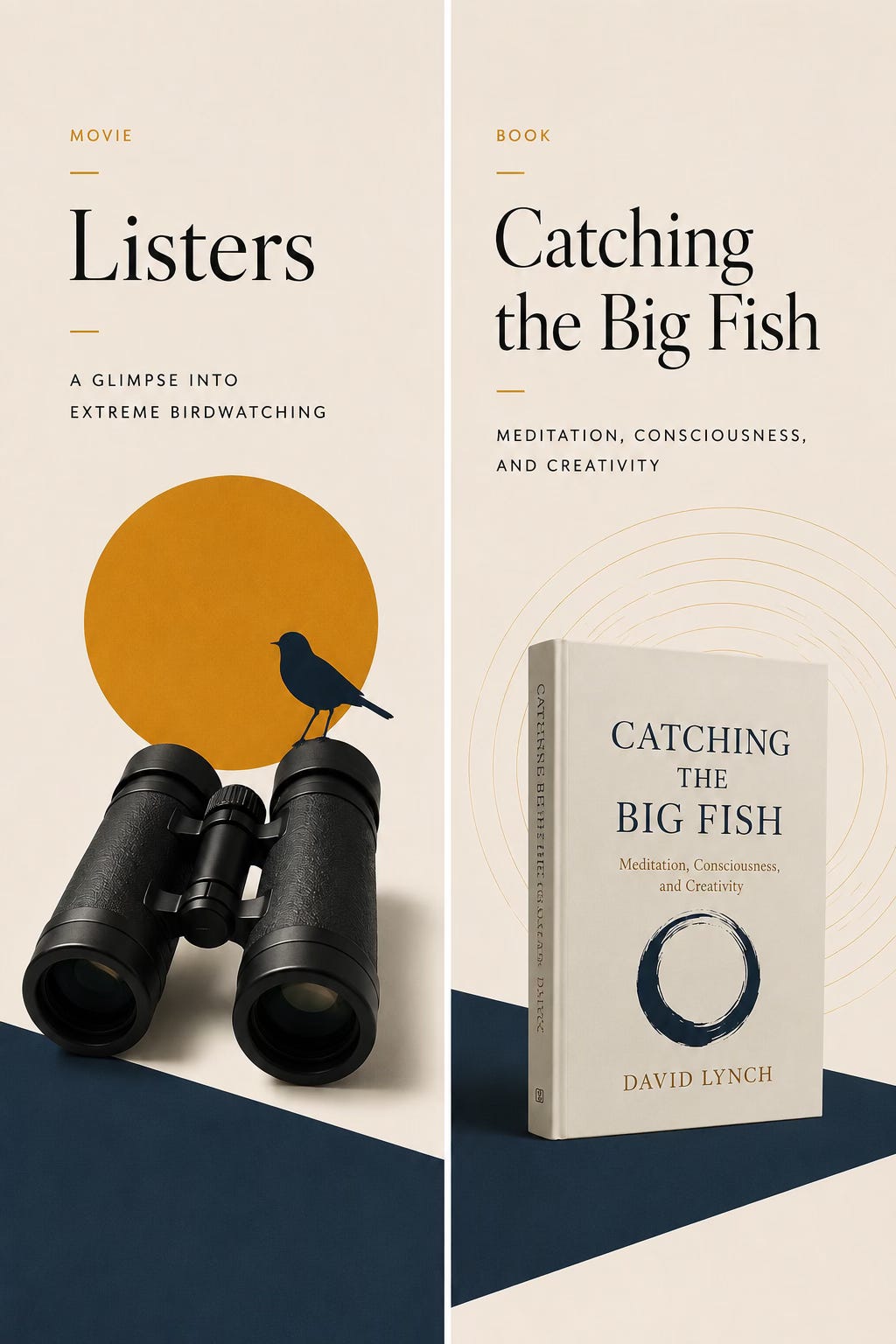
A fellow Substacker recommended this in a comment on one of my notes, and he was not wrong. Lynch’s book starts with filmmaking and ends as an invitation to fish in deeper creative waters. He talks about ideas the way fishermen talk: you can’t force them, you can only stay still long enough for one to rise. For someone buried in logistics all summer, it’s been the exact message I needed. True to Lynch’s style, it’s strange and creatively generous, and I’ve thought about it every writing session since.
Every summer I intentionally abandon my literary itinerary for a fluffy beach read. Something set in a beachy town, built for hammocks and too much sunlight, with no ambitions beyond a good time, and Hilderbrand delivers. This one’s been adapted into a Peacock series starring Jennifer Garner. I saw the trailer and knew immediately it was meant to stay on the sandy shores of fantasy; the screen version rarely survives the crossing, and from what I could gather, this one does not. Without a lazy beach vacation this summer, I’ve been listening on Audible instead. It’s still giving me the feel of a summer treat that I can take anywhere.
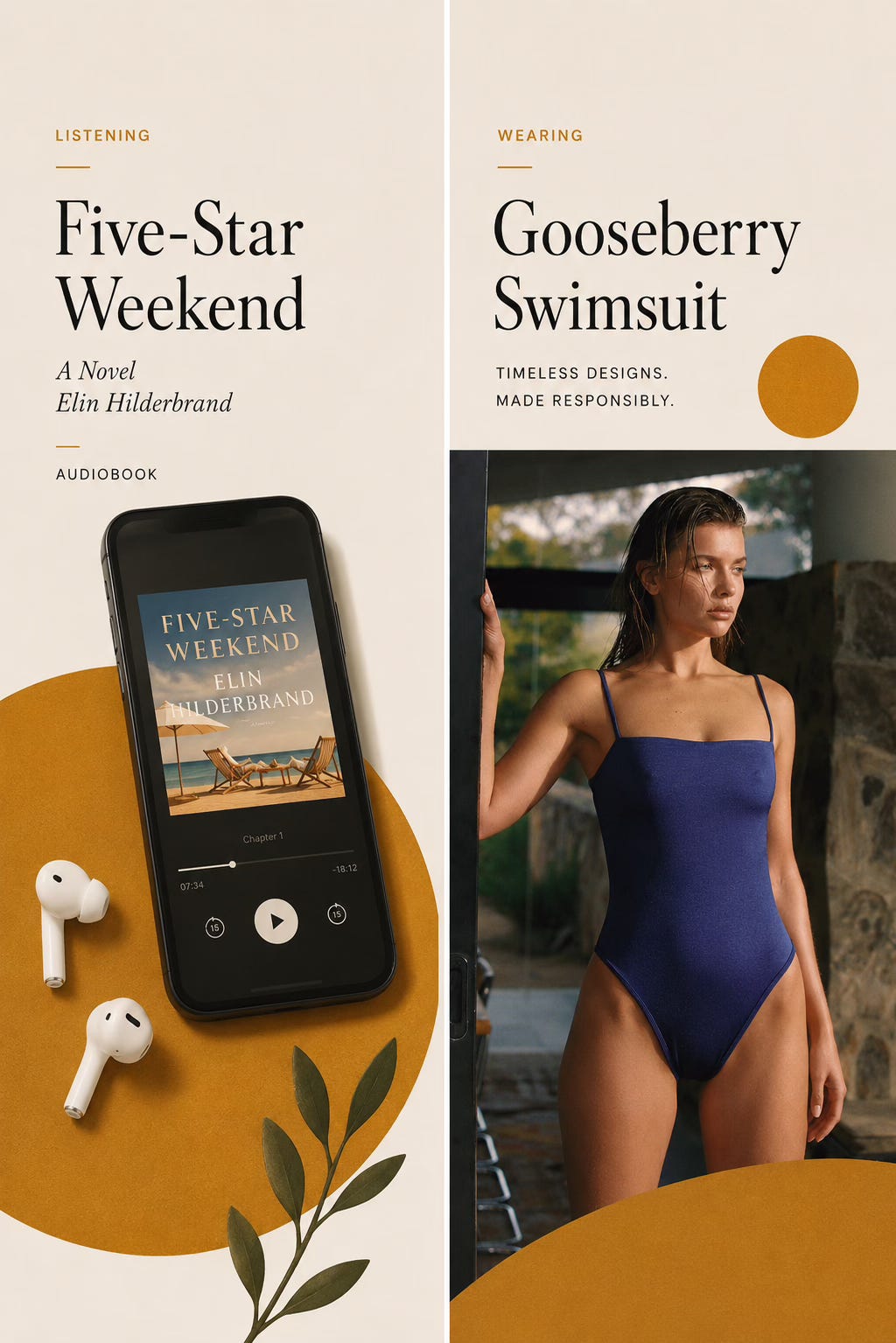
Last year I went on a dance retreat in Bali, stayed a few extra days, and ended up at an interior designer’s dreamscape. Gooseberry sits above Bingin Beach in Uluwatu: French restaurant, cocktail bar, pool, DJs, cactus garden. It’s screen-free, which tells you everything about the vibe. The boutique is almost incidental to the experience, which is how I ended up in a dressing room between margaritas trying on every piece they make. I came home with several colorways, all in the same square-neckline cut (taking my own advice: when you find a swimsuit that feels good on you, purchase multiple). A year later I’m still reaching for them. Covered enough for a pool day with kids and sexy enough for a resort swim-up bar. If you find yourself in Bali anytime soon, the headquarters are well worth a visit.
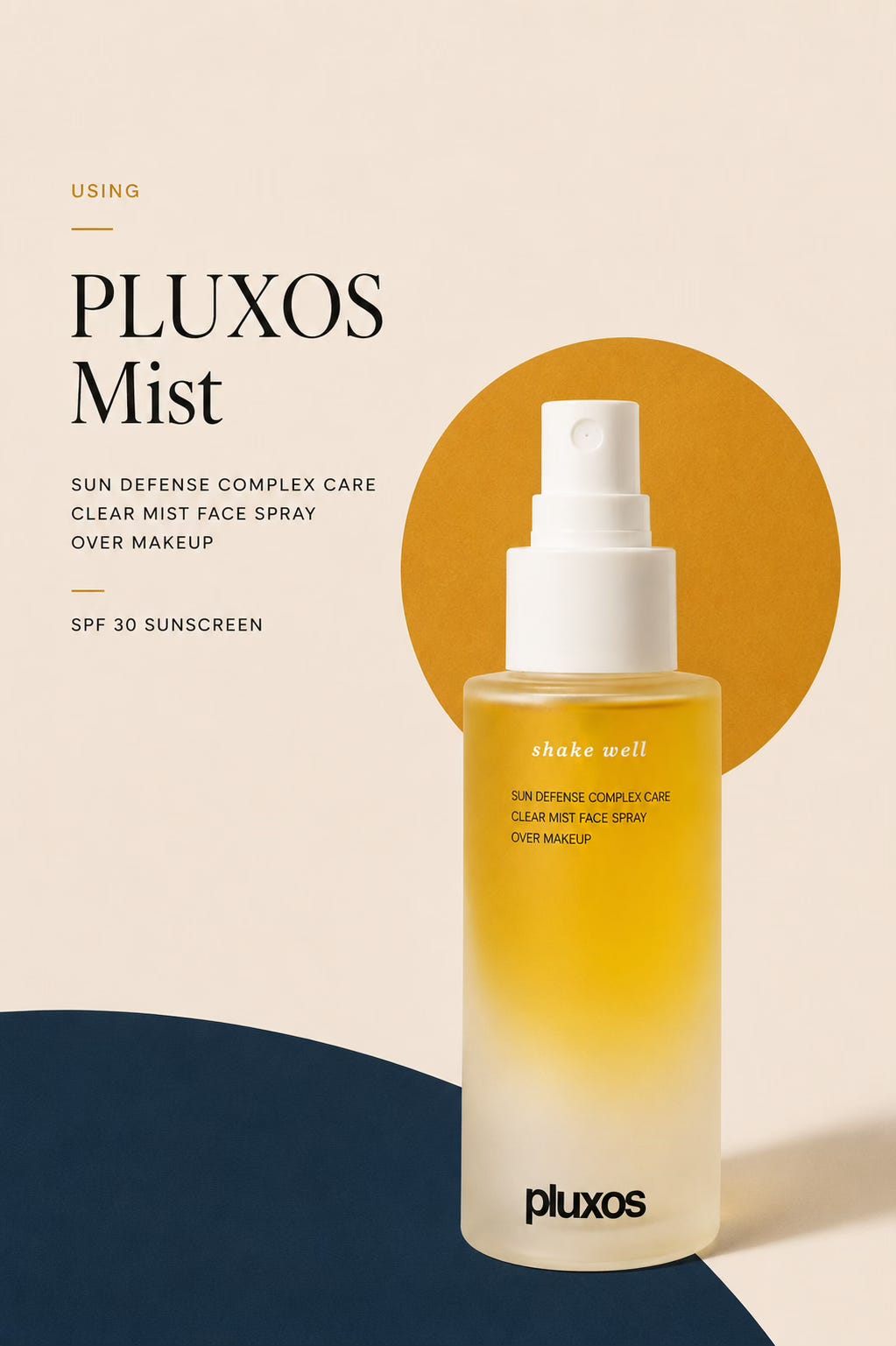
I rarely get excited about sunscreen, but I apparently I am about this one (I’ve gifted it to three friends and sent links to multiple others). Organic SPF 47 in a glass bottle — not a plastic tube of chemicals — loaded with quality skincare ingredients. Spray it over your makeup or body, and it settles into something light and cooling, faintly luminous and easy to reapply throughout the day. The kind of finish that feels more like a medi-spa product than sunburn protection. My absolute favorite find this summer.
My local studio calls it sleep yoga, which is the most accurate rebrand of a wellness practice I’ve ever heard. It’s a guided non-sleep deep rest where you lie completely still while a voice walks you through a body scan designed to drop your nervous system into the space between waking and sleep. The claim is that it offers more restoration than several hours of sleep.
Any day with a nap is a good day in my book. This summer has not been nap-friendly, and Yoga Nidra has been the answer. You don’t have to do anything right; you don’t even have to stay awake. Insight Timer and YouTube both have free guided sessions. Search “yoga nidra” and lie down.
Six words is a constraint that forces honesty. Try to describe your summer in exactly six. Notice what rises first and what gets left out, then write the last line you want it to have.
There’s still August.
This section usually covers a wide mix of articles I discovered on Substack: different genres, topics, whatever catches my eye. This summer, time made the decision for me to narrow it down (just for this post). One topic has been generating more conversation on the platform than anything else right now.
Substack recently added Pangram, an AI detection and scoring tool. For the first 24 hours, it was mandatory before you could opt out. It set off a wave of questions: are these tools accurate and fair, do they show bias, what happens when AI is policing AI, should authors disclose how they use it?
In full transparency: I write everything here myself. I use Grammarly as a copy editor and AI to stress test my drafts. My visuals are made with a combination of digital and AI tools.
I ran Pangram on this piece once — 75% human, 0% generative AI, 25% AI. That feels fairly accurate. I’ve edited since, so your scan may differ.
There are also real concerns about accuracy, and bigger questions about how it affects writers working in English as a second language or who are neurodivergent.
Here are four articles on the subject by fellow Substackers that are worth reading:
Kelly says what a lot of us are thinking, in the way only Kelly can. She argues that you know how you feel when you read something, and the percentage that shows up afterward has nothing to do with it. This one made me stop and ask whether I was spending energy on something that doesn’t actually matter.
Sam did the research. False positives, bias against non-native English speakers and neurodivergent writers, the same post scoring 100% human and 100% AI depending on which tool touched it last. His conclusion: keep the “How I make this” statement, drop the scan. Hard to argue with and probably where I will end up on the matter.
Westenberg makes the case that the Pangram screenshot is already aging out. When “written by a human” stops being a useful shortcut for “worth your time,” the question stops being interesting. From calculators to Photoshop, the panic always fades. He’s probably right.
I included this one because it’s worth knowing what Pangram is actually measuring before deciding how you feel about it. Read it and make up your own mind.
Full summers have their own kind of generosity. You find out what matters by running out of time for what doesn’t.
Kindest,
Shannon
What are you reading, wearing, or reaching for this season? I’d love to know. Hit reply or leave it in the comments.
Hi, I’m Shannon. I write about change, creativity, psychology, and staying human in an accelerating world.
Writing is a solo sport, but building your paid tier doesn’t have to be!
The Flow Room is my paid community for Substackers who are ready to build a paid tier and want to do it with people doing the same thing.
Monthly coaching reads, group Zooms, a private community chat, guest experts, and a one-on-one strategy call for Founding Members.
$80/year or $10/month.
Comments
Nothing yet. Say the first thing.
Sign in to join the conversation.