
A simple Substack note about Highly Sensitive People sparked thousands of responses from readers who felt seen. We explore what it means to be an HSP, why so many sensitive people end up writing, and how understanding your nervous system can change the way you see yourself.
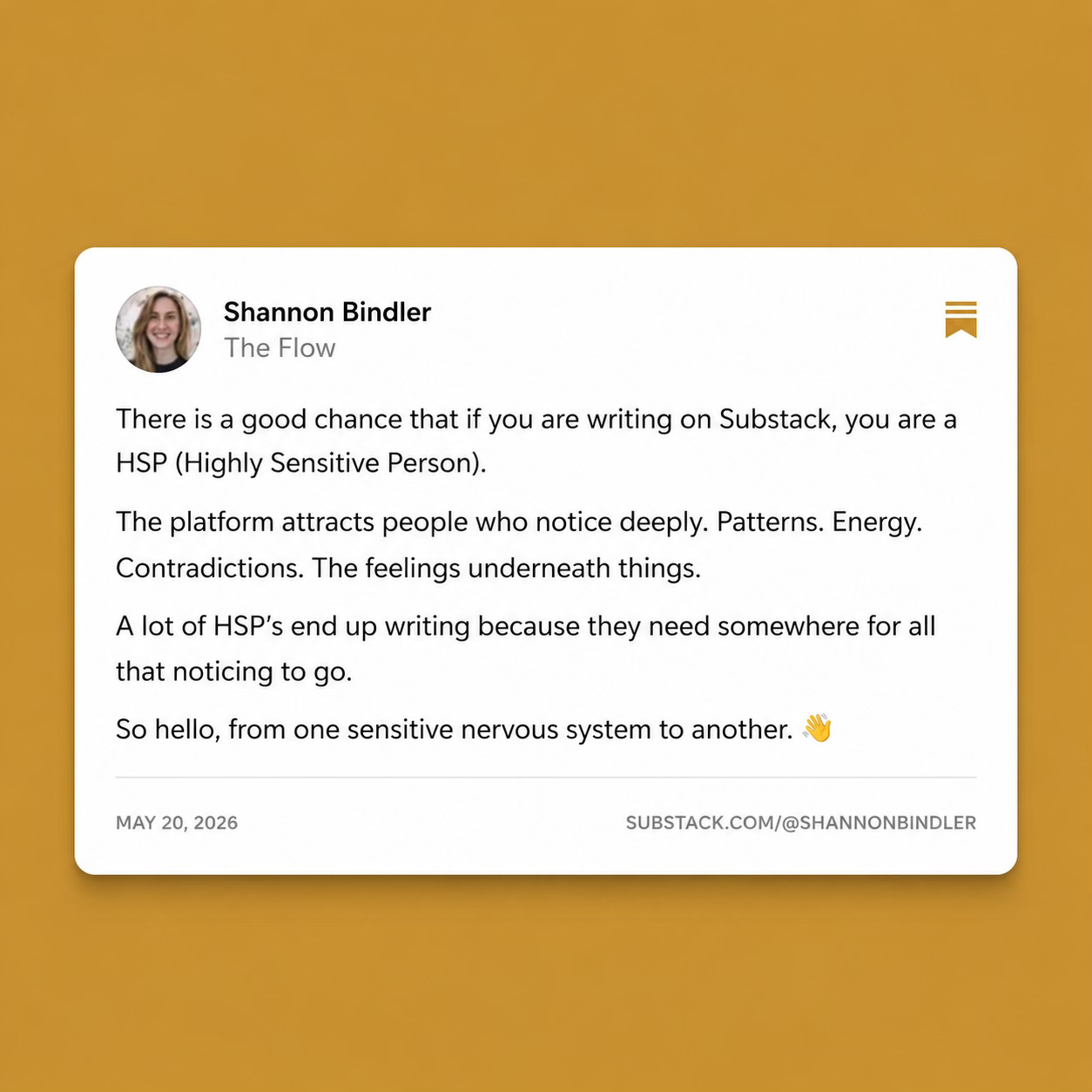
I posted that on a Tuesday in May. Four sentences, nothing I labored over.
By the time I sat down to write this, it had 13,000 hearts and over 1,100 comments.
What came back felt like a giant, collective exhale. People writing things like, “I didn’t know there was a name for this.” And, “I’ve been wondering what was wrong with me my whole life.”
One reader, BPWhite, offered his own reframe: HSP, he wrote, stands for Highly Spirited People. I love that. Another signed off simply as another nervous system that had been taking notes on everything.
Over a thousand versions of the same recognition. The noticing had been real. And so had the loneliness of it.
I first heard the term highly sensitive person in my early twenties, sitting across a desk from my boss at a yoga magazine.
We were going over an article together, and I caught something in the copy, a pattern, a contradiction buried in the subtext, and she looked up and said, almost offhand, “Well, of course, you spotted that. You’re an HSP.”
I had no idea what she meant.
She got up, pulled a book from the office shelf, handed it to me, and said, “Oh! This is going to be a real treat. Being an HSP is a gift.”
The book was Elaine Aron’s The Highly Sensitive Person: How to Thrive When the World Overwhelms You. I read it in one sitting. Something shifted. The kind of shift where you suddenly see yourself clearly for the first time, and the version you were looking at before seems like a stranger.
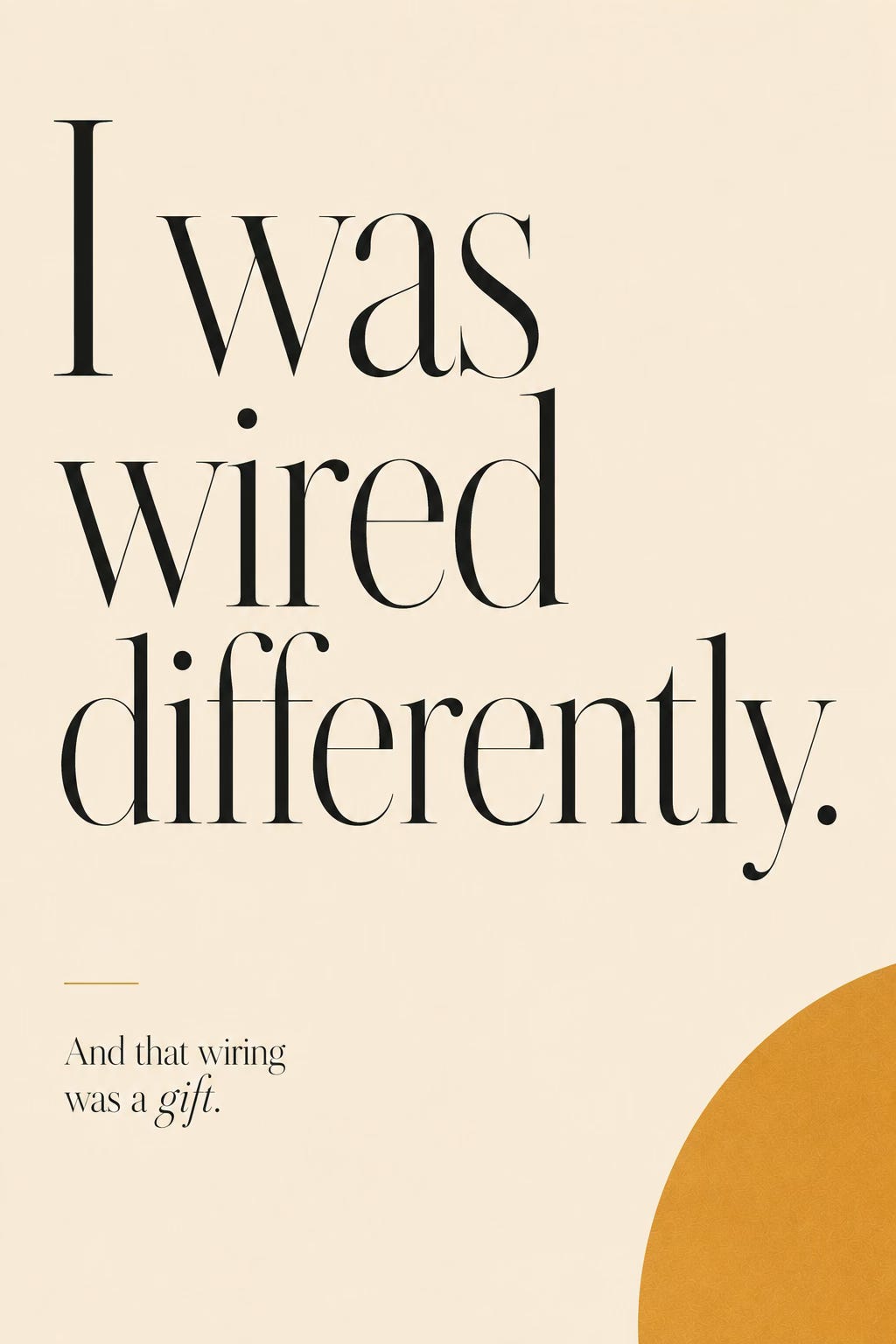
I was wired differently. And that wiring was, as she said, a gift.
The term was coined by research psychologist Dr. Elaine N. Aron, who began studying high sensitivity in 1991. What she found was consistent, measurable, and biological, a trait present in roughly 15 to 20 percent of the population, found across more than 100 species.
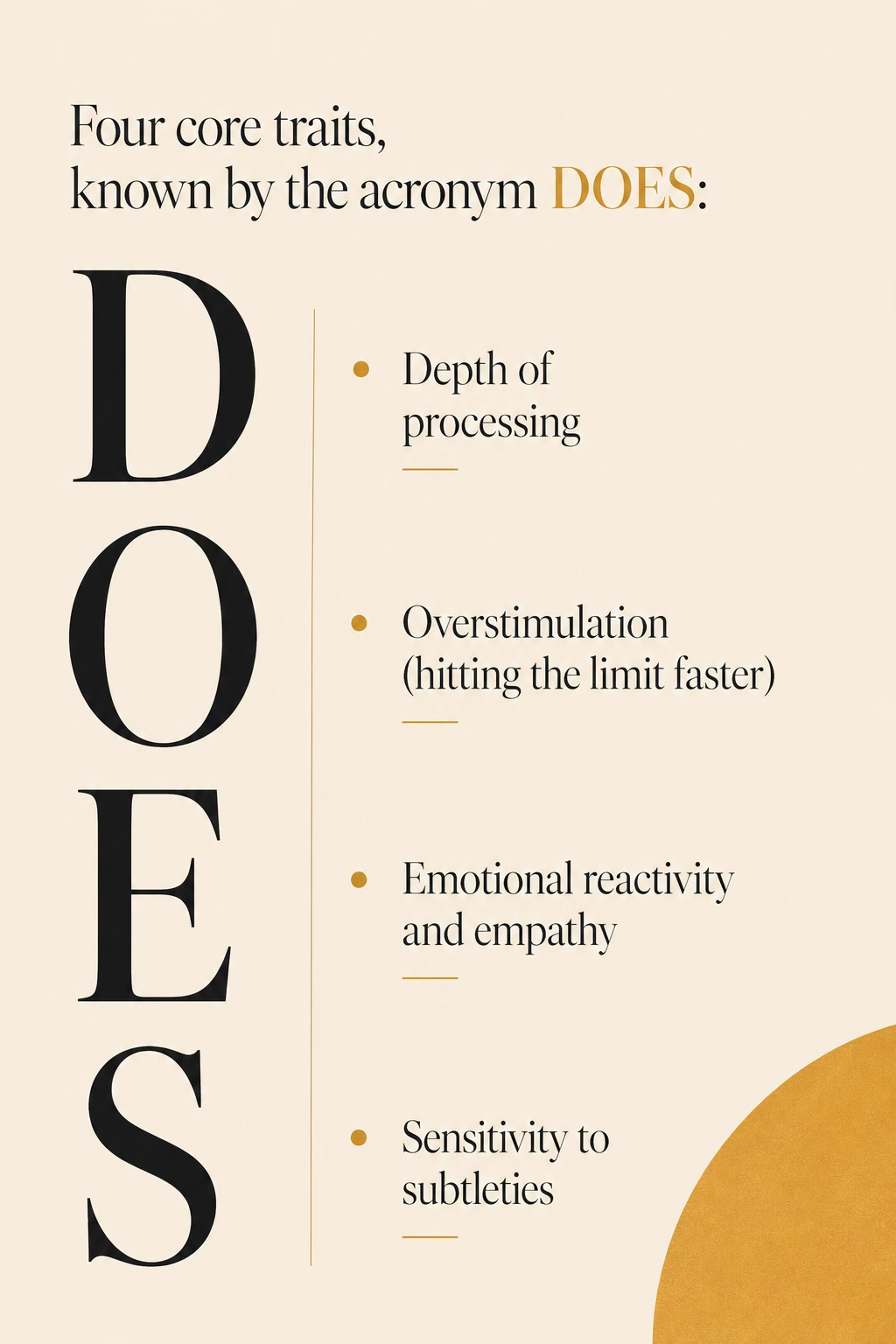
The HSP nervous system processes everything more deeply: emotions, subtleties, the energy of a room. This depth of processing is the defining feature, not shyness, introversion, or anxiety, though those can sometimes accompany it.
It’s the music in a restaurant that makes it hard to think. Fluorescent lights that are felt before they’re consciously registered. A smell that stops you mid-step. A crowded room with physical weight. A conversation from three days ago, you’re still turning over.
For an HSP, the world arrives at full volume.
Aron’s book includes a self-assessment. If you answer true to 14 or more of the questions, or if the description in chapter one simply resonates, that’s your indicator. Her website has additional resources, including the full self-test.
HSP is not a clinical diagnosis. It is a framework for self-understanding, not a medical or psychiatric label.
Not everyone wants one, and that’s fair. You don’t have to call yourself an HSP, identify with the term, or adopt it as part of how you move through the world.
What Aron’s framework offers isn’t a category to belong to; it’s a lens. A way of understanding why certain environments drain you, why you notice what others miss, and why you’ve needed more quiet than the people around you seem to. The label is optional. The self-knowledge isn’t.
When I was younger, I presented as someone who was good at parties.
I could connect with almost anyone, hold a conversation in any room, and genuinely loved the electricity of a good night out. I was also, I understand now, managing the input.
The social ease had scaffolding beneath it: a glass of wine (or three) to soften the edges, a carefully chosen outfit that felt like armor, and the ability to perform with confidence, keeping the more sensitive parts tucked away.
What nobody saw was the aftermath. A good night out could take days to unwind from. Not because anything went wrong. Because everything went in. That's the HSP tax.
The older I’ve gotten, the less I can sustain the override. Quiet has become structural. Nature is non-negotiable. The page is where I go to hear myself think. These aren’t preferences or habits. They’re how I stay intact.
My body was always telling me. I was just busy not listening.
Culture wanted me to be resilient, decisive, and fast. Optimizing the feeling rather than living inside it. I tried it the way you try shoes molded to someone else’s feet. It fit, sort of. For a while.
But I kept finding my way back to the forest floor. Craving quiet, needing to feel the ground under me before I could move again.
I’m a girl moss, as it turns out.
Growing slowly, close to the earth. My system works the way the mycelium network runs beneath the surface, connecting things and feeding the ecosystem without anyone seeing the mechanism. Depth over speed. Roots over reach.
It took me a long time to stop apologizing for that. To understand it was a particular kind of intelligence, moving at its own pace.
Some people who identify as HSPs later discover they also have ADHD or are autistic. It makes sense. All three involve heightened sensitivity to sensory input, emotional intensity, and the feeling that the world wasn’t quite designed for your nervous system.
They are distinct, though. HSP is a personality trait present in roughly 20% of the population. Autism affects approximately 2-3%. ADHD affects approximately 10%. There is real overlap in lived experience, but the underlying mechanisms differ. HSP doesn’t involve the social communication differences characteristic of autism, or the inattention and impulsivity that define ADHD.
Being an HSP doesn’t rule out also having ADHD or being autistic. One doesn’t determine the other.
If you suspect you may have ADHD, autism, or another neurodevelopmental condition, please seek assessment from a qualified psychiatrist or psychologist. The HSP framework and Aron’s self-test are tools for self-understanding, not substitutes for clinical diagnosis.
The comments that kept arriving were people describing, in their own words, exactly what writing does for a nervous system like this.
Writing, one reader said, is the only space wide enough to hold what you’re sensing. The one room where the volume of your inner world doesn’t seem too much.
Another described Substack as a sanctuary for the easily overwhelmed but deeply observant. Writing as a necessary release valve for a nervous system that takes in everything.
Someone had just finished writing an entire book, not for publication, just because it was too much to hold in her head (and heart). Another with ADHD wrote that the page is where he makes connections that would never happen in his thoughts alone. That’s where the processing completes.
I asked a couple of writers here who have written about being HSPs to share what writing actually does for them. Natalie Nicholson, who writes The Off Hours, described it this way:
“Writing gives me a safe space for deep observation, both of the world around me and of my own mind too. I think so many sensitive people end up needing to write because it can turn layers of abstract input and emotion into language. And once it’s on the page, I can understand my own internal landscape better, instead of getting lost inside it.”
Dallas’s Payne of Daring Next, who wrote a fantastic piece about HSPs and AI, said:
“I do not keep a journal or even write down my thoughts outside of creating newsletters because seeing my feelings on a page is all kinds of weird. Even though Substack is not designed for my nervous system, it is the first place I have found online where I can share who I am and how I think in public without apologizing or diminishing myself. I write the way I do here because the sensitivity demands I turn up as authentically me, and I’ve found in doing so, it naturally draws close a wonderful, supportive, like-minded community.”
My boss handed me a book and said, “It’s a gift.” It took me a while to receive it. It takes most of us a while.
But you’re here. And so is everyone else who needed somewhere for all of it to go.
Let’s lay it down. On the page.
Kindest,
Shannon
If you identify as an HSP, when did you first realize you weren’t too much — just wired differently? I’d love to hear it in the comments.
Build Your Substack Paid Tier. Together.
A lot of the people who showed up in those comments are thinking about building something on Substack. A paid tier, a program, a next thing. And most of them are trying to figure it out on their own.
The Flow Room is a 12-week coaching circle for Substackers who are ready to stop waiting and start building. Together. Monthly coaching reads, group Zooms, a private community chat, guest experts, and, for annual members, a one-on-one strategy call with me.
Writing is a solo sport. What comes next doesn’t have to be.
Round One opens mid-July. Early rate: $50 a year or $5 a month, before it moves to $80 and $10. The early rate closes July 19th.
Learn more about The Flow Room here.
Come on in.
Stop Trying to Figure Out Your Paid Tier Alone
·
Jun 14
A new coaching circle for Substackers who are ready to launch or elevate their paid tier and want to do it inside a real community. Strategy, psychology, and big magic. Come figure it out together.
Comments
Nothing yet. Say the first thing.
Sign in to join the conversation.