

A while back Pradyu asked a generally simple question. I include the weirdly mean quote tweet by a professor, because understanding why a question would make someone so angry is necessary towards understanding why we still read philosophy and theory. As someone who has read a fair amount both in academia and out, I’ve often chewed on this question myself.
In my undergraduate I studied a lot of Political Theory most of the classics were required. We went back and read guys like Rousseau, Hobbes, and Mill. Learning how to write essays and arguments by engaging with these guys is fine. Most undergraduates are barely literate, and you have to write essays about something.
Still, whatever you think about the pedagogy of teaching theory as a didactic exercise, that’s not usually the reason these works are taught. Often the professors teaching it are themselves conducting ongoing research in “Political Theory.” Like most academic social science, this is mostly ridiculous and mostly a waste of time.

Professors and graduate students are still writing papers continuing to investigate these old texts, for hidden fragments of genius that have been overlooked. Inherent in these papers is this idea that Marx, or Hobbes, or whoever, had some otherworldly framework for reasoning embedded within their head, and in their absence we are left forever struggling to know what they would have thought about contemporary events. Or alternatively, that their model for understanding reality is so elegant and true, that our application of it to a radically different world remain relevant.
A question I've chewed on for years, is how much depth really exists within theory texts? Should we spend lots of time reading the classics and still spend late nights poring over these old texts, looking for a hidden insight? Or should we simplify it down to a few core points, maybe a passage or two, and move on with our life towards mastering modern tools and ideas, like Game Theory or Econometrics.
One example I return to in favor of the “we can simplify it down to a few core points” hypothesis, is that Hobbes wrote this huge book Leviathan and the take-away is basically that you shouldn't defect against the sovereign, even under a dictator or monarch, because a stable equilibrium where people aren't in a state of chaos and war are rare enough that it's probably not worth giving it up for something more utopian.
This is an enduring observation of reality, and a lesson worth internalizing. Would you have preferred to live under Iraq or Syria in the past regime? Or risked it all through their transitions to their contemporary regimes? In any event, that’s most of what Leviathan is about, and you can write the lesson in a single paragraph, or in game theoretic notation.
Rousseau was like hey, in a state of nature we're all chill hippies. But then, like, society makes us love ourselves, which makes us evil. Still think society is good? Marx predicted a specific path of economic development, which was wrong, and how society would divide up between classes, which was a partially useful framework.
These are sort of cherry-picked examples, except these are still books that are part of academic curriculum, and there continues to exist ongoing research on these texts (primarily Marx).
I think a lot of people are hesitant to admit that such an important text, and one they spent hours reading, can be compressed to a few take-away points — or maybe a single essay. It's understandable, if it's true that an entire text of political theory boils down to something that could be summarized on a single page, why wouldn't they have just written that? They were clearly pretty smart. Am I seriously saying that Das Kapital could have been a few substack posts?
Well, sort of. At the time, no. While it's something we are rarely cognizant of, we are able to compress what we write by embedding within it lots of references and exploiting a common knowledge of shared primitives. It’s not unlike any other technical field that involves processing and building upon information abstractions.
We can write complex AI models now in a few thousand lines of python. Of course, that’s built upon hundreds of thousands of lines of primitive libraries and languages that have been built up over the past half century, and longer if you consider the theoretical foundations. In most cases we only go to these original creations out of deep curiosity, or for pedagogical purposes.
(Although we do still entrust a few nerds who belonged in a past world to ensure our knowledge of these foundations isn’t lost entirely. We should also probably spare a few academics to do the same for old theory texts.)
To understand why a theorist didn't write the compressed version first, you need to contort your mind to understand that they were the first people to bring these ideas into existence. It's true that we can now write a huge part of Hobbes entire book as a one-page game theory problem, but when he wrote that this level of formalization didn't even exist. It wasn't within his tools. He was grasping for an idea of human behavior and social organization that had literally not been invented. Compression comes after your initial ugly version.
We can see analogies here in other fields: Galton’s original paper on the correlation coefficient was much longer than the two page derivation in a modern textbook on Mathematical Statistics.
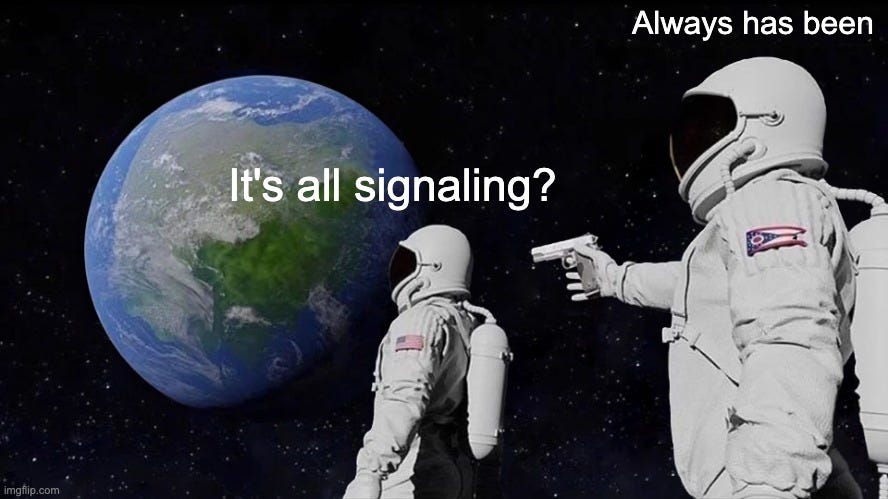
A follow-up question then is why do we still have these huge institutions hiring professors and spending vast amounts of time continuing to scrutinize these old texts, mining them for some hidden truth that has been overlooked, or not properly applied to our modern day? Are they just stupid? Well, yes they are stupid, theorists like the one in the tweet above are not disciplined thinkers, but it goes further then that.
Take a look at Political Theory, the leading theory journal. The front page currently has new takes on Machiavelli and Freud. If you scroll to 2023 you get this beautiful abstract, which I pick only to have a concrete snippet to discuss a more general point:
This article traces Aimé Césaire’s engagement with Marxism through the concept of alienation, which is central to the Marxist-Hegelian tradition. The idea of restoring human creative powers, which take on an alien character under particular historical conditions, deeply shaped Césaire’s analysis of French colonial assimilation, which compelled the Black colonized subjects to identify with French bourgeois culture instead of taking revolutionary action against capitalism.
It’s easy to make fun of this, but what is this? Is it nonsense? Is it something meaningful? I think it clearly has some meaning. Marxist thought did influence the world, and French colonial assimilation was a real thing that happened. Presumably black colonized subjects would have taken revolutionary action against capitalism in a counterfactual scenario, and didn’t because they identified with French bourgeois culture, and we can understand this by going through Césaire’s engagement with Marxism.
So then in what way is it nonsense? It’s nonsense because it’s completely fake. It’s projecting some idealized way they wish they world went “Revolution against capitalism!” and claiming it didn’t happen due to some subtle bourgeois cultural mind-tricks. And even still, the way in which a century old philosopher engaged with Marxist thought to make an argument about French bourgeois culture isn’t important research. It’s barely even research at all, it’s a personal interest.
A lot of modern theory constitutes this academic game. It doesn't count as academia if you just talk about your opinions (capitalism is bad), save that for your twitter post. You have to derive your personal opinion from the historical theoretical texts. When you do that, what are you doing?
What you need to understand is all these old theoretical texts are basically a set of constraints, and they are trying to find the most beautiful derivation of their argument within them. If you look through modern theory research, it’s mostly by activists who are studying or highlighting old ideas of queer or racial theory in old texts.
We can think of a lot of academia as a game, dealing within the aesthetics of some old idea space. This is hard, it requires having an incredible grasp of complex arguments, a huge context of information in your head, and being tapped into the fashion of the time. It’s not that these researchers are low IQ. If anything their problem is their IQ is too high, but they’ve never disciplined their ability to reason about the future. Instead they use their verbal skills to conjure up aesthetically beautiful arguments based on old texts that have no correspondence to reality.
So Should you Read Political Theory?
Don’t read old theory expecting to uncover a hidden gem that was overlooked, or god forbid hoping to do research in the field. It’s not there, the summaries are basically correct.
The enduring reason you should still read theory, is if you do it properly, is it can help you exercise your defensive abilities against bad arguments. With the good arguments, it can help you understand how in the absence of information, what type of reasoning skills are most predictive of the future. What are the traits of the disciplined and prophetic thinker? Is that how you reason about the world?
After spending hundreds of hours reading long texts that go into excruciating detail justifying a world view, only to notice not only are they all mutually incompatible, but their predictions didn’t pan out, you begin to become aware of the overwhelming odds anyone has at deriving human behaviors from first principles, and you’ll probably be more mistrustful of anyone selling you a cohesive framework for reality today.
No posts
Comments
Nothing yet. Say the first thing.
Sign in to join the conversation.