
I liked Richard Hanania’s review of Foucault, where he speculates why he is our most famous intellectual by citations. It’s worth reading in full, as he reads and gives a candid review of his work, but his conclusion for his success is that “much of his success was based on his identity and personal charisma.” I agree with that, but I don’t think it’s a complete explanation. My addition would be this: Using Foucault’s framework represents this sort of sleight of hand that lets the author supplant their own reality by casting existing knowledge as being derived from maligned power structures.
My hands on experience here came from having the privilege to take some seminars on Crime & Punishment and African American Political Thought in academia. Why did we spend the whole seminar reading Foucault rather than looking at any empirical statistics regarding crime in America? I spent a lot of time thinking about this at the time.
Why were we reading Foucault? Why were we reading all these post-modern theorists? I was vaguely aware there was this difference between “quantitative and qualitative” social science. Only it didn’t add up. In my Economic courses regressions and computers were how we understood the world, why in these other courses did we discard them entirely and read old post-modern theorists instead? I only believe there is one type of science, so these department specific approaches left me feeling uneasy.
I’m not saying we should have spent the entire 12 week course reading FBI crime statistics, but you know, seems worth at least glancing at? A rational approach to Crime & Punishment would fixate on measurement and marginal improvement to existing institutions. The rational focus on improvement tends to follow empirical and economic forms of thought. Namely that building and improving things is difficult, and requires measurement and experimentation.
Within these courses, my introduction to Foucault was Discipline and Punish. This is where he sets up his core epistemology, which you've heard abbreviated a million times when people talk about 'power structures.' He makes the claim that knowledge itself is shaped and descends from societal power structures.
As his key piece of ‘evidence’ Foucault set up this argument around a prison design by Bentham called the ‘Panopticon.’ The Panopticon was a circular prison with a central watchtower, designed so inmates couldn't know if they were being observed at any given moment. Foucault extends this to society at large: imagine a world where you might always be watched, but you never know when. People would police their own behavior, internalizing the gaze of authority. The implication of this extends to science and knowledge itself, where scientists themselves would only research or say words that support existing authoritative power structures.
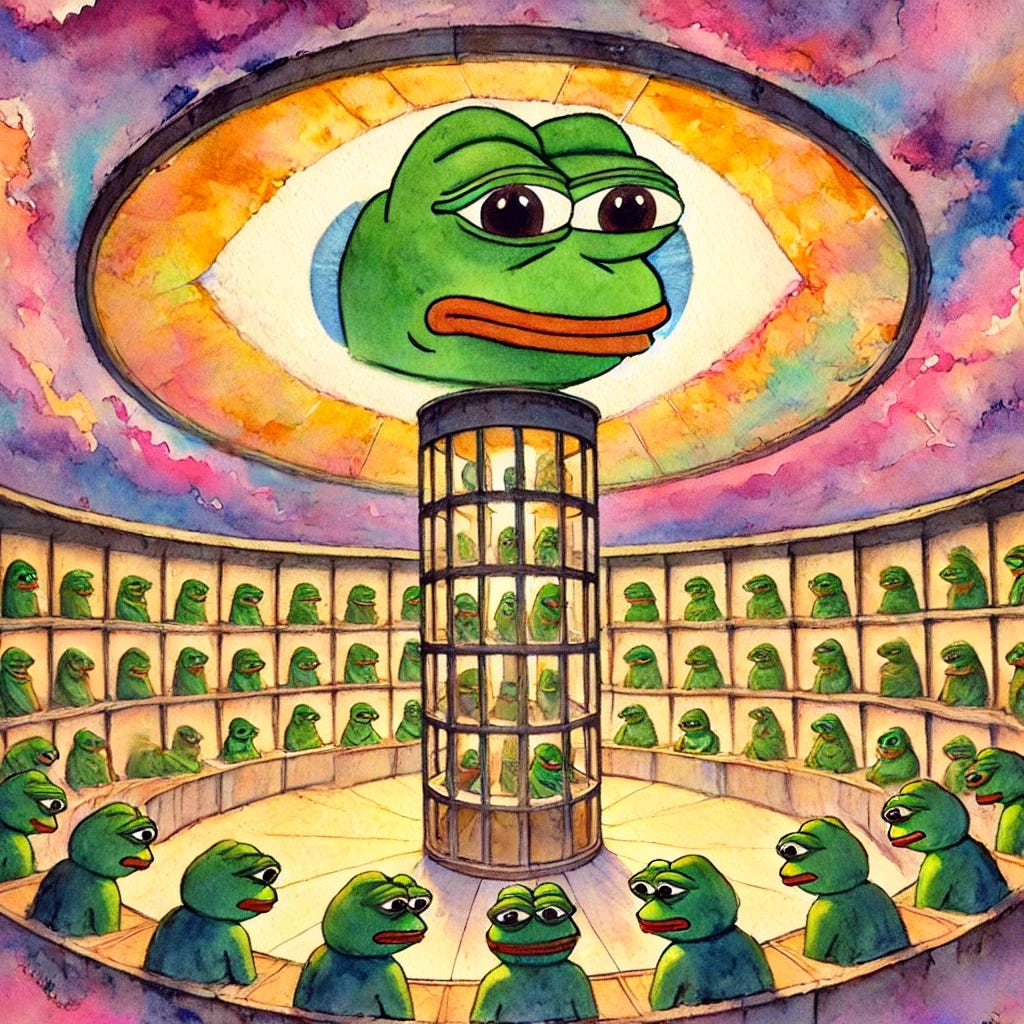
This metaphor is how Foucault sets up this idea of what he calls power-dynamics: control isn't just top-down force, but a subtle influence that shapes how we think and act. Fundamentally though it relies more on analogy than empirical evidence. As with a lot of these post-modern frameworks, they rely on identifying a reasonable factor that could bias some conclusions within Science, then turning it into an entire conspiracy theory.
Still, it’s an interesting concept, and in some cases his tools work pretty well. His best observations relate to things like Psychiatry, which at the time attempted to ground itself in some objective scientific approach in its diagnoses. Of course, mental illness is obviously heavily influenced by social structures. The famous example being homosexuality shifting as a classified mental illness (it not being a coincidence that Foucault himself was gay).
In general the post-modern epistemics have some compelling points, like some of Feyerabend's critiques of science. It's true, science and our relationship to knowledge is itself subject to our own specific cultural assumptions and beliefs. My personal view is that the failure is that their critiques have merit, but that there is only one true scientific epistemology, and that these critiques should be used to refine how we know things about the world, not dismiss them entirely.
I think we need to rephrase our question though: Why are these ideas so incredibly popular and frequently cited given their content? Why isn't it just a niche academic sub-field along with so many others? In short, it provides a simple framework to dismiss and refuse to engage with serious empirical efforts. Science is painful and hard, and fundamentally empirical. Learning new things about the world is a slog, and the things we learn are often disturbing. The social and power based construction of science is one framework for understanding society’s relationship with science.
Foucault is the invocation that lets you dismiss the empirical ugliness and the dangerous implications of considering them. What if all knowledge is from power-structures, and it's imposed on us by an antagonist authority? Then the only real way to solve the issue is to come up with a new system from first philosophical principles (ideally the ones we think are good and true).
There is an even more cynical view here, which is that Foucault is also a way to escape the fact that many academic theorists are innumerate. Modern empiricism is fundamentally quantitative and difficult. Reading statistics and critiquing them requires a baseline ability most of these academics lack. If it turned out though that they are all built on a fundamentally racist understanding of knowledge, then it becomes easier to dismiss them out-of-hand. This would probably be too uncharitable, if I hadn’t seen it first hand in the departments of sufficiently prestigious Political Science departments.
My few examples so far have centered on race, because dismissing empirical reality and substituting it with appeals to impossible-to-measure power-structures is the primary use for Foucault within academia. As a result it can be tempting to dismiss Foucault entirely as some sort of left-wing, post-modern Marxist French homosexual. Only that’s not exactly correct, because Foucault’s epistemics are not intrinsically left-wing. Foucault’s politics were complex, and not so easily classified on a contemporary scale (where exactly do French philosophers who advocated against age-of-consent laws land?).
As it turns out, there are a few right-wing thinkers though who use the Foucault power-structure framework. Nick Land and Curtis Yarvin (Moldbug) are two of the most notable ones. Moldbug’s writing studies how power informs knowledge within the American academic system, which he calls the cathedral. His most interesting work has always been reading hundreds of old, and once famous books, and wondering why we stopped reading them? In fact, even within Moldbug’s own work you can observe he’s writing as the underdog. He’s critiquing the power-structures that protect some forms of knowledge, but punish others.
I think the popularity of Foucault then goes even one final step deeper than as a tool to dismiss existing arguments. It’s intellectually intoxicating. I remember when studying this stuff being told our reading these texts was subversive. It’s unclear in what way, but the professor certainly believed it. There is this aesthetic to the argument where you’re being let in on a secret. This is also why undergraduates who get really into Chomsky are so annoying. Whether Chomsky made them annoying, or they were annoying so they got into Chomsky is an open question. But what is definitely true is that they think they’re far smarter than they are.
On the other hand, I’ve never felt any sort of dopamine hit reading marginal effects statistics from panel regressions in Political Economy journals. Whereas critiquing an entire field as arising only from maligned or biased power and knowledge structures has a feeling of being let in on forbidden knowledge.
(If you stop to think about it though, is it true? The citations and historical references between Chomsky and Moldbug of course aren’t secret. No one ever stopped you from reading history books on US involvement in South America. No one ever stopped you from reading old reactionary texts. Are you upset because it wasn’t assigned to you in 11th grade? Grow up.)
It also adds a certain Manichean structure to the world around us, in many ways, it is the opposite of the intensely empirical way of understanding reality. The world is not endlessly complex, requiring painstaking empirical decomposition of cause and effect. Rather: It’s simple, but they wouldn’t have you think so, for they have poisoned your well of knowledge. After all, a framework for thinking that lets you avoid a decade of studying statistics, reading, learning to code… and instead gives you that all for free up front is going to be endlessly popular for an intellectually lazy researcher and student alike.
Foucault's enduring influence in academia isn't just about the merit of his ideas or his personal charisma. It's about the intellectual toolkit he provides – a framework that allows for the rejection of existing knowledge structures and letting you replace them with your own. This offers a seductive alternative to the grueling work of empirical research. Foucault's legacy is not just his ideas, but the way they've been wielded – as tools for critique, as shortcuts to insight, and as the bedrock of entire fields of study.
Anyway, that's why I think Foucault is the most cited academic.
No posts
Comments
Nothing yet. Say the first thing.
Sign in to join the conversation.