
“This might be the last trip to Wal-Mart you ever take,” my uncle told me in a solemn tone. He was wild-eyed and driving fast. I was nine years old and I completely believed him. I knew this could be very bad: I knew I had to be ready.
Moments before he’d picked me up, I’d been standing in my herb garden outside, vaguely worried. The power was out; it was August of 2003. It didn’t just go out at our house like it occasionally did during storms: it went out suddenly and without warning on a clear-weather day through the entire county. Soon we heard reports coming in that it was out everywhere — even in New York City, Boston, and for all we knew, in all fifty states.
Standing there in the herb garden, I mulled over the possibility of a ‘dirty bomb’ insurgent attack on US soil. Transformers blowing up; nuclear fallout, Iraqi operatives… Just then, my uncle rolled up in his rusted-out minivan. “Get in!” he hollered. He was wearing a red bandana tied around his bald skull, which was odd: he never did that. He looked sort of crazy; his eyes looked red. He was probably high. After talking to my grandparents through his car window for a moment, we sped off and headed to Wal-Mart to buy large quantities of ammunition and big cases of canned beans — on what I’d been told might really be the “last trip to Wal-Mart I’d ever take.”
A few days later, the power came back on. Nothing crazy had happened. It was a strange occurrence that had something to do with a thing they called a “cascade failure.” OK: false alarm. Apocalypse was cancelled.
My uncle ate all those beans eventually, I guess.
There was only one reason why, at the age of nine, I had assumed that the End of the World might really be imminent — or why I might’ve guessed that the infamous blackout of 2003 could have been caused by a “dirty bomb.” We were then a nation at war. Kids were drawing gory pictures of a vanquished Saddam Hussein in crayon, much to the horror — or chuckling approval — of their teachers. Gas prices were rising. Fears about the stock market were discussed nightly on the news. September eleventh was seared into everybody’s brains like a psychic tattoo. And for many us “90’s babies,” that day was among our first memories.
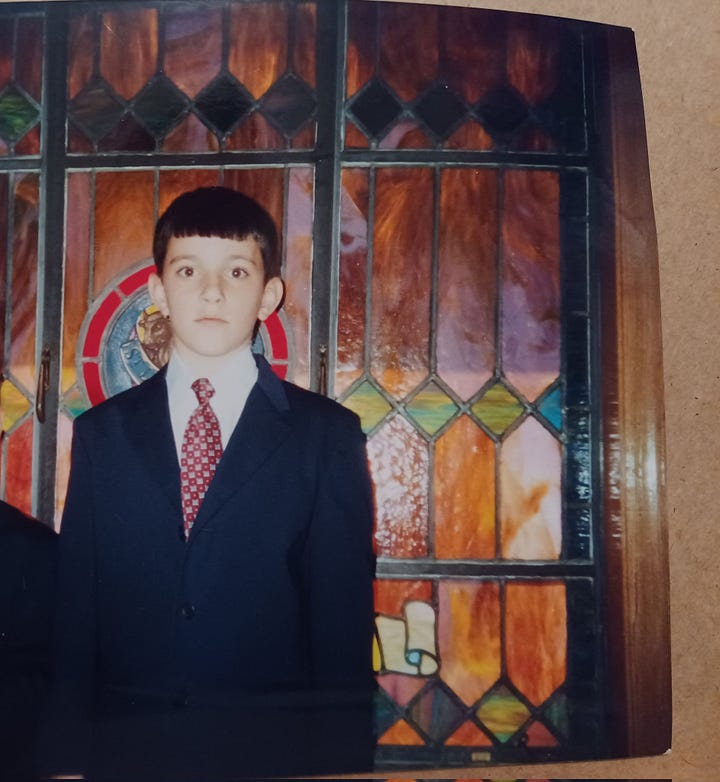
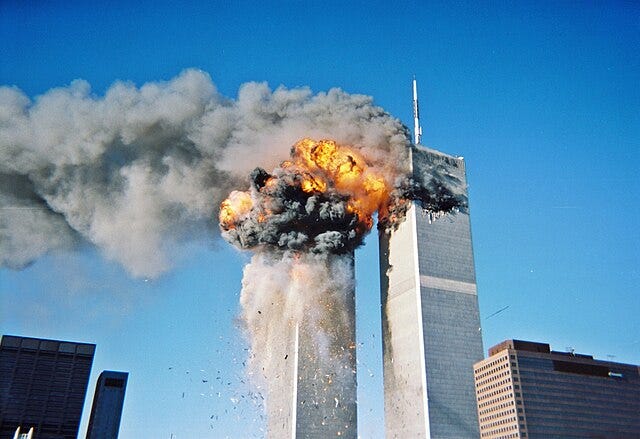
I remember it well: I was seven years old. In those days, the school bus let me off at the village library, where my grandmother was the librarian. On this particular day, we’d been inexplicably released from school early by teachers who looked even more dour and harried than usual. It was chilly and sunny, a classic Upstate New York September sublime: billowing breezes knocked orange-yellow leaves off the trees in great spinning wind-devils as the bus sped through the village. And before I’d even stepped off into the grass, I saw a girl from my village crying as I looked out through the bus window. Bizarrely enough, she was crying in the arms of my grandfather — who should’ve been at work at this hour.
Her name was Kaleigh and she was a few years older than I was. She was babbling, fraught with worry, totally inconsolable, and he kept hugging her tightly and telling her that everything was going to be alright. Clearly, I thought, something very bad had happened somewhere. But looking around the streets of the village, it did not seem to me as if it had happened there.
Soon I was taken home, where my grandfather informed me that “some very bad people” had “attacked the United States.” My eyes widened at the notion — was this “the shot heard round the world” I’d heard of in school, all over again?
What followed was a flurry of information that sent me into a well-hidden panic. I was a sharp kid: I knew about nukes. I knew about F-15’s, B-52’s, submarines, North Korea, and soon I’d be learning about Osama Bin Laden and Saddam Hussein. I knew that maybe, this attack was only the beginning. And everywhere in my little village, I heard people talking about guns and bullets, stocking up on canned goods, and making ready for what sounded like some kind of World War Three.
That sense of panic was not a passing phase; it was a DNA-altering event that never left me, nor did it leave many others my age. Though after three attacks on American soil, that infamous day would come to a merciful end with no further bloodshed — four weeks later, we would be a nation at war.
I remained on ‘high alert’ in the days to follow, watching for signs of Something Bad happening again. Months and years passed; I later remember watching the footage of “Shock and Awe” on the television screen. Some people were mad about that; others cheered it on with lusty eyes and hoots and hollers. Some spoke of the grave evils of the US government (which was, to a patriotic young kid like me, profoundly disillusioning). Others referred to Muslims as subhuman, orc-like monsters who wore “diapers” on their heads, and they wove gory fantasies of bloody revenge against all of them as a single monolith (which also made me very nervous to hear).
I was just a boy — I had no idea what to make of any of it except that I had better be ready for anything.
As time wore on, a low-level background tension remained within me. I understood that the world system was extremely complex, both in terms of material realities and in terms of foreign policy and war. Now, I began to pay attention — at the age of eight, I was already monitoring the situation.
Late at night, I’d listen to the Lars Larsen show on AM talk radio, where he’d talk about gas prices, sometimes for an hour or more at a go. I kept a journal of the price of gas, the price of wheat, the Dow Jones Industrial Average. Obama was president by then and gas prices had risen by a full dollar. Hummer advertised on AM talk radio — I liked Hummers. I wanted to grow up to become a US Navy Seal; a Navy Seal who drove a Hummer. My friends all liked Hummers and wanted to become Navy Seals, too. We took turns drowning each other in the river as “training” for “war.” We carried huge bags full of bricks up and down steep cliffs in the woods as “training.” We were going on group runs, beating each other with sticks, all to get ready for what we always referred to interchangeably as “the next American Revolution” or World War Three.
By the time I was ten and eleven, I started reading about peak oil and climate change, too. I read The Long Emergency by James Howard Kunstler. I read then-obscure doomer blogs about Arctic sea ice on the computers at the library. Eventually, I got my hands on a downloaded-and-printed copy of Industrial Society and its Future by Ted Kaczynski. I knew very well that I shouldn’t be reading it, so I kept it a secret.
My hiding spot for the manifesto was in an old folder from when I was in the choir in the Catholic Church, a church that my family no longer attended. After my grandparents’ divorce, our new family religion was believing in nothing, I guess, and it was this nothing that I used as a canvas on which to form my own kind of private, quasi-religious millenarian doom-cult.
“The industrial revolution and its consequences have been a disaster for the human race” was Kaczynski’s searing opening line. I read his manifesto deep in the woods, alone, so as to ensure that nobody would see me reading it. By then, my grandparents — who’d raised me in a very temperate, conservative kind of home — had sold our old house, and I was living with my newly-sober mother and her not-so-sober husband. He had a penchant for Hydrocodone, Natural Ice beer, and pinning me to the ground to slap me and spit in my face.
You cannot imagine the hatred I felt in my heart for him, nor the radical disillusionment that the breakdown of my childhood home had caused me. My mother denied he was violent and did not help me; and in the end, I was alone against the malevolent forces of familial destruction, addiction, and domestic violence.
It was in this state that I found Kaczynski’s work.
He goes on:
The industrial-technological system may survive or it may break down. If it survives, it may eventually achieve a low level of physical and psychological suffering, but only after passing through a long and very painful period of adjustment and only at the cost of permanently reducing human beings and many other living organisms to engineered products and mere cogs in the social machine. Furthermore, if the system survives, the consequences will be inevitable: There is no way of reforming or modifying the system so as to prevent it from depriving people of dignity and autonomy.
If the system breaks down, the consequences will still be very painful. But the bigger the system grows the more disastrous the results of its breakdown will be, so if it is to break down it had best break down sooner rather than later.
I read and re-read his words almost daily, poring over them, trying my hardest to understand what the “breakdown of the techno-industrial society” would look like for me. High up a dark, rough tributary of the Mohawk River, I hung from the cedars jutting out of crumbly slate cliffs, staring down at the rushing dark water at dawn before school, reading by headlamp, meditating on the collapse of civilization.
It began to register that the problem was civilization itself. War, poverty, environmental destruction, climate change, even my stepfather’s violence and addiction — all of it stemmed from the forcible and almost always violent inclusion of aboriginal peoples into agrarian societies, where stockpiles of grain, standing armies, written language, monotheistic faith, and cities took precedence over the dignity and rights of both man and nature.
What began with Kaczynski led me to Marx and later, to anarchists like Proudhon, Goldman, and Bakunin. This was only the beginning. I would soon spend every ounce of my free time studying any material I could get my hands on that might help me diagnose and respond to “The Problem.” As my teenage years wore on, the 2008 ‘Great Recession’ ramped up and my studies intensified. At the age of fourteen, I became convinced that the devastating ‘stagflation’ that the system had produced was the result of the internal contradictions within the capitalist system, and that indeed, this crisis was only the beginning of a great and likely painful transition toward decentralized, federated workers communes and syndicates as the new world system of power. Soon, as the Energy Invested over Energy Returned continued to decrease, and ‘light, sweet’ crude oil became scarcer, it would force the world system into a kind of ‘shutdown mode’ — and from there, revolutionaries might stand a chance at seizing power.
No such luck; normalcy continued, albeit in a more strained and disgruntled form. Instead of revolution, “quantitative easing” began in full force, and the Federal Reserve was printing money feverishly fast. Obama’s TARP bill was passed — the banks got bailed out. Ford got bailed out. The rest of us got, as the slogan goes, sold out. By now I was also reading Ron Paul; I was studying Keynes and Hayek and Rothbard, and as I graduated early and went off to the state college, Occupy Wall Street began. I was now fully preoccupied: by now, I did practically nothing else but study economics, primitive anthropologies, ecology, Marxian theory, and (my favorite) the works of ‘classic’ anarcho-primitivists like Derrick Jensen and John Zerzan.
In this climate, college seemed pointless to me. Why get a job when I’d never get a retirement anyway? And if human beings had been nomadic hunter-foragers for 99.8% of human history, why would I try to live any way other than they did? What I needed was to drop out of civilization, to “collapse now to avoid the rush,” to “re-wild myself” so as to sharpen my skills for survival in the apocalyptic and potentially violently revolutionary century ahead. In those days, I lived, breathed, and slept in a feverish millenarian haze; I could truly think about nothing else.
I did what I said I’d do. I dropped out of college. I refused to drive automobiles or get a license. I refused to get a bank account, or to work a job, and attempted to avoid using money wherever possible. I became obsessed with frugality, too: constantly, I was making assessments of grocery store goods based on price per calorie, devising shopping lists that could meet my basic nutritional needs at the absolute lowest price possible. As a kid, I’d also read The Four Hour Workweek by Tim Ferriss and was already cobbling together an extreme, poverty-based, apocalyptic version of “FIRE”. If I spent as little as humanly possible, I reasoned, I could work as little as possible — thereby freeing up my time to “rewild myself” and promote revolutionary anti-civilization anarchist action and philosophy.
My mother plead with me after I’d dropped out: “Please try college again.” She made me read a book called College by Andrew Del Banco. An appendix at the end of the book listed “weird” colleges — colleges with no tests or grades or majors, colleges for students who were ‘weird’ and ‘gifted’. One of them was Hampshire College in Western Massachussetts, and I applied. After a brief stint at Community College (commuting 9 miles one-way by bicycle, as I refused to drive), I was accepted and I attended.
What I found there was profoundly underwhelming. Ultra-wealthy kids who had more interest in cocaine and psychoanalysis than in revolution seemed to be their primary export, at least at first. In time, however, I did find the handful of anarchist rabble-rousers at the school, and at least one of them would become one of my best lifelong friends. But after a single semester, I dropped out and began living in the dorms on the slick, lifting free meals from the dining hall, auditing classes as I liked, and reading nearly a book a day in the college library. In other words, I was “shoplifting an education,” a phrase I absolutely loved to use to encourage the other anarchist students to do the same. There, I wrote endless drafts of doomer manifestos and attempted to agitate my compatriots into joining my anti-civilizational cause.
In time, I outgrew my chapter as an “academic bum”. Above all, I wanted to travel, and so I left with a backpack and a sleeping bag. The moment I lifted my thumb along the roadside, I would begin the next phase of my apocalypse training, and the journey would take me over eight years in all: five years of traveling, as well as long stints of stationary homelessness.
Why wait for civilization to collapse when you can just begin living as if it’s already collapsed now? No doubt, what I saw only fed my doomer bias: the country I traveled had been ravaged by boundless commercialism, ecocide, pollution, homelessness, and a gut-wrenching degree of drug addiction, depression, and suicide. On the highway, I saw the blank stares of countless drivers on their way to their soul-sucking jobs; I saw the calloused hard-heartedness of everyday people as they stepped over the homeless or called the cops on me and my friends. There were even times — more than a couple — when I was spit at or attacked by regular “normies” who hated the homeless.
Everywhere, there was an injustice. Everywhere, a sign of our degradation and waywardness — a muffled cry out for a return to our ancestral state as primitive hunter-gatherers. When the stock market dipped, I started licking my lips; when the oil price spiked, I looked on with butterflies in my stomach — maybe this was really it, I’d say to myself every time. Maybe this is when it all finally crashes and burns. I couldn’t wait to see the techno-industrial civilization unravel, and every ‘crack’ in it was exhilarating to observe.
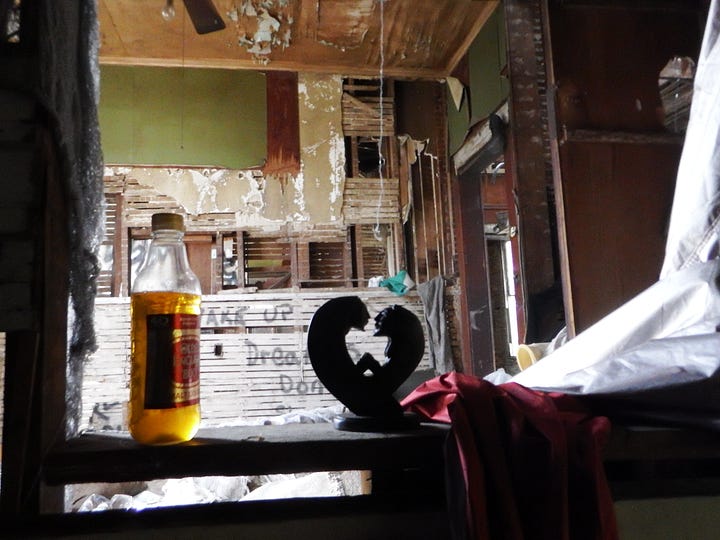
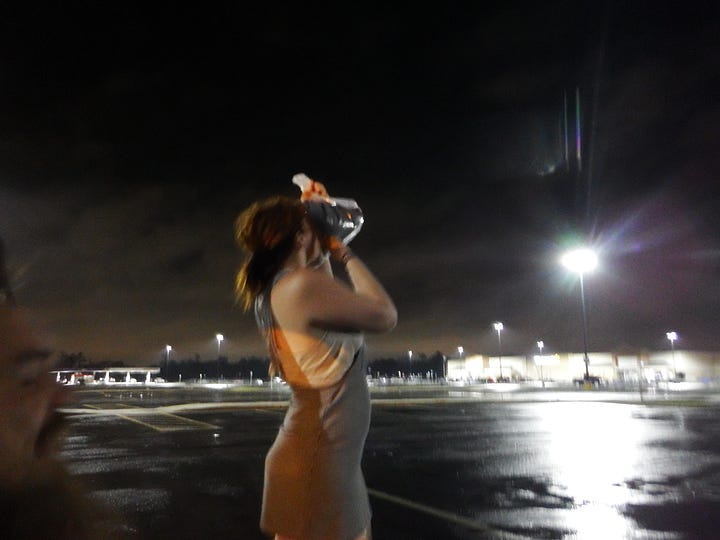
And in my everyday life, I sought harsher and harsher degrees of punishment for myself. I wanted to ‘harden myself up’ even more, I wanted to become an unkillable master of survival, and I pushed myself into wilder and wilder situations in order to train myself. Or, in many cases, I sleepwalked into them in moments when I was unprepared, drunk, chased by cops, or caught in foul weather. I relished every bloody brawl, every surprise hard freeze, every day when I found myself walking for miles in the hellish desert sun with no food and not enough water.
After so long, I was sleeping with one eye open every night. Twice I’d been attacked by drug addicts in my sleep — one of those times, I had to wrestle the guy off me and wound up whacking him with a 3/4” piece of rebar I kept in my pack as a defense weapon. I don’t know if he was trying to rob or to rape me, but I fought him off, gave him a full-force whack to the ribs, and he lay in the ballast by the railroad tracks, wheezing in pain and coughing up big gobs of blood.
I felt sick — is this what survival would require?
Later that night, railroad cops would see me in their headlights, and I’d sprint down a steep, garbage-strewn ravine choked with sharp brambles. I was covered in blood, I hadn’t slept more than an hour in weeks, I was hungry, I was skinny, I was bruised and hungover — but I was thrilled. There was a kind of soldierly ghost in me that’d come alive. The End of the World I’d dreamt of was a thing I was ready for. I would trounce any enemy, I would drink from oily puddles, I would eat half-rotten garbage, I would fight off hordes of starving pillagers and still WIN. No one could kill me. When I walked down the street, it often seemed that people were even afraid of me.
Yet that morning, I distinctly remember a wave of exhaustion creeping over me. A twinge of recognition that I couldn’t go on living like this. But frankly, the part of me that was obsessed with survival seemed, paradoxically, to also crave death. My daily life seemed to be one long, breathless suicidal ideation — yet by the same token, it was all paradoxically couched in terms of survival. Why would a suicidal person want to survive? Why would a survivor want to tempt fate as I did? The days of my life during those years were a neverending discourse between survival and the death drive — and in groping toward the invisible ‘line’ between them, I felt intuitively able to divine that life had some sort of a purpose. Whatever it was, I didn’t know it, and frankly, I didn’t care. I just wanted more chaos, and I thrived on it.
And in fact, at bottom I didn’t really want to stick around for the bloody downfall of civilization, not really. Nuclear fallout, cannibalism, the re-emergence of slavery, storms of bullets and starving children prostituting themselves to warlords — what kind of a life would this be? Where was my tribe of “re-wilders” who were returning to the life of hunter-gatherers? Most of the people who would’ve done that shit were all shooting heroin and later, fentanyl. Now, most of them are dead.
In the end, my stepfather’s abuse and addiction was my salvation, in a strange and perverted sort of way. That man taught me to hate opioids with nothing short of a burning passion. Because of him, I would never try them even once — and so even though I was a prime candidate for doing the heroin that was so popular amongst disillusioned and nihilistic punk anarchists, I was somehow immune. I stuck with my liquor always and never went for anything else. And while I probably drank a few holes in my liver — I never went down the road that proved so lethal for so many of my old traveling compatriots. It’s at least partially because of this, I’d wager, that I’m alive today.
But when you outlive a culture of death and apocalypse, there is nowhere else for you afterwards. After a close traveler friend of mine disappeared in Mexico, and was assumed by those familiar with his trip there to be dead, I withdrew from the culture of the Crust Punks. I didn’t want to be around anyone else. What began as an exercise in millenarian self-immolation finally wound down to mumbling embers and little more; piece by piece, I didn’t care about ‘revolution’ anymore. I stopped calling myself an ‘anarchist’.
Bit by bit, I came to realize that the ‘plasticity’ of the techno-industrial system was far more intense than I’d given it credit for being. It was dynamic and far less ‘brittle’ than I’d ever assumed. The system was probably going to keep expanding for many years (or even lifetimes) to come before the big fall. It began to seem at least moderately plausible that the human race might manage to stave off entropy for thousands of years, which made my particular brand of apocalypticism harrowingly useless.
Moreover, travel lost its spice. How many times can you walk around in a strip mall before you’re sick of it? Hitchhiking in America is really like this: strip mall in the desert, strip mall in the pines, strip mall in the mountains, strip mall in an industrial swamp. Wal-Mart, Lowes, One Truth First Grace Megachurch, Liquor City, McDonalds, interstate, lanes of speeding cars, junkies crouched behind the Dunkin Donuts dumpsters, psychotic cops. After 100,000 miles of hitchhiking, it was all the same; I’d grown cynical to the whole thing.
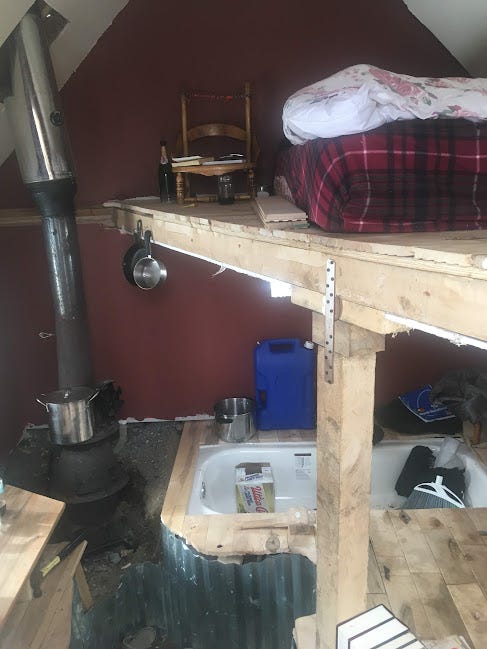
In fact, I’d grown cynical to everything. I went home. My cousin and I started partying at the bars with nothing short of suicidal abandon; that winter was a fugue of liquored-up delirium out in the boondocks. The apocalypse hadn’t come, I guess — again, I found another way to simulate it in my own life. Old Grandad 100-Proof Whiskey seemed to do the trick. Later, I’d shack up with a nihilistic woman from New Jersey, build a filthy little cabin on my uncle’s land, and by spring — in what was really the ultimate flourish of cynicism — I’d join the US military.
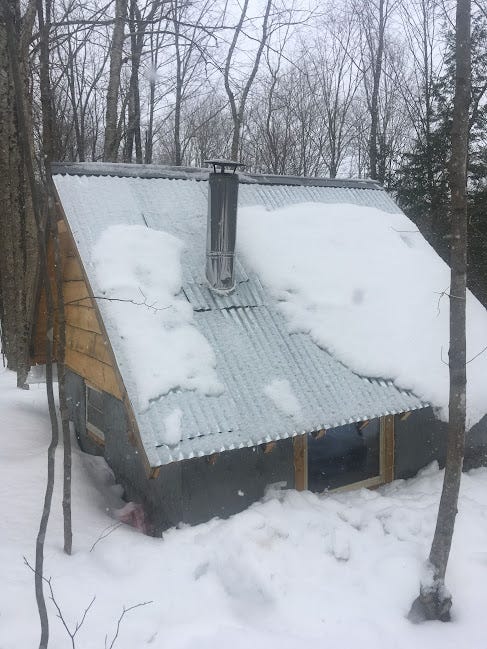
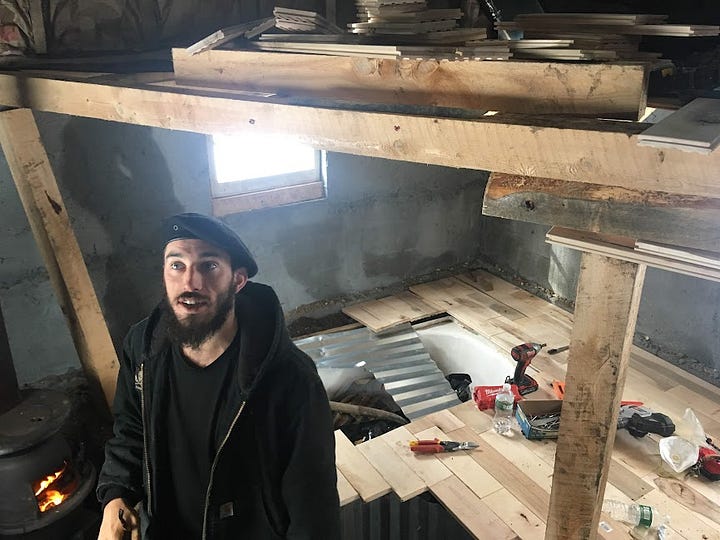
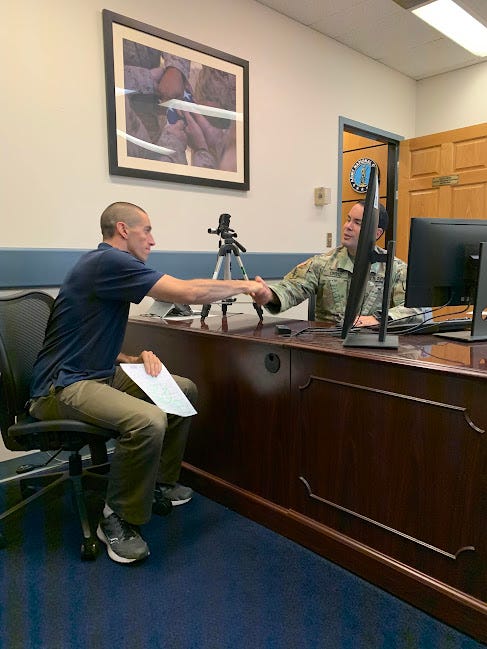
It was there that I’d enter the “Covid Era” as property of Uncle Sam.
They made me get a bank account. They made me get a license. They made me shave my face, cut my hair, pay my taxes, iron my clothes, and wake up to an alarm clock.
Walking around in that uniform, I felt like a hollowed-out ghost. People who would’ve called the cops on me the year before now held doors open for me and thanked me for my service. It didn’t feel good — it felt fake. The only real respite I got from the whole thing was when we went out to sea. There, the stakes were real — we operated in dangerous conditions, the boat was our lifeline, critical systems occasionally broke, and in a flourish of the kind of intensity and drama I craved, I got to dive down into the hot oil spraying out into the bilge to fix leaks or turn wrenches, getting tossed around belowdecks in heavy seas, sick to my stomach, banging my head and bones involuntarily against the heavy-gauge metal of the ship’s freezing cold hull. In those moments, I was reminded that I was still alive.
That only lasted a year: when my time on the ship drew to a close, I was trapped in Covid Era bureaucracy at various training centers for nearly a year. At both TRACENS, I was confined to the tiny bases, barred from going out into the outside world. For a couple months of that time in total, I was in “quarantine” isolation or in the “regimental holding element” — alone, unable to go outside, stuck, waiting like a prisoner. Now I’d gotten a different taste of apocalypse; no longer was I swashbuckling about from fistfight to fistfight or dumpster to dumpster in a struggle against material reality — now I’d enlisted myself into a psychological apocalypse whereby every dearly-held idea (or coping mechanism) was robbed of me. It was there that I sat in silence, sober, rifling through the scrap-heap of mostly pointless ideas and experiences I’d struggled so hard to collect and perfect throughout my years – alone.
During this time, I was let out into the outside world only a handful of times in all. Once was to transfer to another base; another was when California lifted quarantine restrictions, though the lift wound up being temporary. During that brief window of interaction with the outside world, my girlfriend happened to visit me. By then, she’d broken up with me a hundred times, in spite of the fact that the only reason I’d joined the military in the first place was for her: I had wanted to show her I was serious by “getting a job.” It didn’t work. She didn’t want to be a “military wife,” and that was that. Still, we’d occasionally get back together, and I’d always try to right the ship somehow, as I did love her.
“This doesn’t mean a relationship,” she told me in the Motel 6 room in Ukiah California on a balmy summer night. I disregarded that warning completely; why else had she come? And soon, her hard facade melted down until we were face to face, doing things that no unmarried people should ever do. That night, a methhead tried to break into our room with a cinder block: I leapt naked out of bed, ripping the microwave out of the wall, ready to launch it at the attacker. I screamed through the door, kicked it, and he fled. No part of me was alright, no part of me was relaxed — I had certainly forgotten how to “have fun,” and my girlfriend said I “looked sick.”
Days later, as I took her back to the bus station, we drove by a dead fawn in the road. It lay in a pool of fresh, shiny red blood on the shoulder on a cold foggy morning.
“An omen,” she said, half-joking, half-serious. We parted ways with a cold hug, and I returned to my barracks room.
Days later, “lockdown” would begin again, and all of the men on base were utterly crestfallen. As consolation, the Captain opened the enlistedmen’s club, where by a lottery system, six of us would be allowed to go to the bar to consume no more than “two” drinks. The bartender took pity on us, and served us nearly full pint-glasses of cheap vodka with just a splash of juice over it. We sat amidst the hanging sheets of plastic in awkward silence, all of us strangers, taking long, harsh sips of our drinks and staggering back to our rooms later, with our faces muzzled by masks made of denim (I never understood why they had to be denim…).
A few weeks later, my girlfriend called me. “I’m pregnant.” Stunned but not remotely unhappy, I said: “OK. I will email my chief about re-enlistment. Might as well stay in the service if we’re gonna raise a baby,” and to this, she agreed. My time at that base was almost over; now a glimmer of hope had shone through. A sense of fatherliness welled up in me; I was ready to be a father. That week, something clicked, something felt right, I suddenly had a real purpose, and I walked with a newfound resolve. I called her mother, we spoke through tears, I swore her daughter and grandchild would be safe with me. Over the next couple months, my girlfriend and I would discuss baby names, what types of wood we’d use for a crib, and various parenting concerns. It seemed by then that I’d won — that I’d gotten the girl in the end, and it all felt to be a very romantic American tale. And for the first time ever, I was actually glad that the techno-industrial civilization wasn’t actively collapsing.
The story ends, however, in a biohazard dumpster in Trenton, New Jersey.
“It is finished,” she told me on the telephone, in what in hindsight seemed like a blasphemous nod to the last words of Christ at the Crucifixion. And, something like Christ, the baby was an innocent oblation of a kind. Except she was offered not for the sins of the world nor by her own volition; she was sacrificed at the altar of anxiety and nihilism and the vague, all-consuming apocalyptic fear that’d ever brought her mother and I together to begin with. That child was the final culmination of an ideology of death and fear; how else could the story have gone but this?
There are instances of grief and suffering that are only momentary, like a bruise that heals — and there are those that alter a human heart forever. For weeks, I was nauseous, sleepless, achey, though my condition wasn’t Covid. Each night I lay silent, feeling heat course over my skin and my eyes; it was as if my bones were melting. I thought of hanging myself with my belt. I will not hang myself with my belt — I had to keep saying it to myself out loud. But it didn’t work; I couldn’t stop thinking about it.
I wanted desperately to join that tiny baby in whatever comes after this life.
The bitterness of my weeping was beyond description. I pounded my fists against my legs, I threw water on my face, but my innards were squirming and my face was as numb as ether. My stomach churned, I swore I was going to die then and there. Something had gone terribly wrong, and my grief had a morbidly paralyzing effect on every cell of my body.
Finally, in desperation, the words slipped out:
Text within this block will maintain its original spacing when published
Our Father, who art in heaven, hallowed by Thy Name,
Thy Kingdom come, Thy will be done,
On earth as it is in heaven.
Give us this day our daily bread,
And forgive us our trespasses
As we forgive those who trespass against us
And lead us not into temptation,
But deliver us from evil,
Amen.
It was as if I’d belched it out involuntarily. It’d been fifteen years since I’d seen the inside of a Church; I had not thought very seriously about its absence when, after my grandparents’ divorce, we stopped going. Truthfully, I had not even noticed. More than this, I’d spent years scrawling “NO GODS, NO MASTERS” and “666” on every bathroom wall I could find. I’d even made fraudulent baptismal certificates for today’s date whenever I wanted a free Grand Slam at Denny’s — since baptismal certificates were considered valid ID for one’s free birthday Grand Slam breakfast. I’d blasphemed, fornicated, drank myself stupid, stolen, fought, hated, cursed, and spat at God Himself, cursing Him by name over and over and over again. In hindsight, and in spite of the good days during that time, it was, in all, a wretched life.
Now, in my self-assuredness, I’d crossed the line into murder. Though up to that day, I would never have used that word to describe abortion, I could not think of it otherwise now. Up to that day, in fact, I had literally defended infanticide — after all, primitive tribes of hunter-gatherers often practiced it as a very reasonable and natural form of population control during scarce times. It was all antropologist-confirmed; all very ancient (and therefore good). Now the idea of infanticide made me want to wretch, and wretch I did.
The prayer came from nowhere; it was a final, last-call plea — a transmission launched into the blackness of nothing, on the off-chance that the author of that nothingness had his radio on. I can’t do this alone anymore, I said aloud. I have no idea what I am doing and I need help. It was then that help came with a degree of suddenness that I can only consider to be miraculous.
For as I prayed, I found I could breathe again. The gurgling torrent of nails and needles that had wracked through my stomach so violently just moments before settled into a strange and almost suspiciously warm eddy of calm. My bones solidified, my back was erect. I knelt quietly in silence.
I had finally admitted it: I need help. I can’t do this alone.
And what was this but the antithesis of the apocalypticism that had ever driven me? The ‘survivor’ mentality — the man-against-world fantasies, the hunger for punishing conditions and grueling elemental roughness, all of it to grind me down further and further toward a kind of soldierly mastery of my own fate. And to gratify my pride and ego, I craved the nuclear warhead, the great depression, the hurricane, the riot, the brawl. I needed endless torrents of disasters in which to prove myself, for proving myself to myself was the only high I could ever obtain.
It was not different with sex, with women, with crime, with high-flying all-night intellectual debate. Always another chance to prove myself; always craving chaos, that I might demonstrate to all present that I am a kind of “lord of chaos,” that I am the crazy warlord who eats death itself – that I need no God for I am him. This was my fantasy; it was a ridiculous thing, a callous, empty-headed fever dream — a Godless, exhausting, nightmare of a life. And finally its logical conclusion was not only within sight but had arrived in earnest: a helpless infant, sucked with a vacuum from the nervous, icy womb of my estranged beloved, disposed of without a funeral into a biohazard dumpster in the New Jersey ghetto.
“If the rule brought you to this, of what use was the rule?” These are the famous words of Anton Chigurh in Cormac McCarthy’s No Country for Old Men, and they are the most succinct expression of what happened to me in the weeks following the abortion. To kneel and pray the Our Father was only my first admission that in a long and somber life of pointless destitution and pride, the “rule” I’d used was not merely useless – it was actively malignant.
And it was through this that I could begin to reason: Is the real apocalypse not within?
For if nuclear war is my fear, what could cause it but the sin of men? Recessions and climate change, deforestation and slavery, spiked fentanyl and revolution — where does any of it hearken from but from the anxieties and fears of men? If, in turn, I fear the consequences of their sin, and my fear drives me to my own kind of profligacy and paranoid madness and even violence, such that I myself become the thing to be feared — have I really “survived”? Or have I only cynically lowered myself down into the apocalypse that was already happening deep within the hearts of all men the world over?
Then: can we not say that the seed of ‘End of the World’ is, at its core, the self-inflicted death of a man’s own innocence, by way of his nerves and his ‘rationality’? Is the root of apocalypse not a nervous and willful destruction of the flower of our sensitivity and good-will towards our fellow man? Is the notion of ‘surviving the end of days’ not fundamentally a heart-hardening glorification of the self over the will of the Creator? For if He is God, and He is good — whatever ghastly consequences might be wrought by the sin of man, will He not spare His people from them if they seek to do His will, whether it be in this life or after it?
It is from here that we choose: do we become the apocalypse, or do we submit to He who is our only refuge and haven? Though I am hesitant to pose this question as a binary, I believe that ultimately, it is truly an “either or” sort of question.
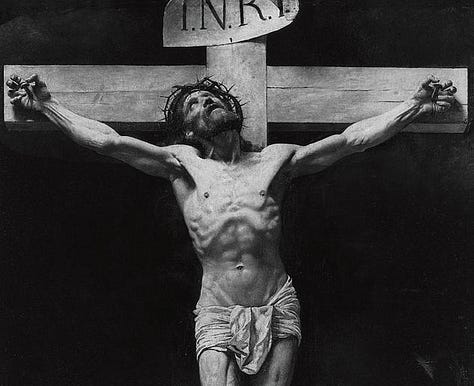
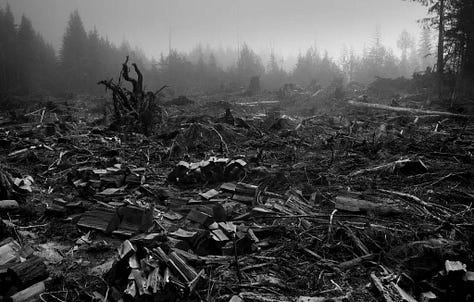
For if our answer is the latter and not the former — we must prepare to die. We must find peace with our own death, even if it is violent, ghastly, torturous. Perhaps we must even smile at it; preferring martyrdom to whatever chinsy, pallid sense of “peace” we ourselves could create by force of will. We must know what our work is, and know that it is love, and pour out our own blood for the sake of our suffering neighbor, even if it may cause us to expire, or to starve at our neighbor’s side, or to be taken captive by evildoers. Daily, as anxieties and worries rise in our chests, we must bring them to the foot of His Cross, to leave them there, that He might strengthen us with His perfect love and fortify us to love as He loves. Daily, we must pray and meditate and set a calming rudder onto our hearts, even if the turmoil is grave, such that no dark fate that befalls us could ruin us so long as we do not lose our grip upon the guiding hand of the Savior.
What is the alternative but a kind of ceaseless arms race of the human will? A race in which, by technical prowess or actuarial vigilance, we construct a kind of fortress of foresight and of material security — we harden our hearts to the suffering, that we might come out ahead, to hoard what little we have, clinging bitterly not onto life but onto what limp, insufficient approximation of it can be protected purely by our own will: Is this not the spirit of “survival” at its bitter end?
Christ Himself said in Matthew 6:25-34:
“Therefore I tell you, do not worry about your life, what you will eat or drink; or about your body, what you will wear. Is not life more than food, and the body more than clothes? Look at the birds of the air; they do not sow or reap or store away in barns, and yet your heavenly Father feeds them. Are you not much more valuable than they? Can any one of you by worrying add a single hour to your life?
“And why do you worry about clothes? See how the flowers of the field grow. They do not labor or spin. Yet I tell you that not even Solomon in all his splendor was dressed like one of these. If that is how God clothes the grass of the field, which is here today and tomorrow is thrown into the fire, will he not much more clothe you—you of little faith?
“So do not worry, saying, ‘What shall we eat?’ or ‘What shall we drink?’ or ‘What shall we wear?’ For the pagans run after all these things, and your heavenly Father knows that you need them. But seek first his kingdom and his righteousness, and all these things will be given to you as well. Therefore do not worry about tomorrow, for tomorrow will worry about itself. Each day has enough trouble of its own.”
Fail in this and one’s own descent begins. Worry begets fear, fear begets a posture of vigilance and anxiety; the mind begins to wander off into the dark possibilities of apocalypse — one begins to prepare, that they may be saved by their own prudence and foresight even if the others may suffer and die for their lack of it. But the mind’s own posture against disaster finds its limits in the body; the body must be hardened for survival — and in hardening the body, one may also harden the heart, for genuine survival requires it. It is in this ‘hardening’ that the soft heart of love dissipates and is paved over with callousness. And there, exhaustion follows, along with anomie, nihilism, and eventually — sin.
At the point of sin, one is no longer preparing for The End — one is “The End” itself. If one cannot avoid the storm — they are only free either to willingly suffer the lashing it delivers and to give aid to the meek and unprepared, or they may instead elect to become the storm themselves. It is this latter path that leads to hell on earth, for the will cannot suffer the wages of sin long before they are either taken under or are, if God is merciful to them, granted another chance.
It is here that we find a comparison of logical conclusions to be instructive. He who, at the outset, elects to empty himself out for the sake of love, as Christ taught, and to unburden himself from the grief of cosmic worry — sets himself out to do the work of binding together and of holding the flame of good-heartedness even as he is sent by the cruel forces of darkness hurtling headlong into disaster zones and battlefields.
And as his brother who chooses to act with ‘great prudence’ begins with his risk assessments and sober-eyed preparations; he begins hardening himself, body and mind, to all manner of difficulty, for the storm ahead will demand much of him, and he knows it. Soon he has hardened even his heart, for what can the “survivor” do when his store of bread is dwindling but deny the starving wayfarer? What can he do but shoot his rifle at the looters and thieves as they attempt to scale his compound fence? The road from here to grave darkness and sin is not a long one; and indeed, many a ghastly warlord of a type that smiles at murder and corpses has been made from this kind of thinking. The very worry that set his arc into motion was the thing Christ preached against; from here, it is not difficult to see why He would have taught against it, for its fruits are bitter and vile, and do ultimately recreate hell on earth.
Startlingly, that worry begins with even the slightest notion that our individual will could protect us from misfortune more efficaciously than the will of God ever could. Even in the 401(k), the insurance plan, the savings account, we find invitations to urges that could very well turn us into man-devouring warlords over time, though it may at the outset seem hard to believe. Again and again, even genteel and harmless men have been turned into monsters by dangerous times; therefore, why ever tolerate even the slightest germ of that monstrous seed? Are we not to guard against it at all times – even during eras of plenty and peace? These are formulations I wish I had learned many years ago, before all this.
That night, kneeling on that floor in my barracks room, I could not have said all of what I have just said, not word-for-word. I couldn’t have even articulated the vaguest thread of it. Instead, I was breathed on — I was led to smile at death not as the warlords and gangsters and suicidal punks smile at death, but to smile at the self-emptying denial of the Crucifixion, and of whatever its corollary could maybe – somehow – be in my own life.
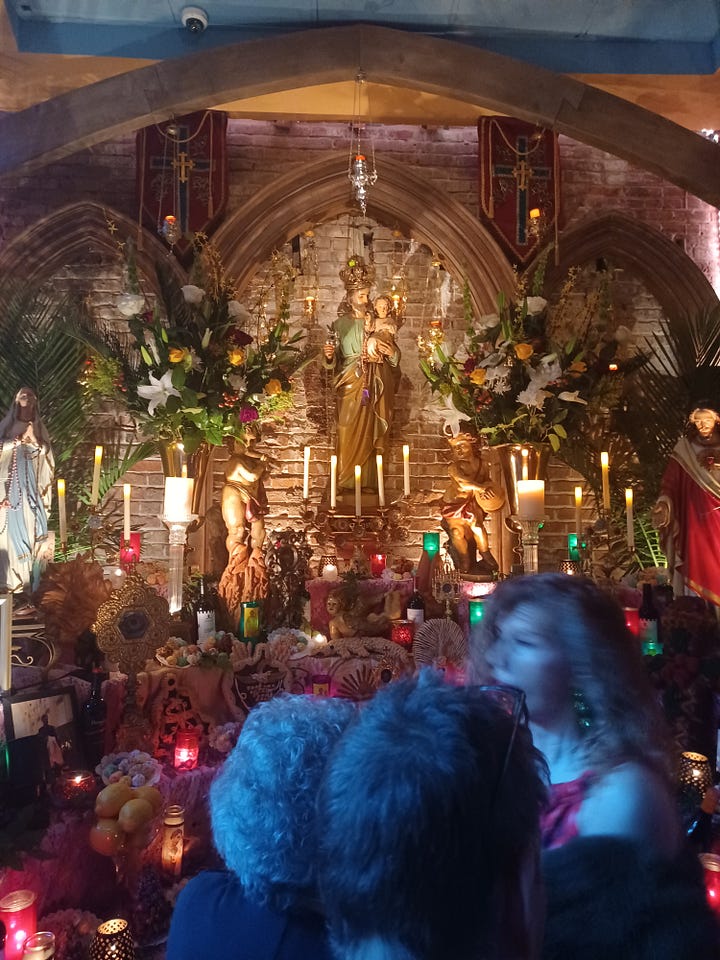
All of it pointed away from worry, away from exhaustion. It pointed toward Christ the King, in whom the suicidal urge is alchemized into the life of self-denying love and even martyrdom, and in whom, by His defeat of death, ‘survival’ and its very impetus has also been defeated.
For why should one who will not die after this life seek to preserve his own flesh? Why should he store away for tomorrow, or stock up on ammunition with which to kill, or build himself a bunker? To the contrary, the Christian is and forever must be a man who is ready to die, eager to die; a man who prefers his own self immolation for the sake of Christ over anything else, and it is this ready eagerness for the total exhaustion of the flesh for even his lowliest, most corrupt neighbor’s sake that leads us to the all-loving hands of the eternal God.
Had I known this from the start, what would my life have been? Had the seeds of the arduous path to Sainthood been sown in me by rigorous catechesis and the blossoming mysticism of the Eucharist been stitched into the fabric of my heart from the very start – would I have suffered so pointlessly and for so long? Would I have thieved and slunk about with the vagrants in the briars, or guzzled booze in industrial ghettos, or done all of the running I’d done for so many years? Would my first child have been born healthy and vibrant – instead of being executed by brutal “doctors” under the fluorescent lights of an abortion clinic?
It is a question that I now and again wish to ask the administrators of my childhood Parish Church’s religious education program; for somehow, the coloring books and Veggie Tales videos failed to inculcate in me anything like a Christian sensibility. The felt banners in the Church, the worldly modern hymns, the homilies about football never drove it home for me. Though those tasked with my religious formation could’ve armed me against the grave darkness that I would eventually encounter: they failed there, or I failed, or some miscommunication happened, and by the end of it all, I was left to stand naked before the Devil himself – dangerously exposed.
The word “apocalypse” originates from the Greek word ‘ἀποκάλυψις’ (apokalypsis), roughly translating to “off with the cover,” or “the unveiling of a great truth.” In this regard, “the apocalypse” is not simply a catastrophe that brings about “the end of the world” – it is any revelation so totalizing that it is deeply traumatic; a type of rapid, often violent, all-at-once learning that leaves the learner permanently unable to return to his former state. While no doubt, a nuclear holocaust would produce exactly this – the true nature of the word “apocalypse” can in no way be confined to such “SHTF” or “TEOTWAWKI” scenarios.
More likely than famine or plague; more possible than industrial collapse or World War Three are the subtler, more personal apocalypses of mysticism – or conversely, of grave sin and its wages. These do, like major world catastrophes on a personal scale, “lift the veil” to show the survivor “how things really are,” and they do this in a manner that alters a man forever.
In the months and years to follow my rattling and unexpected recitation of the Our Father prayer, I would learn that the Eucharist is exactly this. For as Saint John Vianney said in the 19th century: “If we truly understood the Mass, we would die of joy.” Indeed, on the rare occasions when the devout Christian can cut through the miasma of his own distraction, and can kneel before the altar as the host is consecrated into the true Flesh and Blood of our Lord Jesus Christ, seeing Him for what He is now and ever shall be – the heart is cut to the bone, and it is natural to weep. For we are a forgetful race; in our brokenness, we stumble and pass over the Holy of Holies and all that His hand has ever wrought, not only in our own lives but in the life of the world. There, on the altar, there is a recollection of the immensity of His graces; He is with us, and if we do not eat His Flesh and drink His Blood, we have ‘no life within us’.
To see all of this for what it is is to leave whatever you carried with you into the Sanctuary behind you; it is to let the dross of worldly life atrophy and die, to be born again in Him. That it is true that Catholics the world over can experience this immense mystery not merely on Sundays but daily is the greatest gift imaginable; there is nothing greater than this. For every time His body is elevated before the people, the veil is lifted, the world as we understood it only moments before crumbles in our hands, and the ephemerality of our life and of our time on earth is made blindingly apparent.
Is this not the ultimate “apocalypse?” For truly, if we are attentive to what He does in us, and if we are keenly focused on Him as He is in the Eucharist, we are altered, led to face Him, led to imitate Him, and it is as if our old sins and the vagaries of our warped and aimless wills are all bombed into oblivion – we start over again in Him, every time, rising from the ashes of a broken spirit.
Yet the road from that fateful night in my barracks room to the altar was by no means a straight one. One does not unlearn worry in a single breath, after all. The body remembers, the spirit is bruised, and old habits of the mind may send a man variously into fits of rage or of doubt and anomie. Habitual sins flare up like malignant boils across the flesh of a ravaged man, and one can only do battle against them with furious abandon. And, if one has ever been taken with the end-of-the-world, struggle-for-life-and-death, “bunker mentality” of the Godless doomsday prophets – they can verily find “bunkers” of a disturbingly similar type anywhere in the ‘trad’ religious world if they wish.
In the years to follow, I would slip into more than my share of these; religious “remnants” who proclaimed to stand courageously against the degenerate modern world – all them prophets of crisis, infiltration, subversion, and spiritual doom for all mankind. All of them hewing to something too ancient and unchanging to have been sullied by the formless, demonic vicissitudes of the modern era. Just as the prepper seeks his refuge in a “low-risk” region, or as the SHTF survivalist builds a “life raft” compound for his bloodline and kin, many religious traditionalists share a psychological overlap with these, albeit with exponentially higher degrees of zeal, and a sense of absolute certainty of a kind that is suspiciously solid. Each pushes the “antidote” to the fearsome spiritual enemies of the post-modern world with wild-eyed conviction, trafficking them around the margins of a broken-hearted world, introducing them as ‘the answer’ to souls who are often mired in existential crises, depressive episodes, or doing solitary battle against armies of demons.
And when the suffering soul surveys what they are selling, he can only ask: “Are they right?”
This is “Part One” of a two-part series.
Stay tuned for “Part Two.”
Comments
Nothing yet. Say the first thing.
Sign in to join the conversation.