
This is “Part Two” of a two-part series. Find Part One here.
I have long thought that the hallmark of the Western intellect might be, above all — overcorrection. For when one employs the full force of their mind and rationality toward a particular end, or toward the avoidance of a particular negative result — they may, in overturning every stone in the foundation of whatever it is that they wish to avoid, create a system of ideas that produces another, new set of negative results. Following this, it is rinse and repeat. Solve the new problems created by the solution of the old problems, and in so doing, create still more problems.
It is altogether like the swinging of a great and terrifying pendulum.
Some years ago, I saw a fellow take a dangerously large dose of LSD. Psychedelics have always been completely terrifying to me, though a morbid curiosity led me to observe him as his “trip” sent him into a feverish and dissociative state. His eyes seemed pickled and frozen; his pupils remained transfixed on whatever weird hallucination he was no doubt seeing, and I heard him say the words: “I’m OK” over and over again. He went on and on: “I’m OK I’m OK I’m OK I’m OK I’m OK…” for what seemed like hours.
The scene was bone-chilling to me. Why would anybody want to do this to themselves?
He only uttered these words, I should guess, precisely because he knew he was very much not “OK”. In a desperate race to regain his psychic equilibrium, he said those words over and over again, as if they might have some incantational power to sober him up and free him from his bizarre and harrowing delirium. It was all a strange and deeply unnerving display to behold — but stranger still was how, after he’d finally sobered up and the “trip” was over, he kept saying over and over again just how great it was. This “great” experience was, I remembered, one through which he appeared to desperately remind himself that he was “OK” for many hours. I was utterly baffled by the whole thing.
This comes to mind because it seems to succinctly express the kind of madness that more ideological varieties of “pendulum-swinging” involve. When a fellow goes between extremes without the faintest realization that he has done so, he appears to be unbalanced or even insane. In these cases, the mind works more quickly than the perception does; one blindly speeds through a series of uncoordinated motions, as if in a kind of desperate and ecstatic state, and it is a state that can be almost painful for a sober-minded witness to observe. Certainly, those who are calm and collected do not envy those who are taken with oscillating between wild extremes; it instead inculcates in them a vague feeling of worry for the poor soul caught in such weird and spasmodic tribulations.
So too with our various ideologues and extremophiles; one meets more and more of them all the time. A man might, for example, watch the infamously depressing animal rights documentary “Earthlings” and as a result of it, become a vegan. But after so long living under such an austere nutritional regime, he may find that he has health problems, for his body is desperate for fats and B-vitamins. He begins to Google things about nutrition furiously.
So then he has a revelation: he comes to believe that his diet is killing him. And he buys pounds of grass-fed beef tallow and consumes it by the spoonful! Now he is “paleo,” now he is gobbling raw liver and eating whole broasted chickens by the day, until finally after some years of carnivorous gluttony he gets a flare-up of gout, and blames it on the chemicals in the food supply that “they” have put there to weaken the American people. Soon, he moves off to Bolivia, where the food is “purer.” He puts his savings in Bitcoin, develops an esoteric spiritual practice, and even begins to sun his testicles daily. But after getting robbed in La Paz, he shifts again — the indio is an inferior and thieving race! He now sees the truth of Human Biodiversity! The white man is under attack… and finally, he moves to a racialist compound in Idaho, where he is given a copy of the Scofield Bible… and the cycle begins yet again…
This particular biographic trajectory is of course totally fictional, and has been rendered in a particularly extreme way for humorous effect. Nevertheless, the process I describe is exceedingly common, particularly in subtle ways; we are, as a race, addicted to “revelations.” We hunger for new “self-help” methods; we crave new pop psychology answers to long-standing emotional troubles. We demand new diets, new conspiracies, new gym routines, new political “hot takes” and movements. And — sprinting through them, glossing over their details, never zooming out to see the forest for the trees, we spasm through this weird race of whiplash in an endless search for palliatives that might ease some inescapable, unnamed, and deeply ultimate sense of dread.
For us moderns do appear to be, on the whole, disturbed and homeless creatures who’ve altogether lost anything resembling a ‘rudder’ or a ‘center’ or a ‘backbone’. In lieu of ultimate truth, we fumble and founder between the various “rushes” and temporary highs we can obtain by unlocking new esoteric knowledge, and for many of us — that appears to be as good as it ever gets.
Of late, so-called “Trad” religion is quite often exactly like this, and can, in certain important regards, be viewed as a continuation of the same. Just as the South Beach Diet hit a certain class of overweight boomers in the 1990’s, or as ‘mindfulness’ and ‘minimalism’ spread like wildfire amongst a certain type of white collar millennial in the 2010’s — so too with the more avowedly “anti-modern” expressions of the Christian faith. These have arrived on the scene like catnip for a certain kind of bookish and radically disaffected young person living in Western nations today, and I do not shy away from the truth that I am one of these.
For, as the West has run headlong into an era of degeneracy and self-defeat, and has commenced with a crusade against all forms of vigor and truth and wholesomeness and vitality and honor — it was only a matter of time before a counterrevolution against it all rose to a place of prominence in the discourses of thinking people.
I am not being cheeky here; the problem that our “Trads” identify is, in at least some regard, very real indeed. The societies of Western nations have rotted almost overnight; we have made an incredible and speedy moral descent into a world of Godlessness. We are consumed by an inescapable sense of purposelessness and moral decay; we’ve become weak, tepid, geriatric, flag-lowering societies. Demolished Cathedrals and universal access to hardcore pornography — we’ve aborted literally tens of millions of unborn infants. Marriage is a perfunctory bureaucratic affair and the dating scene is infinitely bleak, too. And it has all been in service of an impotent, Godless, ugly, nihilistic consumerism that now sprawls across the SSRI-choked landscape.
How bleak indeed.
Perhaps the great trouble with “the pendulum swingers” among us is that much of what catalyzes so much “swinging” does consist of real problems, that are then grouped with imaginary problems, and later spiderweb out into an all-consuming sense of paranoiac delusion and apocalypticism — all to feed a reaction that will create just as many problems anyhow, and may altogether fail at solving the initial problems to boot… but this is not to say that the earliest and most initial diagnosis is always erroneous. Very often with any of these sorts of things, the first look at “The Problem” is in fact remarkably astute.
Things only go sideways, it seems, when we seek to solve a correctly-identified “Problem” within a psychological architecture of paranoia. When the infrastructure that empowered us to level a valid and sober-eyed critique is first gratified by the correctness of what it produces, it then risks going haywire, as a kind of bestial and autonomous philosophical process, and in it, prudence is brutalized, reason is abandoned, and the very tools that might’ve been required to address “The Problem” in the first place have been lost, blunted, and vandalized. Overcorrection ensues, and a new sort of headless beast runs wild to create a novel and unpredictable mix of positive and, far more often, negative results.
This has certainly been the case with the “Trads,” a term that loosely defines those who have run headlong into ultra-traditional expressions of the Christian faith, especially as found in Eastern Orthodoxy and in “Rad Trad” Catholicism. Such people find in these expressions of faith a kind of salvific escape from the worst excesses of modernity; a cleansing balm from the grotesqueries of our time. And if we are to think of modernity as a kind of philosophical or even existential corrosive — a thing that cuts away at tradition and order and even at God — we find that there is only so much psychic and spiritual infrastructure that can corrode before madness becomes widespread. It is increasingly clear to observe that the souls of men simply cannot withstand any more corrosion, and so many of them do, perhaps unexpectedly, stumble into a Church.
It is only natural that young people today would finally rise up to say: “no more;” that they would wish to turn toward Godly things, toward tradition and order and a deeper, more timeless sense of beauty. It makes perfect sense that they might reach toward whatever the deepest backbone of the human heart might really be, and if such a question is given a fair and thorough shake — those seeking an answer are very likely to find Jesus Christ there.
Yet the trouble is not with where they are going but with what they are carrying with them. For revelations on the corruption of modern society seldom arrive neatly packaged, and they do not tend to come about as purely philosophical epiphanies. To the contrary, these revelations generally come about quite traumatically and are often attached to a specific grief. It is this grief, in some (usually acute) form, that ever pushes an individual into asking such desperate, harrowing, frantic kinds of questions in the first place; and the bedfellow of this grief is usually some form of trauma that can lead one to overreact, overcorrect, or hurtle headlong into instability, apocalypticism, and paranoia.
I speak from experience on these fronts; these are lessons that it took me quite a long time to learn. Without aiming to offend the “Trads” — “Convertodox” and “TLMer” alike, not to speak of their less common Protestant analogues — I write on the subject to offer a less-often-mentioned view of the spiritual hazards of diving headfirst into the depths of hardcore traditional Christianity.
First and foremost amongst them is what I can only call ‘Apocalypticism.’
A thick oaken door hung ajar over crumbling granite stair-steps. I am walking in a rough old part of a dying Rust Belt city. Fading trails of incense leak out from the half-open door and onto the needle-strewn sidewalk, where despondent men lay crumpled up like urchins below the rusty Church gates and the silent Cross. It was an old Polish ghetto neighborhood, where amidst the grimness of old brick streets, pure light leaked out from the Parish Church door, and immaculate voices were crying out in heavenly song from within.
It was the spring of 2018. I was filthy then; my gums were bleeding with gingavitis and my nails were caked with dirt. My face was covered in dust-stained lines, like the calligraphy of haggard devils and babbling cynics, and I was hungover to boot. I was in no condition to be entering a Sanctuary of the Lord. Yet enter I did, drawn in by a kind of wordless and inexplicable magnetism. Involuntarily, I crept toward the strange, exotic, medieval-looking scene inside. It was a hot, humid morning; my backpack had cut welts in my half-bare shoulders; I probably stank, but I needed a rest and so I stepped in, leaving my rucksack at the door.
Stern looking blue-eyed women in headscarves sang in heart-fluttering harmony. A somber-looking fellow with a gigantic beard and a tall black headdress on his head gesticulated at the altar, holding some sort of golden jingle bells that belched large amounts of smoke. An elderly, large-paunched fellow with slicked-back hair and gold chains sucked on a cigarette just outside the doorway, and as he tossed it out, he came up to me without a word, pressing a booklet into my hand. I’m not sure why he did it; I couldn’t understand so much as a word of it. It read:
Text within this block will maintain its original spacing when published
ї҆́же херꙋвї́мы та́йнѡ ѡ҆бразꙋ́юще,
и҆ Животворѧ́щей тро́ицѣ Трисвѧтꙋ́ю пѣ́снь припѣва́юще,
всѧ́кое ны́нѣ жите́йское ѿложи́мъ попече́нїе.
Ꙗ҆́кѡ да царѧ̀ всѣ́хъ подымемъ,
ангельскими неви́димѡ дорѷноси́ма чи́нми.
Аллилꙋ́іа
I assumed it was Russian at the time, or perhaps Romanian. It was instead Old Church Slavonic — an ancient language that is now used only in Liturgical contexts in certain Eastern Orthodox jurisdictions. But I didn’t know any of this at all. I was not even aware of the existence of “Eastern Orthodoxy;” I had never heard of it before. The only thing I knew was that I’d never seen any expression of Christian worship that looked remotely like this — and I also got a distinct sense that I probably shouldn’t be in there. This was clearly no place for an anarchist vagrant.
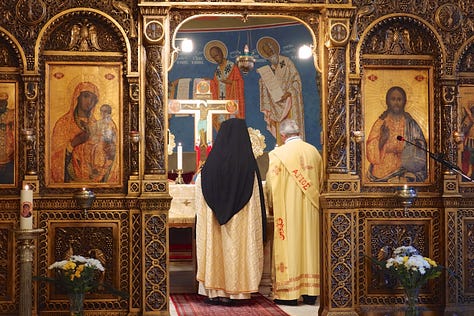
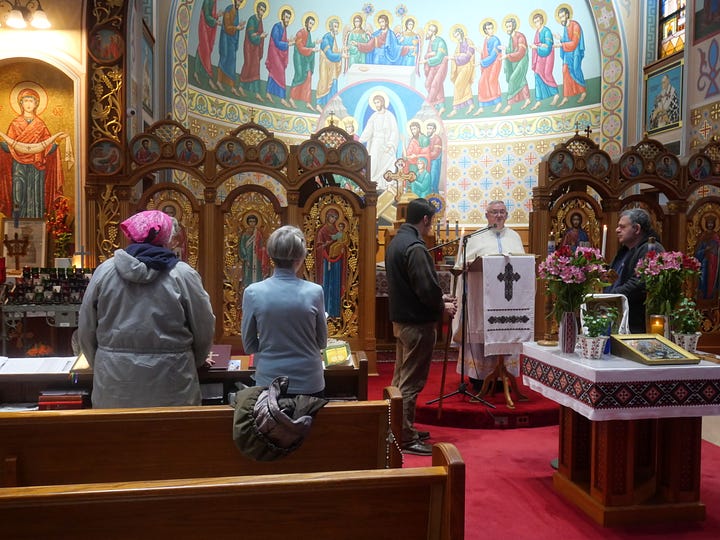
Nevertheless I gazed on, transfixed. Now the Priest was again mumbling in sharp, almost warlike tones; now younger men, whose beards were not quite so long as the Priest’s, held scepter-looking poles on which little lanterns bobbled and waved. The sanctuary was dark, almost cavernous; hundreds of faces — all of them Saints — peered down through the candlight and dense smoke, watching us. And above it all, the face of Jesus Christ was painted in a kind of fresco-on-wood, with an expression of vague indignance or even holy fury — a fury that burned all the more brightly for the glare of the oil lantern hanging before the image. It was a fury about which I knew nothing, yet just then, it looked startlingly real.
I darted out the door, where the man with the greased-back hair was smoking again and talking on a cellphone, raising his huge eyebrows at my early departure. Harrowed by this strange and bewildering slice of what looked like a scene from medieval Eastern Europe, I pressed on down the street — back to the world of yowling crackheads and neon-lit 7-11’s and speeding automobiles on the cracked-pavement streets, where that night, I’d be sleeping. The contrast sent me reeling; it was completely surreal.
So went my first contact with Eastern Orthodoxy, though as I say, I had no real idea of what it was or what I’d seen. It was merely a vague, hallucinatory memory that did not leave me; a momentary grasp of something that was neither dead, nor a piece in a museum, nor inaccessible — and yet was obviously and definitively anti-modern.
Naturally, then, in the days and weeks following my mystical brush with God in the aftermath of my ex-girlfriend’s abortion, my mind shot back to that strange morning when I’d accidentally happened upon some earlier, purer, more unknown expression of Christendom. It was a memory of a momentary coincidence that, many years later, I would come to believe was the work of God Almighty.
The season during which I waded through my conversion to Christianity could only be called the “high Covid” era. That era was a Gnostic’s paradise; a time where there was practically nothing else to do but to root out and receive revelations and esoteric knowledge. A time when skepticism took root in the minds of otherwise vanilla-type people; when phony information and bizarre hypocrisies seemed to multiply ad infinitum. It was an era when families and marriages and friendships blew apart over strange subjects like masking or Donald Trump or Pfizer shots or Zoom calls — a season of collective psychosis.
Nationwide, Americans became ‘extremely online’, en masse, all at once, and niches started to fill and split and blossom out into numerous cultic occurrences and novel sectarian cliques. Conspiracies swirled; riots broke out in the streets, a few people left the USA, many others fled from the cities out to the hinterlands. Millions switched parties, or stopped voting, or became survivalists. Still others sank into a miasma of pot, booze, and DoorDash.
But most significantly, and amidst it all — some very unlikely people became very Christian practically overnight.
I was one of them.
Yet what began with one desperate offering of the Our Father prayer did not immediately coagulate into a clear and well-defined religious practice at all. Instead, it precipitated a flurry of Googling. Was Christianity as evil as I had assumed? What did the Gospels actually say? Did Jesus really exist? Were Islamic truth claims somehow more valid? Who are the Oriental Orthodox and what was the Council of Chalcedon? What was the Filioque and why did it matter? Who was Ulrich Zwingli? And why on earth was Luther always talking about feces?
Though my search was earnest, my mind was utterly clouded. I was drenched in misery, desperately clinging to life, sloughing around all the baggage of my exhausting number of former lives and former ideas. All of it flotsam and detritus to sift through in my lonesome and quarantined barracks’ room. Just as certainly as I had begun to seek refuge in Christ, I sought a haven from what I’d come to believe was a culture of death, a dying society, an era of moral degradation and degeneracy that gave Sodom and Gommorah a run for its money. It was an apocalypse out there — I needed a safe harbor.
For this reason, regular-old Christianity just wouldn’t do; and the various novel and man-made sects that had been invented during and since the Reformation, of course, wouldn’t do either. I began to suspect, in fact, that the Reformation was the great-grandfather of the modern world I’d come to hate; that the rebellion of Luther led to the rebellion of his innumerable sectarian offspring, and eventually to the rebellion of Christians against Christ, of man against God, and of man against nature. Luther’s frenetic intemperance, I reasoned, was the opening of a pandora’s box that eventually led to atheism, communism, and modernism. I would need a far more ancient sort of haven than all of that.
It made great sense that I would search for such a thing; it was only natural to aim to deconstruct and critique every ideological forerunner to the modern world that had hurt me so terribly. But the pure, white-hot hate and paranoia I carried in the depths of my heart occluded my view of all this new religious information; my instincts were weak and confused. Moreover, I was not a wandering Pilgrim knocking on the doors of Monasteries but an anonymous Googler, a forum-reader, a Wikipedia scroller. 100% of my inquiry came to me through a glowing screen, which only exponentiated the frantic and synthetic nature of my search, for no part of it was social or human.
Even before all this, there was the even more basic question of whether I believed in God at all — or of whether I accepted that Jesus Christ was indeed God. After my experience with praying the Our Father, I was at least tentatively convinced of the idea of Christianity — but my deeply secular and atheistic biases obstructed me considerably, as did my childhood in the Catholic Church.
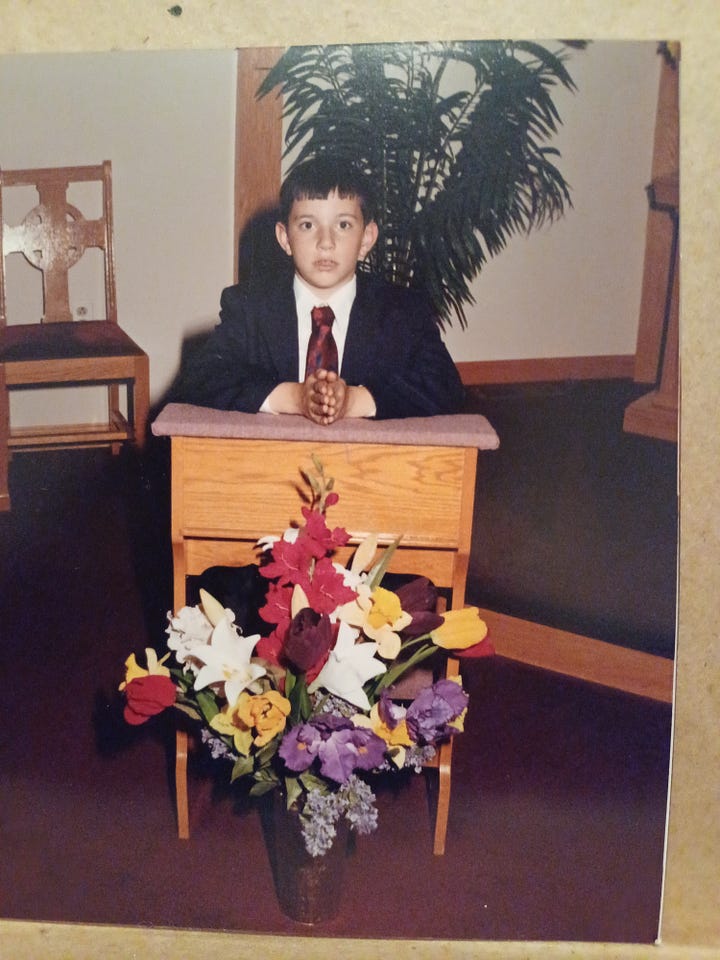
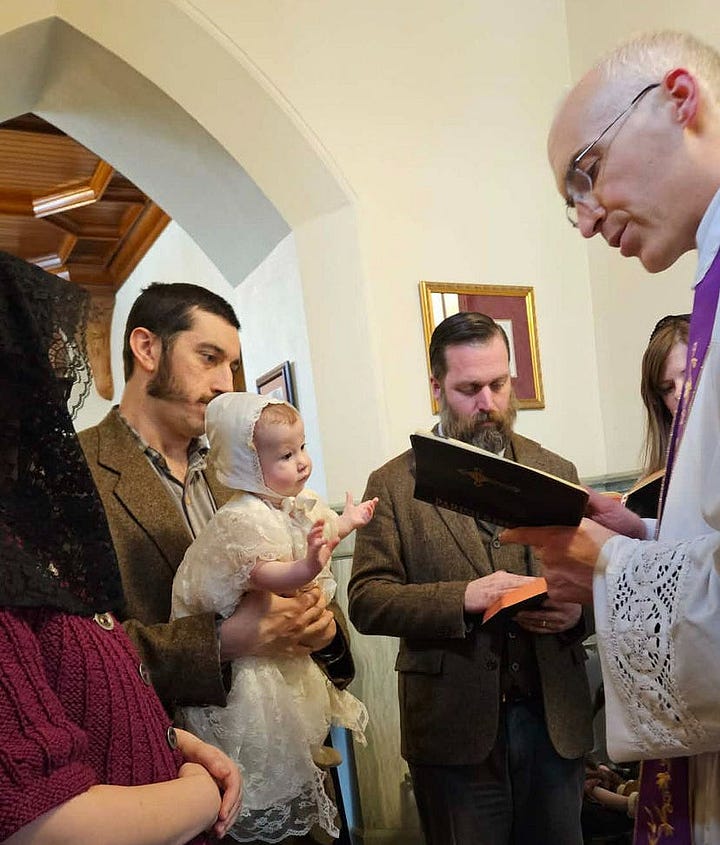
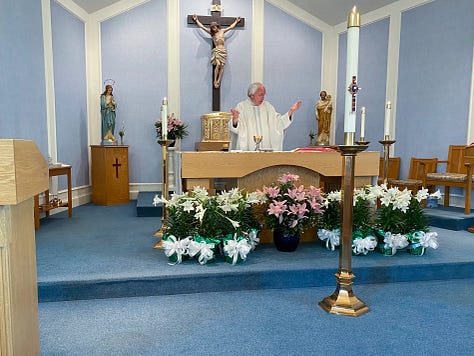
For as a boy, I only remember Mass as a somewhat stodgy, dorky, boring sort of affair. I saw no fervor there; it never seemed to me as if those people believed in anything. Mine was not a Parish full of Rosary-praying, veil-wearing, incense-wafting faithful — it was the sort of place where the Priest gave homilies about sportscars and football, and where in all likelihood, nobody had even given a thought to going to confession for many years, if ever. There were cheesy felt banners on the walls; the music often sounded like a Christianized version of Jimmy Buffett’s Margaritaville. Organ interludes made the Mass sound as if it were a game show — the Priest’s consecrations seemed to involve much preening and “smiling for the camera.” Though none of this registered to me as a boy, in hindsight, that was how it was.
Or so I remember. The memory is a fickle thing; and so far as it served me then, the solitary experience of an accidental fifteen minutes in an Eastern Orthodox Church seemed to outweigh the 10+ years of my Roman Catholic childhood. There in my barracks’ room, I’d become increasingly convinced that if I was to find the true Christian faith anywhere — I’d find it amongst the Eastern Orthodox. My judgement on that matter came not so much from a study of doctrine nor of history (the Filioque controversy was utterly indecipherable to me), nor from an intimate knowledge of Eastern ecclesiology (I had not yet thought to ask “which Orthodox Church and why?”), nor really anything but a vague instinct built upon a cursory memory of the aesthetics.
In other words, I was basically drawn to it for the same reasons that hippies are drawn to Buddhism: because it was exotic.
More than this, it wasn’t just exotic — it was not Western. For in my decade as an avowed anarcho-primitivist with leftish tendencies, I’d cultivated the unshakeable certainty that the West was evil; that the civilization arising out of the Mediterranean and of Rome and of London was the source of a uniquely massive torrent of raw human suffering and ecocide. As an anarchist I hated America, I hated Europe, I hated the Catholic Church. It was only in my brief encounters with biographic accounts of left-leaning Catholics like Dorothy Day and Oscar Romero that I ever entertained even the slightest bit of sympathy for the Church — but even there, whatever the Church could be, or maybe once was in isolated instances, it was obvious to me that on the whole, the Catholic Church was not only boring but irredeemable.
Instead, I sought and found the ultimate escape, not only from the hellish evils of the modern world, but also from the insurmountably massive baggage that comes with all things Western. That was a burden that I wanted no part of, and by stumbling across the Tiber in a mad sprint, I relieved myself of all the bruises and scars left on the face of the faith of my own forerunners.
To be Eastern Orthodox seemed to me to be a way to participate in a form of Christianity that is more ancient than the various weak, watered-down Christianities that are common in “Main Street America.” It was even (or so I thought then) older than the Catholic Church; for I had heard and uncritically accepted the idea that “the Catholics split from the true Church” and not the other way around.
And so I found a way into titillating, eye-popping levels of ancient Sacramental and Liturgical beauty that would not require me to answer for the sins of the Roman Church nor of Western Civilization. Rather than getting the Church I deserved as a miserable sinner, I reached out for the Church I wanted, and it seemed so much cleaner and purer from the outside looking in.
What a relief this was! All the sex scandals and simony, the conquering of helpless natives, the Crusades and Inquisitions and corrupt Popes: now, by my merely going east, suddenly none of it was mine to answer for. I had found my way into a Church so old it had skipped all of that, and had so proved my own ancestry as a Westerner to be tragically corrupt. A Church that was a purer, older, more perfect expression of the Christian faith — of a kind that the “degenerate West” could’ve never produced.
And for quite some time it worked. I really had found the haven that I had ever sought — so long as I blurred my eyes, anyway.
Yet the trouble did not consist of where I was going but of what I was carrying with me. My old ‘apocalypse instinct’ remained completely intact as I sprinted into the world of Eastern Orthodoxy. In fact, in many ways — my gnawing sense of cosmic doom actually grew. For, once a fellow can put his finger on whatever The Problem is in definite terms, he can then find himself The Answer. In making inquiries into the problem, the apocalyptic type is wont to erect a binary that is almost computer-esque. If this, then that; all of it “yes or no,” “good or bad,” “holy or demonic.”
Every Sunday at Divine Liturgy, it felt as if I’d entered a storm shelter of a kind, a bunker in which to shield myself from the impossible evils of a dark and even Satanic world. When coming upon a new idea, or a heterodox notion, or entertaining the alleged “wisdom” of non-Orthodox people or sources — my brain automatically cast those ideas in a skeptical light. Soon, even within Eastern Orthodoxy, I was learning reasons why even many self-proclaimed Eastern Orthodox Christians and sects were heterodox, “schismatic,” “outside the Church,” and so on.
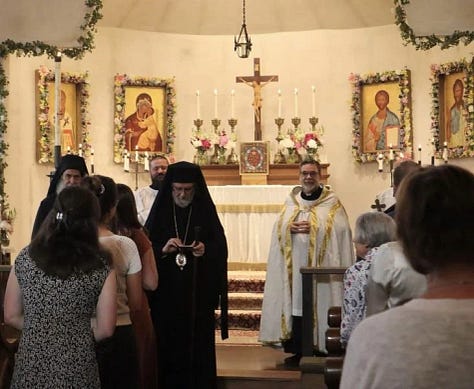
The banter at the post-Liturgy coffee hours was often confirmation of these instincts; I began to have my newfound and aggressively-held biases confirmed to me by my peers as I traveled the country as a military man, dropping in from Church to Church. One day I was at a ROCOR Church, then a GOARCH Church, then visited the Antiochians, then even the Copts (for I was still only vaguely aware of the differences between Oriental Orthodoxy and Eastern Orthodoxy). Often at these Churches, the coffee hour crowd seemed to bifurcate into different “cliques,” almost like the high school lunchroom. On one side — the Russian speakers, or the Romanians, or the Serbs; on the other side, the “convertodox” — ex-hippies, tatted-up ex-punks, former Evangelicals, and aging non-ethnics with names like “Johnson” and “Smith” who’d converted in the 1970’s. At many Parishes, there were no converts at all, and it often appeared that there had never been any to begin with.
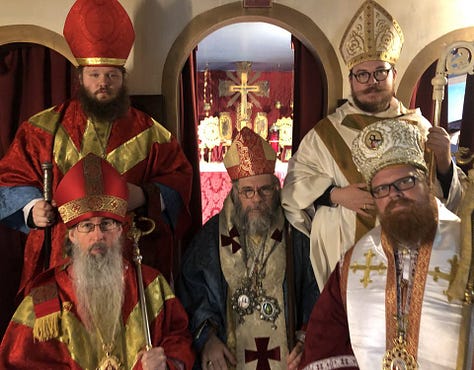
“Our final hope will be found in Russia,” one young man with a scraggly beard once declared to the table over borscht and boiled eggs served in styrofoam bowls. “It is a fact that Putin is a devout man — not the monster the Mainstream Media tells us to think he is.” He went on to describe a terrifying future prophecy involving nuclear holocaust and gruesome warfare in a worldwide struggle to save Moscow, the “third Rome” and final bastion of true Christendom on earth. This fellow was clearly an outlier — and at that, an “extremely online” outlier if I were to guess — and yet he seemed to give a voice to at least some portion of the Zeitgeist just below the surface of it all. No objections were raised at his ideas; even the Priest did not seem particularly phased.
Another time, at another Church, I heard a Priest say that “Jesus Christ was certainly a Serb.” He may have been joking, of course, but I couldn’t tell — for these were some of the only words I heard him say in English. In fact, at many of these Churches, I often did not hear very much English spoken at all. The Liturgies, too, were quite often in foreign languages that I could not understand. There were many Sundays during which I spoke to nobody at all for this reason; I was merely a silent seeker — a fly on the wall of a strange and alien world.
No matter, I thought to myself sometimes, the Church is in such a crisis that we must go where we can. I saw myself as a pilgrim seeker humbly passing through a broken, fallen, hopeless world — a world in which the sole flame of the truth of our Lord Jesus Christ could only be carried by obscure ethnic Churches that the vast majority of people on earth have never heard of. If that ultimate and undeniable truth would have to be presented to me in a foreign language, that was only a testament to how far the wide world had fallen.
None of what I saw or experienced in these Churches ought to be taken as being plainly indicative of what Eastern Orthodoxy truly is, mind you. I was, at the time, a broken and confused man who groped in the darkness toward the first notion of an authentic Christianity that I could find. Many of the others I found along the way — particularly the ones who were really “far out” converts — were doing exactly the same. Some of those have no doubt gone on to be good and holy Christians who have been sanctified considerably by their turn towards these obscure Churches; I wish such people well, even if I eventually have come to pray for their return to the largest, most unified Apostolic Church in human history, whose head is in Rome.
But before I had any visions of Rome or anything Roman, I entered the catechumenate at a Greek Church, where I was taken under the wing of a good and holy Priest of the finest kind. I came to his office in the rain, literally knocking at the door, and soon, he really did take on a fatherly role in my life. I went to every Liturgy I could, and to every Parish event. Him and his wife invited me to their home for the holidays, too. I found great friends in them, and still pray for them often. How grateful I was to receive such incredible hospitality at so low a point in my life! How much does it mean to an ailing soul when a Christian treats him as a Christian should! And so alas, I found my home in the Greek Church, though again, I was always seated at the “convert table” and did not mix so much with the ethnic Greeks.
Often in those days, I even came to Church outside of Sundays, for Vespers or other minor Liturgies. Always on those occasions, I saw a young couple. Both wore long hair; he dressed in antiquarian garb with an old workman’s cap. She wore dresses and carried a big bag full of books and was always taking notes or perhaps drawing things. Here were two other Orthodox souls of the warmest type, both my age, both converts! And we often conversed over coffee there in the Parish hall, speaking of holy things, of the love of Christ — and the two of them always impressed me with their sharp knowledge of truly spiritual things.
Yet I noticed one strange thing: they were never there on Sundays. Never even once. So finally I worked up the courage to ask them: “Why aren’t you ever here on Sundays?”
His response flummoxed me: “Ah, it’s because we have an obligation.”
“Obligation?” I asked, incredulous. “What obligation could possibly prevent you from attending the most important Liturgy of the week??”
It was then that he told me that they were Catholic.
I was crestfallen and shocked. How could anybody be Catholic when they are obviously so intimately acquainted with the perfect truth of Holy Orthodoxy? Could it really be that these deeply spiritual people were so taken with felt banners and corny pop-hymns and used-car-salesman-type Priests who face the people rather than the altar that they would really spurn the One, Holy, Catholic and Apostolic (Greek) Church here every Sunday?
He heard my sputtering over this subject and peaceably raised his hand before himself, saying: “My friend, do you not know that we have orthodoxy in the West, too?”
Stunned, I said that I knew no such thing. This fellow was starting to piss me off; I could hardly tolerate the idea that there was anything Christian about “the degenerate West” — nor that his carousing with schismatics was anything but a certain path to hell. As far as I knew just then, it was all doom and gloom outside that Church door; why he and his good wife would sully themselves with such delirious darkness was inconceivable to me.
He invited me to the Traditional Latin Mass anyway, and I thought I might go, though I would go not as a seeker but as a scoffer. I would not go without a veritable truckload of misgivings and gripes — and not before a series of distinctly unsettling realizations there at the Greek Church.
It’d been another rainy evening, and I’d found myself arriving early to the Parish for some sort of movie night or event of some kind. I dropped by Father’s office to see him, and to ask him all sorts of far-fetched theological questions, as was my habit. Our back-and-forth had grown quite friendly and personal by then; we really spoke as friends speak. And on that night, Father was in some sort of a mood — he seemed perturbed. We quickly moved past my question, and got onto the delicate subject of ethnophyletism.
“There are some now who are upset that I do some parts of the Liturgy in English, saying ‘Where is the Greek, Father?’ — but how am I to ‘make disciples of all nations’ by staying with only Greek?”
He was gently rankled by the ethnic sentimentality of his parishioners; time and again he and they had been at odds over matters such as these. The Father, being a Christian of a most sincere disposition, strove to evangelize and to promote the Church that he quite earnestly considered to be the “one true Church.” Yet many of his Parishioners — some of them quite influential in the community — seemed to interact with the Parish less as a “hospital for souls” and more as a sort of social group for ethnic Greek nostalgia.
Finally, he said a thing I wouldn’t forget:
“I hate to say it, but this Church is really more of a Baklava club than anything.”
The words stuck in my mind as a rare and valuable candid moment of commentary on whatever this Eastern Orthodox thing really might’ve been. They stuck with me furthermore for the fact that I had that week been studying from 1 Corinthians in the New Testament, where verse 1:10 states:
“I appeal to you, brothers and sisters, in the name of our Lord Jesus Christ, that all of you agree with one another in what you say and that there be no divisions among you, but that you be perfectly united in mind and thought.”
Paul then goes on to ask: “Is Christ divided?” At the time when I read it, I did not think so much of it beyond the simple meaning of the words; it was a simple injunction to unity and nothing more.
Yet on the night that the Father made his comment about his Church feeling like a “baklava club,” the gears started to turn for me. I had heard much talk of the “schismatic” Church down the road from us, and moreover walked past a Coptic Orthodox Church on my way to the Greek Church every Sunday. I had been to dozens and dozens of Eastern Orthodox Parishes where there was a stark divide between the Western converts and the ethnic Orthodox, or where it was said that intercommunion with other canonical Orthodox jurisdictions was not possible; and I had heard numerous fringe theorists amongst the “convertodox” who seemed to hate the West, and to glorify all things non-Western. This was a strange series of divides, of a type that Paul seemed to be warning us about in the Scripture.
Could it really be that this divided, disorganized, often ethnically-sentimentalist series of practically unknown Churches was even capable of “making disciples of all nations?”
Moreover, too, I had also just learned of the breakage in Communion between the Russian Orthodox Church and the Patriarchate of Constantinople, which had arisen owing to the political situation surrounding the Ukrainian Orthodox Church. This edict (which is, by the way, still in effect) formally instructed, in a binding way, that all Christians under the Patriarch of Moscow — which is to say roughly half of all Orthodox Christians on earth — are not to receive communion at all Churches falling under the authority of Constantinople. This includes the Greek Church in America, and it even includes 19 out of 20 Monasteries on Mount Athos, the most holy site in Eastern Orthodoxy outside of the Holy Land. Worse still, from 1054 A.D. to 2018, when Patriarch Kiril issued this edict, Constantinople had been considered “first among equals” in lieu of Rome — a title now voided by the semi-schism. And so it seemed that a major rupture in Eastern Orthodox Communion was afoot, right here in our time.
This Eastern fervor of mine began to unravel slowly in the months to come, all set into motion by questions of unity and doctrinal clarity. For how could we justify breakages in the Body of Christ? How could we ghettoize ourselves in ethno-Churches? Why did so many convert-heavy Parishes seem so “different” from ethnic Parishes? And why was it that so many answers within this faith boiled down to “ask your Priest” — with the faithful knowing well that if they sought a different answer, they could ask a different Priest? Even on subjects like contraception and divorce, it all varied so much; how could such a Church be “the foundation and pillar of truth,” as 1 Timothy 3:15 states? Then finally, it seemed that political squabbles within Eastern Orthodox communions truly threatened the universality of this “one true Church” that Christ gave us for all mankind.
These questions all burned in me; I began to become profoundly concerned. My previously unshakeable conviction that I should become Eastern Orthodox began to be thrown out of balance, for I had been presented with a series of circles that I simply could not square.
Finally, I relented in my resistance to accepting my Catholic friend’s invitation to the Traditional Latin Mass. It was in the midst of such grave and difficult questions about Eastern Orthodoxy that I walked down to the Catholic Church one morning, now less inclined to scoff and more inclined to seek. Still, I remained laden down with doubts of every kind — fully expecting that whatever “Liturgy” they were having in there would be very obviously heterodox and altogether without merit.
Asperges me, Domine, hyssopo et mundabor,
Lavabis me, et super nivem dealbabor.
Miserere mei, Deus, secundum magnam misericordiam tuam.
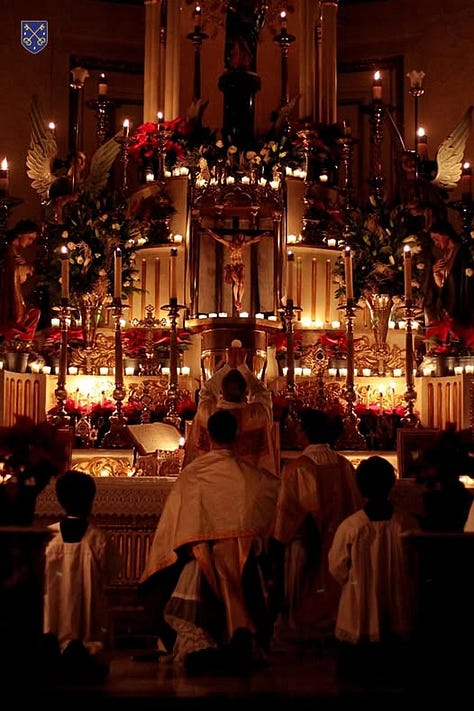
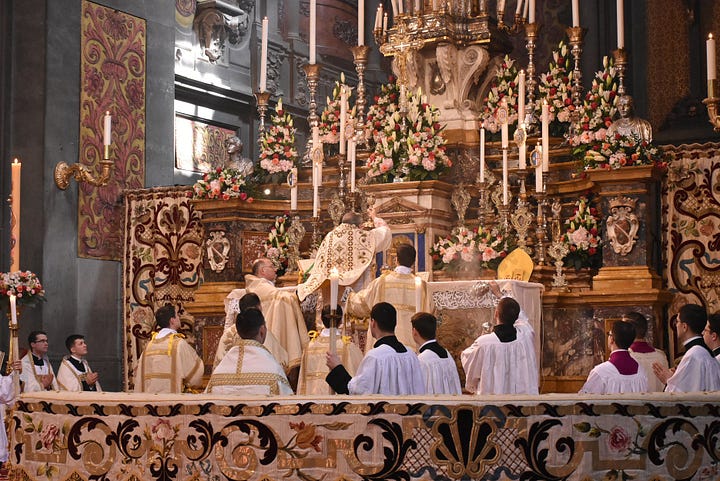
I had never seen so many altar boys in my life. All of them in long white robes and bearing a somber expression; all them cloaked in incense as they filed behind the raised Crucifix, parading toward the Altar. It was the Eastern Orthodox Great Entrance rendered in marble and Roman Fresco; it was the Divine Liturgy of Saint John Chrysostom painted by Fra Angelico. Around me there were hundreds of Parishioners — the place was as gigantic as it was packed, all with pew after pew of women in veils and men in sharp, crisp suits. The incense smelled different somehow; and though I was amply familiar with the incense of the East, it was the first time I had ever seen incense used in a Roman Catholic Church before.
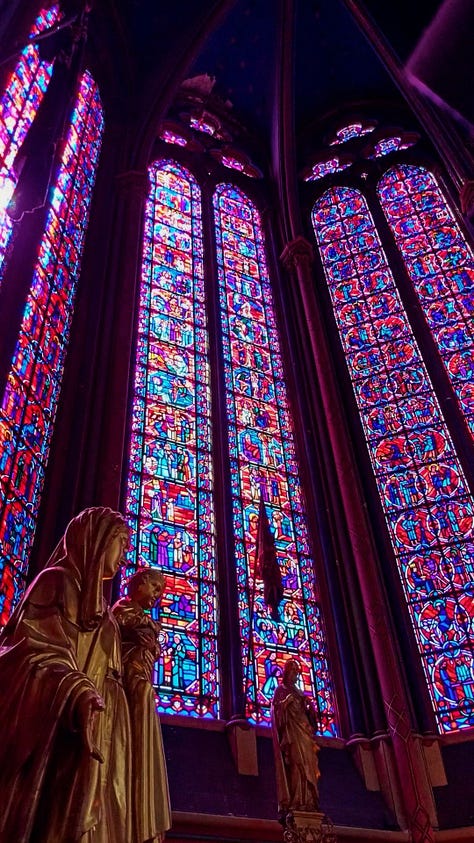
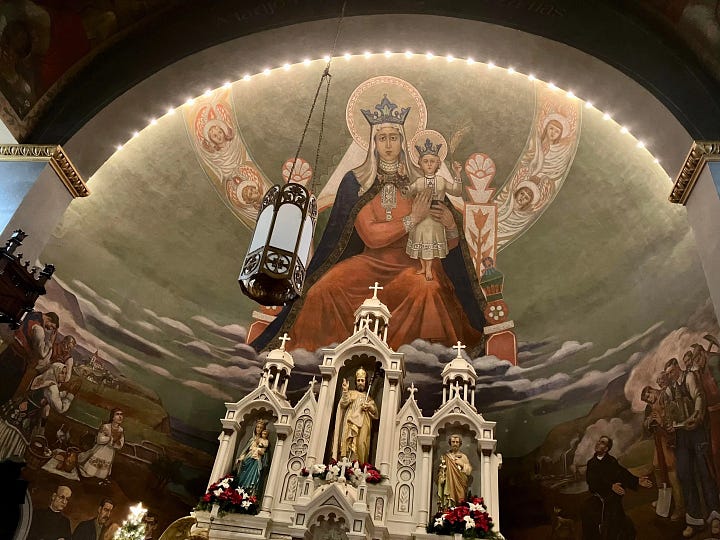
I gazed upward at the vaulted ceilings, all painted with Angels and Cherubim and the faces of the Apostles. Turning, I noticed the morning light filtering in through the gargantuan stained glass windows. Everything was bigger here than it was in the East; there were easily ten or fifteen times the people. The art was not strictly two-dimensional but also done in statue and sculpture, too. Where the Greek Church had felt like the Metropolitan Museum of Art’s 12th century painting exhibit — this Church seemed to be run by some people who had not fossilized the artistic traditions of Christendom to one single time period, but who instead celebrated every era of development in the visual arts, all at once.
Then, I noticed a statue beside me, marked with a placard: Shrine to the Unborn. A wave of superstition crept over me; it felt providential that I, who had had a direct hand in conceiving a child who would be slaughtered at an abortion clinic not a year before, would find myself seated here. Emotion broiled up into my face; I softly wept for my lost child as the Kyrie Eleison belted out. The Mass was now getting into full swing — I hadn’t a clue what they were saying. It didn’t hardly matter; there was a richness to it that came as a great comfort. The sheer volume of the the responses of the Parishioners — all in Latin — was rattling; the manner in which the sounds of the choir’s Gregorian Chant filled the vaulted ceilings was nothing short of surreal.
More to the point of my friend who’d invited me here: the Mass was startlingly similar to the Divine Liturgy of Saint John Chrysostom. It did appear that what he said was true: that there was orthodoxy in the West indeed.
In spite of all of this, I remained unnerved. Not only by the fact of my presence in a heterodox, schismatic offshoot of the one true holy Orthodox Church, but by the fact of realizing that whatever I might’ve thought I knew about Catholicism —I knew nothing.
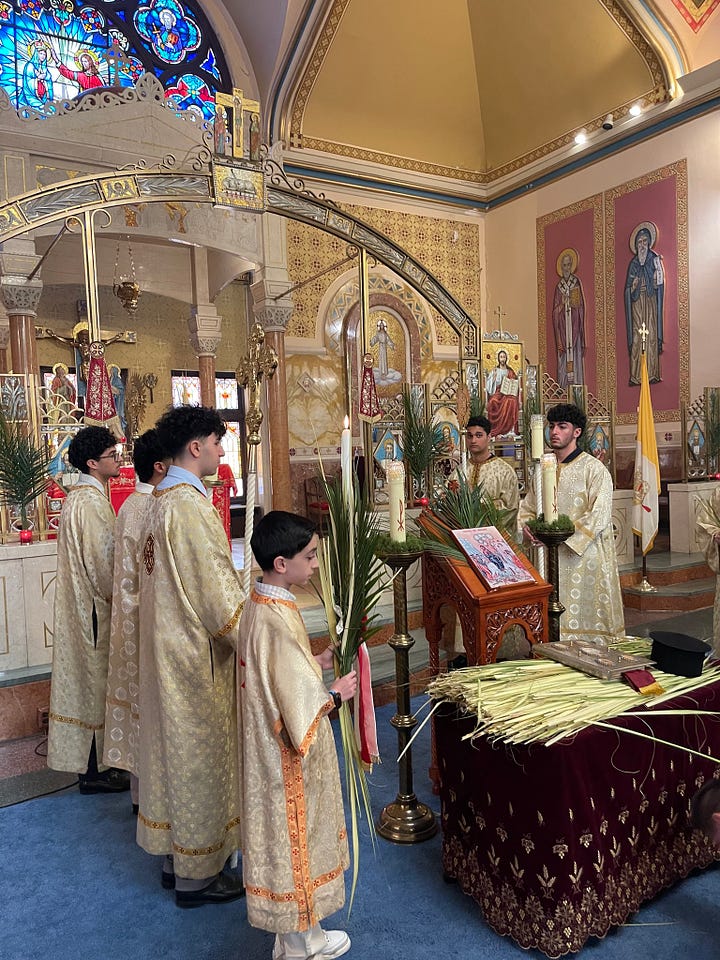
Days would come and days would go; a whole period ensued during which I found myself bouncing between the Greek Church and that grandiose and incense-filled Catholic Church. And, at that time, I was also taken with going on side-trips to other Churches; some of them Catholic, some of them Eastern Orthodox. At least a couple of them appeared, bizarrely, to be both — these were the Eastern Catholic or ‘Byzantine’ Catholic Churches. They used the Divine Liturgy of Saint John Chrysostom — no different than that used by the Eastern Orthodox, word-for-word, even omitting the Filioque — and yet, strangely, they were in full Communion with the Pope of Rome.
My head swirled at all of this; it was a period of incredible growth for me on a spiritual level. Yet in the chaos all of this inquiry, I had still not received the sacred Flesh of our Lord Jesus Christ, though I desperately hungered for it. Realizing that I was indeed a baptized Roman Catholic, and that I was only one confession away from validly and licitly receiving His Blessed Flesh and Blood, I began to mull over making a general confession. After substantial prayer and debate, and many deep and lengthy conversations with my new Catholic friends (and several Catholic Priests), I decided to do it. And indeed, the sense of renewal I felt after that first hour-long confession, through all the weeping and warmth of the Priest’s incredible charity and counsel — was nothing short of miraculous.
I had come home to Rome. I glided through to her open doors as if in a holy fog; I felt an overwhelming sense that whatever had been lost in my spiritual youth and in my Catholic upbringing was not gone entirely — that some long-missing piece of the puzzle had finally snapped back into place. I let go of some rigid obstruction in my spiritual life, and for it, I began to flourish in prayer and in the Sacramental life.
Old Eastern Orthodox friends of mine were concerned, saying: “Why did you do it?”
The answer was twofold in nature, though it demands at least a brief bit of the backdrop to fully explain. For from the start of all of this, I had come, by way of a simple prayer, to be increasingly convinced of the existence of God. I had become convinced moreover that the Book of John’s characterization of God as being “love” was true — for what good in the world had been done by men who had not love in their hearts? And what higher form of love could be found in this world than in the person of Jesus Christ, true God and true man — the only instance in all religious history of the one great God choosing by His own sovereign volition to walk among us as a human man?
To follow Him is to learn what love truly is; to follow Him is to learn to alchemize our suffering into dignity and grace and even into Divinity. It is even to be tortured and to die for the lowliest and most wayward among us. Toward that end, to then cede our free will, which He gave us (for He made us in His image) back to Him — to say “Thy will be done” — was this not the answer to the waywardness that had brought me to such a low state before? Was this not the perfect salve for the grievous darkness of the modern world that I had come to so thoroughly mistrust and recoil from?
If I wished to follow Him, and to worship Him, and to walk the path that He had laid for all mankind to live by — where would I find it? He had said in Matthew 16:18, that “the gates of hell will not prevail” against His Church, and that moreover, His Church has the “authority to bind and to loose,” “to forgive and to retain sins,” and to settle disputes. It seemed, from this, that His Church would be a definite, visible, authoritative human institition that He created during the time of the Apostles. It would also be a unified institution (1 Cor 1:10) that is the pillar and foundation of all truth (1 Timothy 3:15) — and this unified, visible, doctrinally authoritative and coherent institition would exist continuously and without interruption from Apostolic days until He comes again.
These ideas alone seemed to summarily disprove the validity of any version of Christianity invented since the Radical Reformation in the 16th Century, (and they threw significant questions on the various Eastern Orthodox communions, especially so far as Apostolic Succession was concerned).
Moreover, owing to the Bread of Life Discourse in John 6, whereupon Christ instructs his followers to “eat His Flesh and drink His Blood” or else we have “no life within us,” I sought to find a place where I might find His sacred Flesh and Blood. It could not be a vagary or a mere memorialization — for in the Koine Greek, He used the verb “trogo,” meaning “to gnaw,” as in to gnaw meat; it was a verb that had no poetical or metaphorical use in that language. That many left Him over this “hard teaching” in the aptly-numbered John 6:66 only seemed to buttress the seriousness of this command.
Finally, that from the First Century onward to the present, three major Christian Communions, including the largest one in human history, all continued to believe in the literal presence of Christ’s Flesh and Blood in the Eucharist sealed the deal. One of these three Churches — the Eastern Orthodox, the Oriental Orthodox, or the Roman Catholics — had to be correct, or else Scripture was somehow vague and the “gates of hell” had indeed prevailed against His Church.
How, then, to figure which of these Churches could be the most true? As an Eastern Orthodox Catechumen, I simply accepted their claim that they are the oldest at face value. I accepted the idea that they are “THE Orthodox Church,” rather than a series of loosely affiliated, often doctrinally conflicted (or doctrinally incoherent), politically separated Churches. Yet now my faith in these answers was being tested — and the claims of both the Eastern and, to some degree Oriental Orthodox were very much found wanting.
More than being found wanting — these claims appeared to me to be essentially apocalyptic. The notion that the 88% of all Christians who are not Eastern Orthodox might be in grave danger of hell, being that they are outside of Communion with the “one” true Church seemed exceedingly dark. One wondered why God would allow such a thing. Moreover, that to enter into Communion with the “one true Church” involved wandering through so many strange and foreign ethnic groups, or through groups of zealous converts from Evangelicalism or ex-secular hippiedom seemed even stranger. And when I furthermore found that any attempt at starting a Westernized (yet non-Catholic) expression of the Orthodox faith was exceedingly controversial, I became all the more skeptical — how could a loose network of Churches like this somehow be the one and only universal Church, if they are often so explicitly anti-Western?
This business about “making disciples of all nations,” then, seemed not really to have happened in their world of admittedly obscure ethno-Churches — while meanwhile, it appeared that the Roman Catholic Church had genuinely managed to bring the Gospel to the billions and effectively Christianized truly staggering swaths of the earth. They had moreover done this without abandoning the Biblical teaching to “enter through the narrow gate” — for their doctrines were incredibly specific, clear, and substantial in spite of all claims to the contrary. Matthew 7:16 teaches us that we will judge the tree by its fruit, and so far as I could tell, the fruits of the Roman Catholic Church were not nearly so bad as they’d been made out to be by her detractors, both Eastern and Protestant alike. In fact, the more I explored them, the more rich those fruits began to appear — in no small part, I suspect, because of the intensely clarifying effect of Rome’s strong central leadership.
And so, for the first part, my turn towards Rome came about owing to what Eastern Orthodoxy was not, or in what those Churches appeared to consistently fail in. But for the second — and more significant — part, my reversion to Catholicism came about because of what the Roman Catholic Church is.
I do not believe, for example, that it is arrogant for Catholics to say that the Pope is the “main character” of global Christendom on earth. As the spiritual leader of 1,400,000,000 people — over half of all Christians — the Supreme Pontiff is in a distinctive and unique position to rally the faithful globally around the truths carried by the Church in the Deposit of Faith; he is the unifier and the tie-breaker that allows us to fully honor 1 Corinthians 1:10. That his office was set into motion by Christ, when He gave Peter the “keys to the Kingdom of heaven” made the claims seem all the stronger. When he makes a move — he often sets the tone for what other, smaller Churches will teach and do.
Because of the hierarchical leadership that the Roman Catholic Church offers, there are final and crystal-clear teachings on matters such as birth control, IVF, war and nuclear weapons, care for the poor, the communion of Saints, stewardship of creation, sexual morality, and Liturgical norms that are all disseminated globally and with incredible consistency. Because of this, the Church has succeeded in not just founding but also leading the global pro-life movement, in forming the largest and most substantial universities and hospitals in the history of civilization, and in educating countless souls in both written language and the Gospels. Verily, the Church governed by the successor of the Apostle Peter has continued to bear the prophetic flame that Christ gave to His disciples nearly 2,000 years ago — and has done so with a degree of efficacy that knows no comparison anywhere else in Christendom.
Moreover, the Church has also managed to convene universally-binding ecumenical councils in order to develop doctrine as the times have changed. It is a fact that great movements in civilizational history such as the Reformation and the Enlightenment, Communism and the industrial revolution, the sexual revolution and now the advent of digital technology and AI have all generated countless spiritual questions that demand prompt, clear, and authoritative answers. The Roman Church has succeeded in this where the others have failed. It is a fact that the Eastern Orthodox have not managed to convene a universally-binding Ecumenical Council in 1,239 years. Much has changed in that time that the Easterns have been all too willing to leave to Oikonomia. All too often, their (deeply unsatisfying and often conflictual) answer is only — “ask your Priest.”
And so it was that I found myself limping toward Rome after doing great battle with all manner of strange, tedious, exotic, and high-minded ideas — and while at the same time juggling the trauma and sense of exhaustion that my old, pre-Christian life had wrought upon my spirit and flesh.
Yet once again — the dark seed of apocalypticism remained buried deep within me. I still had not yet shed it; not at all.
I found myself seated in the courtyard at a house run by a society called Tradition, Family, Property — otherwise known as “TFP.” The men were all in nice suits; we sat below the palm-trees as the breezes fiddled the fronds and the springtime birds all chortled in the bushes. Tonight was Mardis Gras in New Orleans — but we might as well have been in a different world than all of the debauched revelers on the other side of the river.
“It is a fact that Masonic influence has corrupted the Church from within,” one fellow said. The man continued by expounding on the Third Secret of Our Lady of Fatima — a Marian apparition that occurred in Portugal in 1917. “She warned us that the Great Apostasy in the Church would begin at the top; I have no doubt that the crisis in the Church we now have on our hands is exactly this.”
As he continued to describe his theories about the “crisis in the Church,” he began to speak with intense negativity about Pope Francis — a figure who seemed to be widely hated by so many of the traditionalist Catholics I’d begun associating with. Many would not even call Him “Pope Francis,” in fact: they would instead call him by his pre-Pontifical name of Bergoglio.
“Jorge Bergoglio is worshiping Pachamama,” another said later. “He is a communist infiltrator — may God help us if this crisis does not end swiftly.”
The men all spoke in such terms constantly. Their home was decorated with replicas of the swords of the Knights Templar, and in one corner beside the oak and mahagony bookcases filled with titles like Nobility and Analogous Traditional Elites in the Allocutions of Pius XII and Revolution and Counter-Revolution was a replica suit of armor. As we dined that night, taking our pasta and bread over temperate and modest servings of red wine, I noticed that the walls were flanked with portraits of martyred French Catholic Counterrevolutionaries — a sight that I’ll admit tickled the former anarchist in me. It appeared just then that I’d come full circle in earnest.
Coming full circle does, of course, not always involve a change in the fundamentals. Just as when I was an anarchist I constantly spoke of a “crisis” with regards to capitalism, climate change, and the state, the men of TFP spoke of “crisis” too, albeit of a drastically different nature. That word was on the tip of everybody’s tongues there in all discussions concerning the Church; a patina of doom frosted nearly every religious discussion. It was, in fact, quite a distinct contrast from Pope Francis’ frequent exhortations to partake in the joy and gladness of Christ Jesus and of the Sacraments of His Church.
I would later find out that these men were veritable moderates compared to some of the other “TradCaths” I would soon come to meet. Some had gone so far as to say that there is no Pope — that the See of Peter is Vacant, and that because of this, they referred to themselves as “Sedevacantists.” This was the world of some truly fringe individuals, so brutalized by their own anxieties and apocalyptic fears that there were even some in Kansas who held their own homegrown conclave — electing “Pope Michael of Kansas.” Among those voting in their “election” of Michael included his mother and father; and I believe it was held at the household kitchen table (rumor has it that he repented of all these shennanigans on his deathbed; but the truth of that matter will never be known).
And so I found a spectrum of a kind, ranging from those who expressed mild dismay of Pope Francis’ suppression of the Traditional Latin Mass to those who truly believed that there was no Pope and that all mankind save for a few hundred fringe quasi-Catholics on earth were on the highway to hell. Perhaps the largest contingent of those in the middle of this spectrum are members of the Society of Saint Pius X. They might be best described as a breakaway group of Catholics who seem to claim that they are ‘more Catholic than the Church.’ The group has just recently been warned by the Vatican that they will be excommunicated if they defy the orders of Rome by consecrating new Bishops.
What seemed to unite all of these “TradCaths” was an inescapable sense that all was lost; that our situation was so dark and ghastly as to lead one to despair — that the core of the spiritual life consisted not of the works of mercy nor of the heavenly joys of prayer, but of merely coping with the grave darkness that had now taken root in the world and in the Church. It was a philosophy of retreat — a ‘bunker mentality,’ a somber life of playing the eternal rearguard. With them, there was an all-encompassing and constant fixation on doom and apocalypse; a niggling and omnipresent sense of profound anxiety and worry and fear, all of which pointed toward a neverending obsession with the persistence of a “remnant,” a bunker, a lost cause, a holy war.
I, acolyte that I was — and now on my second major bout of catechesis, this time on the other side of the Tiber — once again took their claims at face value. Our Argentinian Pope’s habit of paying lip service to South American communists and “liberation theologians” on the far left fringes of the Church did concern me; his repression of the Traditional Latin Mass with his motu propio Traditiones Custodes struck me as a full-frontal attack against the most thriving wing of the Church in the US.
How could he have gone after us in the Latin Mass world? Our Churches were standing-room only. Our faithful actually obeyed the Church teaching on birth control, and consequently, they had gigantic families. Where the “boomer Churches” with their felt banners and pop-hymns and empty confessionals were dying, bereft of youth, without converts or even baptisms — we were thriving, yet this dark-sided Pope of ours was coming after us. We were under siege by a spiritual leader who some likened to an abusive father, and based on what I was seeing just then, I agreed with the sentiment: the Church was in a serious crisis, with a leader who appeared not to be Catholic at all. Perhaps he really was an evil communist, prophesied to come to corrupt the Church from within.
But in the opinions of most Catholic Traditionalists, the origins of that crisis far predated the Argentinian Pope. If you asked virtually anyone in the circles I was running in where it all began, you’d be liable to get one answer more frequently than any other: “The Second Vatican Council.”
“Have you ever actually read the documents of the Second Vatican Council?”
The good Priest looked at me with wide, calm, innocent eyes as he spoke. He was seated on the couch in the living room of a house I’d just bought — my first house. He’d come over to bless the place and then afterward, he sat awhile to chit-chat. We’d gotten on the subject of the Society of Saint Pius X — the SSPX — who had a nearby Priory where I’d been going to morning weekday Mass. He counseled me against going there, and I’d fired back that I was glad to attend a Parish whose leadership was skeptical of the infamous Vatican II council and its likely invalid ‘Novus Ordo’ Mass.
You must understand — if you wish to know anything about the mentality of “TradCaths” — ‘The Council’, as it is colloquially known, is to them the source of all evils in the Church. There is a tacit assumption baked into all of “traditional Catholicism” that had Vatican II never occurred, the Church would’ve been profoundly robust, would’ve never faced the scandals and crises that hobbled her so — that the en masse apostasy of the modern era from the life and teachings of the Church simply would’ve never occurred. This is never outright said, but is the implicit logical conclusion of the tireless critiques of Vatican II, notwithstanding the fact that all Christian denominations suffered massive losses from the 1960’s to the present.
This is because that council inaugurated serious and deep-reaching Liturgical reforms of a type and intensity that had not been seen for centuries or perhaps ever before. The Council began in the early years of the tumnultous and revolutionary 1960’s, and was explicitly convened out of a desire to engage more effectively with the increasingly secularized modern world. Dramatic reforms were implemented in the Liturgy, allowing for an increased use of the vernacular rather than Latin, removing redundant or perhaps outmoded elements of the old Latin Rite, and allowing greater flexibility in the parts of the Mass and in Liturgical music. The calendar was reformed; certain doctrines of the Faith were adjusted to be more broad and ecumenical — the core thrust of the Council was often summed up by the Italian word “aggiornamento,” meaning “to bring up to date.”
At the time, even serious traditionalist Bishops and Cardinals seemed supportive of the effort, even to include the notorious Archbishop Marcel Lefebvre — the one who would later, well after the Council, form the Society of Saint Pius X, and would infamously consecrate Bishops for that society in open defiance of the Vatican. It was his act of revolt that led to the existence of the little SSPX Church down the road, where I’d then been in the habit of going to Mass.
The good Priest in my house that night was the first to tell me this most useful factoid about Lefebvre. He moreover told me that there is a little-known document that to his knowledge has not yet been translated to English — an article written by Abp. Lefebvre actually praising the Second Vatican Council for its timely adjustments to the doctrine and practices of the Church. I was stunned by this information, of course, as such information would cause a certain amount of opprobrium at any SSPX Church. I naturally asked the Priest how such a thing could really be.
“Because if you read the Council documents themselves,” he told me, “you’ll find that they are not nearly so radical as they’ve been made out to be.” He went on to describe how the vast majority of the reforms that traditionalists so famously despise came after the Council, and consist mostly of non-binding directives that did not come directly from Vatican II itself. For example, the Liturgical constitution of the Council — Sacrosanctum Concilium — did not abolish the use of Latin in the Roman Rite at all. To the contrary, it explicitly stated that Latin “is to be preserved” in the Mass. Similarly with regards to music, it gave Gregorian Chant “pride of place”.
The complete abolition of Latin and Gregorian Chant in American Churches came much later. It was not until the General Instruction of the Roman Missal came about in 1970, as well as a series of decisions from the US Conference of Bishops around the same time, that Latin and Gregorian Chant fell into more or less total disuse. Those decisions involved taking significant liberties with what the Council taught; they were and are reversible, revisable, non-binding, and indeed, it appeared that a movement within the Church to walk these non-binding decisions back now had real legs — and was an altogether better path than complete rejection of the Council could ever be. For in many, many regards, the reforms of the Council are capable of bearing more spiritual fruit in the modern world than a return to aggressive radical traditionalism could ever be — or so went the argument, anyway.
The point the Priest was making may seem decidedly subtle, and yet he was making a fascinating counterargument to the Traditionalist obsession with “the crisis in the Church.” Where the Trads tended to assume the worst — that the Church had been infiltrated or subverted by evil Masons and Communists and so on, and that therefore, the teaching authority of the Church had been somehow compromised, reduced, or even abrogated entirely — leaving us alone in the world, forced to reason through the tedious granularities of the Faith for ourselves — the Priest was saying no, look at the documents, what they contain is not nearly as bad as you think; in fact, it is not bad at all.
The problem, then, lay not in what the Church taught, but in how it was implemented — and in fact, if the Council has rankled us, the hard truth may perhaps be that there is a valid spiritual call there; perhaps there is some growth that the Church has, through the Second Vatican Council and the Magesterial authority that has blessed it, called us all to undergo.
Our conversation that night sowed a seed that would — like many others before it — take years to bear fruit. This Priest (who, by the way, knows and regularly offers the Traditional Latin Mass) was gently shepherding me toward the ultimate realization that my spiritual growth would require: he was, at the bottom of it, positing that there is an unbridgeable chasm between apocalypticism and cosmopolitanism. His exhortation to me to actually study the Second Vatican Council for myself was really, in a sense, an invitation to meditate upon the apparent tension between ‘making disciples of all nations’ (Matthew 28:19) and the fact that we are to enter through ‘the narrow gate’ (Matthew 7:13-14).
For — how could it be that we are to somehow bring “all nations” into this “narrow gate?” Why has there been such a temptation to focus on one of these or the other — rather than unifying their essences and marrying them to the core mission of Christ’s visible Church on earth?
On the one side, the “all nations” types might be tempted to be so ecumenical and so limitlessly tolerant that their doctrines are watered down into nothingness; that they might, for the sake of “unity,” compromise on all truth. How many rainbow-flag-clad Churches are there now whose pews are emptied out and populated solely by geriatric liberals, all them asking themselves: “Where are the young people?” and failing to recognize that they long ago dispensed with the hearty spiritual meal that the young and disaffected now crave.
On the other side of the same question, there are those who emphasize the “narrowness of the gate” so vehemently that their idea of religion quickly becomes impossibly obscure, ever spiraling towards purer and purer and more inaccessible expressions of the so-called “one true faith.” When, inevitably, their obscure, rigid, and often singular conceptions of the ultimate truth are not seen echoed or defended by the Churches whose job it is to “make disciples of all nations” — it is assumed that we are all doomed, and the doom in turn drives us to make purer and more obscure assertions about the nature of our faith. We become conspiratorial, “crisis-focused,” hiding in our bunkers from the dark, evil, fallen world.
My good friend the Priest dared to ask in the face of these questions: Could there instead be balance? Are we not called to strive for that balance for the salvation of souls and the improvement of the Church? Where could there be a marriage between genuine right belief — and a distinctly optimistic, forward-facing, loving and charitable openness toward the wide world?
If such a thing could possibly exist, and if such a position could really be securely arrived at — one could only access it by shedding apocalypse itself, by laying down their arms, by sloughing off all of the fear and paranoid anxiety and worry. Far from hiding in the self-righteous and rigid “Church within the Church,” wherein some infinitessimally-small group of Catholics are somehow “more Catholic” than 99.99% of the Church; far from absconding into obscure foreign ethnic Churches with parochial-minded and bellicose Patriarchs from the other side of the planet, far from doomsday bunker cults with their Scofield Bibles and dispensationalist ramblings, or from Godless men who sow endless torrents of fear about the End of the World, climate doom, or nuclear apocalypse — far from all such fear and loathing and purity and all the locked doors of our ideological bunkers, Christ is there, abiding in perfectly fearless love, forever with us, and forever with His Church, where the bones of the Apostle Peter still lie.
Are we not called to “trust fall” onto Him? Are we not called to unify ourselves to one another globally, no matter what language we speak or where in the world we are — to stitch ourselves together in the mercies of His perfect truth, one body, undivided, rooted in the teaching authority that He has given us under the successor of the Apostle Peter?
If this is our mantle and our charge, we are to abandon fear and to face the world. We are to walk in the cosmopolitan spirit of God’s will for all mankind, bound by the great chain of wisdom that stretches back to the days of Christ’s ministry on earth — nurtured by its living faith; not clinging to fossils nor hiding in bunkers but rising to the harsh and beautiful task of loving our fellow man, of unifying together in the Eucharist, that His will be done, on earth as it is in heaven.
Perhaps it is not so wrong to say that we are living in dark times. Perhaps it is not so wrong, either, to say that we are living in an era during which lines are being drawn — and where we must wield the full weight of our own conscience and intellect to determine where we stand.
On this score, perhaps what the prophets of apocalypse say is definitively and inescapably correct in at least one respect.
And yet once we have made our stand, and have planted our feet where we have, I have come to believe that there is more to the story. Reasoning through the possibility that God exists is the first breath of it; following questions about who God is may then lead us to the inimitable and perfect love of Christ Jesus. And then, if we study His word and wish to follow it, and should want to follow the whole of it, coherently and without flaw — where will it take us but to the visible Church, where there still stands an altar in every town, and where His most sacred Flesh and Blood is today, even now and as I write this, being consecrated around the world for the sanctification of all mankind?
It is there that I wish to meet you; it is there where our final hope breathes and walks and lives. And if His Flesh is truly His Flesh, and His words are all the unblemished truth — does the Eucharistic Jesus not confer on the faithful His blessed and merciful metaphyisical protection? Does His Holy Spirit not guide the binding and unifying authority of His Church? Far from fragmentation, far from rebellion, far from schism and fear and obscurity, His way is preserved and continues to flourish. Hundreds of thousands of souls — many from the most unlikely places — now swirl into His Cathedrals and altars, up from the strange and bustling streets; millions of souls each year are groping through darkness home to His Church.
This is the diametric opposite of the bunker and it is the antithesis of “boutique religion.” It is the singular, universal brotherhood of all Christians the world over, in every time zone and in every tongue, the supreme force of earthly mercies, unified as one under Christ the King. In the cities, our Churches are bastions of sanctifying beauty and peace; in hospitals, war zones, prisons, and in slums across the earth, our clergy are bringers of comfort and solace and ministers to the dying, the sick, and the guilty. Our nuns and monks have washed blood from the walls of bombed Churches with their heavenly song and recitations of the ancient Rosary — our faithful pour out into the streets of cities on every continent, praising the Lord Jesus on parade, all singing hymns that every Catholic the world over knows, from the fallen away and the lukewarm all the way to the Pope.
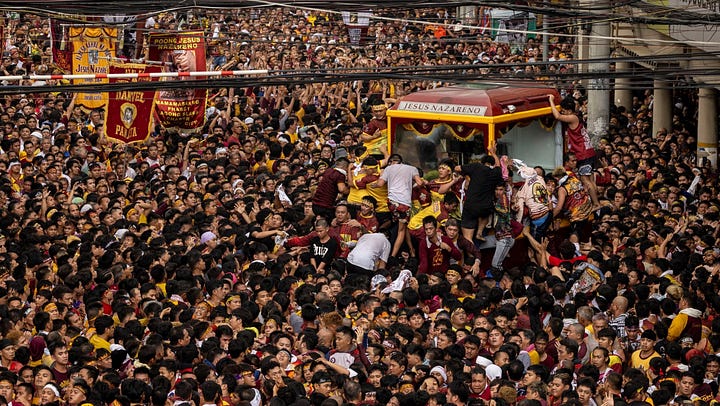
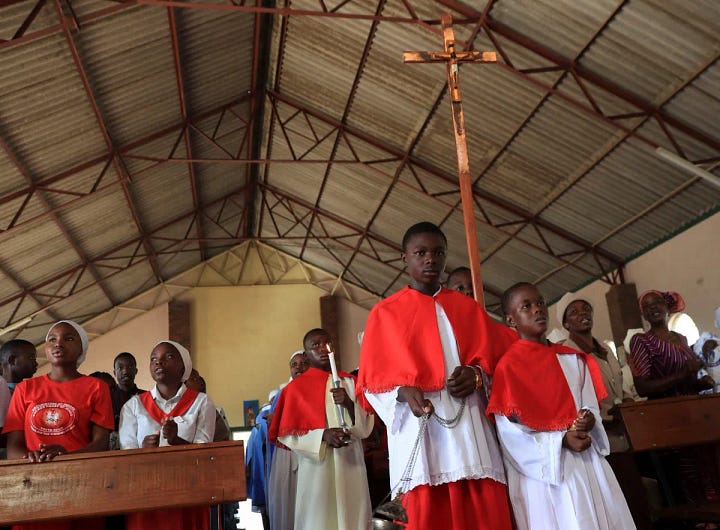
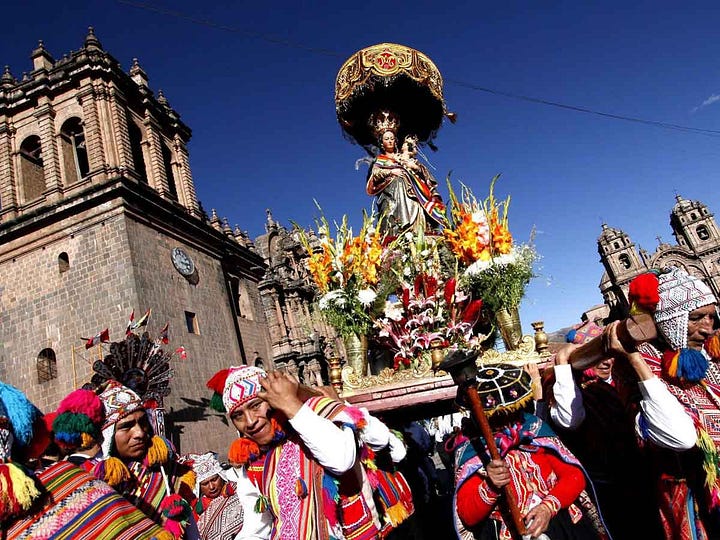
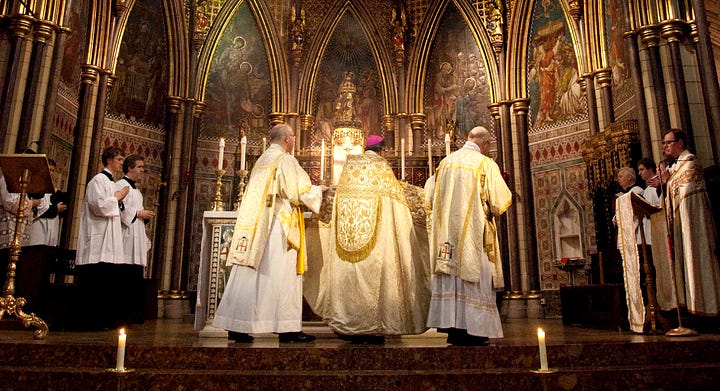
There is no cult, no splinter group, no ‘denomination’ or autocephalous ethnic congregation who has risen to such heights in history; and if anything that such groups have claimed should prove to be more true than what Rome has ever taught — then let us see their good fruits, let us see them spread through all seven continents, let us see them pour out by the hundred-millions across the earth to praise God as one, as Rome’s people have done! Unless I am blind, and God help me if I am, it appears that they have not done it. To the contrary, it appears that they have sacrificed unity for a distortion of purity, that they have clung to a fragment of the truth at the expense of the whole. Their affliction is one of myopia and apocalypse, and for it, will the One who commanded that we “make disciples of all nations” know them?
Far better to face the world. Far better to ask: is there actually a truly good reason not to be in Communion with the largest, oldest, most unified Christian Church in all of history? Is there actually a valid reason not to trust her authority and her judgements? In light of the Scripture’s many admonishments that we be unified in the Lord, our answer to the question is not insignificant by any stretch. If the conclusions of our response are only the seeds of fragmentation, incoherence, and disunity, then may God help us. But if we instead conclude that this Church He has given us is the home of the wretched and the healing of the sinner, if we plunge into its glories, worldwide, amongst all peoples and in all countries — does that not mean that we will finally begin to do His work, not merely in isolated purity but together, across all the world, as one people, under God?
Will you be there with us? Will you face the whole of humanity and love them? Will you open your heart to the stranger — will you get your hands dirty with the lost and the broken? For those who will, know that a renewal is at hand, here and now — the Church is only strengthening as she enters a period of intense ferment and reinvigoration; she has overcome the brokenness of the era and the fractures of earlier revolts and schisms. She has survived against all odds — the Church has withstood every test in spite of impossible odds — all to prove that “the gates of hell will not prevail” against her.
Some may, in reading all of this, marvel at the complexity of the question and all that it has dragged me through. Others may scoff at it, saying that it need not be such a production nor such a trial — that simply following Jesus in a personalistic, perhaps less structured way is “good enough.” And still others may mount their defenses of various groups outside the Church, or will cast their aspersions on Rome for her previous sins or alleged errors. What can I say to such people? What can I do for such people but love them?
God has, in making you in His image, given you reason and free will; He has blessed you with the capacity to love — and has instructed you that love requires sacrifice and understanding of the other and even self-obliteration. What you will do with these gifts is your business and that is all; but if in your sojourns you should meet Catholics, do not be afraid to test them! See who they are; if they suffer from fear, call them out of it — or find them, I hope, smiling and extending a hand, all of them, on every corner of the planet, in every time zone and speaking in every language, all one, all unified in Christ.
Though I have heard and entertained nearly every other idea outside of what the Church is, and though I resisted and bucked it and fought and strove not to be a part of it for years and years of my life — I find that there is nowhere else, that there is nothing better, that there is the deepest fulfillment and bliss to be found not only in my personal relationship with Christ, but in a global, all-encompassing, boundlessly cosmopolitan love for Christ that stretches across all mankind.
To stand in the Cathedral with a thousand people, all praying the Rosary — to walk daily to the little Parish Church to behold the holy face of Christ; to walk in the communion of Saints, alongside Pope Leo and His good Bishops, trusting in their teachings, humble before the body of all they know and understand, gently praying in the garden for all souls who walk upon the earth — is this not where I am supposed to be? Am I really to leave this behind, for some hidden, foreign thing, or for some group of recent marque? Am I really to think that Godlessness or schism is in any way preferable to these heavenly holy gifts?
Away with the bunkers, away with the armories and bullets and the razorwire, away with the fear, up and out of obscurity — let us die not merely to ourselves but even to all that our intellects have led us to hold dear, save Him and Him alone, our dearest Lord Jesus and His Word and His Church. He is our only security; there is no other. And in this, let us strive to walk in the steps of our blessed Saints and of all good Clergy and Bishops. If they should err their Savior shall blot it out in good time; if we should stray He will reach out to pick the burrs from our fleece and the thorns from our eyes — for humble obedience to the authority set forth by Christ cannot be a crime in any era, so help me God.
This is not fear but its antipode — it is instead relinquishment. It is total submission to a thing far larger and more ancient and more global than I; it is the final resting place for all unsettled minds. Not in hiding nor in sojourns in alien worlds; not in sophistries nor in vagueness but in the simple, elegant, ecstatic joy of the whole world kneeling before Christ all at once. And in my rest there I do not slink down in corners nor do I lock doors behind me — I sit by the altar in peace, before Him who is my King, knowing that as I pray, there are a million people just now praying the same prayer, or perhaps a hundred million, and that behind us in the grand dance of time, infinities of souls in heaven above now pray with us, too. It is with them I pray not only for those who suffer today — but for the children of all futures before Christ Jesus does return, that they may be delivered from every machination of the Devil’s heinous fear both within and without.
Whatever the darknesses of the world may be, are they not profoundly small and pitiable little things beside this? Is this not “His will be done, on earth as it is in heaven?” Whatever prickly little doctrines or disputes might obstruct us from communion with this beauty of all beauties, wherever our pendulums have swung before, ought we not have done with all of it and come to this perfect and prayerful place of rest now, together in Christ, for all time?
For is the time not harrowingly short? How could we, with so little time in this life, turn away from the universal brotherhood of the Church?
Was it not written that we are to “have no divisions among us,” and to “be of one mind?” There is but one source of this oneness in Christ on all the earth, and it is found in the Catholic Church, unified under the supreme Pontiff, anchored in the Patristic teachings of the Catechism, sanctified by the limitless graces of the Sacraments instituted by Christ Jesus and carried forth by our forerunners.
Could it really be that our God — our fearless God, our loving God, our unifying Lord Jesus Christ — has ever wanted the fragmentation that fear creates? Could it really be that we are to go as pilgrims, ever towards Rome, ever towards the beating heart of charity and brotherhood that has been carried forth by countless martyrs and Saints?
It is my deepest prayer that I will meet you there, out in the world, fearless and in love with all mankind, in that ancient and universal nation where all people say together:
Text within this block will maintain its original spacing when published
Holy, Holy, Holy, Lord, God of hosts.
Heaven and earth are full of your glory.
Hosanna in the highest.
Blessed is he who comes in the name of the Lord.
Hosanna in the highest.
Comments
Nothing yet. Say the first thing.
Sign in to join the conversation.