
By Annelies Zijderveld, social media manager
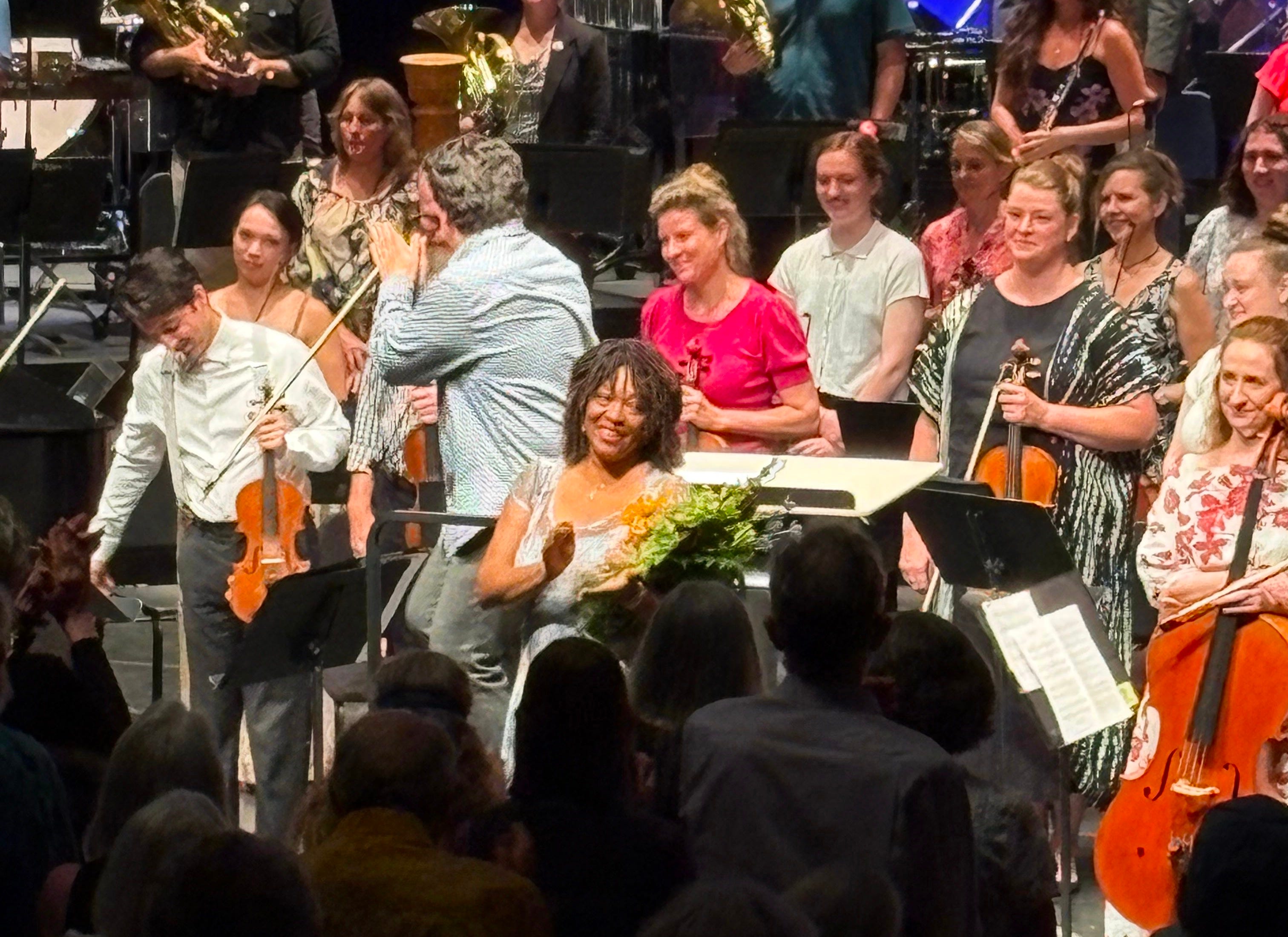
We, the dreamers. We, the people of the United States. We, the patrons of the arts. What might it look like if we took up hope as our banner? I once had a boss who said hope belongs in church, not the boardroom. Yet, where are we now, as a nation, without hope?
A power of art is to speak into a moment, to be a reflecting pool within which we can see ourselves or, perhaps to cast a vision for what might be but is not yet. Cabrillo Festival Music Director Cristian Mӑcelaru is one such dreamer. He told the packed audience on Sunday night at the Santa Cruz Civic Auditorium that originally, the final piece of this season had been Sean Shepherd’s Wanderlust. Instead, he elected to close the concert and the season with a poem written by Rita Dove to be spoken in communion with Samuel Barber’s Adagio for Strings. He chose to present us with a reflection as a send-off and rallying cry to not give up hope.
Rita Dove is a former U.S. poet laureate. She is a Pulitzer Prize winner. But before all that, she was a cellist. She told me how when you play the cello, it’s a full-body experience as your body wraps around the instrument. You feel the music and it becomes part of you.
She first learned the “Adagio” in college as a young musician in the orchestra. Even all these years later, she comes to it with a knowledge of the cello part first. And yet, she said that the music never fails to rip her apart and put her back together again. That kind of kinship with the music is exactly why Mӑcelaru thought of her in commissioning Journeying Song for the Cincinnati Symphony Orchestra to commemorate MLK Day in 2025.
Mӑcelaru said he had heard the Barber piece in conjunction with Dr. King’s “I have a dream” speech years ago and wondered what it might be like to have a poetic response to the speech — what would it be like to respond to the speech from a current perspective? And how might it then lend its voice — and uplift the legacy of Dr. King — in a year full of artistic dedications to the 250th anniversary of the signing of the Declaration of Independence?
The music was already a part of Dove’s body. As she crafted the poem, she desired to create a conversation with the music so the words would not overtake it: “I wanted the voice to be a part of it, to melt, to weave in and out in the same way those strings do.”
The Adagio for Strings is so familiar it has been called “America’s semi-official music for mourning” (NPR), but there is hope there, too. The music evokes raw emotion, but as if it comes in an undulating wave.
“I listened to the Barber and I know that the Barber has been played often as a piece of mourning… but I also felt that it is a piece that says, ‘Wait, we must come together to make this kind of beauty,’” said Dove. “We have to come together, much as these strings keep coming together and building toward the end.”
So, the poem begins, “Once upon a dream” evoking both the beginning of a story but also hearkening back to the original dream of Dr. King. We, the dreamers then sit in great pools of space and time as she weaves between speaking the lines aloud in the beginning, nestled by music. I wonder what the poem looks like on the page. Still, to look forward, we must look back. To move forward, we must come together. And the poem goes there too as Dove cooed from the Civic Auditorium podium: “Yet we pressed on, arms linked toward that gleaming horizon.” Showing how truth can both cut and heal, the poem continues: “Once upon a nation, sitting became the doing.”
Mӑcelaru alerted us to listen for that startling silence that slices into the Adagio. So, too, in the crescendo and build of Dove’s words tumbling into one another, leading to that moment powerfully, she asks: “Where did we stumble? / When did we let the banner fall?” Silence. The music tenderly returns and repairs the silence as does the poem which ends not on a satisfying point of closure, but because it’s a Journeying Song, an acknowledgement that this too can be a turn in our road but only if we can give feet to hope and remember how to dream — together.
“I hope to leave them with an inspiration to be active in their pursuit of the dream and to make sure we don’t lose sight of hope because it is something that is eroding,” said Mӑcelaru. “As you lose trust, as you lose optimism. You are challenged in maintaining hope for a better tomorrow.”
In a program named “Hope as Our Banner” and in a season themed “We, the dreamers,” there is no subtlety in the message here. Mӑcelaru spoke a dream over the Cabrillo Festival audience on Sunday night about “a community of people who dream together.” Dove’s naming the poem, Journeying Song, points to the idea that the journey is not over and that we need a song to get through it. A kind of hopefulness begins in a name.
“It is a journey. The journey is probably never going to be over, but that’s all right, you know,” said Dove. “We move along the way together.”
“The dream awaits the dreamer.”
No posts
Comments
Nothing yet. Say the first thing.
Sign in to join the conversation.