
By Charles Burns, assistant editor/production assistant
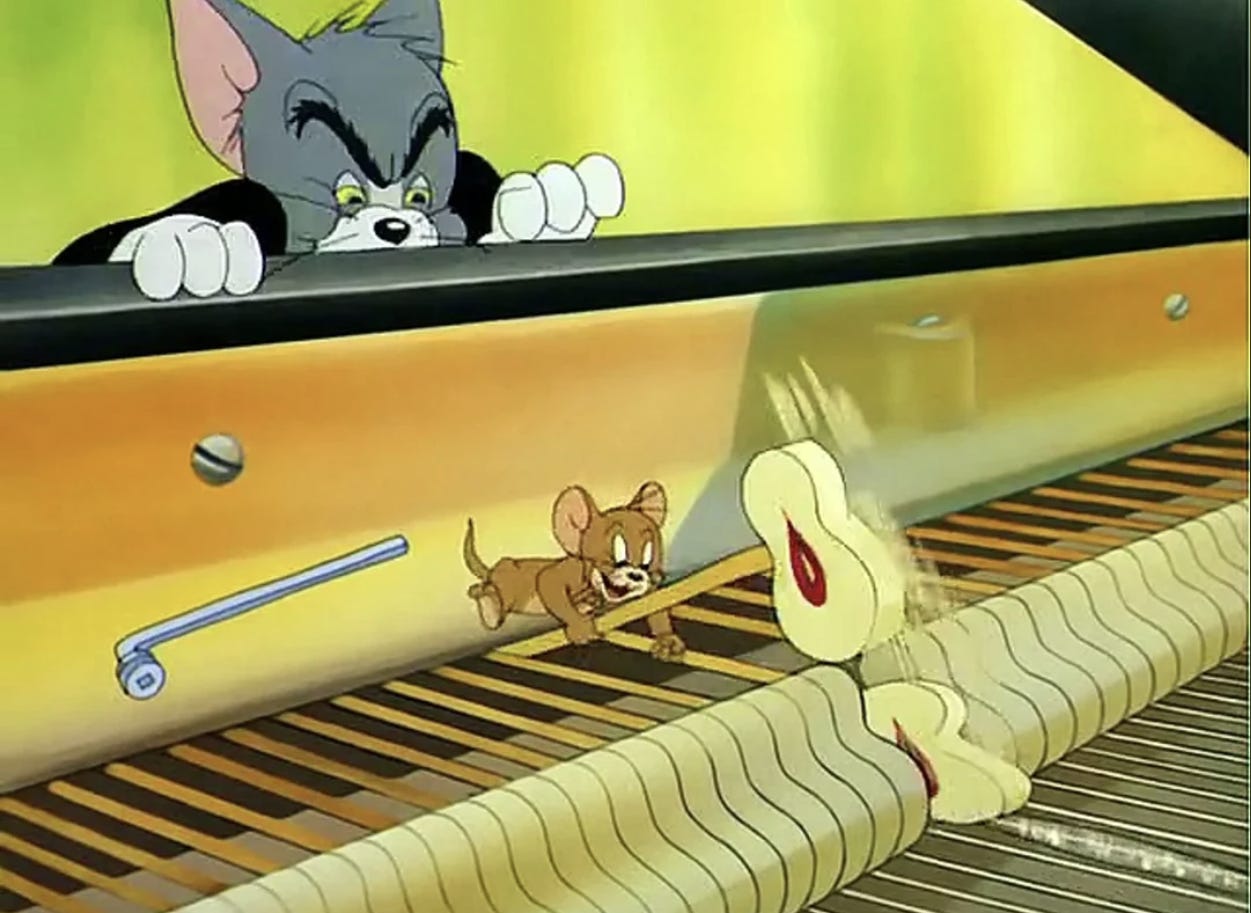
The piano is one of the most familiar instruments in Western music. A big wooden box with about 230 lengths of wire under enormous tension — press a key, then a hammer strikes a string and a note rings out. For most of the piano’s history, composers wrote for the keyboard and left the strings alone.
In the twentieth century, all that began to change. Henry Cowell’s The Aeolian Harp (1923) has the pianist strum the strings like a harp while silently depressing keys. His later piece, The Banshee (1925), is played completely inside the piano. With no use of the keyboard at all, the performer scrapes the strings to create an otherworldly sound. In 1940, John Cage placed objects — bolts, screws, plastic, rubber — between the piano’s strings, and the “prepared” piano was born.
This playlist represents the evolution of these experiments. Cage and Crumb are the canon here. Mehldau, Trueman, Hauschka, Moran, Aphex Twin, and Brion extend these techniques with recording studio technology that further warps the once-familiar sound of the piano.
What interests me about these pieces is how quickly a familiar instrument becomes unfamiliar. Sometimes the piano sounds metallic, brittle, muted, ghostly, mechanical, or almost electronic. Then, just as suddenly, it sounds unmistakably like a piano again. That tension runs through this playlist: an instrument we think we know, continually revealing other identities hidden inside it.
Track by track, listen for the noise floor — the thunk of the action, the buzz of a screw against wire, the inharmonicity of the piano strings, the release of the damper. On most piano recordings, engineers hide all of it. Here it’s the point.
The noise is the music.
Comments
Nothing yet. Say the first thing.
Sign in to join the conversation.