
Many years ago, during an especially hard season, Anna and I met for coffee at the spot on Hillsborough Street where college students and professors smoke cigarettes outside on burnt-orange and hospital-green vintage school chairs.
We both wished we were sipping something stronger than chai tea lattes, but she was eight months pregnant, ready to bring her second son into the world.
She looked down at the foam swirling in her cup, then back up at me, her eyes wet.
“What’s it like?” she asked.
No one had asked me that before.
“How are you?” Yes.
“What can I do?” Often.
“How can I pray?” Too often.
But what’s it like?
That question required more than polite endurance. There were no tidy, Southern answers to offer. No way to make it small enough for a coffee table.
I told her it was hard to explain, but I would try. Grief felt like homesickness — except I knew I could never go back home.
Not because the door was locked, but because the address itself had disappeared. The landscape had shifted. The life that made it home had moved just beyond my reach.
I could spend the rest of my life reaching.
I would never touch it again.
And then I told her about being a little girl at my grandmother’s house.
When I was small, I often spent whole weekends there. Anna remembered. I told her how much I loved it — propped in my grandmother’s bed while we watched The Sound of Music, balancing a tray of her homemade oatmeal cookies and cold grapes cut neatly in half.
We made bird feeders out of pinecones and peanut butter. She had an entire room devoted to arts and crafts. We played Clue and Hungry Hungry Hippos. My cousins poured in and out of the back door, and together we invented elaborate skits with dramatic costume changes and absolutely no plot.
Her house was warm and full of safety. It smelled faintly of Ivory soap and baked goods. The antique clock in the living room ticked in a way that made time feel predictable.
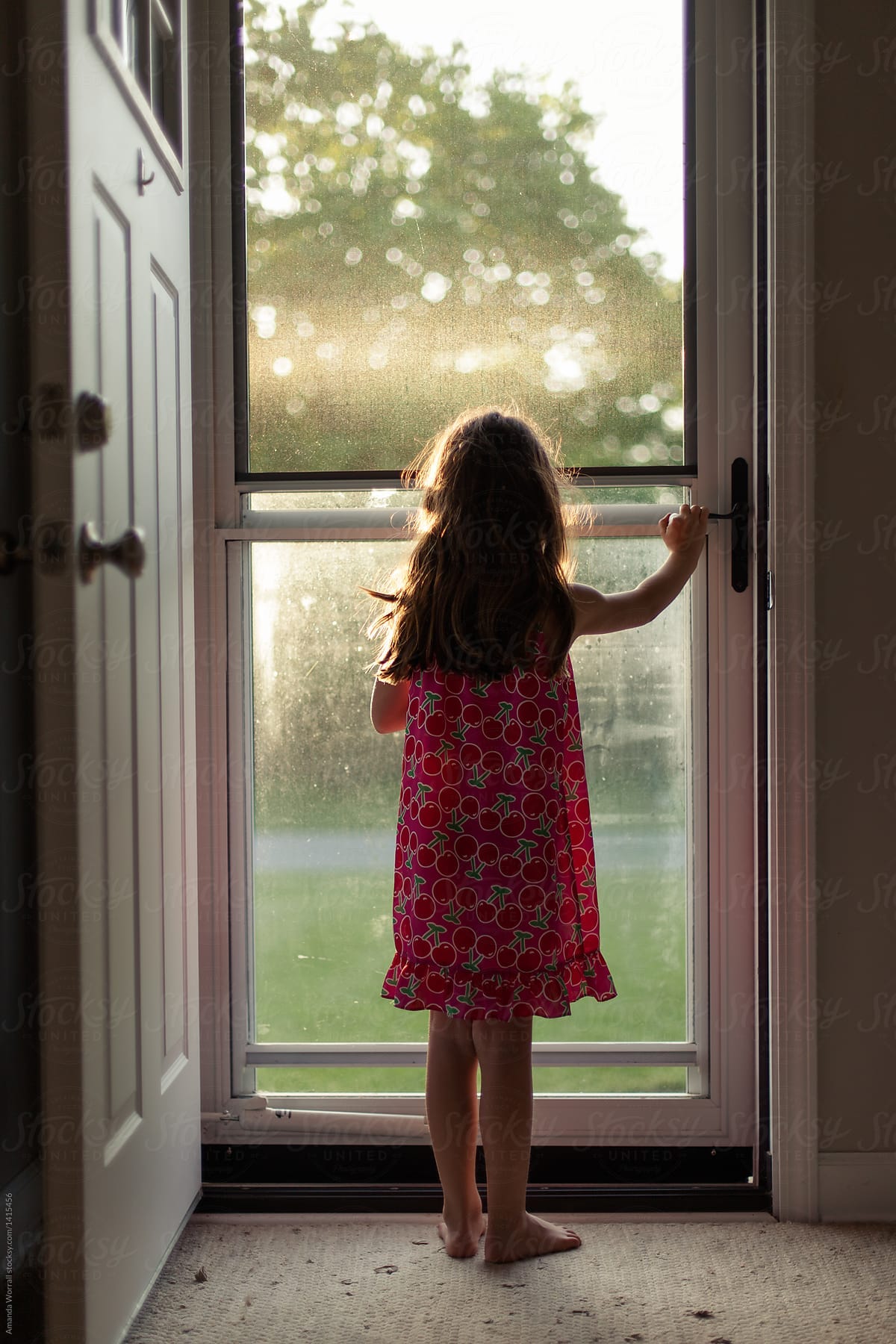
And still — in the mornings — my grandmother would sometimes find me standing at the back door.
Yellow-and-white polka-dotted coat zipped up to my chin.
A small red suitcase clutched in my hand.
Ready.
I would stand at the glass door and stare at the driveway as if willing my parents’ car to appear. The wanting felt physical. It sat in my throat and in my stomach at the same time.
It wasn’t dramatic.
It was steady.
That is what grief feels like, I told her.
It is living somewhere good and beautiful — and still standing at the back door, coat on, suitcase packed, waiting for something that is not coming.
The confusing part is that nothing around you collapses. Life continues moving — children growing, coffee steaming, the news cycling through — while some essential part of you remains poised at the window.
You are homesick.
Not exactly for a place.
For a person, yes.
But also for who you were before.
For the way other people saw you before.
For the way the air felt before.
You are homesick for before.
Sometimes grief is sharp and tidal. But more often it is quiet and stubborn — the steady awareness that there is no returning.
The driveway stays empty.
Anna reached across the table and held my hand.
Grief, I told her, is loving where you are and still waiting at the door.
The strange gift of Lent is that it asks us to stand there.
To look out the back door and feel the ache of wanting something — someone, somewhere — just beyond reach.
We believe Easter is coming.
We trust that the driveway will not always be empty.
But for now, our bags are packed.
Our coats are zipped.
And we wait.
No posts
Comments
Nothing yet. Say the first thing.
Sign in to join the conversation.