
Hello friends (and welcome to new subscribers),
Thanks to all of you who shared my Guardian piece last week with your social media networks. I don’t have a new column this week (I’m spending a holiday week with family). So just sharing a hodgepodge of quick takes – mostly on the theme of how to shift the public conversation – and an exciting gala invitation from the good folks at BC Policy Solutions. And read on to the end for a song recommendation.
Many of you have probably seen some recent polling showing the Canadian public supportive of yet another new oil sands pipeline, and you’re probably feeling discouraged by this news. Both Abacus Data and Angus Reid have published polls in the last month or so showing about 60% of Canadians supportive of a new bitumen pipeline from Alberta to BC.
But take note: neither of these polls tell survey respondents what the cost to taxpayers is slated to be – the public tab currently ranges between $40 to $50 billion. Nor do they share what could be purchased if those same public dollars were deployed elsewhere (as Tzeporah Berman does in this excellent Globe and Mail column published last week). In many ways, these polls simply reveal the deep problem of climate illiteracy – the fact that roughly half the public doesn’t understand that the main source of climate disruption is the burning of fossil fuels (as I wrote about here).
So, take heart. With good public education, these poll results can be shifted. This fight ain’t over.
In the struggle to strengthen climate literacy, we desperately need our public broadcaster to do its job – highlighting the scale of the emergency, and educating Canadians about what is causing this crisis and what we can do to alter course.
Back at the Climate Emergency Unit, we initiated a project that sought to press the CBC to do just that (you can see more on that here). I wrote a column on this topic two summers ago, which you can find here, and did a video column on the subject here.
Now, as wildfires again ravage the landscape and displace thousands, one of our collaborators on that project, SFU’s Tara Mahoney, is re-issuing the call on the CBC to do a better job of connecting the dots between these fires, climate change, and the burning of fossil fuels.
Have a listen to Tara’s excellent interview on a recent issue of The Breach podcast, which you can find here. She also has a great piece in Ricochet, which you can read here.
Tara has also launched a letter-writing campaign directed to the CBC’s editor-in-chief, so you can add your voice to this call. If you want to do so, here’s the campaign link: https://win.newmode.net/connectthedots
Progressive think tanks also play a vital role in shifting the public conversation. As most of you know, I’m a proud board member of BC Policy Solutions, the re-incarnated social justice research institute with which I served much of my adult life.
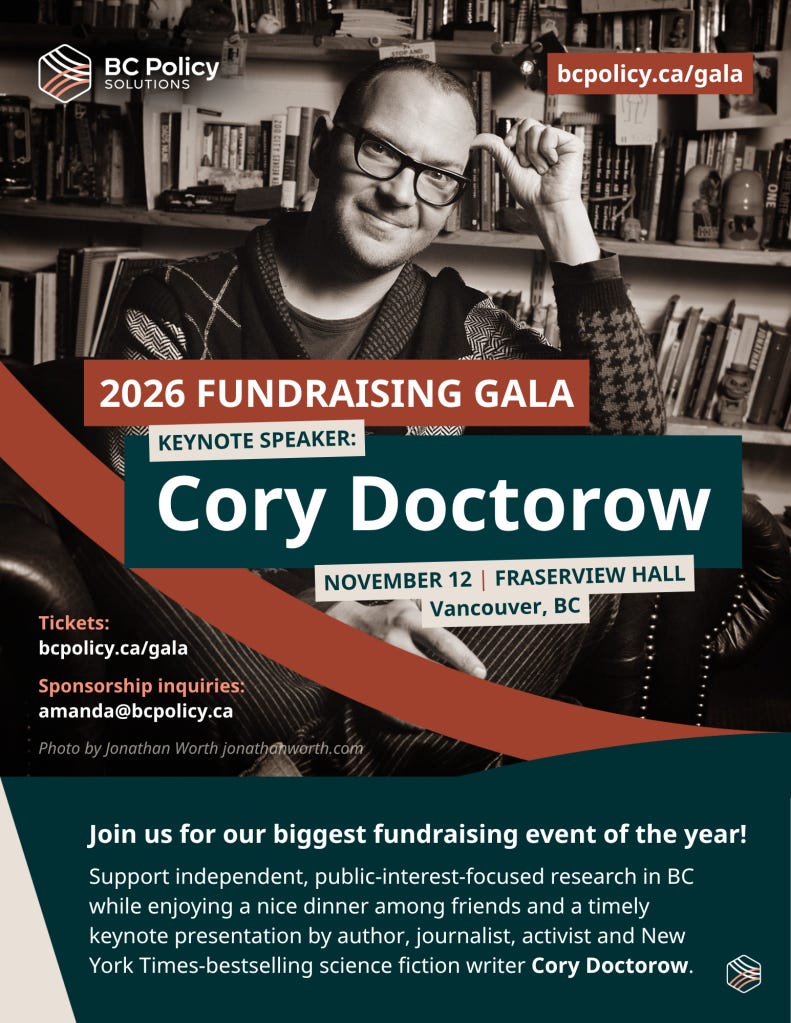
I’m super excited that on November 12, author, journalist, activist and New York Times-bestselling science fiction writer Cory Doctorow will be the keynote speaker at BCPS’s 2026 Fundraising Gala Dinner. If you live in the Vancouver area, early bird tickets prices are available until the end of this month, so act fast. Get your tickets here, and help support the essential work of BC Policy Solutions.
Cory’s super-timely topic: “Disenshittification: How we break free from the US tech grip and leverage digital sovereignty for the public good.”
Hope you can join me there.
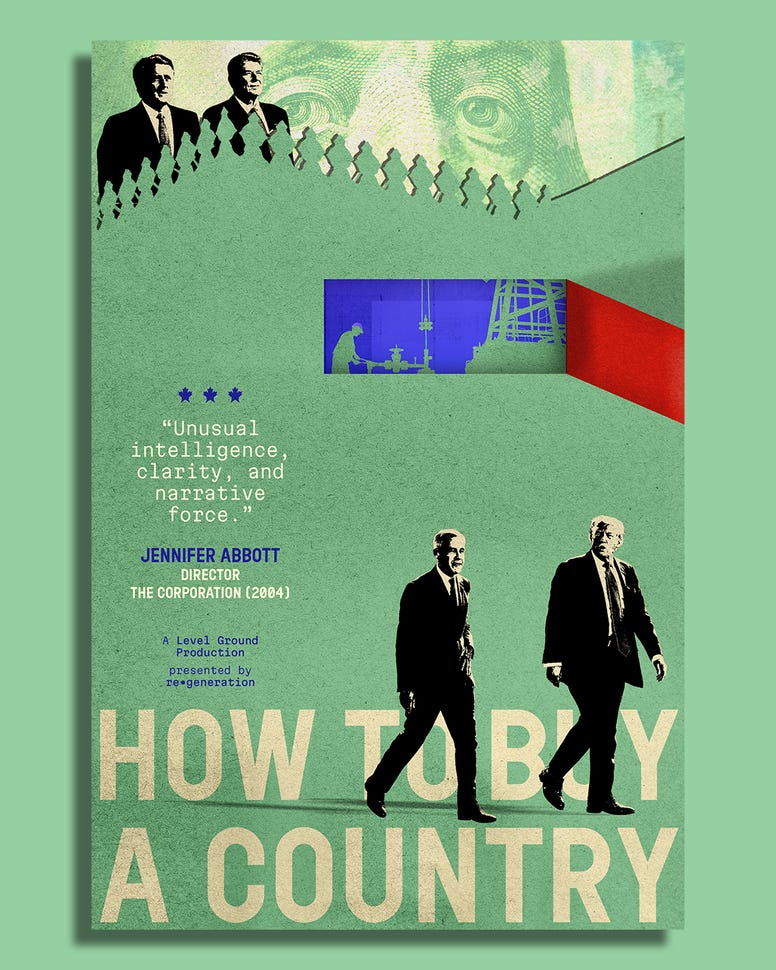
Shifting the public narrative also requires an understanding of how we got here. On that score, I’d like to recommend a great new doc series produced by the young folks at Re-Generation:
How to Buy a Country is a four-part series exploring how Canada has been shaped by the rise and decline of the American empire. Produced by Level Ground Productions and narrated by Jesse Wente, this series (freely available on YouTube) aims to show viewers how the growth of US influence, the rise of corporate power, and Canada’s structural dependence on oil and gas are all parts of a larger underlying story. In doing so, it seeks to spark conversation about the interconnections of energy, economics, and geopolitics, and also paint a hopeful vision of what real sovereignty – rooted in Indigenous rights and non-extractive futures – might really look like.
Finally, I always have an ear out for new music that seeks to sound the climate alarm. As those who have read my book know, I have a special interest in the roll of the arts in mobilizing us to confront emergencies. A year or so ago, I connected with Rupert Hudson, lead singer of Orchid Orchestra, and he shared a song he’d written called The Fires. Given events, the song couldn’t be more timely. Orchid Orchestra is now one of the bands that visits schools with The Jellyfish Project, an initiative that sends rock bands into schools to both perform and engage young people in discussion about the climate crisis (Rupert and his band visited by kid’s elementary school last spring, who offered the high praise: “It was cool”).
Orchid Orchestra has now released their debut album, and I encourage you to check out the haunting penultimate song “The Fires.”
Here’s the Spotify link to the album
And here’s the specific link to The Fires
Or listen on Apple Music here: https://music.apple.com/ca/album/feel/6776165875
I’d love to hear your recommendations about great contemporary climate emergency songs too. Let me know.
**
That’s all for this week.
Let’s break the silence on the climate crisis! Please share these items on your social media.
No posts
Comments
Nothing yet. Say the first thing.
Sign in to join the conversation.