
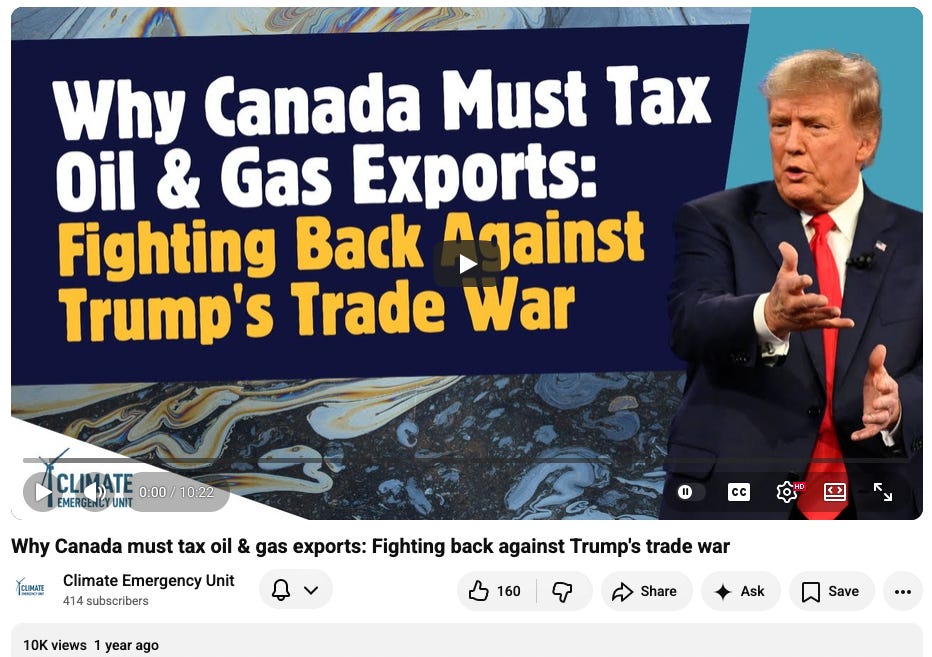
Friends, once again, the United States’ petulant, bully president is threatening Canada’s economy and workers with 50% tariffs on a host of products, all because Canada deigned to retaliate against Trump’s earlier tariffs instead of just quietly taking our beating.
Given events, in this newsletter, I’m sharing a modestly updated column I first wrote in February, 2025, calling on the Canadian government to hit Trump back where it hurts most – oil and gas.
[The piece was originally published in Canada’s National Observer here. And I also produced a video version of the column, which you can watch here.)
As our country burns and broils from climate-induced extreme weather, if Prime Minister Carney and Premier Eby were looking for an opportune moment to rethink their support for new fossil fuel projects backed by some of Trump’s closest allies – not to mention a great chance to reset their relationships with the environmental movement and climate-anxious Canadians – look no further.
Much like our summers, once again, the trade war with the U.S. is heating up. And thankfully, some of Canada’s premiers are saying that, when it comes to our response, everything should be on the table – including the Canadian resources most dear to the U.S.
We’re in for some pain, and we have to fight back – it’s the only thing bullies understand. But the response should also be smart and deliberate, while also putting us on a path to the future society and economy we want.
Vitally, Trump’s decision to offer special treatment for Canada’s oil and gas exports – at no point have they been subject to his tariffs – is a tell; he’s signalling where he is vulnerable, and who has his ear. Trump is the fossil fuel industry’s man in the White House. As Keith Stewart wrote in CNO, “oil companies and executives donated over $170 million to Republican candidates and their conservative allies” in the last U.S. election, and Trump has promised to return the favour many times over. A large share of the oil and gas industry in Canada is U.S.-owned, and its product is largely shipped to parent companies in the U.S. where it is refined and sold. These folks don’t relish having to pay the extra costs that would result from tariffs.
Which is precisely why we should do just that, with a twist. Canada should quickly impose a 15 per cent export tax on the industry.
Such an export tax would certainly face political challenges; Alberta Premier Danielle Smith and the oil and gas companies themselves will blow a gasket. But a strong case can be made that layering an export tax on oil and gas is a fair approach within the overall Canadian response. First, an export tax on oil and gas would even the pain, ensuring all industries are shouldering a similar burden of our collective fight-back. Second, unlike Trump’s tariffs (which the U.S. will collect), an export tax can raise billions in revenues for Canada – money that can then be redeployed to support workers and industries harmed by the U.S. tariffs. Trade researcher Stuart Trew estimates, “a 25 per cent export tax on energy (oil and gas) exports alone would net more than $40 billion a year at current prices and trade levels,” so a 15 per cent one could net close to $25 billion. Most importantly, strategically, this is an approach that can work. It directly harms the oil and gas corporations who have outsized influence with Trump.
The idea of an export tax on oil and gas has growing support. In an excellent statement issued by Climate Action Network Canada last year and signed by about two dozen of its members, the climate movement gave strong support to such an export tax. Similarly, polling conducted in early 2025 found that Canadians are very supportive of an export tax on oil and gas.
Last year, the Canadian Labour Congress, in a remarkably strong statement, has urged even tougher action, calling for an outright ban on exports to the U.S. of electricity, critical minerals, and oil and gas until the Trump tariffs are lifted. That’s worth considering, but it’s a policy response with higher costs and fewer benefits. Specifically, it would result in more immediate job losses in Canada, and we’d lose the revenue stream of an export tax. But worth holding this option as a “trump card.”
In contrast (and unsurprisingly), the fossil fuel industry and its political servants in Canada are pressing for a very different response to the Trump tariffs. Never ones to miss an opportunistic opening, they are seizing on the “trade diversification” mantra to push for more and expedited oil and gas pipelines, east and west, in order to boost shipments to Europe and Asia.
That’s the wrong call.
In the wake of Trump’s tariff threat, the true allegiances of the oil and gas industry were exposed; after wrapping themselves in the Canadian flag for years, turns out they are ready to roll over and become the 51st state on a dime, and are now engaged in a near-treasonous effort to undermine a united Canadian response.
Subsidizing new oil and gas pipelines is the last thing we need.
First off, pipelines take years to build, and God-willing, by the time such a project is complete, Trump will no longer be in the White House and may well have taken up residence in the fiery pits of hell.
We’ve already spent a gobsmacking amount of public money on the TMX pipeline expansion bringing three times as much Alberta oil to Westcoast tidewater. The argument for TMX was that it would allow Alberta oil to fetch a better price in Asian markets. Yet it turns out that most of that TMX oil is being shipped to refineries on the U.S. west coast, while PetroChina recently decided to offload its commitments to the TMX pipeline. So why in heaven’s name should we do more of that?
The latest carbon bomb being pitched for northern British Columbia – the Ksi Lisims LNG facility and its associated PRGT pipeline – is sold as an Indigenous-led project, but U.S. oil interests have their fingerprints all over it. Unlike the Cedar LNG project (majority owned by the Haisla Nation), the Nisga’a don’t actually have an equity stake in Ksi Lisims (the Nation does have an equity stake in the associated PRGT pipeline, but not the LNG project itself). Rather, the Nisga’a would be the facility’s landlords – the project would pay them a steady revenue stream as hosts of the gas liquification plant. The actual money behind the LNG project, however, is being assembled by Western LNG, a Texas-based firm.
Western LNG’s investors, in turn, are mostly big Wall Street private equity and asset management companies such as Blackstone Inc. and Apollo Global Management. As Dogwood’s Kai Nagata has uncovered, “Blackstone is infamous for buying up foreclosed homes after the U.S. subprime mortgage crisis. Now the world’s biggest corporate landlord, it collects ever-increasing rents from hundreds of thousands of tenants, including families in Vancouver, Toronto and Montreal.” And the real kicker – “Blackstone’s CEO is Republican mega-donor Steve Schwarzman, who poured $39 million into the 2024 race in support of Trump’s agenda. A close advisor to the president since 2016, Schwarzman is betting big on a continent-wide expansion of LNG exports.” Apollo’s CEO Marc Rowan is also closely connected to Trump.
[And a quick update: as reported here, Blackstone and Apollo are now seeking to assume a large equity stake in the other major LNG project at play on Canada’s west coast – LNG Canada Phase 2.]
The oil and gas industry is deeply embedded in the Trump White House. LNG and pipeline expansion is being driven by investors who are close allies and donors of Trump. This is exactly the wrong time to reward them!
As Europe did in response to Putin’s invasion of Ukraine, we need to rapidly make ourselves less dependent on oil & gas (overall Russian gas imports to Europe are down, although some Russian LNG is still finding ways into Europe). Fossil fuels are a poison, not only to the earth but to democracy, and the more reliant we are on these products, the more it serves the petro-oligarchs and their political servants like Putin and Trump.
Rather, now is the time to redouble on renewables, and to wean ourselves from the fossil fuel industry once and for all. And as Climate Action Network Canada proposes in their statement, let’s ensure public money spent on social supports, “helps build a bridge for workers to sustainable jobs, including guaranteed jobs for young people via the Youth Climate Corps,” so we can train and employ young impacted workers in the jobs of the future – jobs that we desperately need to confront extreme weather events and drive down carbon emissions.
In short, let’s have a strategic and thoughtful response that puts people and the planet first.
No posts
Comments
Nothing yet. Say the first thing.
Sign in to join the conversation.