
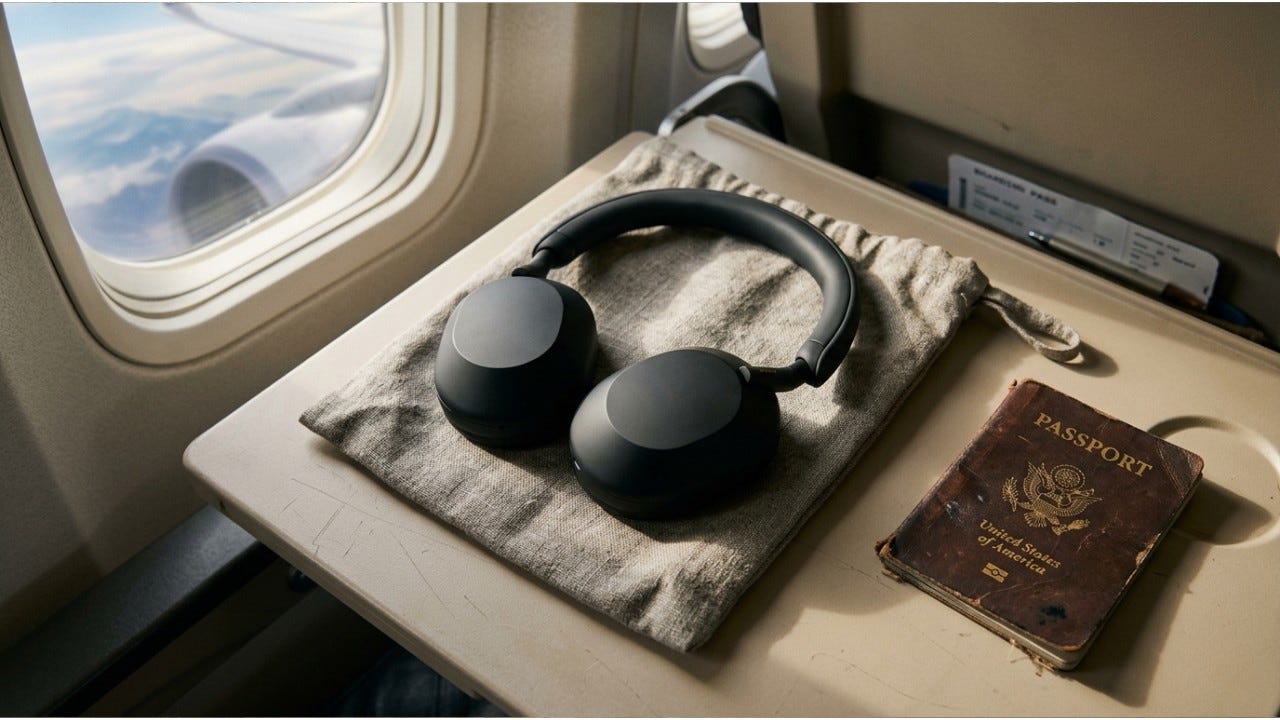
There’s a specific kind of tired that only long-haul flying produces. Not sleepy. Not even physically exhausted, exactly. It’s the tired that comes from ten hours of low-grade assault: engine roar, cabin pressure, the guy three rows back who watched two action movies without headphones, the baby who couldn’t understand why any of this was happening (fair enough). You land and you’re not ready for wherever you’ve arrived. You’re still white-knuckling the flight.
That was me on every transatlantic leg for years. São Paulo to Lisbon. Miami to Madrid. I’d land wrung out before the trip even started.
I’d tried cheap noise-canceling headphones. They did something, technically. But what they mostly did was muffle the world into a slightly quieter version of itself while adding a faint pressure behind my eyes, like the beginning of a headache that never fully committed. I wore them for an hour and gave up. Went back to stuffing foam earplugs in and staring at the seat back screen until my eyes glazed over.
Then, on a last-minute fare from GRU to FCO, the kind where you book it on a Tuesday and you’re boarding on a Thursday, I borrowed a pair of Sony WH-1000XM5s from a friend who swore they were different.
I put them on before we even pushed back from the gate.
The engine wound up. We taxied. And then something strange happened: the noise just stopped. Not muffled. Stopped. The kind of quiet that takes a second to register because your brain is still bracing for the roar that doesn’t arrive. I sat there for a moment thinking something was wrong with the plane.
Nothing was wrong with the plane. That’s just what these headphones do.
I put on an album, nothing dramatic, some low-key jazz I’d been meaning to sit with for months, and I watched São Paulo disappear below the clouds. For the first time in years, I wasn’t enduring a flight. I was just on one.
What makes the XM5s different from every other pair I’d half-heartedly tried isn’t a single feature, it’s the cumulative effect of everything working together. The noise cancellation uses eight microphones and two processors, and you feel that engineering in the first thirty seconds. The ear cups are soft in a way that doesn’t make you feel like you’re clamping your head in a vice. The battery runs for 30 hours, which means a transatlantic marathon doesn’t require a mid-flight charge panic. And the sound, even through airplane Wi-Fi-grade audio, even through a movie you’ve already seen twice, is genuinely good.
What the borrowed flight confirmed was that this wasn’t a product doing something clever. It was a product doing something fundamental: removing the part of flying that makes you feel like you’ve been wrung out before you land.
Long-term owners describe the same pattern. Flights they used to white-knuckle become unremarkable. Overnight legs in economy that should leave you destroyed produce actual sleep. One reviewer mentioned a turbulent hop into Florianópolis where they didn’t notice the bumps until the person across the aisle grabbed their seat. They looked up, thought huh, bumpy, went back to the music.
That is the whole argument for these headphones. Not the specs. Not the thirty-hour battery. The fact that a turbulent flight becomes a non-event because you are somewhere else entirely.
Long-haul flying doesn’t have to be something you survive. With the right pair of headphones, it can be the part of the trip where you finally get to sit still.
Editor’s note: The GRU-FCO borrowed pair experience is personal. Extended use claims are based on reported reviewer experience. Affiliate link, I may earn a commission at no extra cost to you.
No posts
Comments
Nothing yet. Say the first thing.
Sign in to join the conversation.