
In a previous post, we discussed a principle of the Typikon by which the measure of fasting for monastics and laity differs only in terms of the complete dispensation from fasting - an occasion on which laity feast on meat while monks are satisfied with eggs and cheese. In other words, if we propose that monastics do not eat meat not as a matter of fasting, but as a matter of lifestyle, then the Typikon does not make any distinctions in fasting rules for laity and monastics, with one or two notable exceptions to be discussed in a future post. But what exactly is fasting? Does this strange and at times obsessive fascination with the culinary “ladder of divine ascent” - from meat to cheese, from fish to oil, and from wine to water - is this the correct way to understand the Typikon, and is this what fasting is?
In a modern Orthodox context, fasting typically and sadly almost always has come to mean abstinence from certain kinds of foods, such as meat, eggs and milk products, fish, oil, etc. Perhaps the strictest fasting day of the entire year, Great and Holy Friday, is usually observed as complete abstinence from food and drink until the bringing out of the Shroud, an icon of Christ’s lifeless Body taken down from the cross, which happens in most parish churches sometime between two and three o’clock in the afternoon. After this service, according to one source, one may eat only “stale bread and raw water” (that is to say, not boiled). Setting such curiosities aside for the moment, let us examine what fasting actually is.
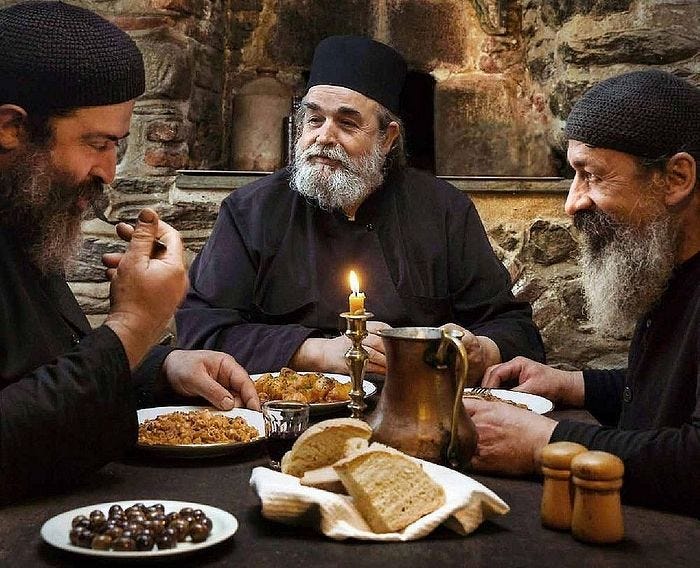
In the most immediate sense, fasting is a complete abstinence from all food of every kind. The rules of the Typikon concerning when fish is allowed or when wine is allowed are not rules of fasting but of feasting - what kinds of delicacies are to be consumed in place of the usual “stale bread and raw water” on account of a celebration. It is important to re-iterate that the default condition assumed by the Typikon is that of perpetual fasting, and the rules, in most cases, do not impose fasting but rather interrupt or suspend it to one degree or another. When one of the popular calendars shows that fish is allowed, for example, this does not mean that we fast from meat and cheese, but rather that when we break our fast at an appointed time, we do so by feasting on fish (or wine, or oil, etc.).
To the early Christians, the idea that some foods are “fasting” while others are not would have been quite foreign. Even modern Christians understand that when Christ fasted for forty days and forty nights, He did not do so by eating tofu and having wine and oil on the week-ends. Likewise, when we learn that a certain kind of malicious spirit “goeth not out but by prayer and fasting” (Matt 17:21), we understand that this does not mean by shrimp and almond milk. An echo of this earlier meaning of fasting can also be found in the English word breakfast - literally, the breaking of a fast after not eating anything during the night.
The traditional fast usually lasted all day until evening at which time it was broken by consuming food - any food, even “stale bread and raw water” breaks a fast. This is why the Gospel specifies that Christ fasted for forty days and forty nights” (Matt 4:2), meaning that He did not break His fast with a nightly meal. Thus, for example, the Typikon speaks of one daily meal on Fridays after the ninth hour (3 pm) - a meal which liturgically belongs to the following day. The Typikon makes this point clear by referring to Wednesdays and Fridays as the eves of Thursdays and Saturdays (see ch. 35). As for Great and Holy Friday, the notation is that “we do not eat on this day of crucifixion.”
It is sometimes proposed that such feats of faith as complete abstinence from food for a few hours was possible for early Christians who were helped by either the Holy Spirit, or their own inner strength, or both, but are no longer possible for many modern Christians who are weak in faith, weak in body, and cannot tolerate even the thought of hunger, much less the feeling of it. So far, I have found no evidence to support such a proposition. On the one hand, early Christians were likely more similar to us than different in any significant way. They believed, struggled, doubted, repented, and in general, lived lives that were just as human in every respect as ours. On the other hand, we do not think that intermittent fasting, or running a marathon, or lifting pieces of metal for no apparent practical purpose only to set them back down and lift them again and again a few more times, are superhuman feats. Even if some of us do not dabble in such things, we understand that most could, if they set their mind to it. Additionally, with more than 70% of Americans being overweight, for many of us, it is theoretically much easier to skip a few meals than it was for our much leaner ancestors, especially since most of us, unlike them, are not subsistence farmers slaving away - often, quite literally - in back-breaking agricultural jobs.
Is it necessary to follow the rules of the Typikon? Cleary not. Most lay people and not a few clergy use the Typikon more as a guiding principle, a direction, than a strict rule by which to live. This is likely the way Orthodoxy has been practiced “everywhere, always, and by all,” to paraphrase the Vincentian Canon. And yet, the “True North” of the Typikon is not purely abstract. If life can be imagined as a winding path through difficult terrain, then we may have to deviate from following the North Star from time to time in order to avoid a swamp or to go around a cliff or a mountain. But we should not deviate solely for the sake of deviance; and if there is a meadow or a level field ahead, why not try walking in as much a northerly direction as possible?

Pilgrim in a Rocky Valley (Pilger im Felsental) by Carl Gustav Carus (1789–1869)
Naturally, much like many other aspects of our lifestyles, fasting of any kind is primarily a matter of habit. Thus, as a practical matter, you may consider starting by skipping breakfasts on Wednesdays and Fridays and having the first meal of the day around noon consisting of “stale bread and raw water,” if you wish, or whatever soy product God happens to give you this day. When the Nativity fast begins in about three months, you may choose to wait until 3 pm to have your first meal. What is the worst thing that can happen? You might discover that it is not for you and go back to obsessing over food labels to ensure there are no milk by-products in your vegan wrap or to carefully picking out crumbs of feta from your Greek salad. Or you may find the practice of actual fasting simple and beneficial and decide to continue with it. If we believe ourselves to be walking in the footsteps of Christ’s disciples, early Christians, Fathers of the Church, and those who walked this path ahead of us, why not trust their experience and give it a try?
See also: “Want to eat sausage? Go ahead!”
This is a reader-supported publication; please share Phroneo with your friends and relations. And if you are saving money by fasting, please consider becoming a paying subscriber - the subscription is only $5 per month; and subscribing to Phroneo is much easier than picking out feta from a Greek salad.
Comments
Nothing yet. Say the first thing.
Sign in to join the conversation.