
August 14 Gregorian calendar / August 1 Julian calendar
The Russian Church traditionally celebrates the baptism of the Rus on July 15 Julian / July 28 Gregorian calendar. But of course, this is not the day that the Rus were baptized; this is the day that Grand Prince Vladimir I, the Baptizer of the Rus, reposed in the Lord. There are other curiosities that surround this event.
Saint Vladimir was actually baptized with the name Basil. Vladimir or *Voldiměrъ (Old Norse: Valdamarr) was his pre-baptismal or Pagan name.
According to the Primary Chronicle written more than a century after the event, at his baptism, Vladimir recited the Arian Creed. In English, this means that instead of saying that the Christ is “of one essence with the Father,” Vladimir said that He is “of like essence with the Father.” He also used the same word - “подобосущен (όμοιούσιος)” - in reference to the Holy Spirit: “of like essence with the Father and the Son.”1 It is not clear why the Chronicle uses this term or whether it is the very term that Vladimir used when reciting the Creed, but it says what it says:
Когда же Владимира крестили и научили его вере христианской, сказали ему так: “Пусть никакие еретики не прельстят тебя, но веруй, говоря так: “Верую во единого Бога Отца Вседержителя, творца неба и земли” - и до конца этот символ веры. И еще: “Верую во единого Бога Отца нерожденного и во единого Сына рожденного, в единый Дух Святой, исходящий: три совершенных естества, мысленных, разделяемых по числу и естеством, но не в божественной сущности: ибо разделяется Бог нераздельно и соединяется без смешения, Отец, Бог Отец, вечно существующий, пребывает в отцовстве, нерожденный, безначальный, начало и первопричина всему, только нерождением своим старший, чем Сын и Дух; от него же рождается Сын прежде всех времен. Дух же Святой исходит вне времени и вне тела; вместе есть Отец, вместе Сын, вместе и Дух Святой. Сын же подобосущен Отцу, только рождением отличаясь от Отца и Духа. Дух же пресвятой подобосущен Отцу и Сыну и вечно сосуществует с ними…
As for the baptism of the Rus, it was not the baptism of Russia or Ukraine or even of the Kievan Rus, if what is meant by the latter is a loose confederation of principalities or anything resembling a state. What actually occurred on that day was the baptism of the elites and possibly merchants and craftsmen who lived in the city of Kiev. Vladimir declared that whoever did not come to be baptized would become his enemy: “Если не придет кто завтра на реку - будь то богатый, или бедный, или нищий, или раб, - будет мне врагом.“ It took some time for the elites in other principalities to be baptized; and as for peasants, their Christianization took until the 14th or 15th century, and in some cases, much later than that.
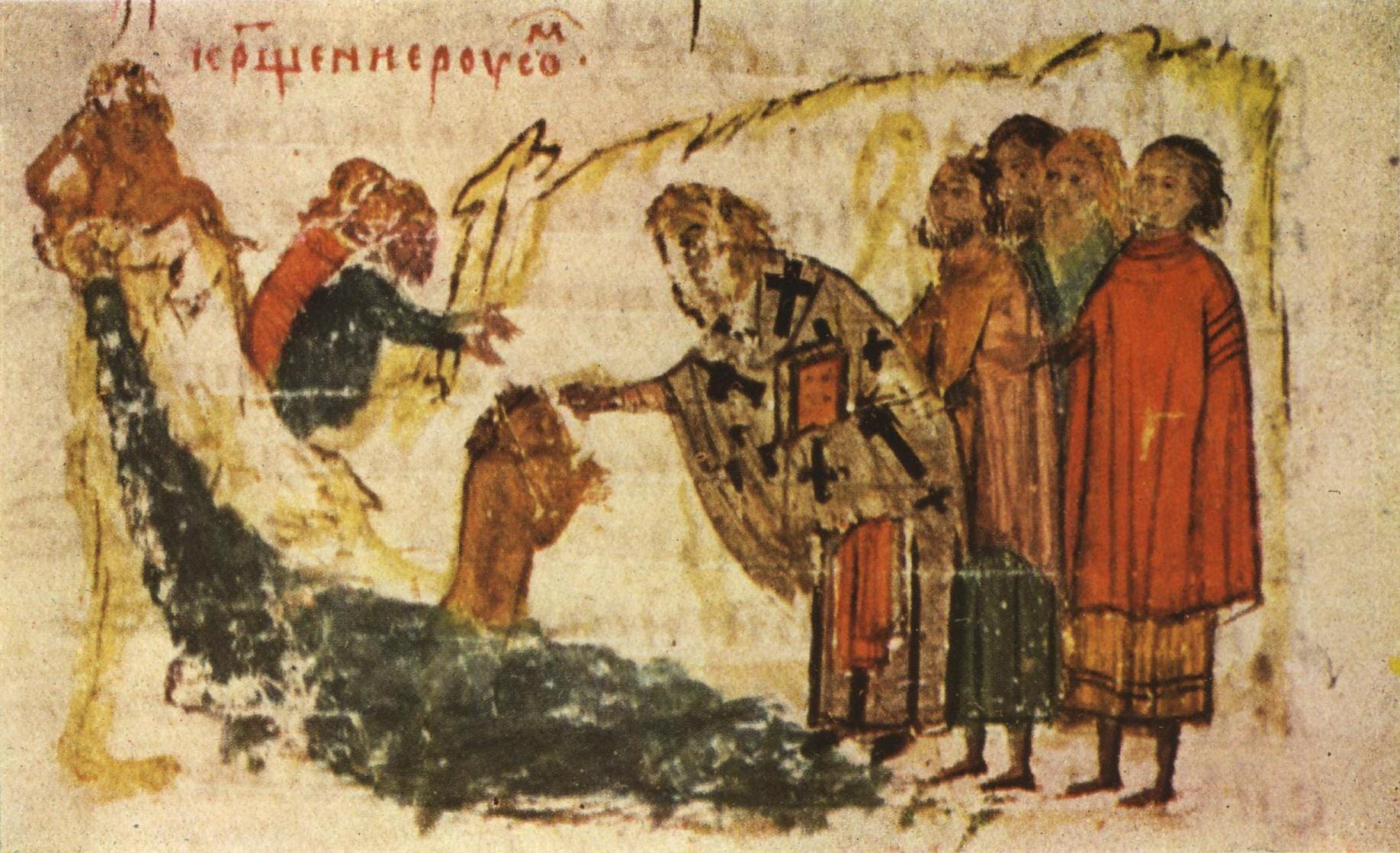
The baptism of the Rus, 1345
As the story goes, Byzantine Emperor Basil II struggled to put down a rebellion of 987 and requested help from the Kievan Vikings. In exchange, he agreed to send Princess Anna as a bride for Vladimir, under the condition that the latter be baptized. Vladimir sent an army, and the rebellion was put down, but the Emperor did not hurry to fulfill his part of the agreement, at which point Vladimir took over Chersonesus (modern-day Kherson), the main Byzantine trading post on the Black Sea. The pretext to the occupation may have been to suppress the remnants of the rebellion against imperial authority, but Vladimir held the city, which forced Basil II to finally send his sister Anna. Vladimir was baptized and married to Anna in Chersonesus. Scholars date these events to 989 or 990. If this dating is correct, this would mean that in 988, when the baptism of Kiev presumably took place, Vladimir himself was not yet baptized.
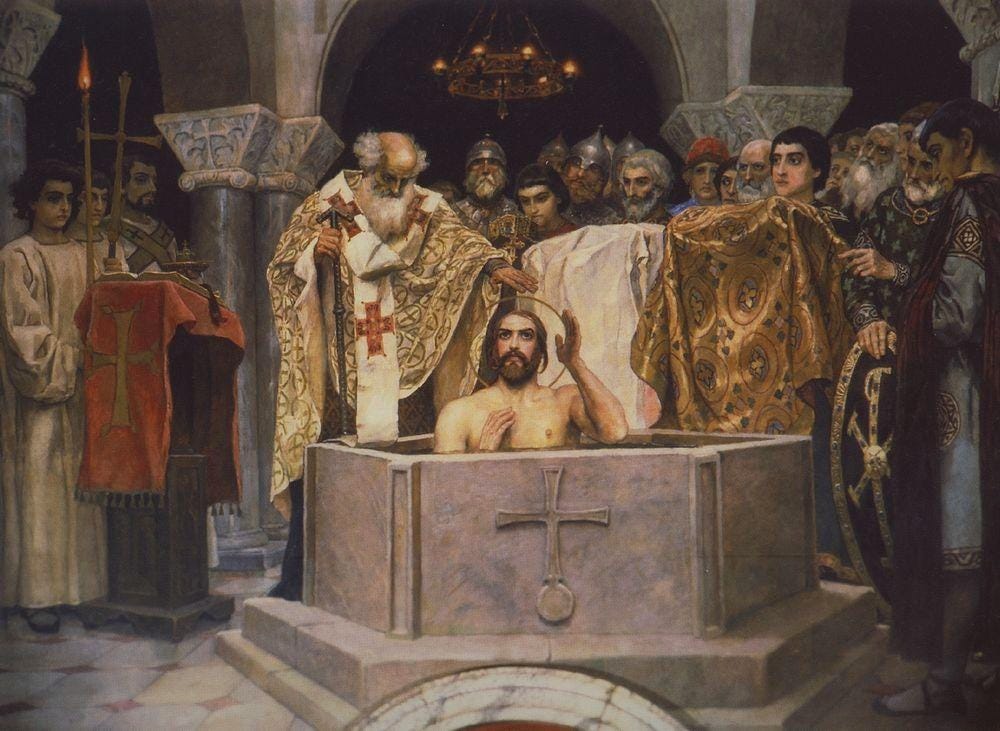
The baptism of Prince Vladimir, V.M. Vasnetsov, 1890
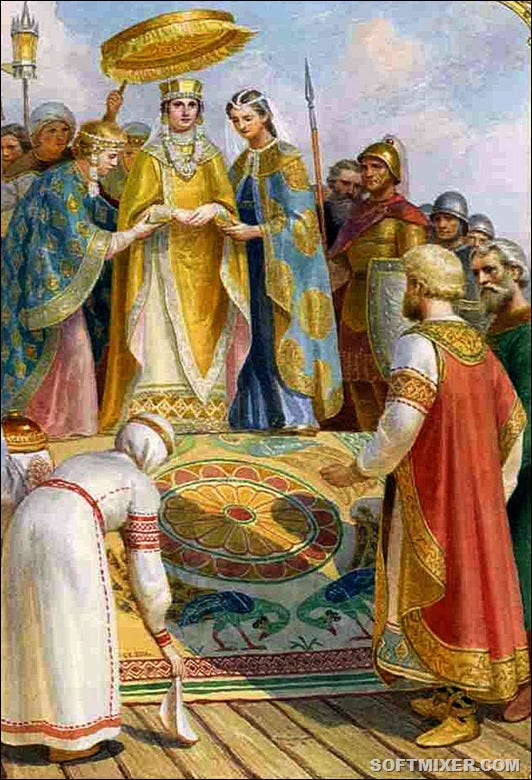
Prince Vladimir greets Princess Anna Porphyrogenita in Chersonesus
Curiously, as far as the Greeks were concerned, the baptism of the Rus had happened a century earlier. It is said that, while the legendary Viking chieftain Rurik (Old Norse: Hrøríkʀ) decided to rule Novgorod, two of his warriors named Askold and Dir (Old Norse: Hǫskuldr and Dýri) - undoubtedly, with a retinue - settled in Kiev on the Dnieper. They subjugated the Polans (or Polanians) who lived there and began to rule in their own right. In the year 860, the Kievan Rus - that is to say, the Rus who lived in Kiev and were led by Askold and Dir - attacked Constantinople. They never took the city but pillaged and destroyed the suburbs. As part of the peace treaty, the Rus agreed to be baptized and to receive a bishop and a priest. Patriarch of Constantinople Saint Photius I even sent an encyclical to other patriarchs in 866 announcing the baptism of the Rus. It is clear that not of the Rus Vikings decided to be baptized, but it appears that a good number of them did, and Christianity began to spread among them. This process was not happening in isolation. At around the same time, in Great Moravia - a Central European state which encompassed a large part of what is now Ukraine - upon arriving there, Byzantine missionaries Cyril and Methodius found a translation of the Gospel and Psalter “written in the Russian script” (“обрѣте тоу Ѥвангєліє и Псалтырь, роусьскыми письмены писано”)2 - that is to say, probably, written in the language of the Rus Vikings. Several decades later, a Rus-Byzantine treaty of 944 allowed for two forms of taking an oath by the Kievan Rus in order to ratify it: one was a Pagan form before the statue of the god Perun and a Christian one, which took place in the cathedral of Saint Elijah in Kiev. Prince Igor, who ruled Kiev in that year, took the Pagan form of the oath.
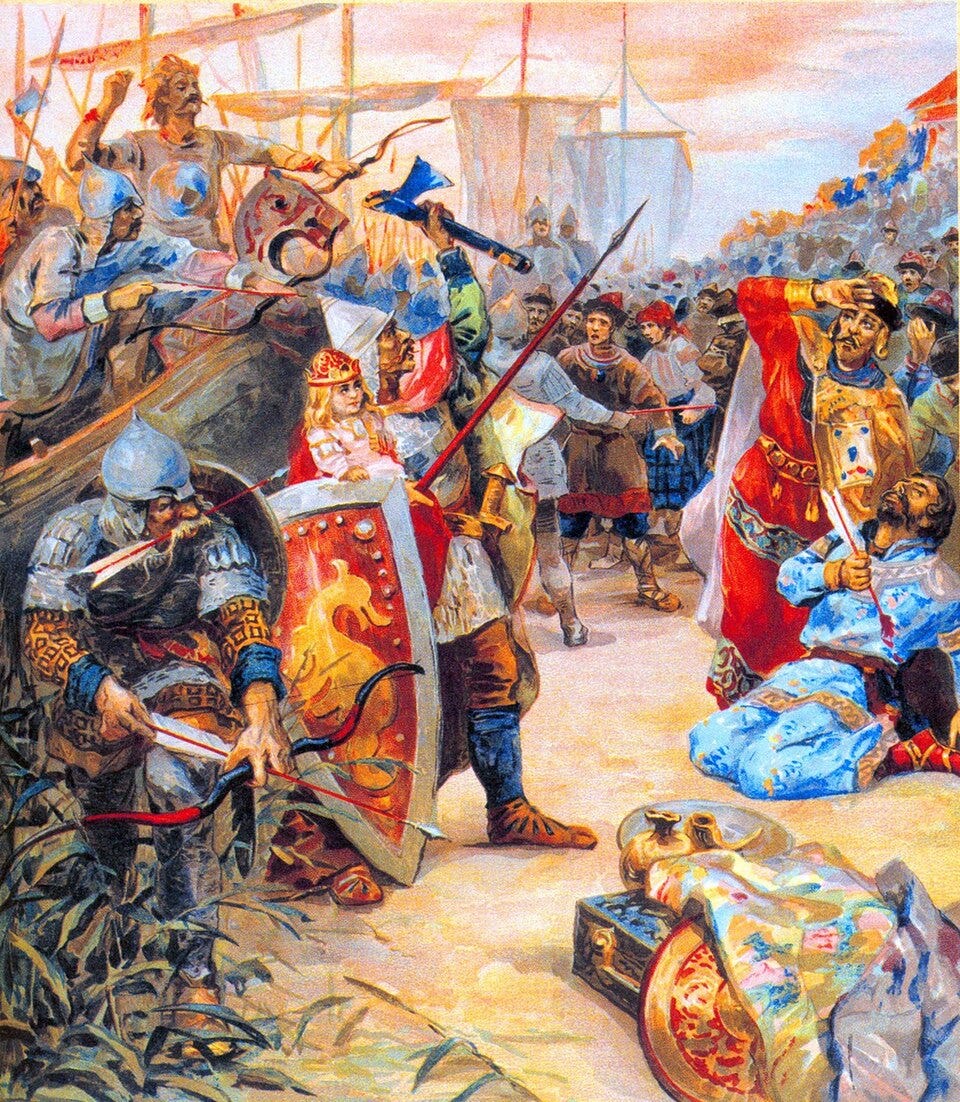
The murder of Askold and Dir by Oleg, Klavdiy Lebedev, 19th c.
At the time of the death of Rurik in Novgorod in 879, his son Igor (Old Norse: Ingvarr) was too young to rule, and Rurik’s kinsman Oleg (Old Norse: Helgi) became regent. Oleg coveted Kiev for its position on the trading route from Scandinavia to Byzantium, so he killed Askold and Dir in 882, after declaring that they were not legitimate chieftains, and moved Rurik’s throne to Kiev. Interestingly, a church was built above the grave of Askold, which may indicate that he was seen as a promoter of Christianity among the Rus. It appears that with the arrival of the Novgorod Rus in Kiev, the spread of Christianity slowed but not stopped, as is evident from the 944 treaty mentioned above. Igor’s wife Olga (Old Norse: Helga) travelled to Constantinople and was baptized in 955 or 957, after the death of her husband.
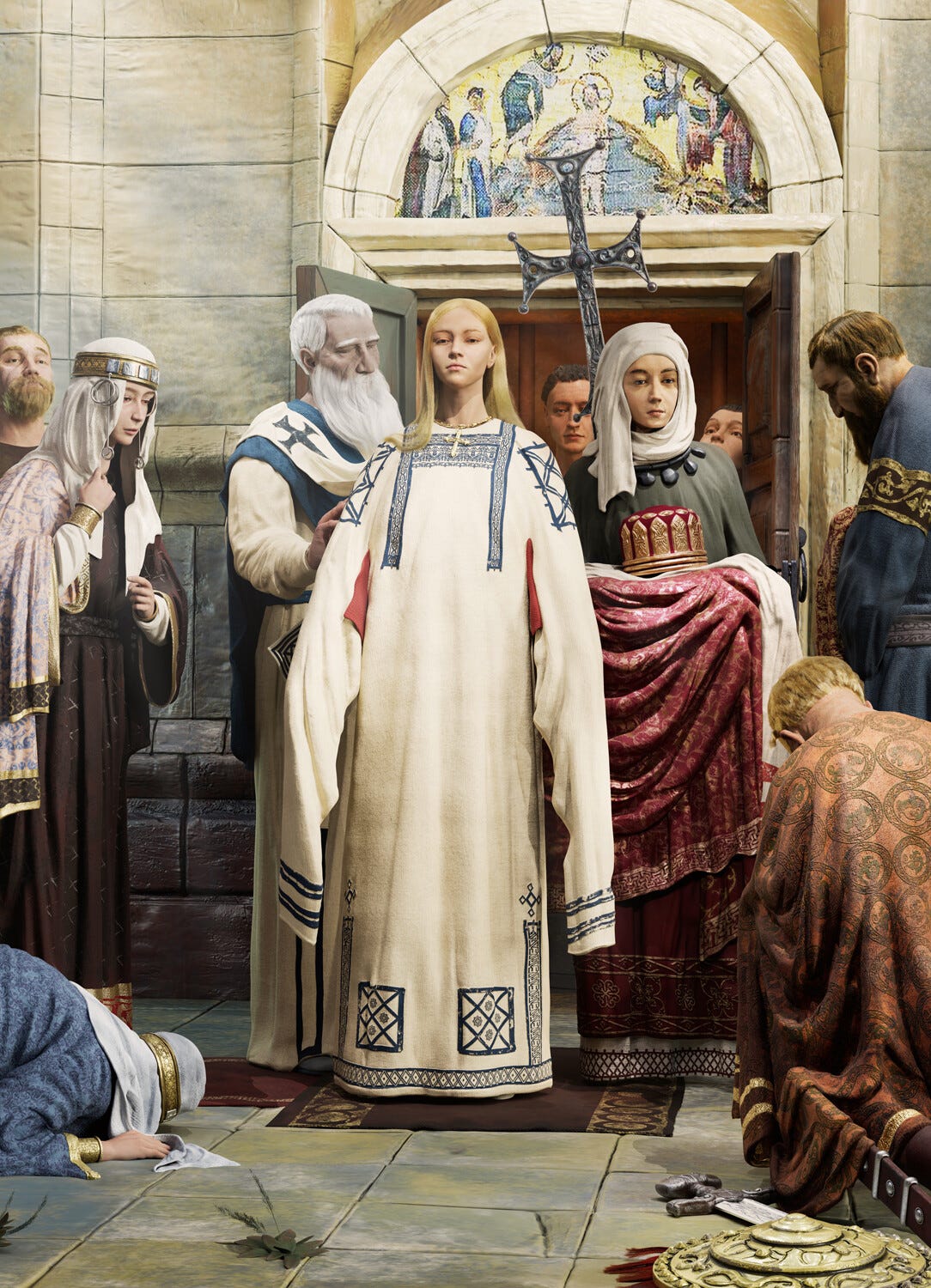
The Baptism of Olga by Sergey Kirilov, 1993
Sviatoslav ( Old Norse: Sveinald), the son of Igor and Olga, remained a Pagan, but his son Yaropolk, the older brother of Vladimir the Great, may have been baptized or become a catechumen. In favour of his possible baptism, some scholars point to the fact that he married a Greek nun. (No, Martin Luther was not the first to marry a nun. Although, in Yaropolk’s defence, some argue that the woman may have been a concubine, not a lawful wife, in which case whether or not he was a Christian would have had no bearing on the relationship.). In 978 or 980, Yaropolk was killed by Vladimir, who took the Kievan throne and his pregnant Greek wife, from whom was born Sviatopolk I of Kiev. However, in 1044, Yaroslav the Wise dug up the bones of his uncle Yaropolk and had them baptized - at least, this is what is written in the Primary Chronicle. (The application of the 26th3 canon of the Council of Carthage, which reads in part, “nor let the ignorance of the presbyters baptize those who are dead,” is a topic for another discussion.)
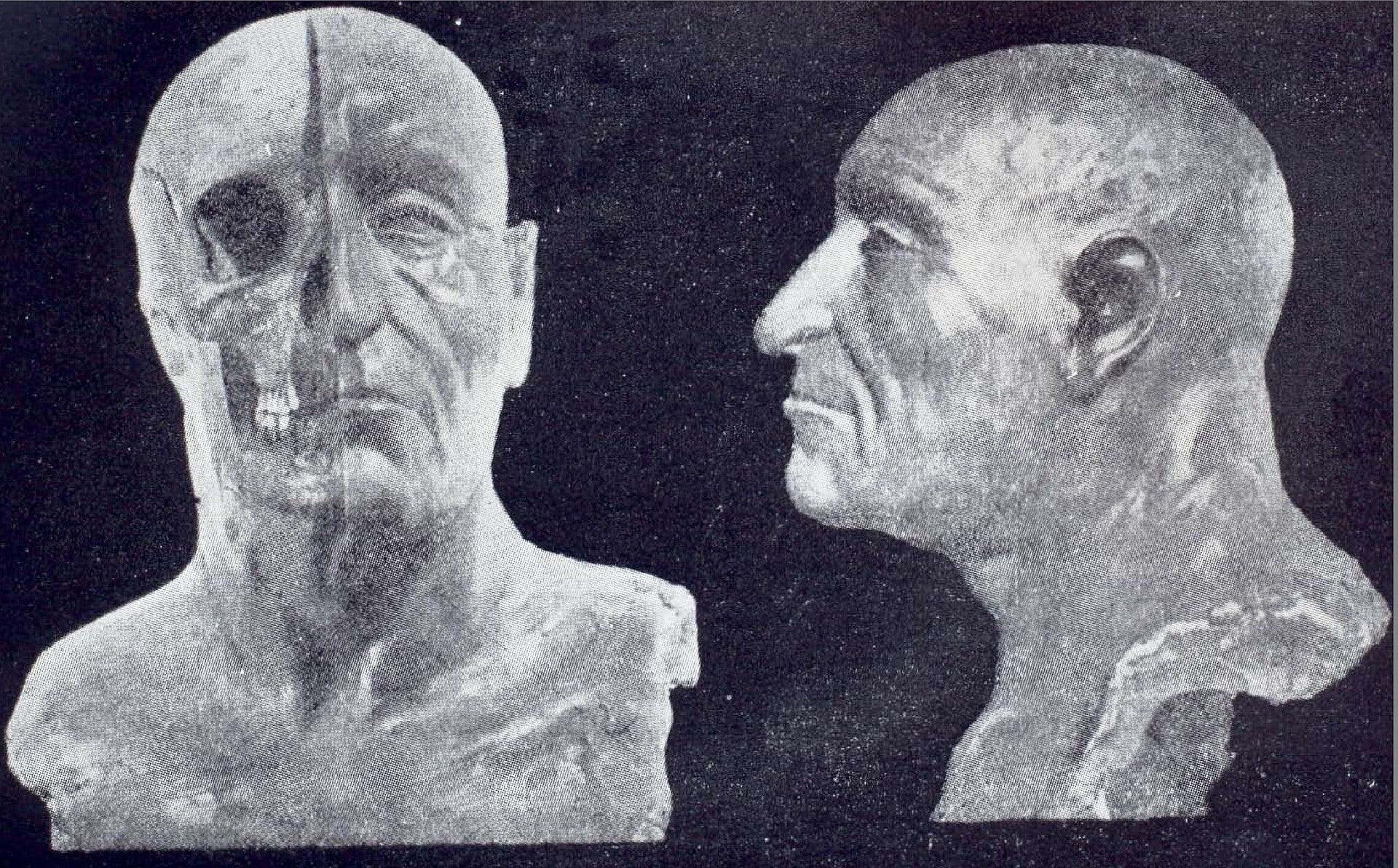
Yaroslav the Wise, a forensic reconstruction by Mikhail Gerasimov, 1940
While the Primary Chronicle does not give the date of the “second” baptism of the Rus - only the year of 988 - 16th-century chronicles state that this event took place on August 1 according to Julian calendar, which falls on August 14 according to Gregorian calendar. In other words, in addition to the Feast of the Procession of the Life-giving Cross, the Feast of the All-Merciful Saviour, the memory of the Seven Brothers Maccabee, and other commemorations, we also celebrate the baptism of the Rus in Kiev.
In accordance with an ancient Byzantine tradition, water is blessed on the first day of every month. This is not always done any longer; and yet on this day, August 1 on Julian calendar, water is blessed in many Russian churches in remembrance of the baptism of the Rus.
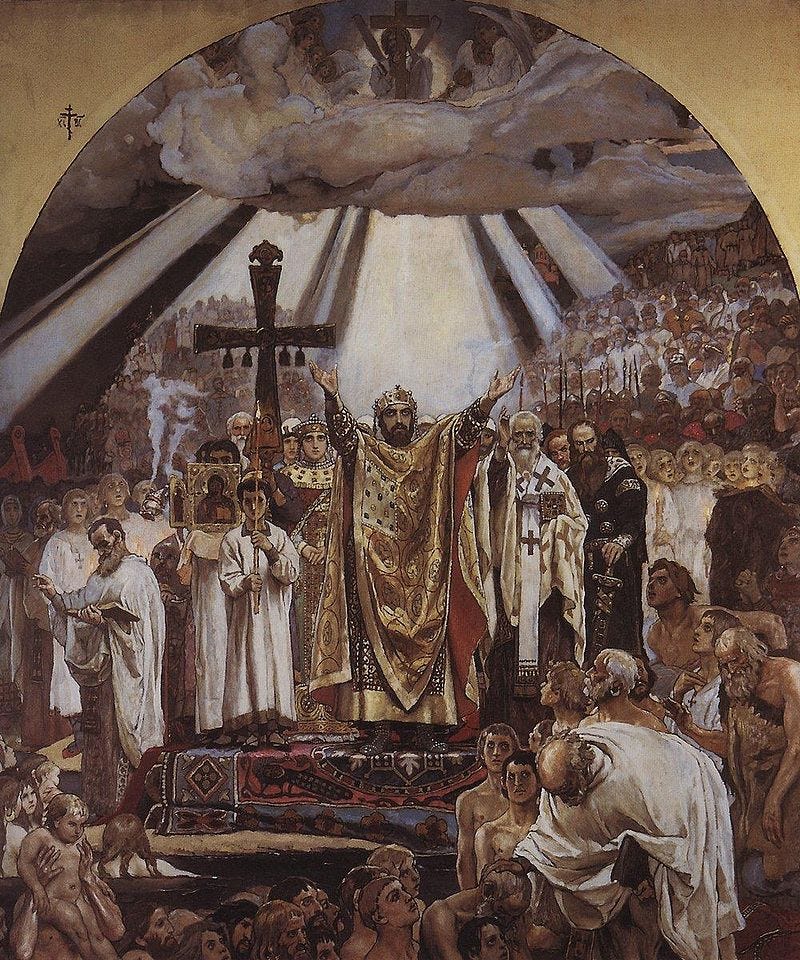
“The Baptism of Rus” by V. M. Vasnetsov, 1895-1896. Saint Vladimir cathedral, Kiev
Last but not least, if you enjoy Phroneo, please share it with your friends and relations. You will not become an enemy of Saint Vladimir if you do not subscribe, but please consider becoming a paying subscriber or gifting a subscription to someone who might appreciate it. This will help a lot.
See the Primary Chronicle, year 6496 (988 AD).
Kantor, Marvin, editor and translator. “The Life of Constantine.” Medieval Slavic Lives of Saints and Princes, University of Michigan, 1983, p. 43.
Canon 18 or 20 in other enumerations.
Comments
Nothing yet. Say the first thing.
Sign in to join the conversation.