
Welcome to this reposting of an episode from “Ask me anything”. If you would like to participate in the discussion or ask a question, please leave a comment or send a direct message. And please share Phroneo with your relatives, friends, and neighbours.
Question: A question about fasting from fruit until the feast of Transfiguration. Before the near year-round availability of fresh fruit, it makes sense that waiting to eat the “first fruits” of apples, peaches, grapes around the Feast of Transfiguration aligned with the growing season. How about now, in the 21st century? Some say we should abstain from eating fruits (specifically apples, peaches, grapes) from the Apostles’ Feast (29 June/12 July) until Transfiguration (Aug 6/19). Others refrain from eating these from the beginning of Dormition Fast until Transfiguration. And then, are we talking about the true first fruits (that is, locally produced apples, peaches, grapes) or whatever is in the supermarket, which may come from a different region? is whatever observance concerning fruit a “lower case” tradition or is it Tradition?
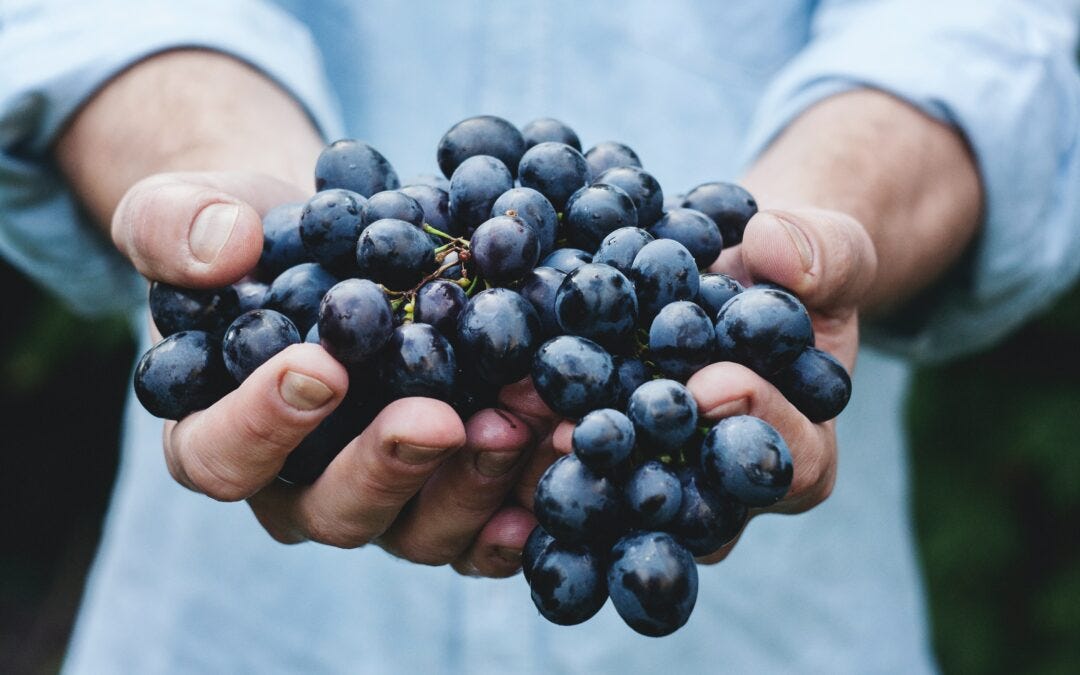
Excellent question! And you are right to be confused. First things first. There is in fact a rule in the Typikon1, according to which, monks may not eat grapes until they are blessed on Transfiguration. The rule is specifically about fresh grapes and concerns the new harvest. Quite naturally, grapes from the previous year’s harvest are processed either into wine or raisins, which are then used to make raisin wine, but this rule is about neither - only fresh grapes. After the grapes are blessed, they are served to the monastic brethren three times per week: on Monday, Wednesday, and Friday.
There is a sentence at the end of that paragraph which is as follows:
The same rule is also for figs and other vegetables: their times are known, whenever each one ripens.
What may be confusing at first glance is the phrase “the same rule.” That is to say, “the same rule” may include the prohibition to eat “figs and other vegetables” until they are brought to the church and blessed. However, the context suggests that the “rule” is simply that as the various fruits and vegetables ripen - each one at a different time, according to its season - they are offered to the brethren three times per week: on Monday, Wednesday, and Friday. For example, the Typikon of Nikephoros Mystikos (1162) speaks about serving fresh figs and melons to the brethren after the Feast of Dormition, because figs and melons ripen later than do grapes:
At the refectory, however, twice or even three times a week after the feast, grapes shall be served up until the time of the vintage; but when figs and melons and other fruits are in season, they shall partake of them also almost every day, if they have any.2
Naturally, it is not palatable to eat figs or melons before they ripen, and thus there is a certain kind of natural “fast” that is observed when there are no fresh figs to be had. But the prohibition against eating fruit until Transfiguration seems to be exclusively about grapes. There is a very specific reason for this rule, but this is not the question at hand.
As Christianity spread to areas where grapes do not grow, it appears that a folk tradition developed to abstain from apples until they are blessed on Transfiguration. This is pure folklore and has nothing at all to do with Christianity, the Church, or theology. However, this practice has become a part of cultural tradition, and some priests seem to encourage it. The inclusion of peaches into this rule, and the various periods during which one should abstain from this “forbidden fruit” is a further elaboration on this folklore. This practice may be harmless enough, and the abstinence may even enhance the pleasure of biting into a juicy peach or apple following the Liturgy on Transfiguration, but there is no support for this dopamine manipulation in Christian theology.
That said, the tradition of offering to God the firstfruits is one of the core tenets found in the Bible. In a recognition that “the earth is the Lord’s, and the fulness thereof” (Ps 24:1), people have been offering the first and the best of what the earth produces to God since the days of Cain and Abel (Gen 4:2-4). The concept is quite simple, really. Everything belongs to God, including the food which He gives to us for our nourishment. That is to say, this is an image (εἰκών) of God feeding us from His table. Therefor, the first and the best must be brought to God’s altar, and only then - we eat from that which remains and has been sanctified by the offering. This rule applied to all mainstay foodstuffs, such as meat, bread, and wine; and partaking of a new harvest or a new flock of lambs was allowed only after the new crop or flock has been sanctified through the offering.3
For example, when Israel settled in the Promised Land, the new harvest was first to be sanctified, before anyone could eat of it (Lev 23:10-14):
Speak unto the children of Israel, and say unto them, When ye be come into the land which I give unto you, and shall reap the harvest thereof, then ye shall bring a sheaf of the firstfruits of your harvest unto the priest:
And he shall wave the sheaf before the Lord, to be accepted for you: on the morrow after the sabbath the priest shall wave it.
And ye shall offer that day when ye wave the sheaf an he lamb without blemish of the first year for a burnt offering unto the Lord.
And the meat offering thereof shall be two tenth deals of fine flour mingled with oil, an offering made by fire unto the Lord for a sweet savour: and the drink offering thereof shall be of wine, the fourth part of an hin.
And ye shall eat neither bread, nor parched corn, nor green ears, until the selfsame day that ye have brought an offering unto your God: it shall be a statute for ever throughout your generations in all your dwellings.
(Note that wine is included in the offerings - this is one connection to the monastic rule about grapes, but there are other reasons as well.)
In other words, nothing of the new harvest was to be consumed until it was sanctified, but foodstuffs from a previous harvest had already been sanctified and could be consumed. This may have included leftover wheat and barley, dried fruits, but perhaps not meat or wine, since meat is difficult to preserve for a whole year, and wine naturally turns into vinegar after just a few months.
The modern world built its supply chains and grocery stores without taking religious principles into account; the main principle of a modern economy seems to be continuous consumption. Indeed, one can purchase any fruit from anywhere in the world in any season, and wine stabilized with sulfates can last for decades without turning into vinegar. Most of us are completely divorced from seasons of food production, harvests, lambing, etc. It really makes no rational sense to buy fruits produced thousands of miles away and bring them to be blessed as firstfruits on Transfiguration. For many people, this tradition has become merely symbolic at best or acquired a hint of superstition at worst. Instead of bringing the firstfruits of their labours as an offering to God, people seem to desire that a cucumber they purchased at the local supermarket magically become a “blessed cucumber”; although, I sincerely doubt that even a skilled theologian could explain what a “blessed cucumber” is with any degree of coherence. In other words, rather than bringing an offering to God, people nowadays wish to receive something from God instead. A more appropriate celebration would include, perhaps, farmers within a community bringing the new harvest to be blessed and sanctified, and for all the faithful to eat of this sanctified food at a common meal, but in today’s Western world - especially, in city parishes - this would be a tall order indeed.
Even more to the point, it may be time to re-envision the entire tradition to include not only the agricultural celebration but something that is also appropriate for office workers, professionals, manufacturers, marketers, and others. (Although, it is difficult to imagine what an AI developer could bring to church as his firstfruits.)
By the way, the historical event of the Transfiguration took place not too long before the Crucifixion - that is to say, in February or March, not in August. Moving the celebration to August likely had a missionary purpose of countering certain Pagan rituals that used to take place at this time of year; but that is a different story altogether.
If you enjoy Phroneo, please share it with your friends and relations. Perhaps, you will consider becoming a paying subscriber or gift a subscription to someone you like (or to someone you do not like). No, this will not really count as your bringing of the firstfruits to the temple, but it will definitely help keep Phroneo going.
Chapter 48, August 6 (folia 368 and 369).
Nikephoros Mystikos, Typikon of Heliou Bomon, ch. 19, in John Thomas and Angela Constantinides Hero, eds., Byzantine Monastic Foundation Documents, vol. 2, Dumbarton Oaks Studies 35 (Washington, DC: Dumbarton Oaks, 2000), p. 1065.
Curiously, quite unrelated to Christianity, there is an old Pagan tradition which is still maintained in some Russian villages of throwing the first piece of meat, the first loaf of bread, and the first mug of wine into a fire as an offering to the various ancestors, deities, and natural forces.
Comments
Nothing yet. Say the first thing.
Sign in to join the conversation.