
Several recent questions for our “Ask me anything” project have touched on the effects of asceticism on health. Indeed, care for our health is a universal human pursuit, and not only in the United States, where healthcare can be so expensive that it can alter the course of a family’s life. The universal human concern for good health stems from the fact that ill health often causes suffering. Thus, intentionally acting in a way that may damage our health is not particularly wise; and the concerns about the effects of asceticism on health are certainly legitimate. Below are some general thoughts on the topic of Christianity, asceticism, and health that add to the context for the discussion.
These thoughts were in response to a talk I attended some years ago, in which a speaker mentioned that many people in America were preoccupied with their bodies more than with their souls. The example he gave was of people who religiously go to the gym, spend many more hours working out than they do praying or attending church services, and spend a lot more money on gym memberships than they donate to the church. By these actions, the speaker proposed, they show what their true priorities are. Perhaps he was right, but this is a common rhetorical device employed by many preachers, and it may be somewhat unfair. People often spend much more on their mortgage or education than they do on a gym membership; even a car payment is usually much larger than a gym membership. In this context, it may not be unreasonable to discuss priorities, but a gym membership rarely if ever rises to the top. Perhaps, some people truly do devote their lives to worshiping their own flesh and meat by becoming “health nuts,” but this hardly describes most people - certainly, not most American Orthodox people or most Americans in general.

For some reason which I do not fully understand, there is a custom among some Orthodox Christians to look down on people who take care of their health, but the very same people do not seem to find it un-Orthodox when someone ruins his health. For whatever reason which also eludes me, it is considered perfectly Orthodox to consume large amounts of starchy, greasy, sugary foods - even during Great Lent. (A vegan triple-dark-chocolate cake is lenten, is it not?) People can spend more money on vegan desserts and fake burgers than they donate to their church or give to the poor, and spend more time on the couch or mindlessly scrolling through Orthodox chat groups than they do in prayer or at church, and somehow no one accuses them of having wrong priorities. Or what about people who buy new cars, while their old car is perfectly serviceable, instead of giving more money to their church? Or what about people who buy many more clothes than they actually need and are convinced that they need a new outfit for every Church holiday? Or what about people whose television sets are the latest and the largest (and the most expensive)? There are so many ways that people waste their time and money instead of praying or feeding the poor or helping the church, that it is rather odd that those trying to stay healthy and to take proper care of their God-given bodies are singled-out for their priorities.
When people do not take care of their health or even damage it through their lifestyle choices, they are not accused of being un-Orthodox. But when people eat healthy foods and go for a jog every morning or exercise at the gym, they are accused of loving their flesh too much. Something is wrong with this thinking. It seems to me that it is the people who suffer from gluttony, laziness, intemperance, and a lack of discipline that are the ones that cater to their flesh. They give in to its desires and pleasures. But healthy eating and exercise take a lot of discipline of the body, mastering of the body, willpower to fight against the demands and urges of the body - in a word, it is very similar to asceticism. It is not an accident that the word asceticism quite literally means “training” or “exercise” and used to mean the training of an athlete preparing for a competition. Everyone who tries to follow a healthy diet will attest to how difficult it is, and how much willpower it takes, and how it is very much like fasting. Everyone who regularly exercises, knows how much effort it takes, but also how much energy it gives in return for being able to pray and attend services. On the other hand, how much effort or willpower does it take to eat a vegan cake or to sit and scroll through Substack? And what spiritual benefit is gained from being overweight or from owning a large-screen television set? Interestingly, the very same people who shy away from diet and exercise also give themselves every conceivable dispensation from fasting and other ascetic pursuits on account that strict asceticism may be bad for their health. I have personally been told by some that they simply could not skip a meal, and that foregoing meat would be bad for their health.
Thus, the more relevant question may be not whether asceticism can be detrimental to our health, but whether a lack of asceticism can. It appears that our bodies have a very strong innate regulator when it comes to deprivations. If we fast too strictly, the hunger will naturally drive most of us to break any fast or diet. If we get too little sleep, we will become very tired to the point of being unable to function. If we make too many prostrations, we will be too sore the next day to do any more of them. But when it comes to abundance, we do not seem to have the same natural governors. Most of us can easily eat too much; and according to statistics, most of us do. It may be difficult to sleep beyond a certain number of hours, but many of us seem to have little difficulty lounging while binge-watching shows or scrolling through other people’s lives on social media. And it is not particularly difficult to do too few prostrations, spend too little time in prayer, or observe too lenient of a fast. Thus, we would do well to worry not about too much asceticism but about too little.
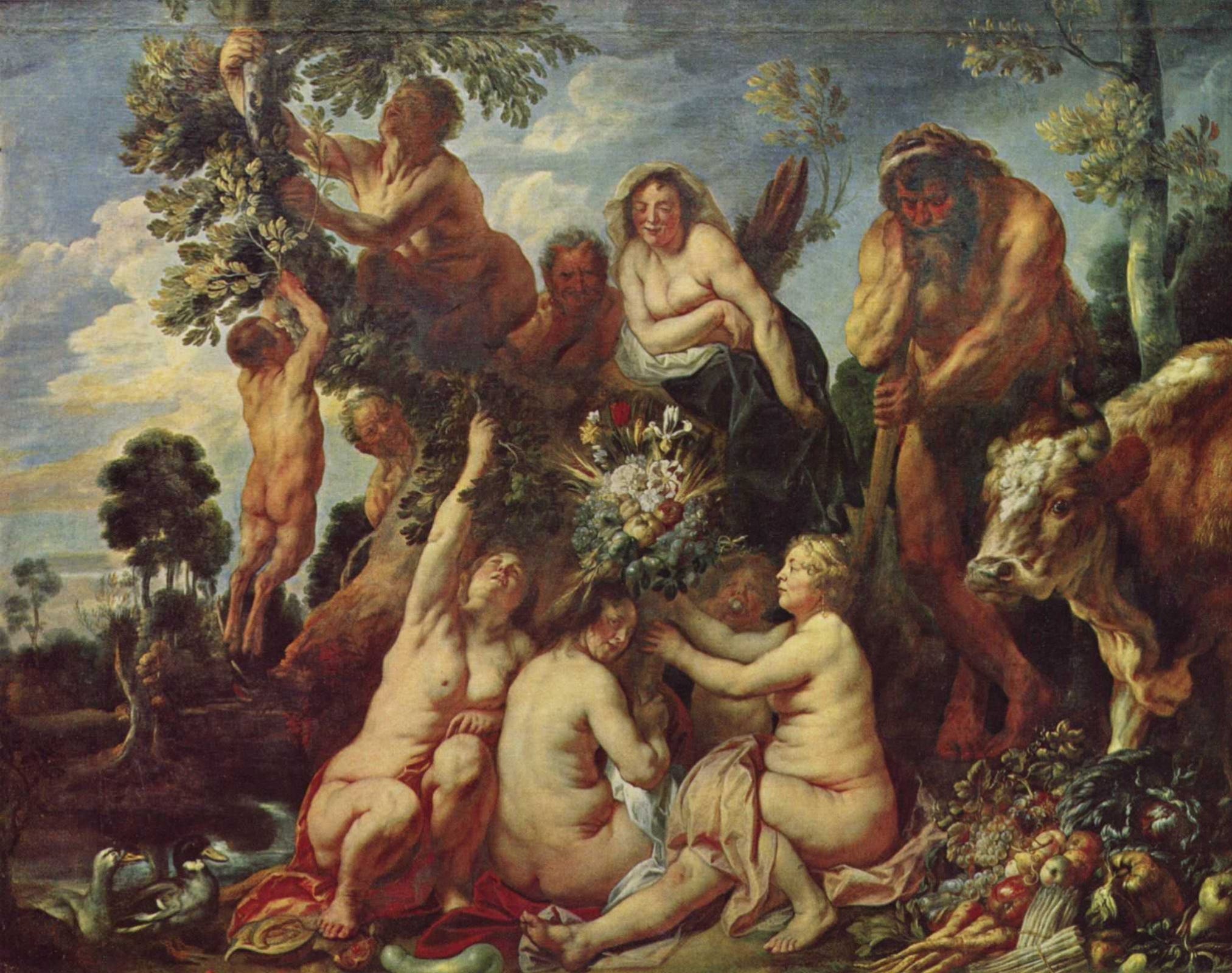
Aheloy and Hercules: the origin of the Horn of Plenty by Jacob Jordaens, 1649
In fact, whether for the sake of good health, sanity, the environment - or for Christ’s sake - we would do well to adopt a worldview and a lifestyle of moderation. This is not solely about food or prostrations; this is about the whole of life, starting with the basics.
Moderation in food - both quantity and quality. If we are not hesitant to feast from time to time or to go for seconds or enjoy desserts, then we should not hesitate to fast from time to time or to skip a meal or two or to forego dessert, as such exercises may indeed be beneficial not only for our spiritual practice but also for our physical health.
Moderation in rest - a proper schedule of rest, including rest from addictive technology; no one has ever said after an hour of doom-scrolling or voyeuring other people’s lives: “This was an hour of my life well-spent.” Most of us should not aspire to spend sleepless vigils in kneeling and prayer, but most of us do not aspire to this anyway. And yet, many people have the experience of regularly sacrificing some of their sleep for a party or a movie or to mindless scrolling. Perhaps, if we are to sacrifice something so precious as restorative sleep, we should consider carefully what we get in return for such a sacrifice; and perhaps, if we decide that sleep is not a priority, replacing it with prayer is better than giving it to social media or mindless video clips.
Moderation in possessions - “Thou fool, this night thy soul shall be required of thee: then whose shall those things be?” (Lk 12:20) Possessions take up space not only in our homes but also in our hearts and minds; they fill our lives with worry and anxiety about acquiring and caring for our things, rather than for our souls. “Lay not up for yourselves treasures upon earth, where moth and rust doth corrupt, and where thieves break through and steal. But lay up for yourselves treasures in heaven, where neither moth nor rust doth corrupt, and where thieves do not break through nor steal. For where your treasure is, there will your heart be also.” (Matt 6:19-21)
And yes, moderation in fasting - we must have enough strength to fulfill obligations to our families and the society. This is hardly a concern for most of us, but if someone finds himself drawn to fasting so much that he is tormenting his loved ones or is unable to properly discharge his duties as a father or a husband due to malnutrition and emaciation, then perhaps he should seek the middle way of moderation.
For some, perhaps - even moderation in prayer; our whole life should be a ceaseless prayer, but what precisely does one hope to accomplish by obsessively rattling off more and more akathists? Once again, this is very rarely a cause for concern for a modern man, and many of us would do well to find more time for prayer.
These are not particularly profound thoughts, and not even particularly Christian. Thinkers of many traditions who contemplated a proper and healthy life agree that moderation is an important key to it. For most of us in the Western world, veering too far into asceticism is rarely a problem which must be addressed. Our modern civilization has prioritized consumption over moderation. Our own governments refer to us as “consumers,” and our economies sputter when we are slow to consume. Our healthcare system is overburdened with diseases of over-consumption and too much leisure, while cases of starvation and physical exhaustion are usually indicative of criminal abuse, rather than a genuine lack or over-zealous self-denial and asceticism.1
Quite clearly, however, statistical averages are not particularly relevant to individual lives. Each man struggles with his own burden, even if those around him do not. Neither consumption nor moderation should be a competition. Just as it is foolhardy to compete with the proverbial Joneses in exhibitionist splurging, it is just as unwise to compete in asceticism. Our only measuring stick should be our own yester-selves. As Jordan Peterson once said: “Compare yourself to who you were yesterday, not to who someone else is today.”2 Despite some other things he may have also said, this one seems like a very sensible piece of advice indeed.
Last but not least, if you are ready to spent less on vegan coffee creamers and fake lab-created burgers, consider becoming a paying subscriber to Phroneo - it is only $5 per month, which is far-less than what one would spend on a “lenten” cake or corn-syrup-drenched honey-walnut shrimp.
It is estimated that $730 billion is spent every year in the U.S. to treat diseases of overconsumption and lack of moderation: high BMI: $238.5 billion, high blood pressure: $179.9 billion, high fasting glucose: $171.9 billion, dietary risks: $143.6 billion, tobacco: $130.0 billion. (Dieleman, Joseph L., et al. “Health-Care Spending Attributable to Modifiable Risk Factors in the USA: An Economic Attribution Analysis.” The Lancet Public Health, vol. 5, no. 10, 2020, pp. e525–e535.)
In comparison, the U.S. spends approximately $100 billion per year on supplemental nutrition or “food stamps.” According to the UN’s Food and Agriculture Organization, it would cost between $7 and $50 billion per year to feed all of the world’s hungry. In other words, the amount of money that Americans spend each year to treat diseases of overindulgence could feed all of the entire world’s hungry people for at least a decade and a half!
Rule 4 of The 12 Rules for Life. While Jordan Peterson has by now said many things, some of which are controversial, I happen to agree with this particular rule.
Comments
Nothing yet. Say the first thing.
Sign in to join the conversation.