
As we have discussed in previous posts, fasting is not a uniquely-Christian discipline, nor is it limited to the last 2000 years of human experience. In an attempt to explore an additional angle on the discipline of fasting, I asked a Muslim friend to tell me about her experience with Ramadan. This interview was in the form of a conversation, and I did not record an audio but took quick written notes. Thus, this post is a recollection of the conversation based on my notes and is not in a question-answer format.
Zeba was born in Delhi to a Muslim mother and an atheist father. Zeba’s father, a Communist politician in India, did not impede his wife’s and his daughter’s practice of Islam, and Zeba grew up a devout Muslim. Zeba’s grandfather was an Muslim hafiz; he lived to be 108 years old, enjoying good physical health and a sound mind until his last, and strictly kept all of the fasts prescribed by his faith (of which, to be fair, there are fewer than those found in present-day Orthodox Christianity).
In Zeba’s recollection, children may begin to fast - in their own peculiar way - when they are 8 or 9 years old. While they do not have to observe the fasts until a few years later, the fact that the adults around them are fasting, prompts their interest in the discipline. The way these young children fast is quite interesting. They are told that they may eat or drink using only one half of their mouth. While this may sound a bit odd, this is first of all a way of developing an awareness; and secondly, it is likely that the amount of food and water consumed by this method is a bit less than the normal average - thus, gently preparing the children toward complete abstinence.
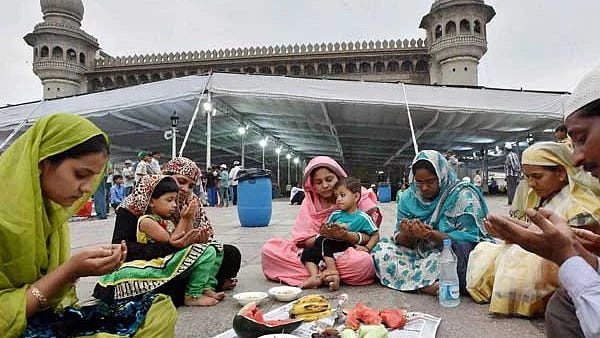
While adults fast during Ramadan, they still cook food for young children as well as for some men who do not keep the fast. Sometimes, this is because men work jobs that make strict fasting impractical; other times, it may be because some men are not as observant as their religion requires - in either case, the instances of breaking the fast remain a private matter and are hidden from extended family and neighbors.
Just as is the case in Christian fasting, those who travel may break their fast, and it is the same with those who may be ill. Unlike in Christian fasting, there does not appear to be such a thing as “relaxing the fast” - one either fasts, or he does not. Observant Muslims make up the missed days of fasting by adding them at the end of the public fasting period.
Starting from approximately 12 years of age, Zeba began fasting the same way as all adult Muslims - that is to say, a complete abstinence from food and water from approximately an hour before sunrise to approximately an hour after sunset during the entire lunar month of Ramadan. When I asked Zeba whether, living in a place where temperatures in April through June range from 25°C to 45°C (77°F to 113°F), she went all day without drinking any water, she said that she did. When I asked whether there were any special considerations for people who live in hot climates, she was a bit surprised by my question and explained that the fast is a complete abstinence, there cannot be any special considerations, one either fasts or he does not. Finally, I asked whether there were any special “tricks” or techniques for going all day without water, Zeba was even more surprised and said that the only technique is to simply not drink water. However, she said that the pre-dawn meal is usually light, consists of foods with a high water content, and excludes fried or spicy foods. Also, if Ramadan falls in the hottest months, there is usually a practice akin to a siesta whereby people take a nap during the hottest hours of the day.
This method of fasting - a complete abstinence from food and drink until evening - is very similar to the Christian discipline as we have discussed in many previous posts and will indubitably continue to discuss in the future. However, unlike in Christian fasting, the nightly breaking of the fast during Ramadan has no restrictions on either the quality or quantity of foodstuffs, and it is not uncommon for people to indulge in joyous feasts night after night. Because of this, according to Zeba, some people manage to gain weight during the month of Ramadan (which is not considered to be a good outcome, since Ramadan should be a time of restraint). As for the time of abstinence, however, not only is one supposed to abstain from food and drink, but one is not even supposed to swallow his own saliva and should spit it out instead. (And according to Zeba, people actually do this.)
There are two other important aspects of the Ramadan fast. One is charity: food is to be shared with the poor or taken to the local mosque where it is offered to all in need. The other important aspect is the study of the Quran. There are 30 chapters or paras in the Quran, and observant Muslims aim to read a full chapter each day of the month of Ramadan.
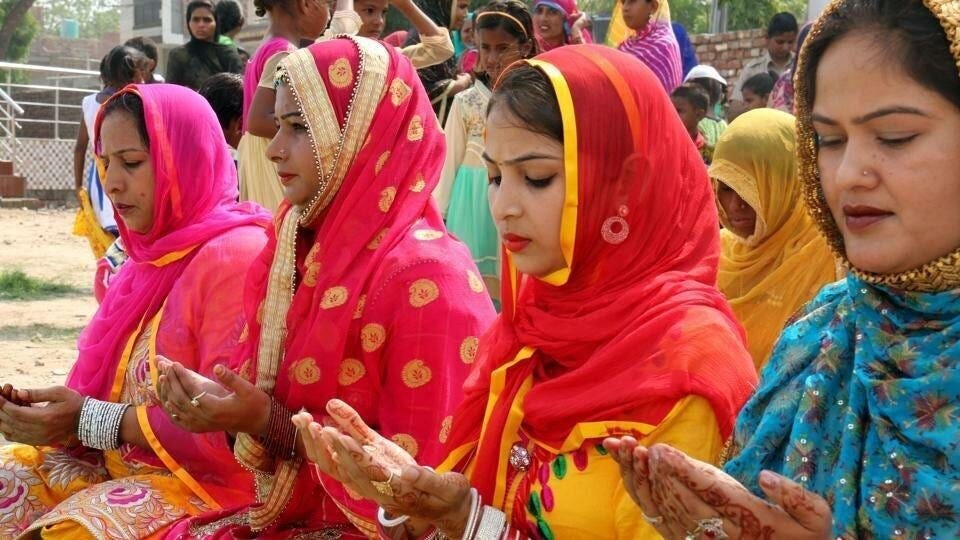
In her late teens, Zeba went to study medicine in Russia. Later, she studied and lived in Türkiye for several years. And now she is finishing a Ph.D. at Yale University. I did not ask whether she kept a strict fast while in Russia, but she mentioned fasting in Türkiye, and that Turkish universities and employers accommodate this religious discipline by allowing for a lighter school- and workload. In Connecticut, Zeba keeps the Ramadan fast by fully abstaining from food and drink as is the rule in her religion.
I found Zeba’s experience particularly interesting in the context of our recent discussion of the Eucharistic fast before the Liturgy of the Presanctified Gifts. It is usually not productive to compare religious practices, the academic discipline of comparative religion notwithstanding, but while present-day Orthodox Christians seem to insist that they are unable to fast for more than 6 hours - even for the sake of partaking of Holy Communion, Muslims living in the same country, studying at the same schools, and working the same jobs abstain from all food and drink for up to 16 hours for an entire month. This became especially poignant when I got the sense from my conversation with Zeba that Islam does not seem to have a culture of dispensations so prevalent in present-day Orthodoxy. Not all Muslims observe the fast, but those who do, seem to “just do it” - no “relaxing” the fast, no dispensations, no vegan-dieting - one either fasts or he does not.
The last interesting bit of information came at the end of our conversation. It turns out that Hindus in India also observe many strict fasts - such as, for example, the twice-monthly Ekadashi - sometimes abstaining from food and drink for 24 to 36 hour. One such fast called Karwa Chauth is practiced by Hindu women who pray for a long life for their husbands. I did not ask for details as this seemed like a reasonable act of a loving wife. But then I realized: in India, there is a practice called sati, whereby a widow burns alive on her deceased husband’s funeral pyre. While officially banned now, this practice appears to have been around for over two millennia, although it may have been most prevalent in the Middle Ages. Isolated cases of sati have persisted into the 21st century. Given this context, it is no wonder that a tradition developed for women to fast and pray for their husbands to live a long, long life - but this is just a guess.
Please support Phroneo by sharing, following, subscribing, or by fasting for 24 hours to ensure that Phroneo enjoys a long, long life. And if you are saving a lot of money by fasting, please consider becoming a paying subscriber - it is only $5 per month. Sure, it is more expensive than what you will pay for street food in Delhi, but still not a bad deal, all things considered.
Comments
Nothing yet. Say the first thing.
Sign in to join the conversation.