
Please enjoy this repost of an episode from the “Ask me anything” project, in which we discuss fasting from sleep. For other episodes, please follow this link. If you would like to participate in the discussion or ask a question, please leave a comment or send a direct message. And please share Phroneo with your friends and relations.
Question: Can you share some of the history of the practice of fasting from sleep in the Orthodox Church?
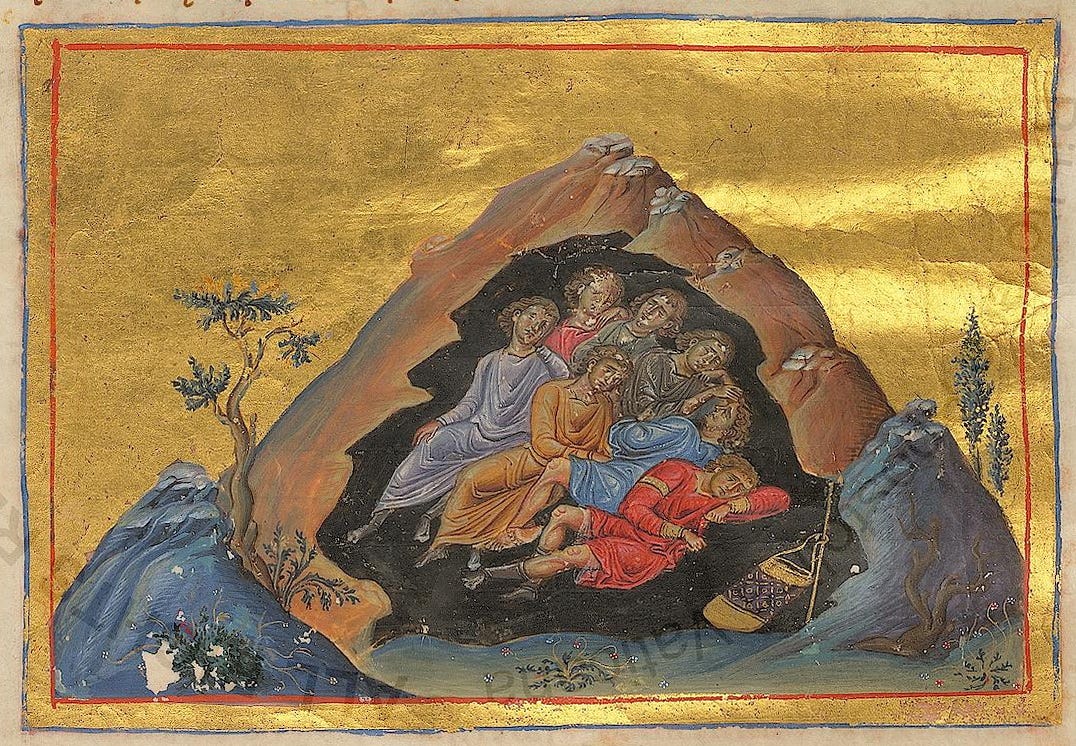
Constantinople. 985. Miniature Minology Vasily II. Vatican Library. Rome.
You are absolutely correct that asceticism as a way of life encompasses the entirety of life, not only dietary practices. Indeed, sleep is one of the areas specifically mentioned both in the Scriptures and in the lives of saints. Some never lay down but rested while leaning against a tree or a stone (Saint Paul of Latros); others - while sitting on a bench or a chair (Saint Arsenii and Saint Isaac of the Kiev Caves); yet others - while leaning on a staff or a couple of walking sticks (Saint Nilus of the Stolobny Island). And, of course, Saint John of San Francisco did not lie down in a bed for more than 40 years. Examples are too numerous to exhaust, but here are just a few.
Saint Bessarion of Egypt who lived in the second half of the fourth century was known for feats of extreme asceticism: he ate only once a week and slept very little, never lying down but only while standing or sitting. It is said that, at least once, he prayed for forty days neither eating nor sleeping the entire time. He lived to a very old age.
When Saint Akakios of Kafsokalyvia (Akakios the New or the Younger) was asked how much sleep a monk should get, he replied that half an hour a night is enough. Some say, however, that Saint Akakios slept an hour; others - that he slept four hours. Perhaps, both testimonies are correct, and the saint practiced different degrees of asceticism at different times in his very long life.
Saint Silouan the Athonite slept in 15-20-minute increments for a total of about two hours per night.
The Venerable Gerasimos of the Iveron Monastery kept a vigil all night each time before serving a Liturgy in the morning.
Saint Theodore the Studite said that four or five hours of sleep is enough for a monk.
Finally, Saint Gregory Palamas, it is said, spent three months without sleep. In the end, he had to forsake this practice in order not to damage his mind.
One important thing to note about all of these examples is that the goal for these ascetics was not to stay awake as such but to remain in prayer. In other words, we do not find examples of saints denying themselves sleep for the sake of reading a novel, browsing Instagram, or watching Netflix. Another important thing to note is that, while numerous in absolute terms, these are still very rare examples in the two-thousand-year history of Christian asceticism. While some ascetics may indeed say when asked that an hour of sleep is enough, no monastic rule actually demands this of anyone - just as no rule demands that monks eat only once a week as some have done, or make three thousand prostrations each night. I am not a monk and may be mistaken, but it seems that most monastic rules allow for between five and seven hours of sleep each night.
Interestingly, some data suggest that Americans today get an average of 6.5 hours of sleep, and one in five Americans gets less than 5 hours. In other words, it may very well be the case that for many people, fasting from sleep should not be a priority.
In general, when discussing asceticism, it may be necessary to define terms. What many Christians nowadays consider an ascetic exercise is in reality merely a slight inconvenience produced by a voluntary temporary abstinence from some of the luxuries of modern life. Then, there is asceticism proper, which is an actual restriction on our physiological needs - for example, eating less, not less meat, but just less. And then, there is what I would call extreme asceticism - eating only once a week, sleeping one hour each night, owning only one thread-bare robe, etc. As with most other human pursuits, extreme asceticism requires a special calling and a special talent, it is not for everyone.
If we were to apply this model to sleep, then maintaining a proper sleeping schedule and not lazily lounging in bed is step one. Step two is, perhaps, waking up 30 minutes earlier in order to spend more time in prayer. Step three may be sleeping for no more than five hours each night, or never lying down in bed, or some other such feat; it seems self-evident that only a few should experiment with this and only as an experiment - being ever-vigilant of their sanity and ready to return to more appropriate schedules, as did Saint Gregory Palamas.
Humans are incredibly resilient, but it is not altogether impossible to damage one’s health through overly-zealous asceticism. Saint Gregory Nazianzen in a letter to Saint Basil the Great recalled their youthful experimentation with asceticism at Basil’s hermitage in Pontus, and how if it were not for Basil’s mother, they would have perished:
Your roofless and doorless hut, your fireless and smokeless hearth, your walls dried by fire, that we may not be hit by the drops of the mud, condemned like Tantalus thirsting in the midst of waters, and that pitiable feast with nothing to eat, to which we were invited from Cappadocia, not as to a Lotus-eater’s poverty, but to a table of Alcinous — we young and miserable survivors of a wreck. For I remember those loaves and the broth (so it was called), yes, and I shall remember them too, and my poor teeth that slipped on your hunks of bread, and then braced themselves up, and pulled themselves as it were out of mud. You yourself will raise these things to a higher strain of tragedy, having learned to talk big through your own sufferings...for if we had not been quickly delivered by that great supporter of the poor — I mean your mother — who appeared opportunely like a harbour to men tossed by a storm, we should long ago have been dead, rather pitied than admired for our faith in Pontus.1
Saint John Chrysostom, during his time in Antioch, went to live in nearby mountains where he practiced extreme asceticism, including sleep deprivation. After approximately six years of this life, John’s health deteriorated to such a degree that he was forced to abandon his ascetic pursuits and returned to Antioch, where he was soon ordained a presbyter. Saint John’s stomach and kidneys, however, were permanently damaged, and he struggled with poor health caused by overly-zealous asceticism for the rest of his life.
One may note that illness caused by extreme asceticism did not prevent Gregory, Basil, or John from becoming great saints, or perhaps actually aided in their path to sanctity. This may be so, but there were likely many others of whom we know nothing at all, because they perished by not eating and drinking or damaged their mind by not sleeping. An extreme athletic training program is best followed under the watchful eye of an experienced trainer; in much the same way, extreme asceticism may be best experimented with under the guidance of someone who has had a lot of personal experience with such things, not someone who has read a few books about the Desert Fathers. Anyone can dabble in asceticism, but extreme deprivation should not be attempted without proper supervision for more than a short period. It is reported that Saint Seraphim of Sarov recommended getting at least five hours of sleep each night, and two of the five should be before midnight. It is not always easy to separate real words of Saint Seraphim from pious literary fiction, but this seems to be a sensible piece of advice.
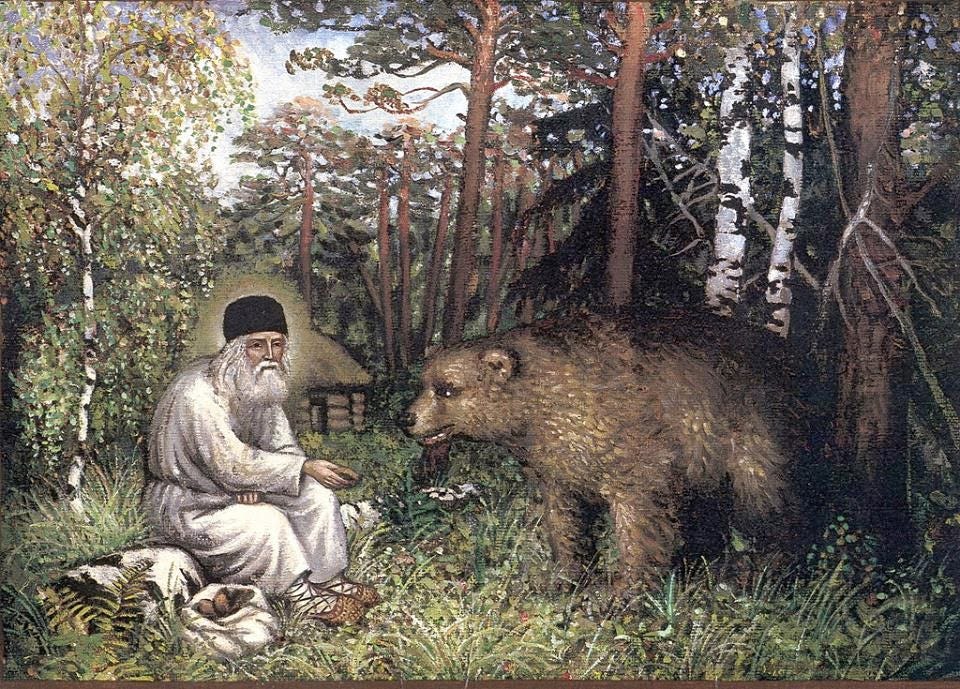
Saint Seraphim of Sarov
Last but not least, perhaps you cannot always get eight hours of sleep, but you can always subscribe to Phroneo - it is only $5 per month. And if you are saving money by fasting, consider gifting a subscription to a good friend who can keep an eye on you as you experiment with fasting from sleep. And as always, please share Phroneo with your friends and relations - this will help a lot. Thank you.
In different editions, this letter is numbered 4 or 5 or 8. It is Gregory’s reply to Basil’s letter 14 written circa 361.
Comments
Nothing yet. Say the first thing.
Sign in to join the conversation.