
The Gospel of Matthew, chapter 14:
22 And straightway Jesus constrained his disciples to get into a ship, and to go before him unto the other side, while he sent the multitudes away.
23 And when he had sent the multitudes away, he went up into a mountain apart to pray: and when the evening was come, he was there alone.
24 But the ship was now in the midst of the sea, tossed with waves: for the wind was contrary.
25 And in the fourth watch of the night Jesus went unto them, walking on the sea.
26 And when the disciples saw him walking on the sea, they were troubled, saying, It is a spirit; and they cried out for fear.
27 But straightway Jesus spake unto them, saying, Be of good cheer; it is I; be not afraid.
28 And Peter answered him and said, Lord, if it be thou, bid me come unto thee on the water.
29 And he said, Come. And when Peter was come down out of the ship, he walked on the water, to go to Jesus.
30 But when he saw the wind boisterous, he was afraid; and beginning to sink, he cried, saying, Lord, save me.
31 And immediately Jesus stretched forth his hand, and caught him, and said unto him, O thou of little faith, wherefore didst thou doubt?
32 And when they were come into the ship, the wind ceased.
33 Then they that were in the ship came and worshipped him, saying, Of a truth thou art the Son of God.
34 And when they were gone over, they came into the land of Gennesaret.
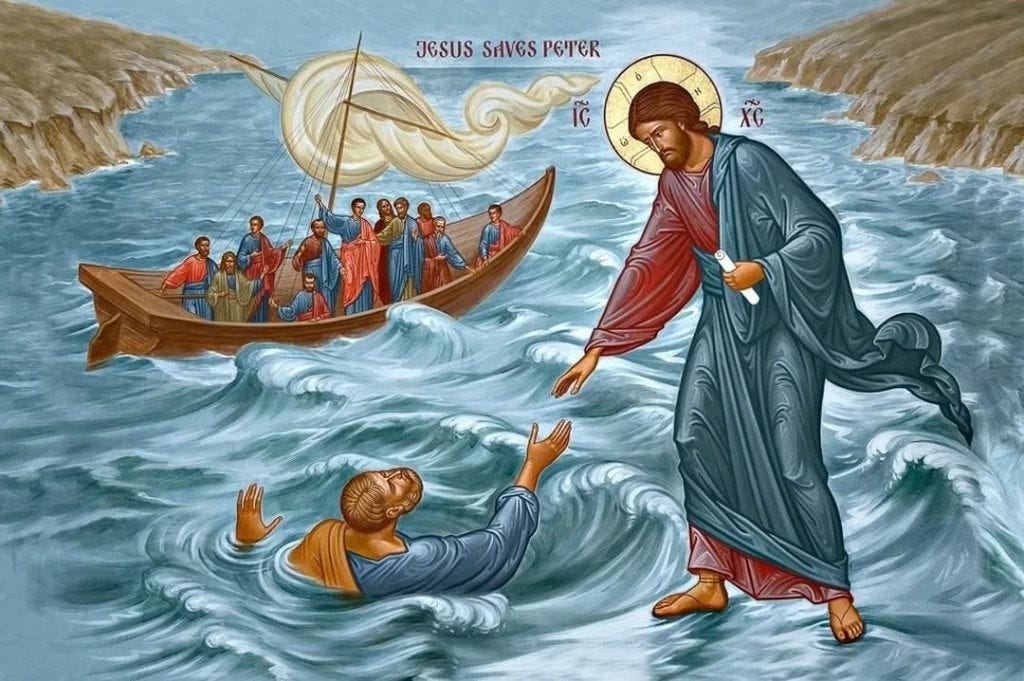
In reading today’s Gospel passage, many of us may be understandably drawn to the image of Christ walking on water. Yet for the ancients, such things as God, or gods, or prophets walking on water, or flying through the air in a fiery chariot, or sailing inside the belly of a fish were not at all supernatural. In fact, the word supernatural is not found in the Scriptures. In our worldview, we have divided phenomena into those we can dissect or natural and those that defy our theoretical analysis or supernatural. The ancients did not often bother with theoretical analysis; to their mind, the world was whole, and a god walking on water was as much a part of the natural order of things as was a star pointing the way to the newly-born Christ. To be sure, speaking donkeys or a few loaves and fishes multiplying to feed a crowd of several thousand were not very common events; they reminded people that God intervened in their affairs, and they marveled at that (Ps 118:23). But it was not altogether unexpected that the One who gave sight to the blind and raised the dead from their graves would also walk on water as if it were dry land. This passage is not about that. It is about the iconography of all things pointing to Jesus as the Son of God; and also, it is about Peter - and through him, about us.
The image of the Lord’s disciples in a ship, “in the midst of the sea, tossed with waves,” unmistakably points to the Church - that is, to us - in the midst of the sea of life, buffeted by a contrary wind.
Christ comes “in the fourth watch of the night” - that is to say, early in the morning (the fourth watch is between 3 am and 6 am); and this points to both the prophetic writing about God’s help which comes in the early morning and to Christ’s resurrection, through which salvation came to all the world.
Ps 143:8 - “Cause me to hear thy lovingkindness in the morning; for in thee do I trust: cause me to know the way wherein I should walk; for I lift up my soul unto thee.”
Isa 17:14 - “And behold at eveningtide trouble; and before the morning he is not.”
Matt 28:1 - “In the end of the sabbath, as it began to dawn toward the first day of the week, came Mary Magdalene and the other Mary to see the sepulchre. And, behold, there was a great earthquake: for the angel of the Lord descended from heaven, and came and rolled back the stone from the door, and sat upon it.”
We should remember that the first readers and hearers of the Gospel knew the Scriptures very well and recognized the references to which the author is alluding. When they heard that Jesus came to His disciples walking on water, they undoubtedly recalled the words from the Book of Job, chapter 9, verse 8: “[God] alone spreadeth out the heavens, and treadeth upon the waves of the sea.”
Yet in the dark, in the middle of a stormy lake, the disciples, whose hearts were hardened (Mk 6:52), thought that they were seeing a ghost and were troubled and afraid. Christ calmed the storm in their minds by revealing to them yet again who He was: “It is I” - “ἐγώ εἰμι.” It is not completely clear in English, but the Greek ἐγώ εἰμι is a way of conveying the sacred name of God - “I am” (Ex 3:14).1 Consider a scene from the Gospel of John, chapter 18, verse 4 through 6: “Jesus saith unto them, I am he (ἐγώ εἰμι). And Judas also, which betrayed him, stood with them. As soon then as he had said unto them, I am he (ἐγώ εἰμι), they went backward, and fell to the ground.” These were Jews, “a band of men and officers from the chief priests and Pharisees” (Matt 14:3), the temple guards, who came to arrest Jesus; and when they heard the sacred name of God: “I am that I am” - they stepped back and made a prostration, as pious Jews should do any time that they hear the name of God spoken.2
Thus, when Jesus came into the ship and calmed the storm - “He maketh the storm a calm, So that the waves thereof are still.” (Ps 107:29) - and upon hearing the divine name of God, the disciples “worshipped Him [προσεκύνησαν αὐτῷ - “bowed, made a prostration”], saying, Of a truth thou art the Son of God.”3 In these ways, the Scripture tells us who Jesus is. But what about us? Who are we in this story?
What is somewhat unusual in this account is what happens to Peter. The idea that God can miraculously cause a man to walk on water is not any more unbelievable to the ancient mind than that He can cause a donkey to speak (Num 22:28) or turn water into wine (Jn 2:3-10). But this is not quite what happened. The walking on water is not a miracle performed by God - for if this were so, Peter surely would not have begun to sink - but an image (εἰκών) of a sacrament: God says, “Let it be so,” but in order for it to be so, man must co-labour with God. Unlike a miracle, a sacrament requires a full and willing participation of man.
Perhaps, man is the weakest link in this relationship; perhaps, man lacks faith, is full of doubt, and begins to sink almost immediately every time. But if he has ever walked on water - even just one step, yea, even half a step - then he knows that it is possible, he knows that God is near, and that His kingdom is at hand. This is why we should never despair, even when we are sinking. Our failure to make more than one small uncertain step on water is not a lack of faith but a presence of it - albeit, imperfect: “Lord, if it be thou, bid me come unto thee on the water. And he said, Come. And when Peter was come down out of the ship, he walked on the water, to go to Jesus.” A man who lacks faith would not be eager to get out of the boat during a storm, and he certainly is not able to make even one step!
God gives us the power to tread on the waves that buffet our lives and on every lion and adder (Ps 91:13), but He does not expect that we will never fail. Every child must first crawl, then walk - stumbling and falling at first - and only later - run; and every Christian will stumble at times or begin to sink. And just as a child can be assured that his parents will lift him up when he falls - even more so, a Christian can be assured that God’s help is near, and His right hand will hold him up (Ps 18:35).
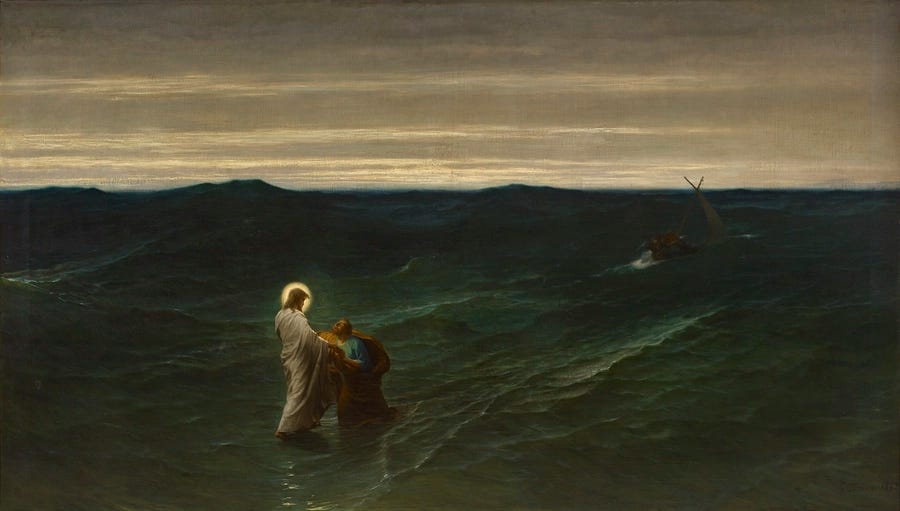
Jesus et Pierre Sur Les Eaux (Jesus and Peter on the Water), by Gustave Brion, 1863
Thus, the most important lesson that the Gospel presents to us is not that God can walk on water, or that He can calm a storm, but that through Christ, we also shall not fear the tempest which tosses us (Isa 54:11), but must cry out like Peter: “Lord, save me,” and the Lord will raise us up (Matt 14:31), and the wind will cease (32).
The present-day scholarly consensus is that the sacred name of God, YHWH, is likely pronounced as Yahweh (see, for example, Шифман, И. Ш., пер. и коммент. Учение. Пятикнижие Моисеево. Республика, 1993). Some linguists have argued that the meaning of this name is not simply “I am” or “I am that I am,” but rather, “I am that I am [with you].” (See Buber, Martin, and Franz Rosenzweig, translators. Die Schrift. Zweites Buch: Schemot (Exodus). Schocken Verlag, 1936, and Buber, Martin. Moses: The Revelation and the Covenant. Harper, 1958.) In other words, the verb in this construction points not to being as such but being in relation. In other words, God says that His nature as such cannot be known by us; all that we can know about God is what He reveals to us in His relationship with us. In Greek, in order to denote that what is being said is not a colloquial “it is I” but the name of God, the common εἰμι, which already means I am, is redundantly paired with ἐγώ. In English, making such a distinction does not seem possible without adding an explanation.
See Brown, Raymond E. The Gospel According to John I–XII. Yale University Press, 1966, and Barrett, C. K. The Gospel According to St. John: An Introduction with Commentary and Notes on the Greek Text. 2nd ed., Westminster John Knox Press, 1978.
For a scholarly treatment of the title “Son of God,” see Collins, Adela Yarbro, and John J. Collins. King and Messiah as Son of God: Divine, Human, and Angelic Messianic Figures in Biblical and Related Literature. William B. Eerdmans Publishing Company, 2008, and Hurtado, Larry W. Lord Jesus Christ: Devotion to Jesus in Earliest Christianity. William B. Eerdmans Publishing Company, 2003.
Comments
Nothing yet. Say the first thing.
Sign in to join the conversation.