
You’re at the skatepark because you’re super cool, and you’re standing at the top of a ramp when you drop your skateboard. You roll your eyes because you know exactly how this goes: the skateboard rolls down the ramp, up the other side, and then back down to rest in the middle where you (embarrassing) have to go grab it. If only it could teleport to the other side where you can grab it quickly and easily without anyone seeing you.

What if I told you this is exactly how quantum tunnelling works? Things disappear where they are and reappear where it is impossible for them to be, like on the other side of a ramp. Sounds like magic? Sounds like quantum.
Let's get into it.
Before we get into quantum tunnelling, let's review some basic chemistry.
Atoms are the smallest particle of an element and are characterized by the number of protons they have. A helium atom is a helium atom because it has two protons; a potassium atom is a potassium atom because it has 19 protons. If they were ever to lose even one of those protons, they wouldn’t be the same element anymore.

However, this is almost impossible to achieve by external force because the strong nuclear force holding atoms together—as the name suggests— is very strong and requires a lot of energy to overcome.
Unless you’re radioactive, of course.
Radioactivity is the phenomenon where inherently unstable elements spontaneously do release protons and neutrons and “decay” into other elements. Henri Becquerel, Marie and Pierre Curie discovered in 1896 that atoms like radium, polonium, and uranium sometimes just give up or emit protons and neutrons called alpha-particles to gain stability.
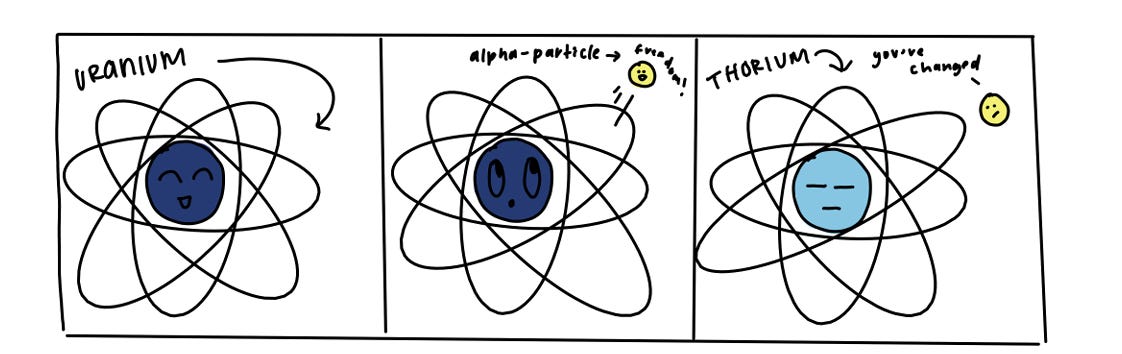
It was only years later in 1928 that George Gamow used quantum theory to suggest the internal mechanism for radioactivity. As I mentioned previously, atoms don’t just lose protons and neutrons: there is an energy barrier keeping those particles in place, and those particles would need a certain amount of energy to overcome that barrier. Gamow found uranium’s emitted alpha-particle had nowhere near the energy it needed to get over the energy barrier, but was still somehow escaping the uranium atom. Even though it didn’t have enough energy, the alpha-particle kept showing up where it wasn’t supposed to reach.
If the alpha-particle was our skateboard, it would be rolling down the ramp, rolling up the other side and then disappearing into the ramp before popping out on the other side. While that would be nice for our dignity, that’s not how it works. Or is it?

Gamow theorized quantum tunnelling could explain it. A particle can use its dual matter-energy nature (see Super...position?) to tunnel through the energy barrier instead of getting over it. In its escape from the uranium atom, an alpha-particle behaves like a wave, gives up some of its energy to tunnel through the energy barrier, and then remerges on the other side as a particle again. If the particle was our skateboard, we would be able to send it down the ramp and have it pop out the other side just where we’d like it.
Though it sounds like magic, quantum tunnelling takes advantage of the probabilistic nature of the universe (see Entanglement). Probability-wise, our skateboard has a non-zero chance of tunneling, but the probability of a skateboard going through ramp is so low we will probably never see it happen. For our alpha-particle however, the probability of uranium decaying is high enough for us to see it happen every once in a while.
Photosynthesis is another surprising example of quantum tunnelling on the macroscale. We know that plants get their energy from the sun, but what you might not know is that when plants absorb light, they are absorbing little packets of energy called photons, which transfer their energy to electrons in the plant. The electrons are then responsible for spreading that energy throughout the plant by way of an electron transport chain, which operates by quantum tunnelling. Electrons disappear in one spot and reappear in another to get the plant the energy it needs efficiently.

Quantum tunnelling doesn’t just happen at the atomic level. A Josephson junction is a part of a quantum computer that uses tunnelling to function; electrons essentially hop from one superconductor to another across an insulator. Superconductors and how they work is another story, but how electrons move from one to the other boils down to quantum tunnelling on a macroscale. Josephson junctions are fundamental components in superconducting circuits and important for the future of building quantum computers.
Enjoyed this article??? Interested in supporting more fun science content?? Buy me a coffee here!
No posts
Comments
Nothing yet. Say the first thing.
Sign in to join the conversation.