
Did you notice?
Amid everything in the news right now, I wouldn’t be surprised if you hadn’t.
Things seem to be taking a turn for the rather sticky at the moment and current developments in science might be falling under the “crazy sh*t I never expected” tab in your brain along with everything else.
While it's true some of these developments should fall under “crazy sh*t I never expected” (looking at you Majorana-1 chip ) I’m here to tell you the current state of scientific progress is actually really exciting and worth keeping up with if you’d like to follow society’s positive progress.
What I’m talking about (and what everyone is talking about) are the developments in quantum computing. The cooler cousin of AI, quantum computing will likely be the next culture-bending technology unleashed into our world; whether in five years or fifty, it has the potential to change almost everything about the way we solve problems with computers.
This article introduces the three major building blocks of quantum computing—theory, software, and hardware—and explains what makes it so revolutionary. By the end, I hope you will have the information you need to better understand what's happening on the news (and maybe even laugh at quantum jokes).
Ready? Let’s get into it.
Quantum computing is a new era of computing that uses quantum mechanics to solve problems that fall outside a classical computer’s abilities.

Simulating complex systems, finding the best option out of a large set, or factoring really large numbers are all the kinds of problems classical computers can’t solve, but quantum computers can.
For example, finding a molecule that can be used as a new drug is a “best option out of a large set” problem. Any one set of atoms has multiple arrangements that can change its nature or function, and the number of those arrangements (called configurations) only increases exponentially with the number of atoms. Figuring out the right configuration for a molecule to be a functional drug when it has, say, 100 atoms is a long and laborious process that can take years and years of trial and error. Classical computing can speed up the process by simulating possible configurations of that molecule, but that can still take weeks or months. Quantum computing can get it done in seconds. Think about it like this: if a classical computer tries to find the right answer behind 100 closed doors by opening every one, a quantum computer can do it by opening all the doors at once. How?
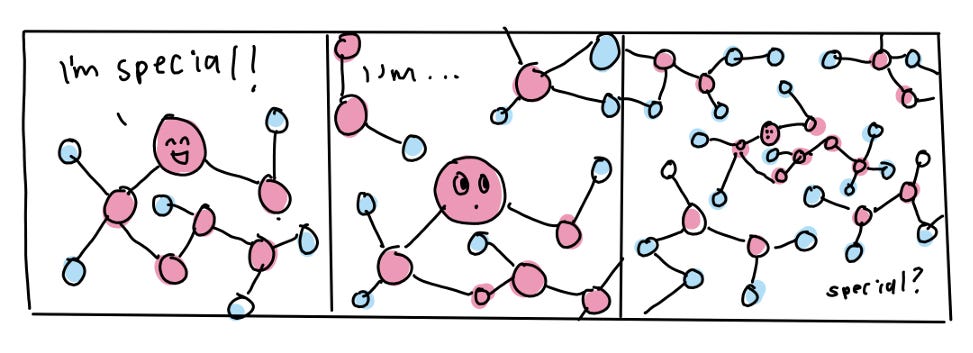
The answer lies in superposition, or a quantum concept meaning a state between two states. In superposition, things aren’t considered to be one or the other, they are technically both at once. So 100 doors in a superposition would be both open and closed at the same time and would immediately reveal where the right answer is.
For our molecule, this means checking all possible configurations simultaneously. We could come up with the right one a lot faster.
But how do we get there?
The idea behind quantum computing started over a hundred years ago in the early 1900s when it became clear that classical physics was no longer accurately describing physical reality. The equations and theories the OGs like Newton and Maxwell had developed fell short when it came to describing natural phenomenon detected in the double slit or the photoelectric experiments.
While physicists had always assumed particles and waves were two completely different things—matter and energy—evidence was slowly accumulating that they were actually one thing. Einstein proposed that light was released in “quanta”, or particle-like bursts of energy and DeBroglie found electrons behaved like waves.
This discovery led physicists to come up with a new interpretation of reality to address the newly-realized nature of the universe—quantum mechanics.

The principles that fell out of this new interpretation, superposition, entanglement, tunnelling, opened a door to a new way of thinking about computing.
Quantum software developed during the 1990s was the next step in quantum computing. Building on quantum theory, mathematicians like Lov Grover and Peter Shor came up with algorithms to bypass the limits of classical computing.
Grover’s algorithm uses superposition and probability to search through large amounts of information for one right answer by doing what classical computers cannot: it places qubits (quantum bits—or binary digits, 0 and 1) into a state of superposition and amplifies the right state to give us our answer. It does what I mentioned earlier—it opens all doors at once and makes the one with the right answer the most likely to stand out.
His algorithm solves the “picking a right option out of a large set” problem, which is extremely exciting for chemists and biochemists, and anyone interested in simulating new molecules. One industry in particular—pharmaceuticals—is eagerly awaiting the implementation of Grover’s algorithm.
Shor’s algorithm is another quantum algorithm that solves the “factoring really large numbers” problem with game-changing implications for another massive industry. This time, finance.
A large portion of the world’s financial information is secured with an encryption based on un-factorable numbers. Factoring numbers is like reverse multiplication: one number created by multiplying two others together can be reverse-engineered to figure out what those original two numbers were. When the numbers multiplied together are enormous and prime, reverse-engineering the original two is practically impossible. This is why a lot of cybersecurity for finance was built around these un-factorable numbers—they should be un-factorable.
Except Shor’s algorithm, with a combination of superposition and something called a Quantum Fourier Transform, could efficiently factor any number. Even the ones thought impossible.

Obviously, this raises some concern in the finance and cybersecurity industry, but luckily, (or unluckily?) there is no reason to fear quantum computers just yet.
While quantum theory and quantum software have been thoroughly researched and are ready to go, the bottleneck for quantum computing turns out to be the computer itself. The actual hardware is what researchers and scientists all over the world are working on right now.
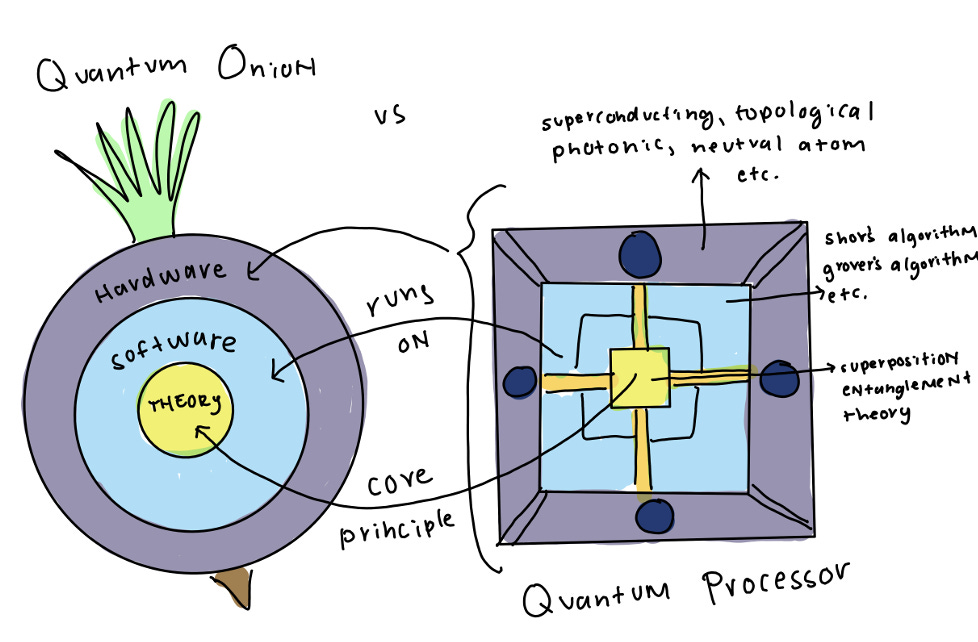
While “quantum computing” refers to the whole field—theory, software, hardware—a “quantum processor” refers to the piece of machinery that does the computing. There are a ton of different ways to build it, and every major tech company is using their own approach, but the overarching structure for each one is the same.
The qubit is at the center of the quantum brain. It is like a classical bit, except it is capable of quantum behavior like superposition and entanglement. Instead of storing information in either 1’s or 0’s, it stores it in both simultaneously, and instead of being independent of other bits, qubits are interconnected to each other through entanglement. These properties allow quantum computers to make calculations fast, but they also make them difficult to build.
In order to maintain their information, qubits have to remain in superposition and entangled all the time. This is difficult for two reasons. First, mere observation collapses a qubit from of superposition; they can’t even be measured without losing the property that makes them useful. Second, since they are all entangled, if one qubit collapses, they all collapse. The result is a system that is very, very sensitive.
Building qubits with these conditions is difficult enough, but building qubits that can maintain them is downright excruciating. That’s where most of the work is being done right now: making qubits that don’t fall out of superposition (decohere), ones that can self-correct (error-correction), and making a lot of them (scalability).
So far there is no one, right, clear way to do it. Scientists all over the world are trying to figure out the best way to build processors that meet all the requirements outlined above. But it is hard. So that’s why it is always in the news. And that’s why it is always exciting to see the progress being made.
The race is on.
Every big tech company and institute around the world is trying to make a practical quantum computer before anybody else does. There are a ton of different ways to do it—superconducting, photonic, neutral atom, even topological—and each one has its drawbacks and benefits, with no clear winner yet.
The latest major developments have been Zuchongzhi 3.0, the University of Science and Technology of China’s quantum processor, built to rival Google’s, and Microsoft’s Majorana-1 Topological Qubit, which may or may not exist. Who’s to say?

The field is always developing, and there is always something new to learn. Let quantum computing be the fun piece of news you look forward to every day and subscribe to my newsletter to join me as I stay updated with everyone else’s business and post it online for other people to enjoy.
See you next time!
Enjoyed this article??? Interested in supporting more fun science content?? Buy me a coffee here!
No posts
Comments
Nothing yet. Say the first thing.
Sign in to join the conversation.