
Your heart just beat.
Your lungs just expanded.
Your brain just processed that sentence.
None of it happened because you decided to make it happen.
It happened because your cells are constantly exchanging electrical signals, firing in precise rhythms, passing messages faster than any thought you can form.
And none of it works without a group of minerals most people only think about when they’re cramping after a run or recovering from a stomach bug.
Electrolytes.
The word sounds clinical. Scientific. Like something that belongs on a sports drink label rather than in a conversation about how your body keeps itself alive.
But the story of electrolytes is actually the story of how your body generates electricity, maintains order, and keeps every organ doing exactly what it’s supposed to do.
And it is one worth understanding.
The name comes from the Greek word for amber, which the ancient Greeks rubbed to generate static electricity.
When scientists later discovered that certain substances dissolved in water could conduct electrical current, they borrowed the same root word.
Electrolytes are substances that, when dissolved in water, break apart into electrically charged particles.
Those charged particles are called ions.
And your body runs on them.
Atoms are made up of protons, neutrons, and electrons.
Protons carry a positive charge. Electrons carry a negative charge. Neutrons carry none.
In a neutral atom, the number of protons and electrons is perfectly balanced.
But some atoms gain or lose electrons when they dissolve in water.
When that happens, the balance tips.
An atom that loses an electron now has more protons than electrons. It becomes positively charged.
An atom that gains an electron now has more electrons than protons. It becomes negatively charged.
These charged atoms are ions.
And ions can move. They can be attracted or repelled. They can carry energy.
That movement is electricity.
Positively charged ions are called cations.
Negatively charged ions are called anions.
Your body uses both.
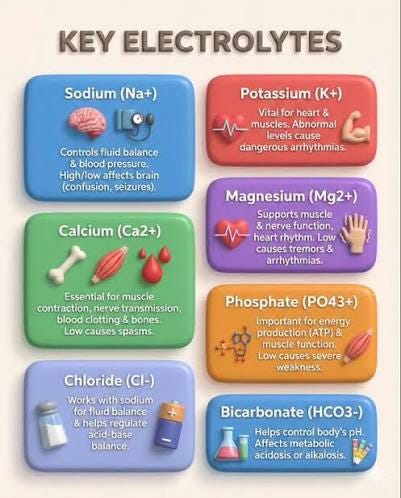
Sodium, potassium, calcium, and magnesium are all cations. They carry positive charges.
Chloride, phosphate, and bicarbonate are anions. They carry negative charges.
The interplay between these opposing charges is what generates the electrical signals your body depends on to function.
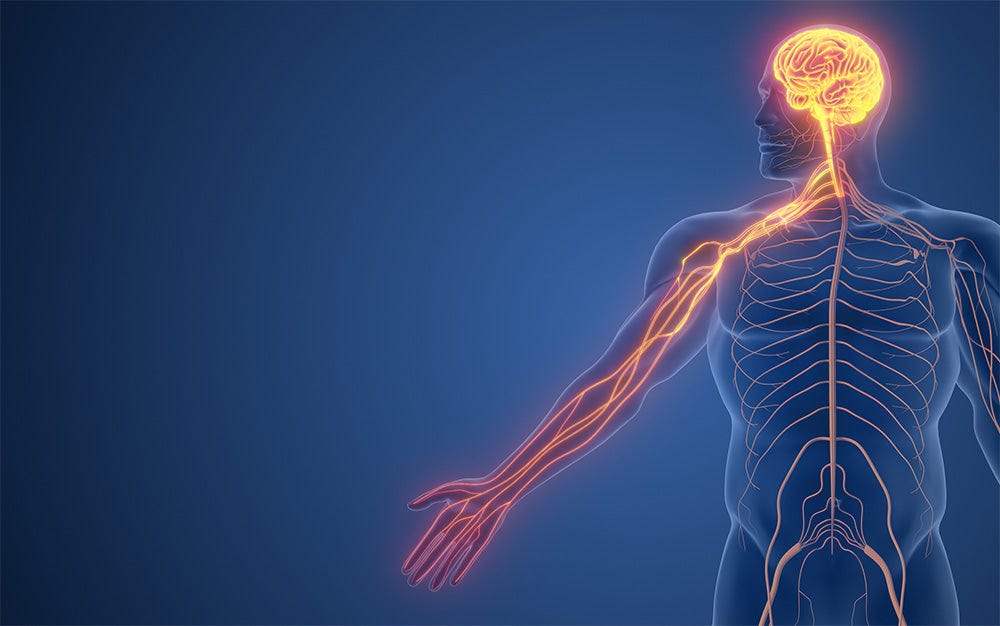
Think of your nervous system as a vast electrical network.
Every thought, movement, heartbeat, and breath requires signals to travel through that network.
Those signals don’t travel through metal wires.
They travel through fluid-filled cells using the movement of ions.
When ions rush across a cell membrane, they create a shift in electrical charge.
That shift is the signal.
Remove the ions, and the signal disappears.
The nerve goes quiet. The muscle doesn’t contract. The heart misses a beat.
This is not a metaphor.
This is exactly what happens when electrolyte levels fall outside the narrow range your body requires.
Thanks for reading Curious Health! Subscribe for free to receive new posts.
Sodium is the primary electrolyte in the fluid surrounding your cells.
It controls how much water stays outside cells, regulates blood volume, and is essential for generating nerve impulses.
It is also the main driver of the sodium-potassium pump, the mechanism that keeps your cells electrically ready to fire.
Low sodium is one of the most common electrolyte disturbances in clinical medicine.
Symptoms include nausea, headache, fatigue, and confusion.
In severe cases, the brain swells due to water moving into cells.
This can cause seizures, coma, and death.
High sodium usually means the body doesn’t have enough water relative to salt.
The brain shrinks slightly as water is drawn out of cells.
Symptoms include intense thirst, confusion, restlessness, and in severe cases, bleeding inside the brain.
Table salt, processed foods, bread, cheese, canned soups, pickled foods.
Potassium is the primary electrolyte inside your cells.
It works in opposition to sodium to maintain the electrical charge difference across cell membranes — the resting membrane potential — which is what allows nerve and muscle cells to fire.
The heart is especially dependent on potassium for its steady rhythm.
Weakness, fatigue, and muscle cramps are common early signs.
The heart becomes irritable. Abnormal rhythms develop.
In severe cases, the heart can go into a fatal arrhythmia.
This is why potassium levels are watched closely in patients taking certain medications or recovering from significant fluid loss.
The heart is again the main concern.
Elevated potassium disrupts the electrical activity of the heart muscle, causing dangerous rhythm disturbances.
Muscle weakness and tingling may also appear.
Bananas, oranges, avocados, tomatoes, potatoes, leafy greens, beans, fish.
Chloride follows sodium almost everywhere it goes.
It helps maintain fluid balance, contributes to stomach acid production, and plays a supporting role in acid-base regulation.
It is quiet and often overlooked, but the body cannot maintain normal sodium balance without it.
Often seen alongside sodium loss, particularly after prolonged vomiting.
Symptoms include muscle weakness, difficulty breathing, and metabolic alkalosis — a condition where the blood becomes too alkaline.
Usually occurs with dehydration or certain kidney conditions.
Contributes to metabolic acidosis — a state where the blood becomes too acidic.
Table salt, seaweed, tomatoes, lettuce, celery, olives.
Calcium has a role in almost every major biological process.
It triggers muscle contraction, including the heartbeat.
It is essential for blood clotting, bone and tooth structure, and nerve signal transmission.
It also acts as an intracellular messenger, activating enzymes and processes inside cells when conditions call for it.
Muscles become overexcitable.
Tingling in the hands, feet, and around the mouth is common.
Muscle cramps, spasms, and in extreme cases, seizures can occur.
The heart rhythm may also be affected.
The opposite effect occurs — cells become less excitable.
Symptoms include fatigue, confusion, constipation, frequent urination, and kidney stones.
In severe cases, the heart slows dangerously.
Dairy products, sardines, canned salmon, tofu, fortified plant milks, leafy greens like ugu and waterleaf.
Magnesium is involved in over 300 enzymatic reactions in the body.
It supports energy production, protein synthesis, nerve function, and muscle relaxation.
It also regulates how calcium and potassium move in and out of cells, making it central to heart rhythm and muscle contraction.
Think of magnesium as the electrolyte that keeps the others working properly.
Muscle cramps, tremors, and weakness are early signs.
Because magnesium regulates calcium and potassium, low magnesium can cause secondary imbalances in both.
Irregular heartbeats, anxiety, and difficulty swallowing may also develop.
It is also associated with high blood pressure.
Rare in people with healthy kidneys but can occur with excessive supplementation or kidney failure.
Symptoms include nausea, low blood pressure, reduced breathing rate, and in severe cases, cardiac arrest.
Nuts, seeds, dark chocolate, whole grains, legumes, dark leafy greens, avocados.
Phosphate is the structural backbone of DNA and RNA.
It is also the central component of ATP — adenosine triphosphate — the molecule your cells use to store and release energy.
In other words, without phosphate, your cells cannot produce the energy needed to do anything.
It also contributes to bone and tooth mineralisation and assists in acid-base balance.
Fatigue, bone pain, and muscle weakness are common.
Because ATP production is compromised, virtually every organ feels the effect.
Severe deficiency can cause respiratory failure and haemolytic anaemia.
Most common in kidney disease, where the kidneys can no longer filter excess phosphate.
Elevated phosphate binds to calcium, lowering calcium levels and leading to bone loss, calcification of soft tissues, and cardiovascular complications.
Meat, poultry, fish, dairy, eggs, beans, lentils, nuts.
Bicarbonate is the body’s primary buffer against changes in blood acidity.
When the blood becomes too acidic, bicarbonate neutralises the excess acid.
When carbon dioxide is produced by cells during metabolism, it is converted into bicarbonate in the blood for transport to the lungs, where it is breathed out.
It is essentially the body’s pH management system in ion form.
Low bicarbonate signals metabolic acidosis — the blood is becoming too acidic.
Symptoms include rapid breathing (the lungs try to compensate by blowing off more carbon dioxide), fatigue, confusion, and nausea.
High bicarbonate signals metabolic alkalosis — the blood is too alkaline.
This can occur with prolonged vomiting, overuse of certain antacids, or diuretic medications.
Symptoms include muscle cramping, tingling, and confusion.
The body largely produces bicarbonate internally from carbon dioxide.
Dietary sources include sparkling water and baking soda, though the kidneys are primarily responsible for regulating bicarbonate levels.
This is the part where it all comes together.
Every nerve cell — or neuron — maintains a difference in electrical charge across its membrane.
The inside of a resting neuron is negatively charged relative to the outside.
This is maintained by the sodium-potassium pump, which continuously moves sodium out of the cell and potassium in.
When a neuron receives a signal, sodium ions rush rapidly into the cell.
The inside suddenly becomes positive.
That shift in charge — called depolarisation — travels down the length of the neuron like a wave.
When it reaches the end, it triggers the release of chemical messengers that carry the signal to the next neuron or to a muscle.
Then potassium flows out, restoring the negative charge inside.
The cell resets and waits to fire again.
This entire sequence depends on sodium and potassium being in the right concentrations, on the right sides of the membrane.
Disrupt that, and the signal fails.
Muscle cells fire using the same basic mechanism as neurons.
But when the signal arrives at a muscle fibre, something additional happens.
Calcium floods into the cell.
That calcium triggers the physical shortening of muscle proteins — actin and myosin — which is the contraction itself.
After contraction, calcium is pumped back out and the muscle relaxes.
Without adequate calcium, muscles cannot contract properly.
Without adequate magnesium, they cannot relax properly.
This is why cramps are so common with magnesium deficiency — the muscle contracts but cannot fully release.
The heart is a muscle.
But it is unique because it generates its own electrical signal.
A group of specialised cells in the upper right chamber of the heart — the sinoatrial node — acts as the heart’s natural pacemaker.
It generates a regular electrical impulse that spreads through the heart, triggering the coordinated contraction that pumps blood.
This impulse depends on the precise movement of sodium, potassium, calcium, and magnesium ions across cardiac cell membranes.
Alter any of them significantly, and the rhythm changes.
Too much potassium slows the heart dangerously.
Too little potassium makes it erratic.
Too little calcium weakens the contraction.
The margin is narrower than most people realise.
Water follows charged particles.
When sodium is high outside a cell, water moves outward to balance it.
When potassium is high inside a cell, water is drawn in.
This movement of water across membranes — called osmosis — is what determines how swollen or shrunken cells become, and how much fluid is in blood vessels versus surrounding tissues.
Electrolytes are essentially the body’s water distribution system.
When they are out of balance, fluid accumulates in the wrong places — causing oedema, dehydration, or dangerously low blood pressure.
Every biochemical reaction in the body works best within a narrow pH range.
Blood pH must stay between 7.35 and 7.45 — slightly alkaline.
Even a small deviation causes serious problems.
Bicarbonate, phosphate, and proteins act as chemical buffers, absorbing or releasing hydrogen ions to keep pH stable.
The lungs adjust breathing rate to control carbon dioxide.
The kidneys regulate bicarbonate and excrete or retain acid as needed.
Electrolytes sit at the centre of this entire regulatory system.
Your body does not leave electrolyte balance to chance.
It has multiple overlapping systems designed specifically to detect and correct imbalances before they become dangerous.
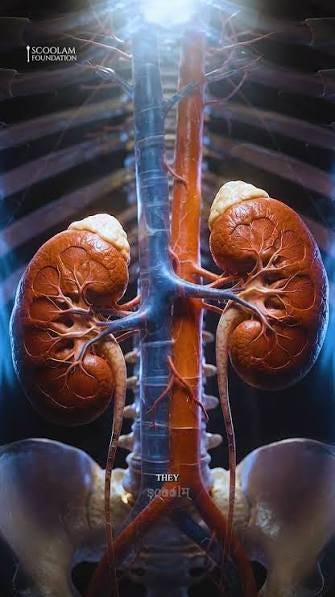
The kidneys are the primary long-term regulators of electrolyte balance.
Every day, they filter roughly 180 litres of fluid from the blood.
Most of that is reabsorbed, along with precise amounts of each electrolyte.
The rest is excreted as urine.
By adjusting exactly how much sodium, potassium, calcium, and other ions are reabsorbed or released, the kidneys can fine-tune blood chemistry within a very tight range.
This is why kidney disease is one of the most common causes of dangerous electrolyte imbalances.
When the kidneys cannot filter properly, electrolytes accumulate or are lost in amounts the body cannot correct.
Aldosterone is a hormone produced by the adrenal glands — two small glands that sit above the kidneys.
When blood pressure drops or sodium levels fall, aldosterone signals the kidneys to retain more sodium.
Because water follows sodium, blood volume and blood pressure rise as a result.
Potassium is excreted in exchange for the retained sodium.
This is why conditions and medications that affect aldosterone have significant effects on both sodium and potassium levels.
ADH, also called vasopressin, is released by the brain when blood becomes too concentrated — usually because you are dehydrated.
It signals the kidneys to reabsorb more water, producing less urine.
Blood volume rises and concentration drops back toward normal.
Thirst, which is also triggered by rising blood concentration, is the conscious experience of the same signal.
Together, ADH and thirst form the body’s rapid dehydration response.
This is perhaps the most important single mechanism in electrolyte balance.
Every cell in your body contains protein pumps embedded in its membrane.
These pumps actively move three sodium ions out of the cell for every two potassium ions they move in.
This continuous movement — which requires energy in the form of ATP — maintains the electrical charge difference across the membrane that nerve and muscle cells need to function.
It is estimated that up to 40 percent of the body’s resting energy is spent running sodium-potassium pumps throughout the body.
This is not an incidental process.
It is one of the most fundamental things your cells do.
Diarrhea causes rapid, significant loss of fluid and electrolytes from the gut.
Sodium, potassium, chloride, and bicarbonate are all lost in large quantities.
This is why severe diarrhea — like that caused by cholera — can be life-threatening within hours.
The solution is not just water. It is water and electrolytes together.
Vomiting expels stomach acid, which is rich in hydrogen ions and chloride.
The result is a drop in chloride levels and a rise in blood pH — metabolic alkalosis.
Prolonged vomiting also causes sodium and potassium depletion, compounding the imbalance.
Sweat contains sodium, chloride, potassium, and smaller amounts of magnesium and calcium.
During prolonged physical activity or heat exposure, the losses can be substantial.
Replacing fluid without replacing electrolytes dilutes the blood, which can paradoxically worsen symptoms.
When the kidneys lose their ability to filter and regulate, electrolyte levels become difficult to control.
Potassium, phosphate, and bicarbonate are particularly affected.
Chronic kidney disease requires careful dietary management of electrolyte intake as a result.
Diuretics, commonly called water pills, increase urine production.
In the process, they also increase the excretion of potassium, sodium, and magnesium.
People on long-term diuretic therapy are monitored closely for electrolyte imbalances.
Other medications, including some antibiotics, laxatives, and certain blood pressure drugs, can also disrupt electrolyte levels.
Hormones control electrolyte regulation, so endocrine disorders frequently disrupt it.
Addison’s disease, in which the adrenal glands produce too little aldosterone, causes sodium loss and potassium retention.
Hyperaldosteronism does the reverse.
Diabetes can affect phosphate and magnesium levels.
Thyroid disorders can alter calcium metabolism.
The electrolyte system is deeply entangled with the hormonal system.
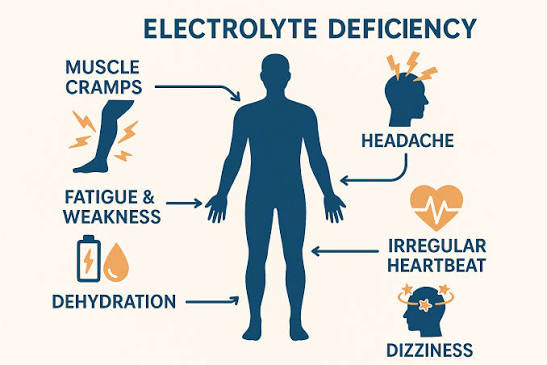
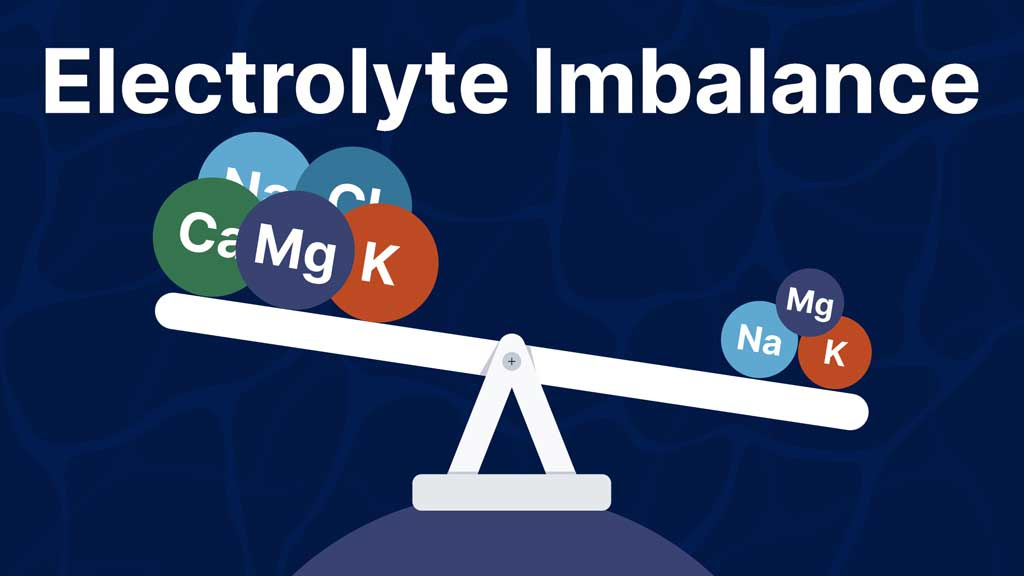
Electrolyte imbalances rarely announce themselves clearly.
Their symptoms are easy to dismiss, especially in the early stages.
Cells depend on electrolytes — particularly sodium, potassium, and magnesium — to produce energy and maintain the membrane potentials that drive every cellular process.
When levels drop, energy production becomes inefficient and the entire body slows down.
Sodium and fluid imbalances reduce blood volume, which lowers blood pressure.
When blood pressure drops, the brain receives less blood, particularly when you stand up suddenly.
The result is lightheadedness or dizziness.
Calcium triggers contraction. Magnesium enables relaxation.
When magnesium is low or calcium is imbalanced, the relaxation phase of the muscle cycle is impaired.
The muscle contracts but cannot fully release, producing a cramp.
Potassium is essential for muscle cell membrane potential.
When potassium falls, the resting membrane potential shifts, making it harder for muscle cells to generate the electrical impulses needed for contraction.
The result is generalised weakness.
Calcium stabilises nerve cell membranes, reducing their excitability.
Low calcium makes nerve membranes hyperexcitable.
They begin firing spontaneously, producing the tingling or pins-and-needles sensation most commonly felt in the hands, feet, and around the mouth.
The brain is especially sensitive to sodium levels.
When sodium is low, water moves into brain cells and they swell.
The brain is enclosed in a rigid skull with no room to expand, so even slight swelling disrupts function and produces confusion, disorientation, and difficulty concentrating.
As described earlier, the heart’s electrical system depends on the precise movement of potassium, sodium, calcium, and magnesium.
Imbalances in any of these can alter the timing, strength, or rhythm of the heartbeat.
Palpitations — the sensation of the heart fluttering, racing, or skipping — are often the first sign.
In severe cases, particularly with very low sodium or calcium, nerve cells become so hyperexcitable that they fire uncontrollably.
The result is a seizure.
This is one of the reasons severe diarrhea, prolonged vomiting, or significant fluid loss is a medical emergency when not treated promptly.
Most commercial sports drinks contain electrolytes.
They also contain significant amounts of sugar and artificial flavouring.
For someone who has been sweating for less than an hour at moderate intensity, a sports drink is generally unnecessary and adds empty calories.
For prolonged, intense activity — or significant fluid loss from illness — they can be genuinely useful.
Context matters more than branding.
Drinking excessive water without electrolytes is not neutral.
It dilutes the blood, lowering sodium concentration.
The condition that results — hyponatremia — can cause nausea, confusion, seizures, and in extreme cases, death.
This has occurred in marathon runners who drank large volumes of plain water without replacing electrolytes.
Hydration is not just about volume. It is about balance.
The relationship between sodium and health is more nuanced than public messaging suggests.
Excess sodium in people who are already hypertensive or have kidney disease is genuinely harmful.
But sodium is an essential electrolyte. The body cannot function without it.
The issue is not salt itself. It is the context, the quantity, and the individual circumstances.
This is perhaps the most widely held misconception.
Electrolytes matter to every cell in your body, every moment of every day.
Athletes lose them faster through sweat.
But older adults, people with chronic illness, those recovering from gastrointestinal infections, people on certain medications, and pregnant women all have specific electrolyte needs that have nothing to do with athletic performance.
Electrolytes are not a sports nutrition topic.
They are a fundamental physiology topic.
Water alone is not sufficient after prolonged vomiting, diarrhea, or heavy sweating.
Oral rehydration salts — which contain sodium, potassium, and glucose in specific proportions — are one of the most effective and inexpensive tools in medicine.
They are widely available in pharmacies across Nigeria and have saved countless lives in settings with limited access to intravenous therapy.
After a stomach bug, use them.
After a gruelling afternoon in the sun, consider them.
Don’t just reach for plain water and assume the job is done.
Supplements are useful in specific clinical situations.
But the most reliable, well-absorbed, and well-regulated source of electrolytes is food.
Potassium from avocados and oranges. Magnesium from dark leafy greens and legumes. Calcium from dairy or fortified alternatives. Sodium from minimally processed food in appropriate amounts.
A varied diet built around whole foods covers most electrolyte needs without any conscious tracking.
These symptoms are easy to attribute to tiredness or stress.
And sometimes they are exactly that.
But persistent cramps, unexplained weakness, dizziness on standing, or tingling in the extremities after a period of fluid loss deserve a conversation with a doctor — and a simple blood test can reveal imbalances that are straightforward to correct when caught early.
Your body generates electricity.
Not metaphorically.
Literally.
Ions rushing across cell membranes. Charges shifting. Signals firing down nerves and into muscle. A heartbeat coordinated not by a mechanical switch but by the precise choreography of electrically charged minerals.
You are, in the most literal biological sense, electric.
And the minerals that make that possible are not exotic compounds found only in supplements or elite sports nutrition.
They are in the food you eat.
The water you drink.
The simple act of replacing what you lose when your body works hard or falls ill.
Electrolyte balance is not a complicated concept.
But it is a consequential one.
And now you understand why.
Still learning your body, one signal at a time.
Layo
If this article clicked with you or made you think of someone, please share it. You might just be helping them hear their own body a little clearer.
Disclaimer: Curious Health is for informational purposes only. It is not intended to replace professional medical advice, diagnosis, or treatment. Always consult a qualified healthcare provider with any health concerns.
No posts
Comments
Nothing yet. Say the first thing.
Sign in to join the conversation.