
Welcome back. This is Part 2 of our Sensus Tech Insights deep dive into Snowflake Inc ($SNOW).
In Part 1, we covered the ground that every investor needs to understand before forming a view on this business.
We walked through the architectural innovation that made Snowflake a category-defining company (the separation of storage and compute in a multi-cloud environment).
We traced the leadership transition across three distinct eras: the founders who built the core engine, Frank Slootman who scaled it into a $3.5bln revenue business and record-setting IPO, and Sridhar Ramaswamy who is now steering the company’s AI pivot.
We broke down the product suite in detail, covering from the core Data Cloud Platform to the rising Cortex AI layer and Snowpark.
And we spent considerable time on explaining the consumption-based revenue model, focusing on why Snowflake’s financials look different from standard SaaS, and why the usual metrics like billings and ARR are less useful here, compared to metrics such as product revenue, NRR and RPO.
If you have not read Part 1 yet, we strongly recommend doing so before continuing. The business model mechanics covered there are essential context for the financial analysis and valuation framework we present in this part of the report.

The question we are addressing in Part 2 is straightforward: can the business thrive in the AI era? And if it can, what price should we be willing to pay as investors?
To answer that, we will cover the following:
Assess whether AI represents a threat or opportunity
Map the competitive landscape
Examine the financials
Deliver our Sensus Research Outlook and verdict
Let’s get into it.
As per the usual structure of our Sensus Tech Insights reports, we address the question that has defined software investor anxiety for the past 6+ months: does AI help Snowflake, or does it make Snowflake redundant?
The bear case relies on arguing that generative AI tools are becoming so capable that they will eventually replace the complex data infrastructure stacks that enterprises have built. Why maintain a data warehouse, a governance layer, and a team of data engineers if an AI agent can simply query raw data, clean it on the fly, and generate insights directly? In this framing, Snowflake is a legacy middleware layer that gets disintermediated.
We said as much in our Klaviyo ($KVYO) Sensus Tech Insights report in February:
We believe that many of the SaaS/Software companies will cease to exist in the next 3-5 years.
That view has not changed.
But the bear case against Snowflake specifically reflects a misunderstanding of what the platform actually does. And it requires us to separate two very different categories of software companies: those whose moats are built on workflow lock-in (where AI is genuinely threatening), and those whose moats are built on data infrastructure (where AI is additive).
The foundational positioning of Snowflake is as an AI Data Cloud. It is a platform designed to store, govern, and serve multiple data formats together with workloads under a single governance model. This is NOT a purely workflow tool or application layer. This distinction is critical and it is the reason we do not place Snowflake in the same risk category as the legacy SaaS providers we have been cautious about.
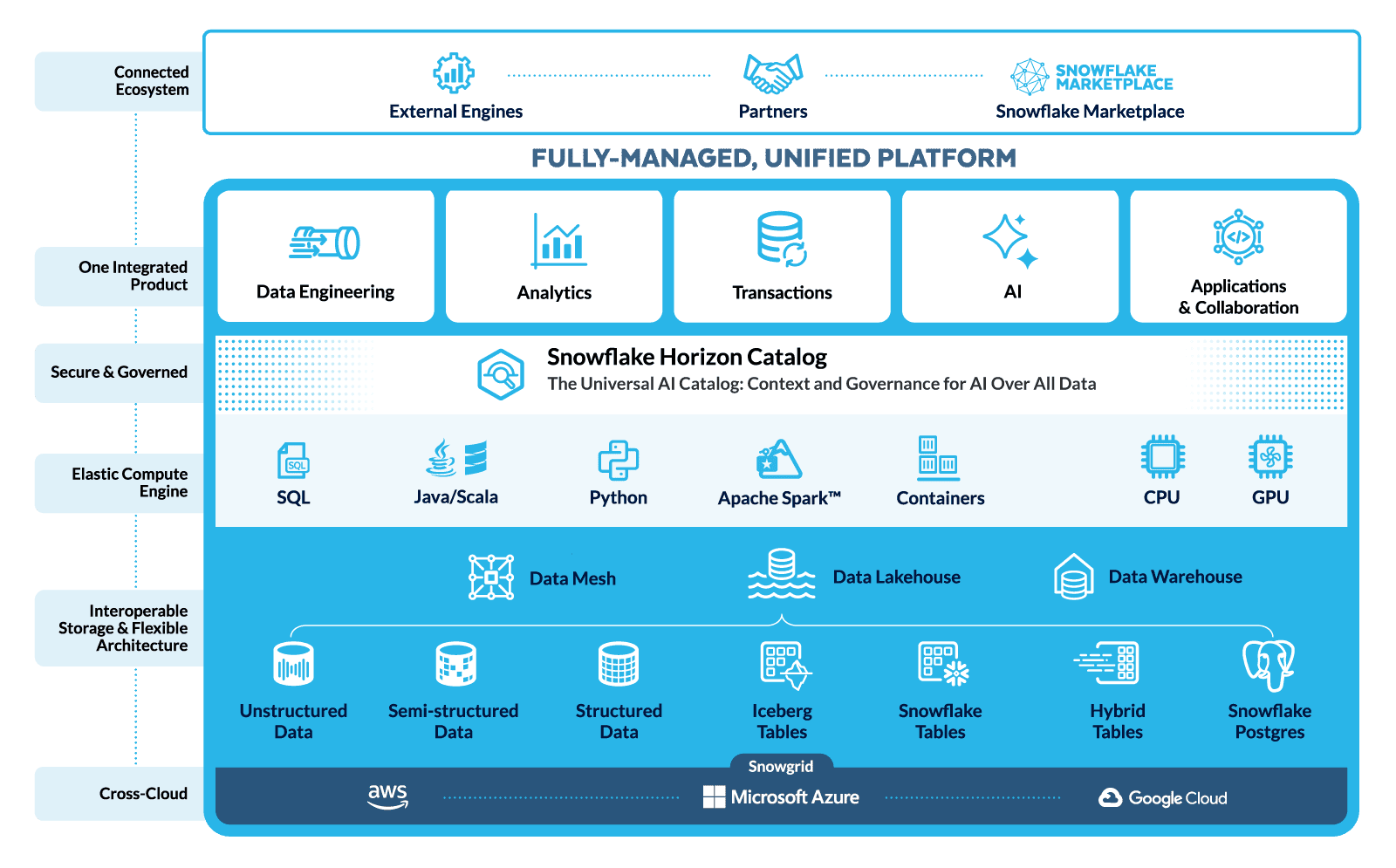
Consider what actually happens when an enterprise deploys an AI system in production.
The AI model, whether it is a LLM, a recommendation engine, or a forecasting algorithm, needs data. Not raw, ungoverned, scattered data sitting in fifty different databases across different cloud providers. It needs curated, governed, accessible and secure data that has been ingested, cleaned, formatted, stored in a queryable structure, and made available through access controls that comply with the enterprise’s regulatory and security requirements.
This is what Snowflake does. It is a layer that AI requires.
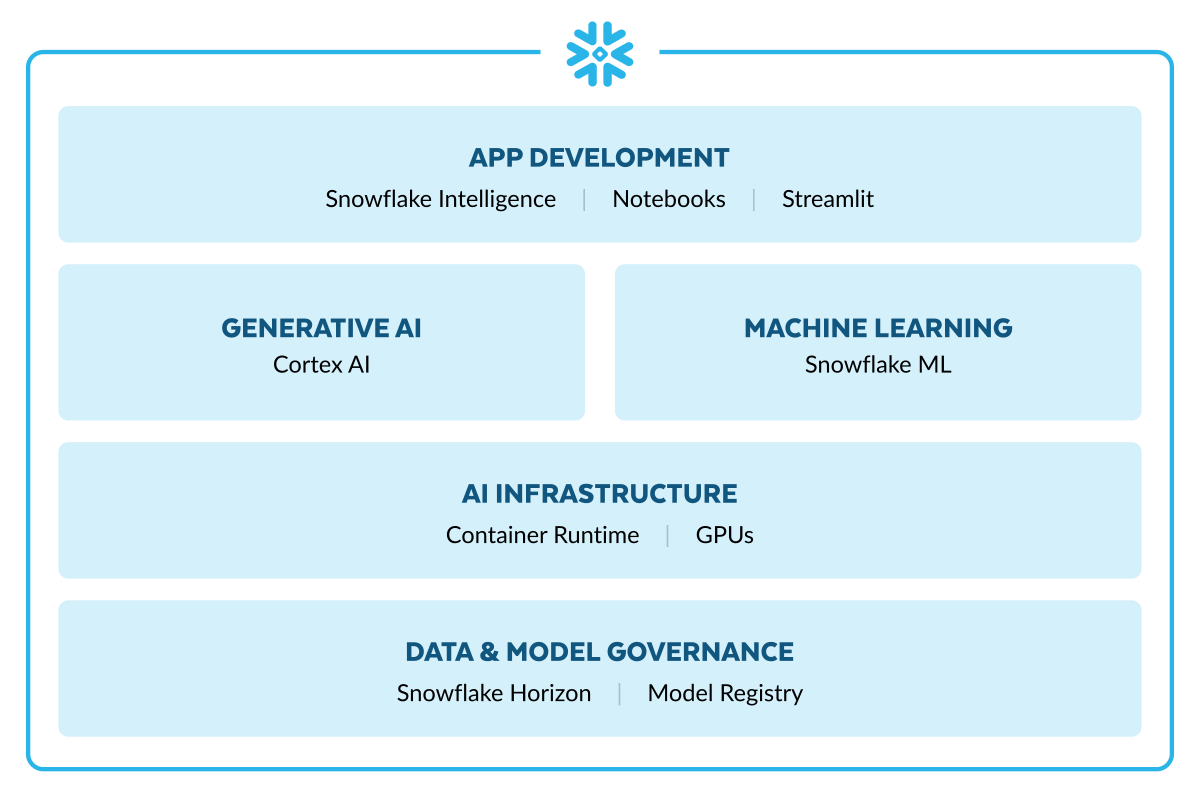
An AI agent that can write SQL queries does not eliminate the need for a data warehouse (where is it going to query that data from?). A LLM that can summarise documents does not eliminate the need for a governed data lake. A conversational analytics tool that lets a business user ask questions in natural language does not replace the underlying data platform.
In every one of those use cases, for them to actually work and boost users’ ROI, the AI capability acts as a consumption layer of data that needs to be stored and managed via data infrastructure. It is the foundation.
This is why we describe Snowflake’s position as “picks and shovels” for enterprise AI. The companies building AI models need to sell them to enterprises. Those enterprises need to feed data into those models (and no, Claude parsing your local excel sheet is not the same). That data lives in platforms like Snowflake. The more AI workloads enterprises deploy, the more data needs to be stored, governed, processed, and served. All of this means more consumption of Snowflake’s credits.
There is a further point worth making: AI is already built into Snowflake’s products.
As we detailed in Part 1, Cortex AI provides native natural language querying, document extraction, conversational analytics, and AI agent capabilities directly within the platform. Snowflake has integrated frontier models from Anthropic, OpenAI, Meta, and DeepSeek into Cortex, all running within the customer’s governance perimeter.
There is nothing that an external AI tool could do to “replace” Snowflake’s data management function that it has not already incorporated into its own offering.
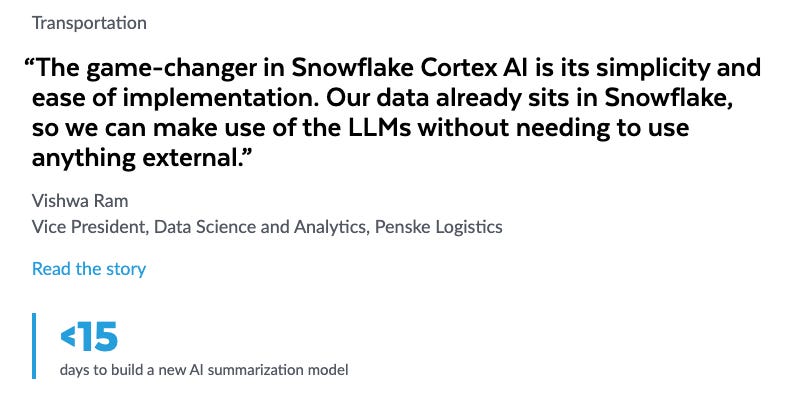
Snowflake’s customers already highlight that:
Before we assess Snowflake’s competitive position, we need to better understand the size of the opportunity it is pursuing.
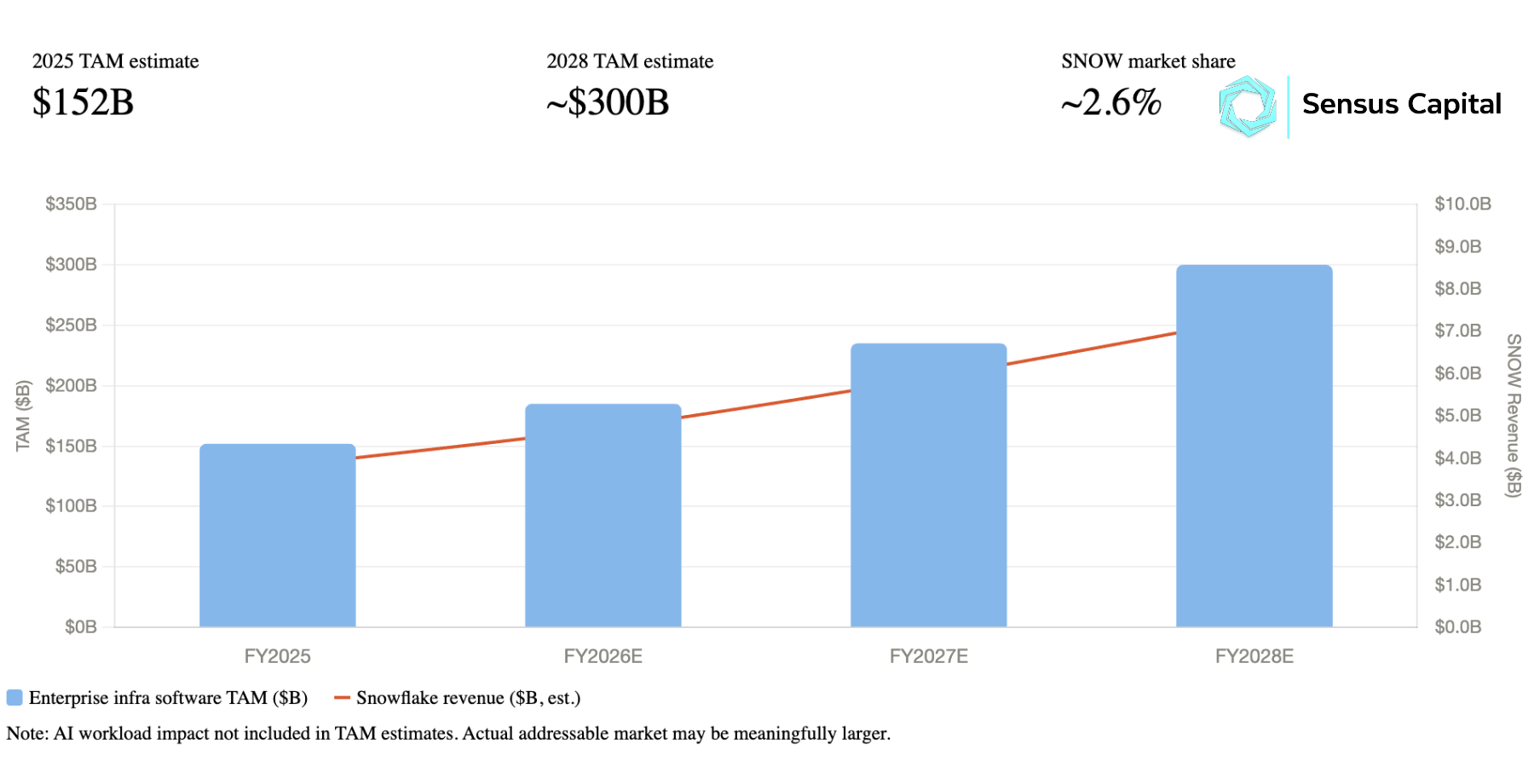
The opportunity that the company is targeting was around $152bln back in CY2023, and it is expected to more than double by CY2028.
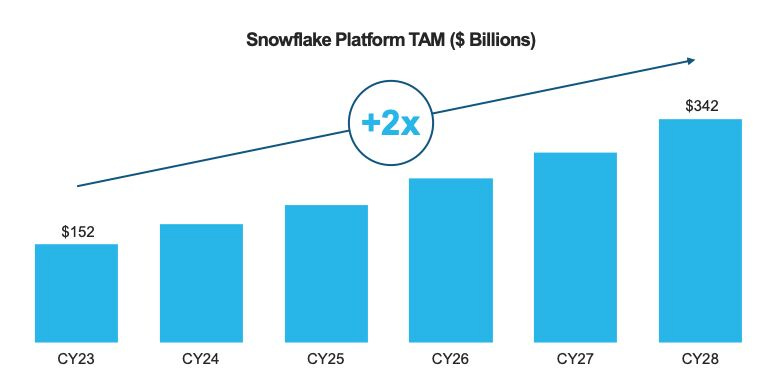
This is a large and growing TAM, driven by the ongoing migration of enterprise workloads from on-premise infrastructure to cloud platforms
However, there is a negative and a positive to be considered here. If we take a look at Snowflake’s revenue, add to it Databricks and Teradata, and let’s assume some of Oracle’s and AWS’s revenue also comes from the same market, we are still a few billions short. This is because not all of the demand will continue to be monetizeable. As enterprises migrate and update their workflows, they become more prudent and efficient with their data management and storage, which in turn, decreases their spend (as the consumption goes down).
On the other hand, AI impact is not fully baked into these estimates. The projections were largely formulated before the current wave of enterprise AI adoption truly began. If AI workloads drive the kind of incremental data storage, processing, and governance demand that we outlined in the previous section, then the actual TAM could be meaningfully larger (look at what happened to hardware TAM for Dell over the last two years).
Snowflake’s current product revenue run rate is approximately $4bln annually. Against a $152bln+ TAM, this represents around 3% market share.
Even against the narrower cloud data platform segment (which various analysts estimate at $60-80bln), Snowflake’s penetration is still small.
It is planning to address this opportunity via two core markets:
Analytics → has historically been a strength for the company
Engineering → “beefing up” the offering via Snowpark and Datavolo acquisition
The cloud data platform market is one of the most competitive arenas in enterprise technology, with well-funded rivals attacking from multiple directions.
We see the competitive landscape as consisting of three distinct tiers of threat.
Tier 1: Databricks
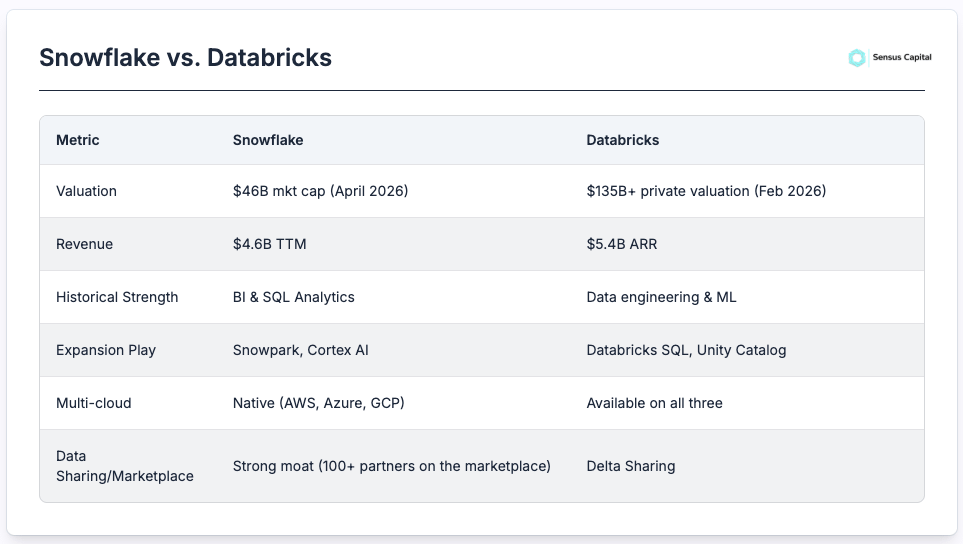
Databricks is, by any measure, Snowflake’s most direct competitor. The two companies are converging from opposite ends of the data stack, and the competitive intensity between them is only increasing.
Historically, the division was relatively clean. Databricks, born out of the Apache Spark project at UC Berkeley, built its reputation on data engineering and machine learning. Its platform excelled at large-scale data processing, ETL pipelines, and training ML models. Snowflake, as we have covered, built its reputation on business intelligence and analytics.
For years, many enterprises ran both: Databricks for data engineering and data science, Snowflake for analytics and BI. The two platforms were more complementary than competitive.
That era is ending. Both companies are now aggressively building into each other's historical territory. Databricks launched Databricks SQL to compete directly with Snowflake's analytics capabilities. Snowflake launched Snowpark to compete with Databricks' Spark-based data engineering. Databricks is pushing its "data lakehouse" concept to unify analytics and engineering on one platform. Snowflake is doing the same with its Data Cloud vision, enhanced by Cortex AI and Iceberg support.
Where Databricks retains an advantage is in AI and ML workloads. Its Spark heritage and deep integration with the Python data science ecosystem mean that data scientists and ML engineers often default to Databricks for model training and advanced analytics. Snowflake is closing this gap with Snowpark (which the company claims is twice as fast and cheaper than Spark for equivalent workloads) and Cortex AI, but the perception gap persists. In enterprise sales cycles where the ML team has a strong voice, Databricks often gets the pick for data science workloads.
Where Snowflake has the advantage is in ease of use for analytics, the Marketplace network effects, and multi-cloud data sharing. These are capabilities that Databricks has not matched so far. For business-facing analytics, SQL-first workflows, and cross-organisation data collaboration, Snowflake remains the default choice.
Our view: the competition between Snowflake and Databricks is likely to be a sustained, multi-year battle where both companies grow. The TAM is large enough for two major winners.
The risk for Snowflake is not that Databricks kills it, but that Databricks' AI/ML momentum prevents Snowflake from capturing as large a share of incremental AI workloads as it needs to re-accelerate growth.
Tier 2: Hyperscalers
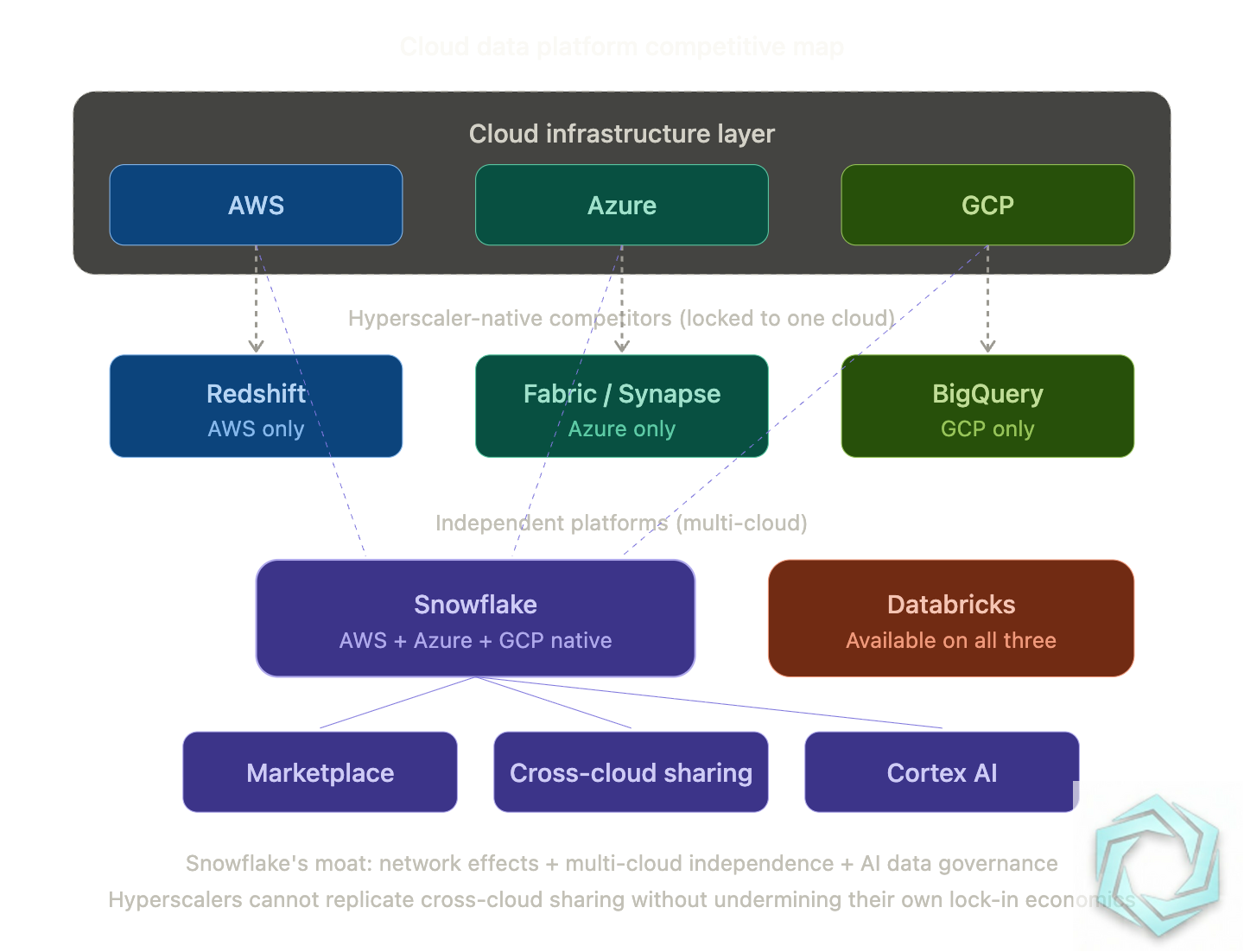
Amazon Redshift, Google BigQuery, and Microsoft's Azure Synapse represent a fundamentally different competitive dynamic than Databricks. These are not independent platforms competing on product merit alone. They are native services bundled within the three largest cloud ecosystems in the world.
The threat from hyperscalers is primarily economic and distribution-driven. For an enterprise already committed to AWS, using Redshift means one vendor, one bill, one security framework, and tight integration with the rest of the AWS stack (S3, SageMaker, Lambda, etc.). Using Snowflake on top of AWS means paying margins to both AWS for the underlying infrastructure and Snowflake for the platform layer. In a cost-conscious environment, that incremental expense requires justification.
Redshift in particular has improved significantly from its early iterations. Amazon has introduced serverless Redshift, added support for more flexible compute scaling, and worked to close the architectural gap with Snowflake. BigQuery has gone further with BigQuery Omni, which can now query data across clouds (this is attacking directly Snowflake’s moat).
However, Snowflake has consistently maintained its lead on several dimensions that hyperscaler-native tools have not matched. Performance benchmarks for complex, concurrent analytical queries continue to favour Snowflake.
This is a real threat that is also much larger than for a company like Dynatrace, as it is clear that hyperscalers want to have a direct share of the pie, instead of just partnering with Snowflake.
Tier 3: Microsoft Fabric
Microsoft Fabric deserves a separate mention because it represents a potentially different kind of threat than the existing hyperscaler tools.
Fabric is Microsoft’s attempt to unify data engineering, analytics, data science, and real-time intelligence on a single Azure-native platform. It integrates Power BI, Azure Data Factory, Azure Synapse, and a new lakehouse engine into one cohesive offering. Microsoft is leveraging its existing enterprise distribution (virtually every large enterprise already has Microsoft licensing agreements) and its Copilot AI integration to drive adoption.
The product is still relatively early in its enterprise deployment cycle, and customer feedback has been mixed. But Microsoft's distribution advantage is enormous. For enterprises already deep in the Microsoft ecosystem, the gravitational pull toward Fabric is strong, particularly when Microsoft bundles it into existing enterprise agreements at attractive pricing.
If Fabric matures and Microsoft executes on the integration vision, it could become the most formidable competitive force Snowflake faces.
The Legacy Displacement Tailwind
Beyond the direct platform competition, there is a broader market dynamic working in Snowflake’s favour: the ongoing displacement of legacy on-premise data infrastructure.
Companies like Teradata, Oracle (on-premise data warehouse), IBM Db2, and first-generation cloud tools represent the installed base that Snowflake is actively migrating. The hardware is aging, the maintenance contracts are expensive, the talent pool for legacy systems is shrinking, and the architectural limitations make it difficult to support modern analytics and AI workloads.
Snowflake's CEO has cited approximately 60% cost savings for customers migrating legacy on-premise workloads to the platform. At Investor Day, the company noted that it continues to win displacement deals from Teradata in particular, and that 745 of the Fortune Global 2000 are already customers.
The competitive question we are most focused on is whether Snowflake can capture a meaningful share of incremental AI workloads, or whether Databricks will continue to dominate and limit the ability of Snowflake to expand. The answer to that question, more than any other competitive variable, will determine whether Snowflake can sustain 20%+ growth rate beyond FY2027.
In Part 1, we explained why Snowflake’s consumption-based revenue model makes its financial results look different from traditional SaaS companies. Let’s take a deeper look at those results.
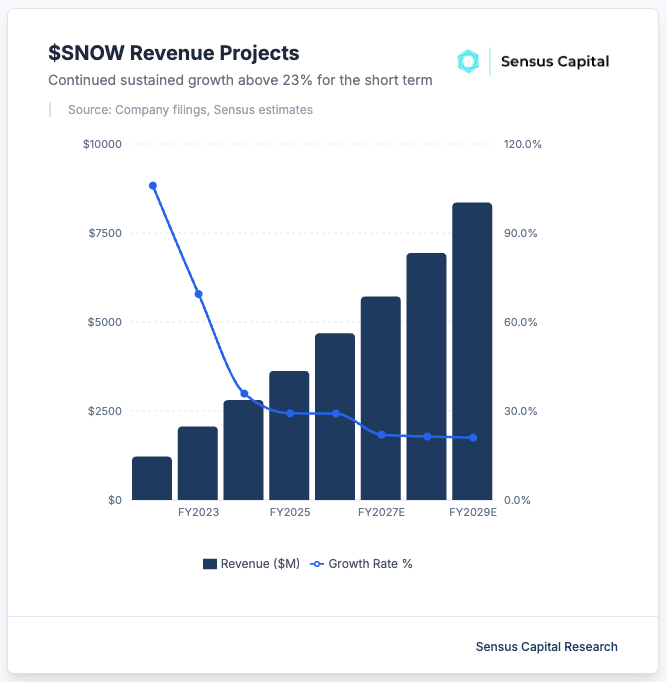
Snowflake remains one of the fastest-growing enterprise software companies at scale. FY2026 product revenue came in at $4.472bln representing 29% YoY growth rate. Guidance for FY2027 product revenue is $5.660bln implying the growth rate of 27% YoY. Although the growth rate will continue to slowdown given a larger base, still, growing 25% YoY and above on a base of $5bln is truly impressive.
The drivers of the revenue trajectory going forward are reasonably clear.
On the positive side: continued enterprise adoption, legacy displacement from Teradata and first-generation cloud warehouses, incremental consumption from AI workloads via Cortex, and geographic expansion in EMEA and APAC.
On the negative side: consumption optimisation by large enterprise customers (a theme that is still present in the cloud companies earnings calls), elongated sales cycles in a tighter macro environment, and the natural base effect that makes each incremental percentage point of growth harder to achieve.
Our realistic expectation is that Snowflake can sustain product revenue growth at the 23% level through FY2030 (CY2029), driven primarily by TAM expansion and continued market share gains from legacy providers. Re-acceleration above 25% would likely require AI workloads to become a material revenue contributor. Deceleration below 20% would signal competitive or demand issues that would warrant a more cautious stance.
NRR peaked at 158% in FY2023, meaning existing customers back then were spending on average 58% more than the year prior, and this metric has declined since. Reaching 125% level in FY2026 and stabilising.
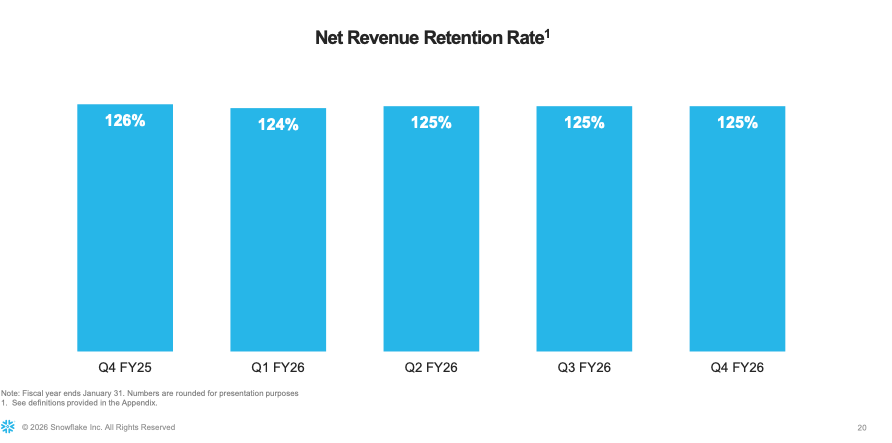
The decline was actually expected, it just perhaps came in a bit sooner than preferred. Back in 2022, most of the larger enterprises were in their pilot programs with Snowflake. Meaning, their data and activity on the platform was still limited, resulting in lower consumption/spend. In 2023/2024, these larger enterprises migrated most of their initial/legacy workflows following the pilot programs, hence the very high level of NRR back then.
What is key now, is whether 125% NRR is the new floor. Keep in mind, most of the other software names are very happy to get NRR above 100% (implying that customers don’t spend less YoY). For Snowflake, their customers are expanding at the 25% rate, which provides a core structural driver to the topline growth for the firm.
Additionally, the potential for AI workloads to drive incremental consumption within the existing accounts could provide a further boost to this metric. If Cortex AI adoption continues to accelerate, these workloads represent net-new consumption that did not exist on the platform previously.
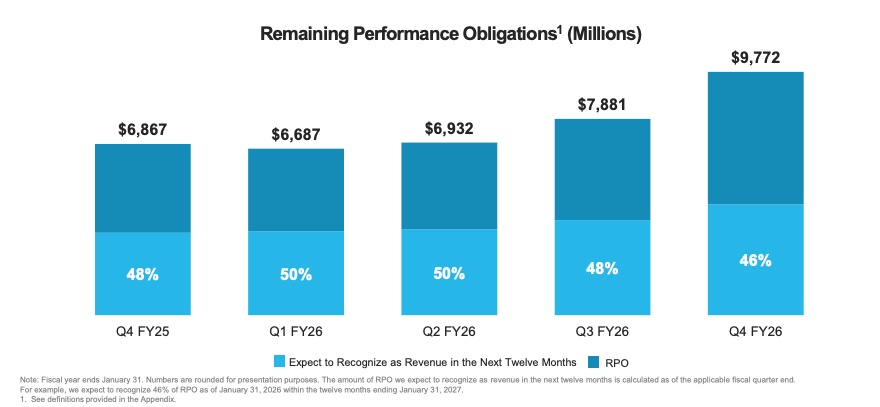
If NRR tells you how fast the existing customers are growing their consumption, the RPO tells you how much contractual revenue is still in the backlog waiting to be consumed.
As of Q4 2026, RPO stands at $9.77bln, growing 42% YoY (the rate has accelerated). Approximately half of the RPO is expected to be recognised as revenue within next twelve months.
The RPO’s growth has been accelerating, and is running significantly above revenue growth. This divergence suggests that the revenue deceleration is driven more by near-term consumption timing (when customers actually use the resources they have contracted) than by underlying demand weakness (whether customers want to be on Snowflake at all).
The contracts are being signed. The consumption is following.
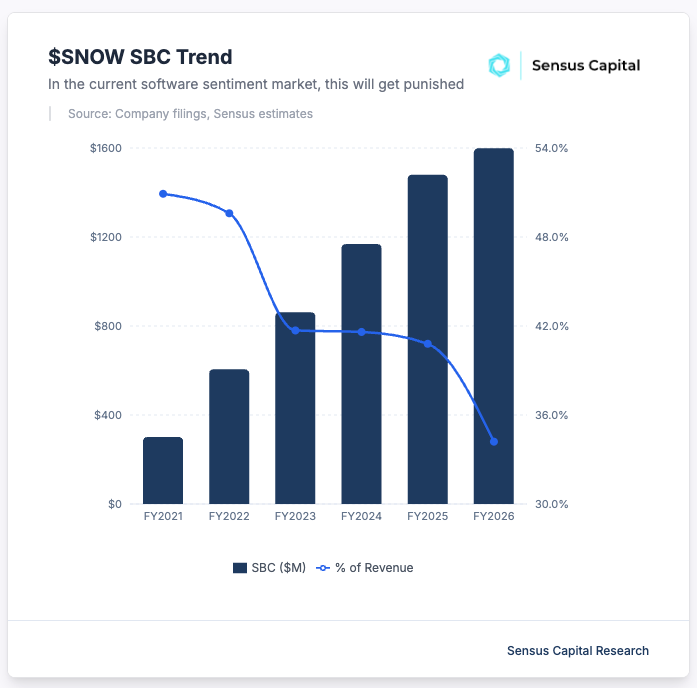
No analysis of Snowflake’s financials is complete without confronting the issue that impacts its profitability the most: stock-based compensation.
In FY2026, Snowflake reported $1.7bln in SBC (around 36% of total revenue). To put this into context: for every dollar of revenue, Snowflake pays out around 40 cents in equity to employees.
This is the primary reason Snowflake remains deeply unprofitable on a GAAP basis. For FY2026, GAAP operating margin was (31)%. Excluding and adjusting for SBC, it is around 9%. The gap is almost entirely SBC.
Why is SBC so high? The answer is competitive talent dynamics. Snowflake operates in one of the most competitive hiring markets in technology and is competing for data engineers and AI researchers who are also recruited by hyperscalers and other well-funded startups offering large equity-comp packages.
It is a cost of doing business in this market. However, it is still real economic dilution.
Management expects this figure to continue declining, but for the next 2-3 years it is still running above 30%, meaning, we are not likely to see a positive GAAP OP. margin in the short-term.
Stepping back from the individual metrics, the financial picture is not yet a “sure thing” set up.
On one side: revenue growth is decelerating, NRR is compressing, GAAP profitability is years away, and SBC is one of the highest in the sector. These are the issues that will continue to weigh on sentiment until they resolve (and keep in mind, the stock is not cheap).
On the other side: the company is generating nearly $1bln in annual free cash flow (easy to claim, given the SBC, adjusted for SBC, there is no free cash flow), RPO is growing faster than revenue, balance sheet holds significant cash position with zero debt.
We have spent two reports establishing that Snowflake’s technology is excellent. The product architecture is differentiated. The competitive positioning is strong. The AI opportunity is real. The consumption model generates real cash. None of that is in dispute.
The question is: at what price does it become attractive?
Our answer is: not at these levels.
Snowflake closed the FY2026 with $4.87bln in revenue with product revenue growing 29% YoY. The Q4 print was actually underrated in how strong it is, as the rate accelerated, a record $400mm deal was signed, RPO surged to $9.77bln are all overlooked elements.
Yet, the business remains deeply GAAP unprofitable. The full-year GAAP operating loss was around $1.4bln. Even on a non-GAAP basis, after stripping out over $1.5bln in SBC, the operating margin is still only around 10%. This is a company approaching $5bln revenue that cannot show a profit. In the current software sentiment environment, that matters.
FY2027 guidance calls for $5.66bln in product revenue (27% YoY) and non-GAAP OP margin of 12.5%. We do not see GAAP profitability possible in the next 2-3 years. Additionally, free cash flow itself will get restricted due to increased investments into AI capabilities.
Meaning, the product is proven, but the financial feasibility at scale, not yet.
The stock trades at around $145 as of this writing, significantly below a 52-week high of $270+. Market capitalisation is around $50bln. On a trailing basis, that is a multiple of 10x on the revenue (P/S), on a forward guidance, this is around 8.8x.
Is 8.8x P/S multiple for a 27%+ growth reasonable? Probably.
But it is still far from undervalued or even fair valued given the lack of core profitability for the platform.
The challenge is this: what multiple does Snowflake deserve when growth normalises to 15-20% in FY2029 and beyond? Software companies growing in that range and generating 25-30% FCF margins typically trade at 6-10x P/S range (and this is before the software panic started). Meaning, there is no room for multiple expansion already, and the appreciation will come in just through the execution of the company.
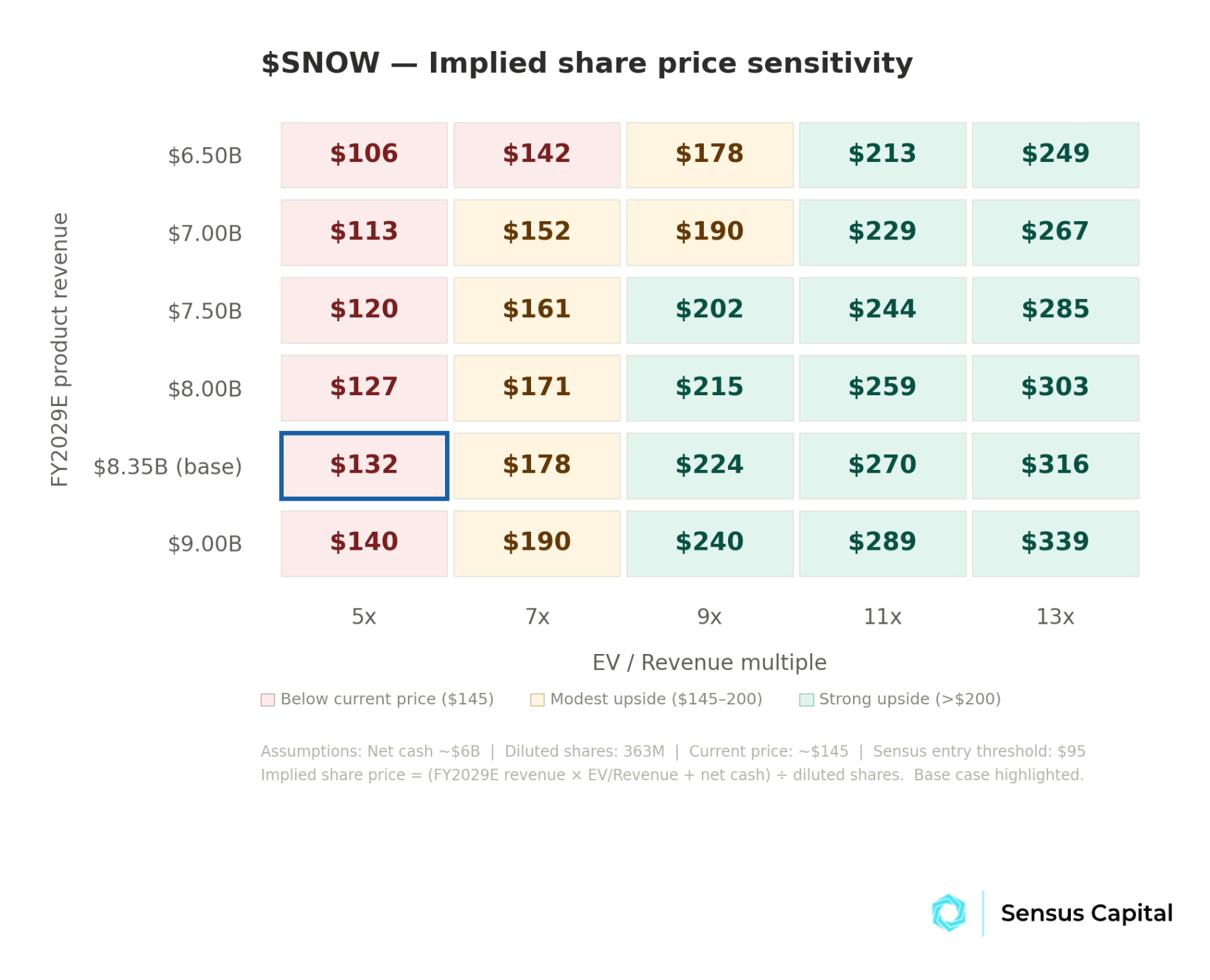
If Snowflake reaches $7-8bln in revenue by FY2029 and the market applies at 10x multiple (generous and unprobable given the current market realities), you arrive at a market cap of $70-80bln. Adjusting for cash and continued share dilution, we are looking at a share price of around $200. So it is a 40-50% return over three years, assuming Snowflake delivers on all of its goals.
Not ideal.
Now apply a more cautious multiple. In a scenario where software sentiment remains compressed (which we believe is likely given the ongoing AI disruption narrative and the lack of GAAP profitability across the sector), a 7–8x revenue multiple is more realistic for a maturing grower. On $7.5 billion in FY2029 revenue at 7.5x, you get approximately $56 billion in enterprise value, roughly today’s value. So, at current prices, you could be paying fair value for a three-year hold.
Even using optimistic assumptions (sustained 27%+ growth, margin expansion ahead of plan, favourable AI monetisation) we struggle to justify a price today above approximately $95 per share that would make the holding genuinely attractive on a risk-adjusted basis. That would represent roughly 5.5x forward FY2027 product revenue, a level that would price in the execution risk, SBC drag, and competitive uncertainty while still giving investors meaningful upside to our base case terminal value.
Beyond the bottom-up valuation, we want to flag a top-down concern. The broader software sector is under significant pressure. SNOW 0.00%↑ is down more than 30% YTD. The entire sector is getting re-priced based on the AI fears.
The market is telling us that it no longer wants to pay 15-20x P/S multiples for companies that cannot show clear profitability together with 20% growth, regardless of how impressive the product or how large the TAM. Until that sentiment shifts, or until Snowflake demonstrates clear GAAP profitability, the multiple will remain compressed.
We love the technology. We do not love the price.
Snowflake is building the right platform for the next decade of enterprise data and AI. The product is differentiated. The Snowflake Marketplace creates genuine network effects. The AI integration is strategically sound. The balance sheet is strong. The management transition is progressing well, and the Q4 FY2026 results, particularly the RPO figure, are encouraging.
But at $145 per share and a $50bln market cap, the stock is priced for execution that leaves little room for error. SBC remains above 30% of revenue. GAAP profitability is years away. The terminal multiple question in a post-AI disruption software market sentiment is truly uncertain.
Our entry threshold is $95. At that level, the risk-reward becomes asymmetric, you would be paying 5.5x forward revenue for a 27% growth platform with durable competitive advantages, and FCF margin profile with some potential.
Until then, we watch.
Disclaimer: The comments and information presented in this post are not investment advice, but opinions. Please do your own research.
No posts
Comments
Nothing yet. Say the first thing.
Sign in to join the conversation.