
Welcome back to Sensus Tech Insights.
Today, we are turning our attention to a name that sits at the very centre of the future-oriented enterprise data infrastructure stack - Snowflake Inc ($SNOW).
Since we see Snowflake’s product as something very unique, we believe it deserves a more in-depth attention, so we have decided to split this report into two parts. Part 1 (this post) covers the company history, the leadership transition, and a detailed breakdown of the business model, product suite, and the pricing model that Snowflake uses. Part 2, which will follow shortly, will address our Sensus Tech Insights question of whether AI is a threat or an opportunity for Snowflake, the competitive landscape, financials, and our outlook.
With that, let us begin.
The market is obsessed with who builds the AI models. Every earnings cycle, every conference keynote, Kalshi prediction markets are all dominated by the same question: who is winning the model race? Some months back it was Google, now it is Anthropic, and the race continues.
But we believe the smarter question is a different one entirely: who stores, governs, and serves the data that makes those models useful?
Large language models are only as valuable as the data they can access, and enterprises do not feed raw, ungoverned data into production AI systems. They need a layer that handles structured and unstructured formats, enforces governance and compliance, manages access controls, and serves clean data to multiple workloads simultaneously.
That is the layer that Snowflake is building.
Three reasons.
First, scale. In Q1 FY2026, Snowflake crossed $1 billion in quarterly product revenue for the first time, while still growing above 25% YoY. It is now a maturing platform that generates nearly $1 billion annually in adjusted free cash flow.
Second, product. After spending significant time reviewing Snowflake’s platform architecture, customer feedback, product roadmap, and of course, using the product ourselves, we believe their offering remains one of the most technically compelling in enterprise software.
Third, thematic relevance. Snowflake is a textbook case study for the Sensus 2026 “AI-Adjacent Software Cycle” thesis. Our core conviction for the theme, laid out in our 2026 outlook, is that the next phase of AI-driven value creation will be concentrated in the infrastructure and data layers that make enteprise AI deployable.
Snowflake sits squarely in that category.
That said, we want to be upfront: We are not adding Snowflake to our stock coverage, as we are unable to issue a BUY or any other positive rating on the stock at these prices. As we will detail later in this post, the technology is great, but the valuation is ahead of itself.
Let us start from the beginning.
Sensus Capital Research remains free for reports like this one because we believe high-quality research should be accessible. If our work has helped sharpen your investment process, pledging your support before March 31 helps us scale this mission and locks you in as a Founding Member with priority access to our premium research desk for life.
To understand why Snowflake matters, you need to understand what enterprise data infrastructure looked like before it existed.
For decades, companies that wanted to run analytics on large datasets had two options:
Invest into expensive on-premise data warehouse (Teradata, Oracle, IBM)
After the cloud era arrived, migrate to first-generation cloud data warehouses like Amazon Redshift or Google BigQuery.
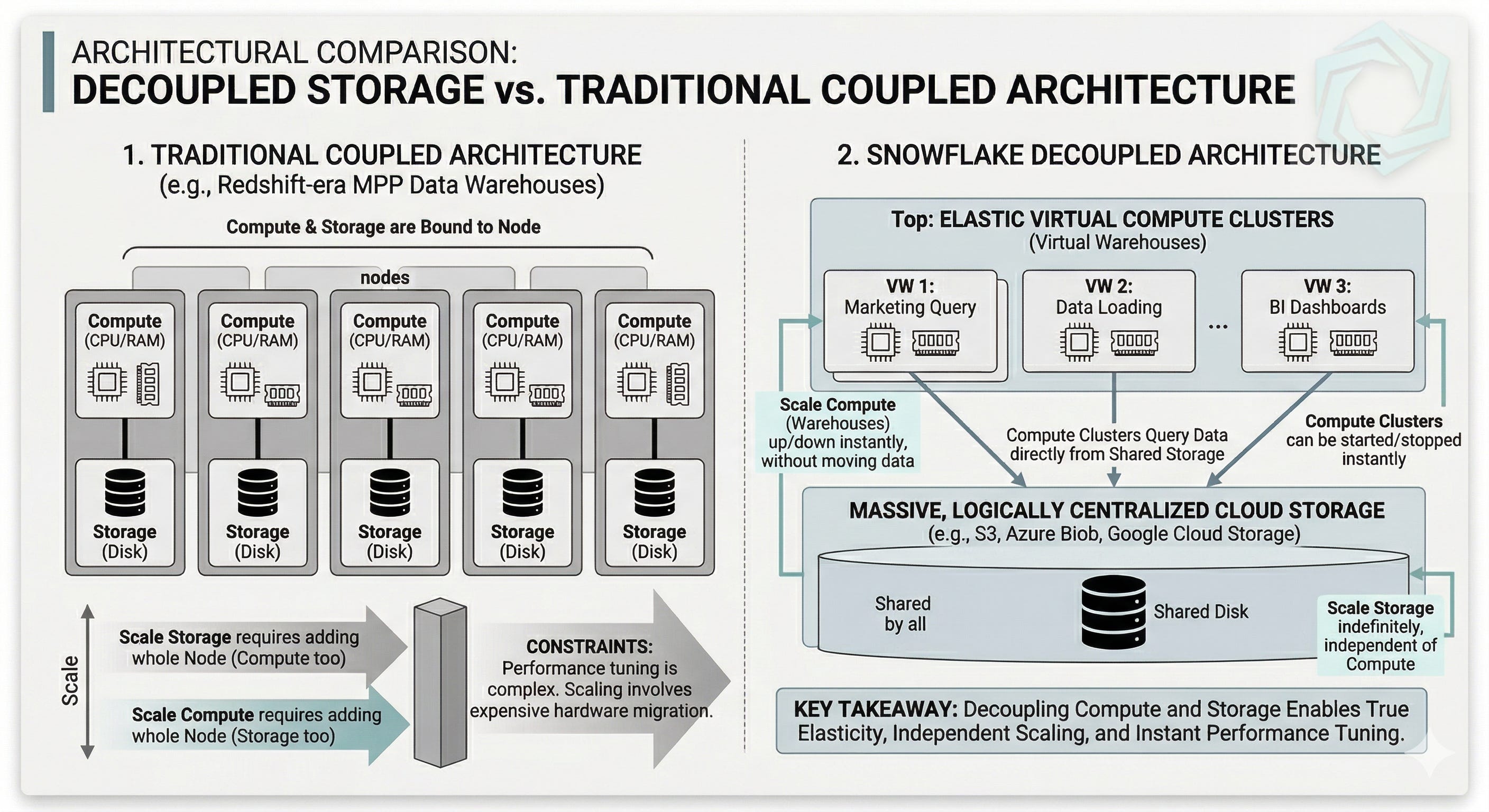
The cloud services were a step forward, but they carried a fundamental architectural limitation: storage and compute were coupled together. If you wanted to scale the processing power to run more complex workflows on the same data, you still had to pay for more storage, regardless if you needed the extra capacity or not.
Snowflake’s founding insight, which in retrospect seems obvious but was genuinely breakthrough at the time, was to separate storage and compute entirely. The company was founded in 2012 by Benoit Dageville and Thierry Cruanes, two data architects who had spent years at Oracle and understood the limitations of legacy systems from the inside.
Their vision was to build a cloud-native data platform from scratch, where customers could scale storage independently of compute, run multiple concurrent workloads without resource contention, and do it all across different clouds (AWS, Azure, Google) simultaneously.
This multi-cloud, decoupled architecture was a breakthrough. It meant that a customer could store petabytes of data cheaply, spin up compute clusters only when needed for specific queries or workloads, and shut them down immediately after, paying only for what was actually consumed.
For large enterprises managing complex, multi-cloud environments, this was transformational.
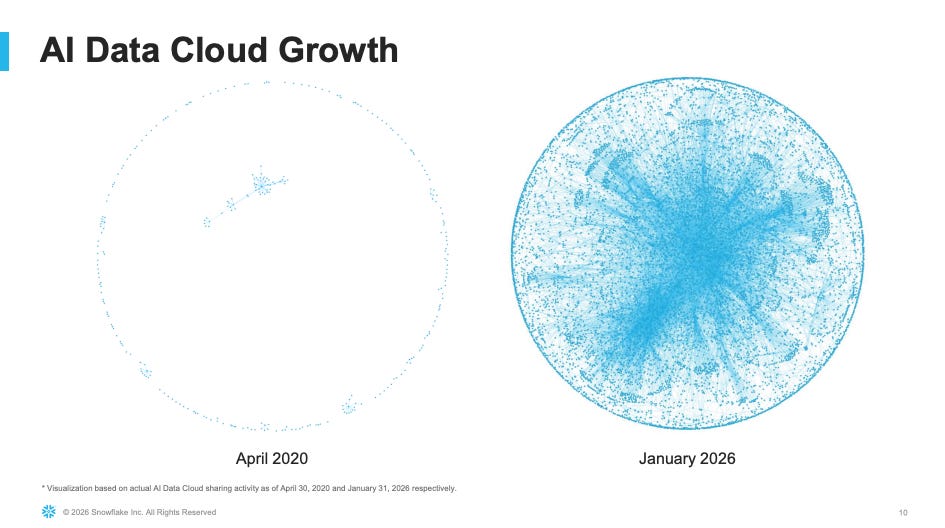
The product found market fit rapidly. By the time Snowflake went public in 2020, it had built a customer base spanning the Fortune 2000, a net revenue retention rate above 105%, and a growth rate that made it the largest software IPO in history at the time.
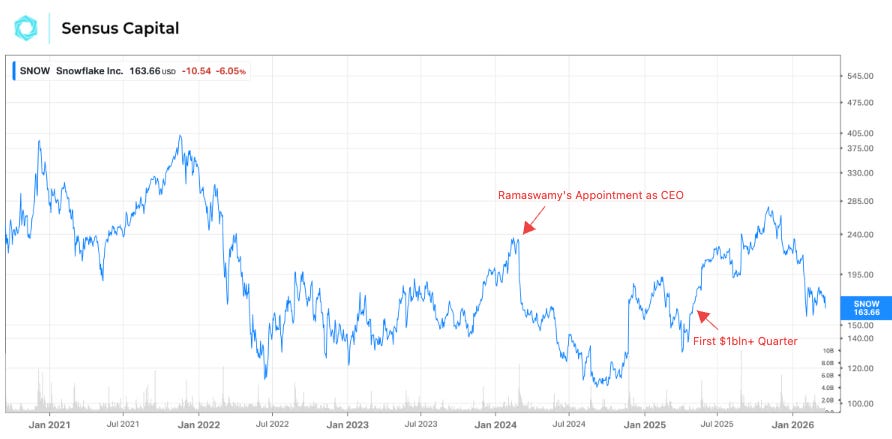
Snowflake’s leadership history is best understood in three distinct phases, each reflecting a different strategic priority for the company.
Act I: The Founders Build the Engine
Dageville and Cruanes focused the first seven years on building a technically superior product. They brought in experienced operators for the commercial side, but the culture was engineering-first. This matters because it embedded a depth of technical differentiation into the platform that competitors have struggled to replicate. The founders remain in senior technical roles today, which provides continuity in the product vision even as the leadership team around them has changed.
Act II: Slootman Scales the Machine
In 2019, Snowflake brought in Frank Slootman as CEO. Slootman is one of the most accomplished enterprise software executives of the last two decades. He previously led Data Domain through its acquisition by EMC and then served as CEO of ServiceNow, where he drove the company from approximately $1.5 billion to over $4 billion in revenue during his tenure.
Slootman’s playbook at Snowflake was consistent with his track record: relentless focus on sales productivity, operational discipline, and high-leverage growth. Under his leadership, Snowflake executed the record-setting 2020 IPO, scaled revenue from under $300 million to nearly $3 billion, built out the enterprise sales force globally, and maintained a NRR above 130%. Slootman also brought on Mike Scarpelli as CFO (another ServiceNow veteran), and the two operated as a well-known pair in the enterprise software circles.
The Slootman era was a masterclass in scaling an enterprise software business. But by 2024, the requirements from the market were shifting. Snowflake’s growth was naturally decelerating as the base expanded. The competitive landscape was evolving, in particular, Databricks was gaining further share through its increased focus on AI/ML workloads, and hyperscalers were fortifying their own native analytics offerings.
The next phase of Snowflake’s value creation would depend less on sales execution and more on product innovation, specifically in AI.
Act III: Ramaswamy and the AI Pivot
In February 2024, Snowflake announced that Slootman would retire as CEO (remaining as Chairman) and that Sridhar Ramaswamy would take the helm. Ramaswamy had joined Snowflake only months earlier as SVP of AI (through an acquisition of his previous company).
The market initially reacted negatively to the transition. However, the appointment made sense and showed that the board was thinking long-term. To enter the AI age, you need an AI expert at the helm.
Since taking over, Ramaswamy has accelerated the rollout of Cortex AI, forged partnerships with Anthropic and OpenAI to integrate frontier models directly into Snowflake’s platform, and acquired Datavolo to strengthen multimodal data pipeline capabilities.
The early indicators are encouraging: AI and ML feature adoption has grown to over 5,200 weekly active accounts as of Q1 2026, up from approximately 3,200 just two quarters prior.
The question investors must answer is whether Ramaswamy can translate this product momentum into sustained revenue acceleration and, critically, whether he can do so while bringing the cost structure (particularly stock-based compensation) under control.
We will address both of these directly in the Financials and Outlook sections in Part 2.
At its foundation, Snowflake is a cloud-native data platform. The core product, Data Cloud, is a comprehensive suite for storing data in virtual multi-cloud warehouses and data lakes, and running analytics and engineering pipelines/workloads against that data.
The key architectural features that define the core platform are the ones we described in the company history: decoupled storage and compute, multi-cloud deployment (AWS, Azure, GCP natively) and the ability to run multiple concurrent workloads without resource contention. But what has evolved significantly since the early days is the breadth of what the platform can handle.
Snowflake moved past the basic data warehouse functionality running SQL queries against structured tables. It now supports structured and unstructured data formats (including documents, images, and PDFs), real-time and batch data ingestion, data engineering pipelines, application development and increasingly AI and ML workloads, all under a single governance model.
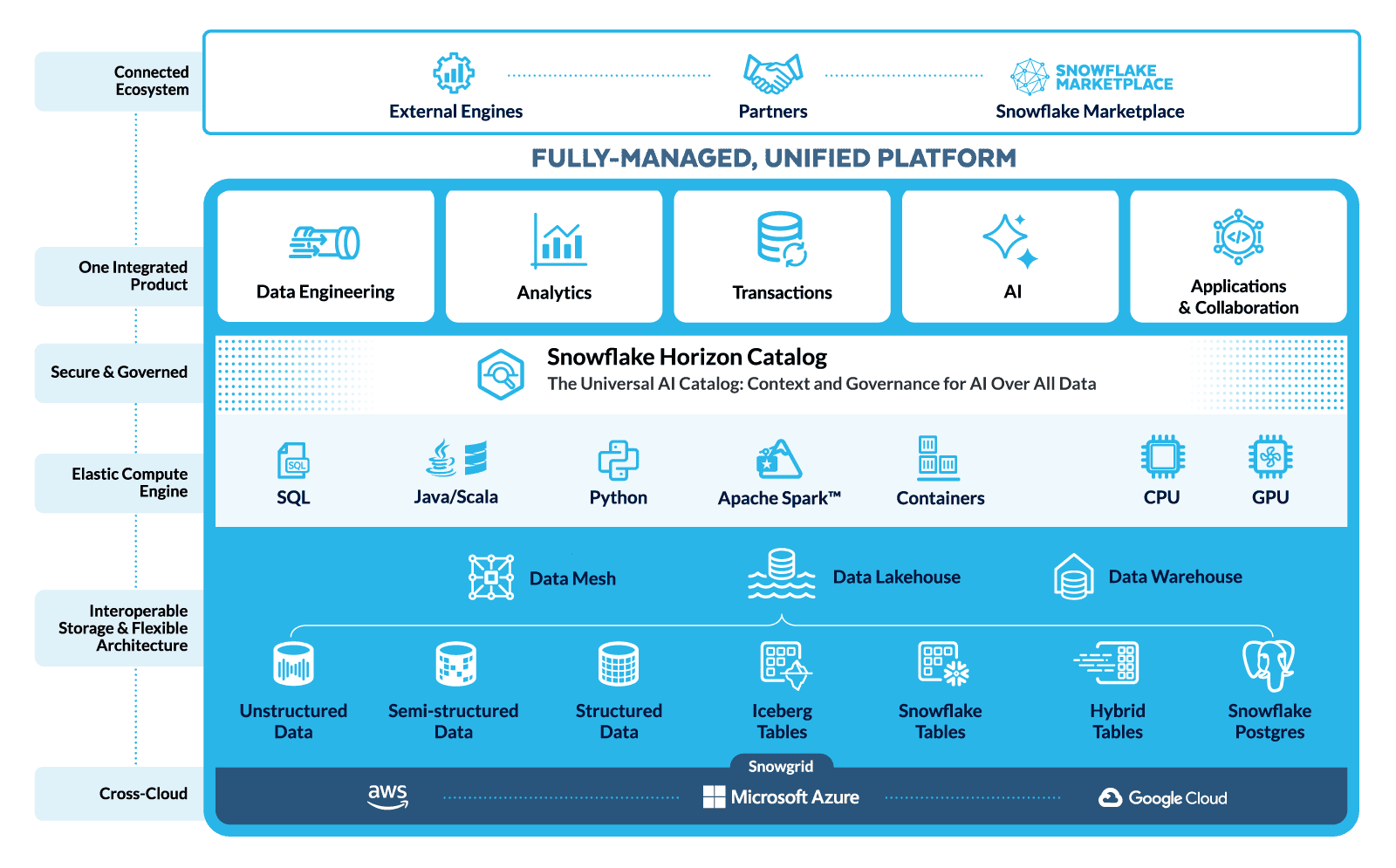
For the enterprise buyer, the value proposition is the ability to consolidate multiple vendors into Snowflake (storage, processing, analytics, data science etc. can all be brought into the same platform). The data stays in one place, governance is unified, and the organisation pays for what it consumes rather than maintaining licenses across a fragmented stack consisting of different vendors.
Cortex is Snowflake’s AI and machine learning layer, built natively on top of the data platform. It allows the users to build and deploy AI-powered applications in the same environment where their data is stored.
The suite now includes several capabilities that are worth understanding individually:
Cortex AI Search enables natural language queries against enterprise data. A non-technical user can ask a question in plain English and receive answers drawn from the company’s Snowflake-stored datasets.
Document AI handles unstructured data extraction: customers upload documents (PDFs, forms, invoices) and a pre-trained model extracts structured data and stores it in queryable format.
Cortex Analyst powers conversational analytics for business users, functioning as an AI-driven interface to the data warehouse.
And Snowflake Intelligence is the broader wrapper that ties these capabilities together into what Snowflake envisions as the enterprise “AI data assistant”.
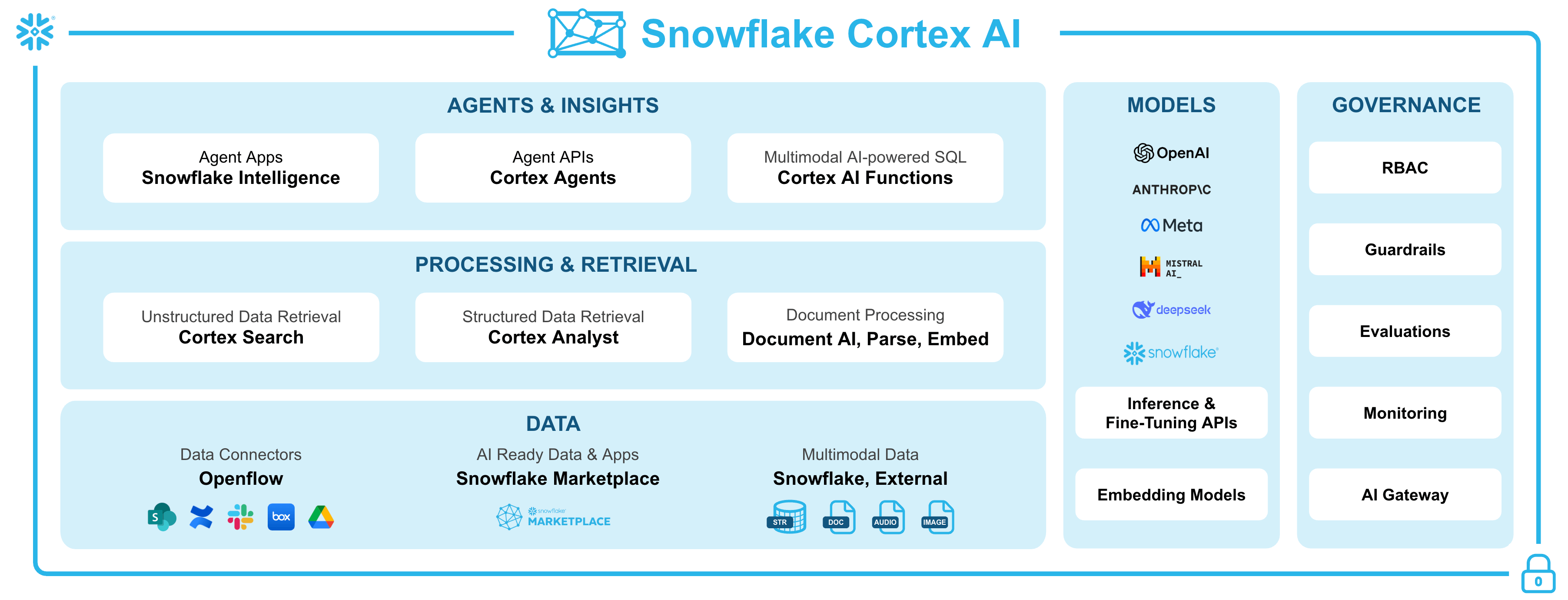
Another important observation is the existing integration with all of the frontier models. All of them run within Snowflake’s governance framework, meaning the data never leaves the customer’s security perimeter. For enterprise buyers who want the capabilities of frontier AI but cannot tolerate data leaving their controlled environment, this is a meaningful differentiator.
The adoption numbers are encouraging. As of Q1 FY2026, over 5,200 accounts were using AI and machine learning features on a weekly basis, up from approximately 3,200 accounts just two quarters earlier. Over 1,000 production AI/ML use cases have been deployed on the platform, spanning industries from pharmaceutical drug discovery (AstraZeneca) to financial analytics (State Street). GPU-optimised containers for running large language models are already in production with early adopters.
We flag Cortex as a “Rising Star” for a reason: this is where the incremental consumption growth will come from. If enterprise AI adoption follows the trajectory that the hyperscalers are projecting for the next 3-5 years, Cortex has the potential to be a meaningful revenue contributor.
Whether that potential converts into material financial impact is what we will be watching in every earnings call going forward.
Beyond the core platform and Cortex, Snowflake has built out several additional products that expand the platform’s addressable workloads. We will cover these more briefly, but each plays a specific role in the ecosystem:
Unistore is Snowflake’s push into transactional data. It allows transactional and analytical data to coexist on the same platform. The key benefit is that it reduces the need for customers to maintain separate OLTP and OLAP systems, further consolidating workloads onto Snowflake and increasing per-customer consumption.
Snowpark is Snowflake’s developer framework. It provides native libraries for Python, Java, and Scala, allowing data engineers and scientists to write code directly on the Snowflake’s platform rather than extracting data to an external environment. This is Snowflake’s direct competitive response to Databricks’ Apache Spark integration. It contributed over 3% of FY2025 product revenue and has been growing at roughly 30% QoQ. The company claims Snowpark is twice as fast and cheaper than Spark for equivalent workloads.
Iceberg is Snowflake’s open table format support, allowing customers to run workloads against data stored externally in their own data lakes. The customer incurs compute costs but avoids storage costs for that data. We treat it more as a smart landing product, as it lowers the barrier for enterprises to start using Snowflake before migrating their data. Over time, Snowflake bets that these customers will recognise the benefits of consolidating storage as well, converting Iceberg users into full-platform customers.
This product is often overlooked, but deserves much more attention in our opinion.
The marketplace is a data exchange layer that allows Snowflake customers to share, discover, and monetise live data directly with other organisations on the platform. This is not file sharing, or API integration. It is a real-time, governed sharing platform, meaning one organisation can grand another access to a live, continuously updated dataset without the data being duplicated, exported, or leaving Snowflake’s governance framework.
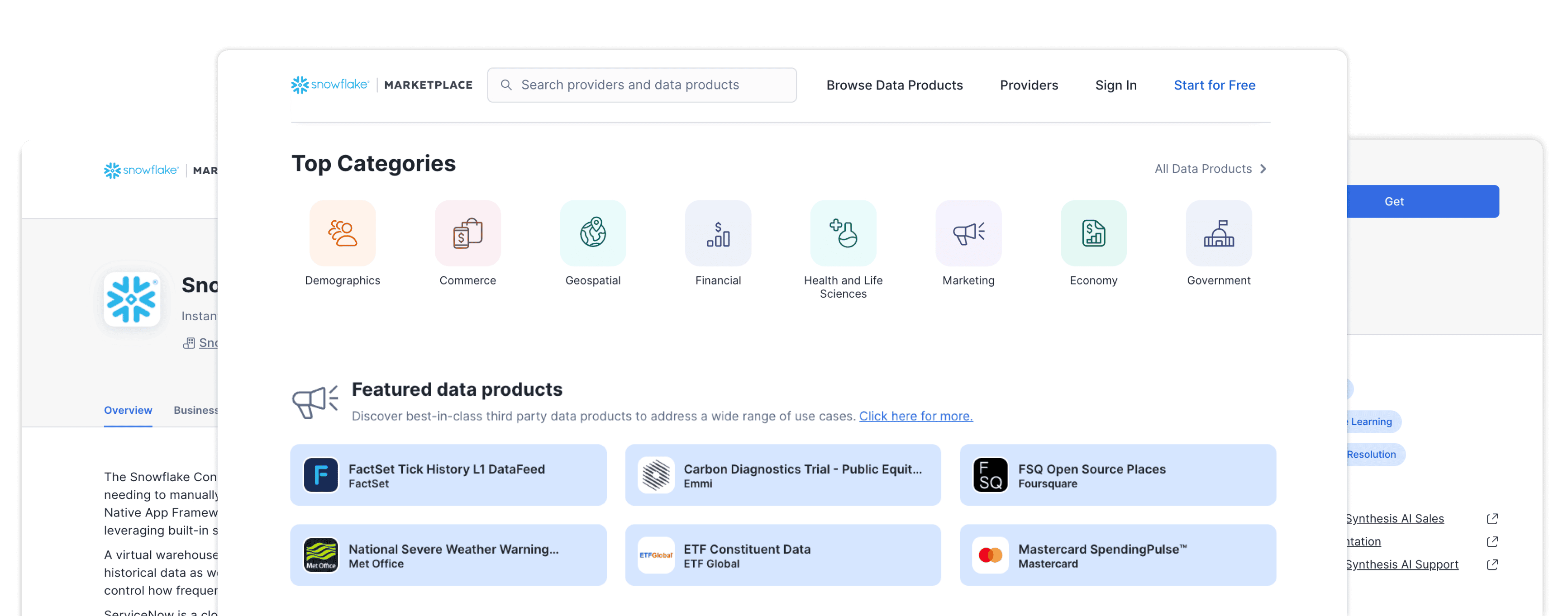
It creates network effects. Every enterprise that joins Snowflake and begins sharing data with its partners, suppliers, or clients makes the platform more valuable for every other participant. And it creates switching costs that have nothing to do with Snowflake’s technology. A company might be willing to migrate its own data to a competitor, but if it has 50+ active data-sharing connections with partners who are also on Snowflake, walking away means severing those connections and rebuilding them on a different platform.
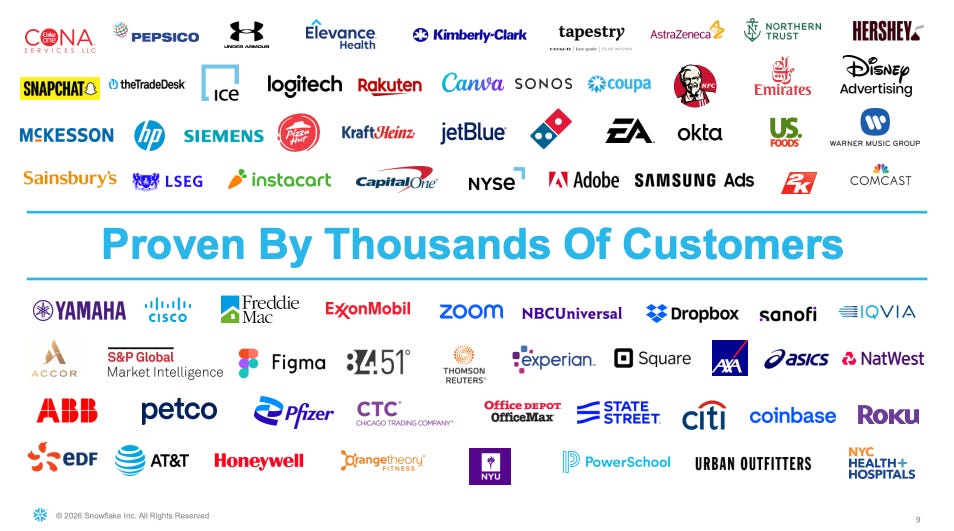
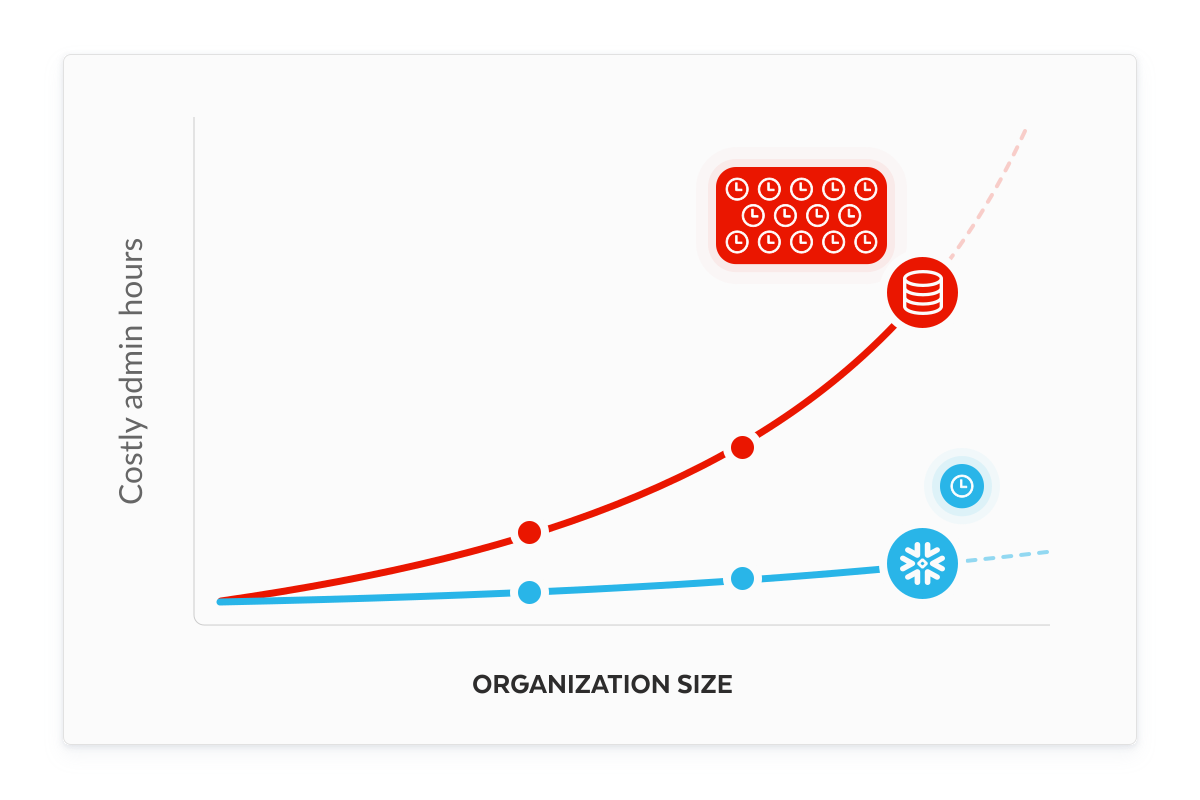
Snowflake’s customer base spans a wide range, from large digital enterprises to SMBs. The platform’s fully managed, cloud-native architecture removes the need for customers to maintain dedicated database administrators or infrastructure teams, which reduces a significant cost and makes the platform accessible even for the companies without internal data analytics teams.
The modern UI and streamlined interactions further lower the adoption barrier. For an SMB that would otherwise need to hire a full-time employee to manage a traditional DB, Snowflake is a compelling alternative.
That said, the financial profile of the business is overwhelmingly enterprise-weighted.
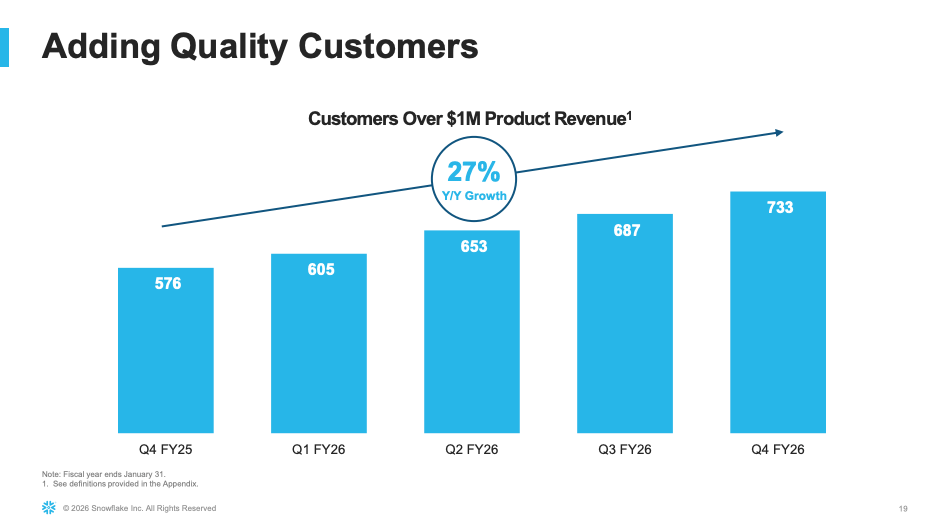
As of the end of FY2026, there are 733 customers with over $1mm in product revenue, and this number is growing 27% YoY.
Based on our notes, Snowflake’s largest individual customer deal on record is around $250mm.
Snowflake charges customers based on three distinct resource categories: compute (the type and duration of processing resources used for queries and workloads), storage (the average volume of data stored on the platform per month) and data transfer (the volume of data moved between regions and/or cloud providers). These three cost categories are independent. A customer can store large volumes of data cheaply and only incur significant compute costs when actively running workloads. This separation is a structural pricing advantage. It means customers do not pay for idle capacity, and they have granular visibility into what each workload, query, or model run actually costs.
The market response to this pricing model has been consistently positive. Customer reviews frequently cite Snowflake as a cheaper service relative to alternatives, and a greater value for the price paid. When compared to legacy on-prem solutions, the cost differential can be even more drastic.
Snowflake, in our assessment, is the pricing leader in the cloud data platform space. The ability to show customers precise cost per workload, per run, and per model is a sales advantage that competitors have been slow to match at the same level of granularity.
When talking about consumption model of Snowflake, we need to be more precise, as misunderstanding this point will lead to misreading the financial statements.
Snowflake does not operate a standard SaaS subscription model. This distinction is critical. In a traditional SaaS business, a customer signs a contract, and revenue recognition is spread over the contract term, regardless of the actual usage. This creates smooth, stable, and predictable revenue curves.
Snowflake explicitly distances itself away from this model.
Revenue is recognised as consumption occurs. A customer may sign a $10mm, 3-year capacity agreement, but Snowflake will recognise the revenue only when that customer actually uses compute, storage, and transfer resources against that commitment.
This has several important implications for how we analyse the business.
First, traditional software metrics are less useful. Numbers such as billings or ARR do not capture the dynamics of a consumption model well. Instead, the metrics that matter for Snowflake are product revenue (actual consumption recognised), NRR, and RPO. RPO currently stands at $9.77bln growing 42% YoY.
Second, the model creates a double-edged sword on predictability. On the positive side, most customers sign capacity agreements with annual-in-advance payments. This means Snowflake collects cash upfront before the customer has consumed the resources. The result is best-in-class free cash flow conversion, with adjusted margins above 20%. On the negative side, since revenue depends on the actual consumption patterns, quarterly results are inherently more variable than a subscription model would produce. If a large customer optimises its queries, scales down a workload, or delays a project, that consumption shortfall hits revenue immediately. This is the reason behind the revenue deceleration seen between FY2025 and FY2026 that has concerned some investors.
In Part 1, we have focused our Sensus Tech Insights report on the key components of Snowflake as a business and their product. Specifically, we looked at the architectural innovation that made Snowflake a category-defining company, the leadership transition from scaling machine to AI-first product vision, the breadth of the product suite anchored by the Data Cloud Platform and the rising Cortex AI layer.
We also highlighted the often overlooked elements when it comes to Snowflake, such as the network effects of Snowflake Marketplace and how their revenue recognition works.
The foundation is necessary to understand the prospects Snowflake has and to determine at what level it is an attractive portfolio addition.
In Part 2, we will address the remaining standard points of a Sensus Tech Insights report:
AI - Threat or Opportunity?
Competitive Landscape
Financials
Sensus Research Outlook & Verdict
Part 2 is coming soon. Make sure you are subscribed so you do not miss out.
If you are not yet a subscriber of Sensus Capital Research, you can join for free below. All of our Sensus Tech Insights reports, including both parts of this Snowflake deep dive, remain free and accessible to all subscribers.
Disclaimer: We may hold or trade $SNOW equity or SNOW 0.00%↑ -related derivatives at any time. The comments and information presented in this post are not investment advice, but opinions. Please do your own research.
No posts
Comments
Nothing yet. Say the first thing.
Sign in to join the conversation.