
Trust has always been the quiet architecture of science — what allows researchers to build on one another’s work without rebuilding the world from scratch each time. We trust that a dataset reflects what its authors claim, that results can be reproduced if we follow the same methods, and that the collective discipline of peer review has tested both for rigor and coherence. Beneath every paper lies a chain of evidence — from data to method to interpretation — that holds the scientific enterprise together. Trust isn’t just an aspiration of science; it’s the mechanism that makes it work.
Today, that architecture is under strain. Artificial intelligence has exposed how fragile our systems of trust have become — and how quickly they can erode when data are stripped of their context and authorship. Vast models train on data drawn from every corner of the digital world — from public repositories to journal archives — often without credit, provenance, or permission (Birhane et al., 2021; Gebru et al., 2021). They generate text, images, and predictions that resemble knowledge but lack the context that makes knowledge reliable. Meanwhile, most scientific data remain inaccessible — locked on personal drives, confined within institutions, or lost after publication (Pasquetto et al., 2017).
The result is a quiet crisis. Metadata vanish, links decay, datasets lose their methods, and findings can’t be verified because the evidence has drifted away. Even honest research struggles to be reproducible. When data circulate without provenance while most remain invisible, the foundation of trust begins to crack.
Repair begins not with regulation, but with redesign — embedding trust directly into the structure of data itself.
FAIR² was conceived to rebuild that architecture — to restore integrity through design.
The FAIR² Open Specification is an open specification for data sharing that encodes credit, context, and sovereignty directly into dataset metadata. By linking every dataset to its methods, materials, and provenance — and by separating metadata from the data itself — FAIR² enables transparency without loss of control. Verification, attribution, and ethical governance become intrinsic properties of the data, not afterthoughts of compliance.
FAIR² extends the original FAIR principles — Findable, Accessible, Interoperable, Reusable (Wilkinson et al., 2016) — with two that the AI era now demands: AI-Ready and Responsible. Together, these six principles define a framework that makes openness meaningful, ensuring reproducibility and integrity as data move across systems and institutions.
At Senscience, in collaboration with Frontiers, we are helping to operationalize this framework through the FAIR² Data Management service — a practical implementation of the FAIR² Open Specification. While the open specification defines what responsible openness looks like, this implementation defines how to practice it day to day.
For researchers, Frontiers FAIR² Data Management automates much of the tedious work that responsible sharing requires. Rather than filling out templates or copying metadata between systems, scientists are assisted by the AI Data Steward — an intelligent tool that prepares and publishes datasets with full context, traceability, and credit. It generates standardized metadata, checks that datasets align with their associated methods and materials, and links relevant documentation. This is automation in service of integrity: a system that strengthens good scientific practice rather than replacing it.
Imagine a neuroscience lab publishing recordings of neural activity collected under different behavioral conditions. Using FAIR², the AI Data Steward identifies the relevant methods, links them to the dataset, and ensures that the metadata clearly describe how and under what conditions the data were generated. The result is AI-ready — compatible with MLCommons Croissant — structured, reusable, and transparent, while remaining responsible by preserving provenance and meaning.
The same principles apply across domains. For repositories, the FAIR² Open Specification ensures that provenance, authorship, and contextual information persist wherever data are found — whether through Zenodo (European Organization for Nuclear Research & OpenAIRE, 2013) or institutional archives. By separating metadata from data, it allows openness and sovereignty to coexist: visibility without dispossession.
Integrity in FAIR² is not a slogan but a structural property. Every dataset must align with a single identifiable study; data must connect explicitly to their methods and materials; and metadata must describe methodology, provenance, and versioning in machine-readable form.
By defining these relationships, the specification makes integrity self-enforcing. Datasets cannot drift from their methods; results cannot detach from their evidence. Reproducibility ceases to be an afterthought — it becomes part of the design itself.
As the ecosystem grows, implementations like Frontiers FAIR² Data Management will add automated provenance tracking and citation alerts, helping researchers who reuse data to give proper credit to original creators. The goal is simple but transformative: to make the social contract of science — to cite, acknowledge, and preserve context — easier to honor and harder to ignore.
When researchers share data, they extend trust: the expectation that others will use their work responsibly and preserve its meaning. That trust must be met with care. Citation is not bureaucracy; it is reciprocity.
Sovereignty, in this sense, is not restriction but recognition. It ensures that openness never becomes exploitation and that collaboration does not erase identity. The FAIR² Open Specification supports this broader understanding of sovereignty through its alignment with the CARE Principles for Indigenous Data Governance — Collective Benefit, Authority to Control, Responsibility, and Ethics (Carroll et al., 2020). Where FAIR describes how data should move, CARE reminds us why and under whose terms.
FAIR² supports these principles by preserving provenance, separating metadata from data, and enabling local governance within global visibility. Yet operationalizing CARE requires more than design; it requires co-design. Sovereignty is realized not in architecture alone but in participation — when the communities whose knowledge is represented are partners in defining how their data are described, accessed, and reused. FAIR² provides the scaffolding; co-design provides the voice that makes it just.
This work does not begin with us. Many communities have been advancing the ethics and infrastructure of responsible data for years — from the developers of FAIR (Wilkinson et al., 2016) and the stewards of CARE (Carroll et al., 2020), to organizations shaping Open Science (UNESCO, 2021), Indigenous Data Sovereignty (Rainie et al., 2017), Responsible AI (Jobin et al., 2019), and the Global Open Research Commons (CODATA, 2023). FAIR² builds on these foundations, translating their insight into an open, operational framework that connects openness with accountability. Frontiers FAIR² Data Management, powered by Senscience, is the first implementation of this framework — a proof that integrity can be automated without being abstracted.
Trust in science has always rested on more than technology; it rests on the collective discipline of review, replication, and respect for evidence. FAIR² strengthens this foundation by extending the principles of peer review to data itself. When datasets are shared with their full context, credit, and provenance, reviewers and readers alike can evaluate results on the strength of their evidence, not just their claims. In this way, responsible data management becomes a continuation of peer review — the ongoing verification that sustains trust.
Artificial intelligence will continue to transform science, but we can decide how. We can build systems that preserve credit, protect context, and respect sovereignty — or allow scale to erode the values that make science reliable. The FAIR² Open Specification is a beginning: a framework for ensuring that as data become more global, science remains human.
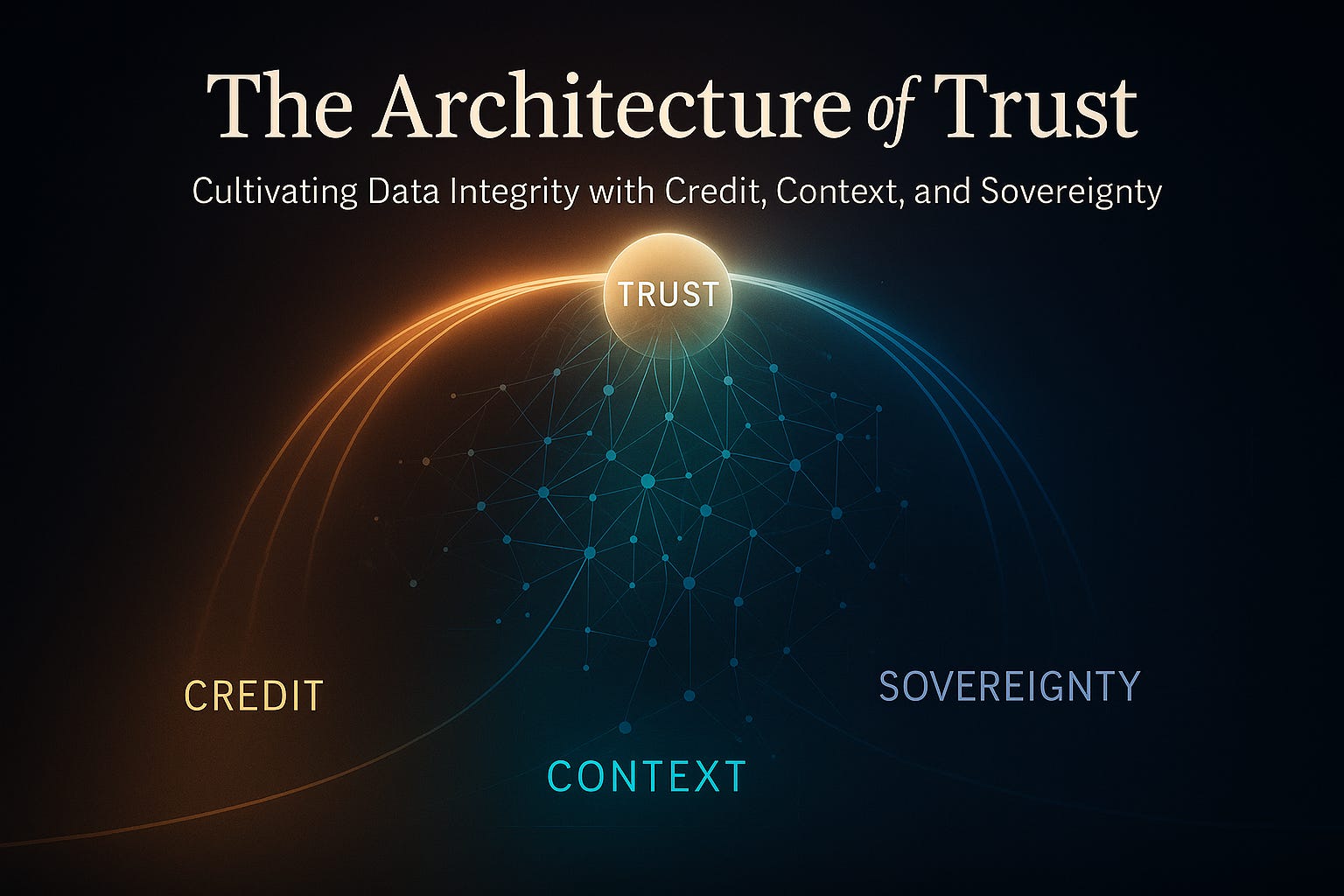
The architecture of trust cannot be rebuilt by one institution. It must be co-created — by researchers, repositories, funders, and policymakers across disciplines and regions. Together, we can design systems where credit gives science continuity, context gives it meaning, and sovereignty gives it agency.
Trust is not a given; it is a system we build. FAIR² begins with open data, but it is built for integrity — to keep knowledge human in the age of AI.
Baker, M. (2016). 1,500 scientists lift the lid on reproducibility. Nature 533, 452–454.
Birhane, A., Prabhu, V. U., & Kahembwe, E. (2021). Multimodal datasets: misogyny, pornography, and malignant stereotypes. arXiv preprint arXiv:2110.01963.
Carroll, S. R., et al. (2020). The CARE Principles for Indigenous Data Governance. Data Science Journal, 19(1), 43.
CODATA. (2023). Global Open Research Commons (GORC) International Model. Committee on Data of the International Science Council.
European Organization for Nuclear Research & OpenAIRE. (2013). Zenodo [Data repository]. CERN.
Gebru, T., et al. (2021). Datasheets for datasets. Communications of the ACM, 64(12), 86–92.
Jobin, A., Ienca, M., & Vayena, E. (2019). The global landscape of AI ethics guidelines. Nature Machine Intelligence, 1(9), 389–399.
Molloy, J. C. (2011). The open knowledge foundation: open data means better science. PLoS Biology, 9(12): e1001195.
Pasquetto, I. V., Randles, B. M., & Borgman, C. L. (2017). On the reuse of scientific data. Data Science Journal, 16.
Rainie, S. C., et al. (2017). Indigenous data sovereignty. International Indigenous Policy Journal, 8(2).
UNESCO. (2021). UNESCO Recommendation on Open Science. Paris: UNESCO.
Wilkinson, M. D., et al. (2016). The FAIR Guiding Principles for scientific data management and stewardship. Scientific Data, 3, 160018.
Comments
Nothing yet. Say the first thing.
Sign in to join the conversation.