
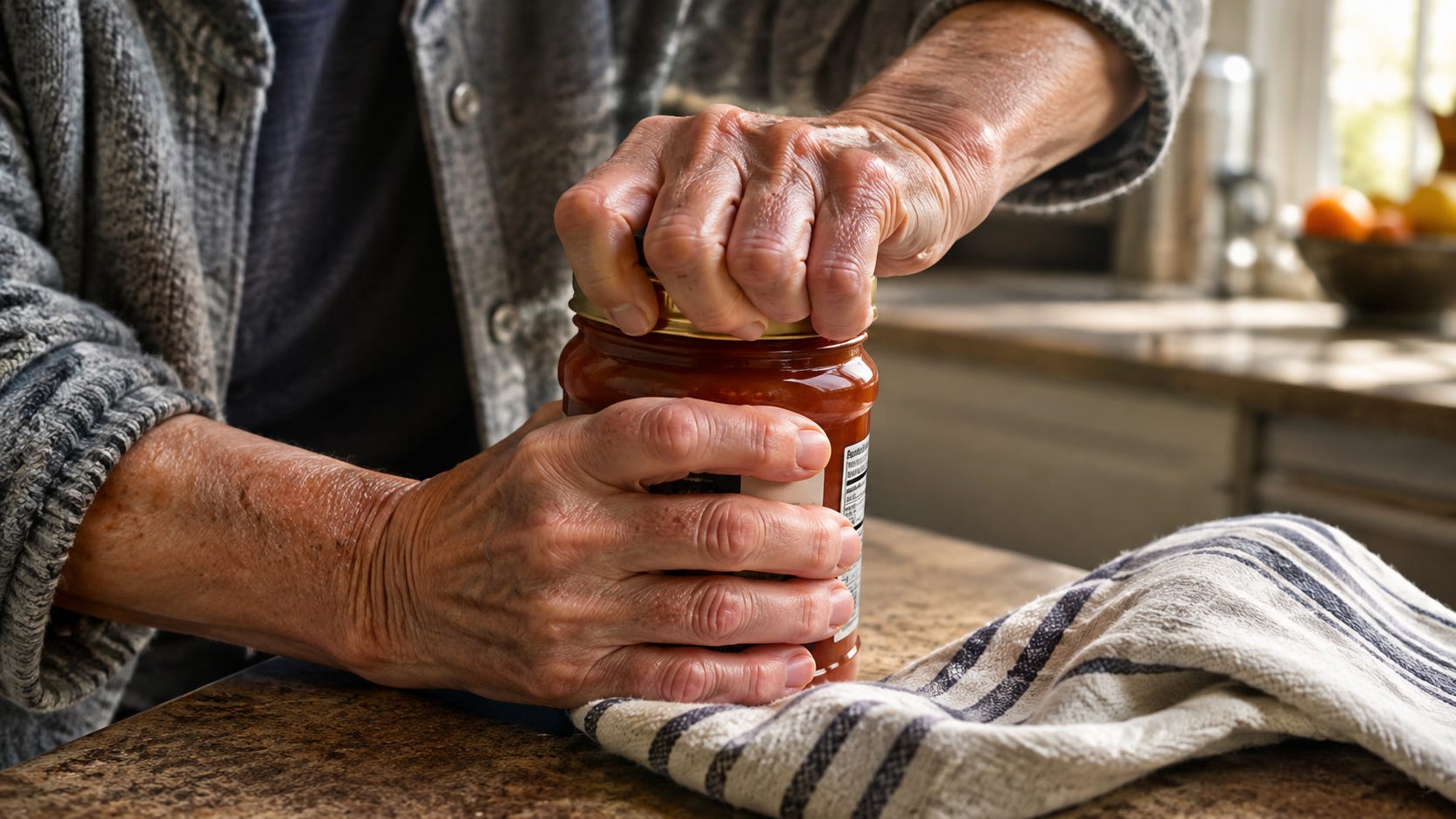
Go find a jar in your kitchen. One you know is difficult.
Try to open it with your dominant hand only.
If it opens easily, that is one answer. If it requires real effort, that is another. If it doesn’t move at all, that is a third.
Whatever happened just now may be more meaningful than it probably looked.
Grip strength changes gradually. It shows up in small moments before it shows up anywhere else. A bag you now carry differently. A door handle that requires more effort than it used to. A handshake you give a little more carefully. None of it dramatic. None of it something you’d mention to a doctor. Just a quiet shift in how physical tasks feel.
The easy assumption is arthritis. Or just aging. Both may be true. But there may be something else worth paying attention to.
A 2015 study followed 139,691 adults across 17 countries. Researchers measured grip strength at the start and tracked who lived and who died over the following years. They compared grip strength against blood pressure, cholesterol, and other standard risk markers.
Grip strength was a stronger predictor of cardiovascular death than systolic blood pressure.
Not a minor difference. A stronger predictor. In a study of 139,691 people.
Your doctor measures your blood pressure at every appointment. Your grip strength has almost certainly never been tested.
Grip strength tells us something about more than the hand. It can serve as a simple proxy for broader muscle strength and physical function. When grip declines, it tends to reflect a broader pattern: fast-twitch muscle fibers reducing in number, the nervous system losing its ability to recruit them quickly, and muscle mass quietly decreasing even when body weight stays the same.
Fast-twitch fibers are involved in rapid force production: catching yourself from a stumble, standing up quickly, and reacting to something unexpected. They tend to decline with age, which is one reason researchers use grip strength as a simple measure of physical function. Not because the hand is the most important part of the body. Because it is one of the earlier places the change becomes measurable.
For context on where you might stand, normative data from population studies gives us a useful starting point. The important word is starting point. Grip strength varies quite a bit between individuals, so there is no single number that means “strong” or “weak” for everyone.
Men generally have higher absolute grip strength than women. That difference is already present in younger adulthood and continues into older age. It is largely related to differences in muscle mass and body size, which is why grip strength is normally interpreted using sex- and age-specific reference values rather than one cutoff for everybody. Large population studies consistently show the same pattern: men have higher average grip strength, and both men and women lose strength as they get older.
For men in their 60s, average grip strength in population studies is often somewhere around the high 30s to low 40s kilograms. By the 70s, averages are generally lower. For women, averages are lower to begin with, commonly falling in the low to mid-20s kilograms during the 60s and moving lower through the 70s. The exact number depends on the population, the equipment used, which hand was tested, and how the test was performed.
That last point matters. You will sometimes see a number online and wonder whether you are “normal.” Be careful with that comparison. A value from one study is not automatically the right reference for you. A person who is 72, physically active, and 6 feet tall is not directly comparable with a sedentary 72-year-old woman of much smaller body size.
What is more interesting is the direction over time.
Grip strength tends to decline gradually with age, but the rate is not identical at every stage of life. In the Women’s Health and Aging Study II, a longitudinal study of 307 community-dwelling women aged 70 to 79 at baseline, grip strength declined by an average of 1.10 kilograms per year between ages 70 and 75, compared with 0.50 kilograms per year after 75. That does not mean everyone loses strength at that rate. Individual changes varied considerably.
Other large datasets show the same general pattern without suggesting one sharp age at which strength suddenly falls. Strength peaks much earlier in adulthood and then declines progressively, with lower average values in the 70s and 80s than in the 60s.
So I would not get hung up on whether your number is exactly 32, 35, or 40 kilograms.
A single measurement tells you where you are today.
A repeat measurement tells you whether you are changing.
That is much more useful.
If you use a dynamometer, test under similar conditions each time and record the result. The number can give you a reference point, but the trend may tell you more than the number itself.
If you want a number, an inexpensive hand dynamometer costs around $20 to $30 online and gives you a reading in kilograms. Sit with your elbow bent at 90 degrees, squeeze as hard as you can for three to five seconds, and take the best of three attempts on each hand. Record it. Retest in three months under the same conditions.
The direction matters more than the number.
If you don’t want a dynamometer, the jar test is still useful as a repeatable reference point. A study of 123 community-dwelling older adults found that difficulty opening a jar was the single question most associated with measured grip strength. The same finding held for women. For men, self-rated grip strength compared with people the same age was equally informative.
Not a clinical test. But not nothing either.
This was an association, not proof that weaker grip causes cardiovascular disease. The PURE study authors were careful about the conclusion. They said further research was needed to determine whether improving muscle strength could actually reduce the risk of death.
What the research does support clearly is resistance training for maintaining strength and physical function after 60. A Cochrane review found that progressive resistance strength training improved physical functioning in older people, including outcomes related to strength, chair rising, and walking. Resistance training is what the evidence supports for this kind of strength, alongside general activity rather than instead of it.
Start with what you can control. Two sessions per week of resistance training, with enough effort that the last repetition feels hard. Squats, sit-to-stands, rows, push-ups against a wall. The specific exercises matter less than the consistency and the load.
The jar test is a useful monthly check. Pick the same jar, try it under the same conditions, notice whether it feels different. Not a medical test. A reference point.
If your grip has changed noticeably in the last year or two, mention it at your next appointment. Specifically. Tell your doctor that something feels different and ask whether it is worth tracking. That question opens a door most routine appointments leave closed.
The handshake feels like a small thing.
The research suggests it may not be.
Sources: Leong et al., PURE study (The Lancet, 2015; PMID 25982160); Simard et al., jar difficulty and grip strength in community-dwelling older adults (Journal of Aging Research, 2012; PMID 22523686); Xue et al., rate of decline in grip strength and mortality, Women’s Health and Aging Study II (Journal of the American Geriatrics Society, 2010; PMID 21054287); Liu CJ, Latham NK, resistance training in older adults (Cochrane, 2009).
Medical Disclaimer: This article is for educational purposes only and does not constitute medical advice. Consult your physician before starting a new exercise program or if you have concerns about muscle strength or cardiovascular health.
Stay independent. Stay capable.
Comments
Nothing yet. Say the first thing.
Sign in to join the conversation.