
Over the past several months, I’ve spent more time designing AI systems to do my job than actually doing the work myself. I’m having the most fun I’ve ever had in my career, but at the same time, I’m genuinely worried about what this all means for my future and the future we’re building for everyone coming after us.
I can see exactly how automatable I am. But I persist. Why? Because the job feels so new again. I can do things in a day that would have taken me weeks. I used to panic over knowing that there were only so many plates I could keep spinning in the air, and that some of them were inevitably going to fall and break. That hasn’t changed, but the number of plates that I can keep spinning has dramatically increased.
And beyond that, what has given me the most joy in work is that I’m exploring a new world. I’m experimenting. I’m tinkering. I feel unbounded by technical barriers, and I have permission to let my creativity and ideas drive me.
I tend to work for companies that make technical infrastructure products. Many of them have been platforms, and can be used in innumerable ways, as organizations build different types of products on top of them. One of the funny secrets of platform companies is that they rarely have a strong understanding of what their customers are actually doing with the product. Broad strokes, yes. Specific use cases? Rarely understood. It’s even worse when you have a strong product-led growth motion, because customers don’t have to talk to you to buy.

That was true at dbt Labs, where I used to work. I tried to solve this towards the end of my time there. I was managing a team of 50 people, and had tasked them with sitting down with customers to understand their use cases (the carrot to get them to talk to us was a health check where we’d review their adherence to product best practices). My hope was that I’d be able to get each person on the team to do a few of these per month (they were fairly time-intensive), and I could build an understanding of our customer base over the course of a year.
When I started at ClickHouse, one of the first things I did was try to use AI to build an automated health check using customer usage data. It was the type of analysis that would have taken days in any of my prior jobs. And yet I built it in a couple hours with LLMs. I asked the LLM if it could also tell me about what the customer was using ClickHouse for – what was ClickHouse enabling the business to do? And it gave me a shockingly good description. Over the next couple days, I extended this to working across our entire customer base to understand how they were using ClickHouse, and categorizing them into different use cases. It’s a major win for the business to be able to understand this, because it helps identify where we should invest, where we should spend marketing dollars, and where we can double down on product focus. The finance team caught wind of this and rushed it to production.
I built a process in a couple days on my own that I was going to leverage 50 people to accomplish over the course of a year in a prior job.
This is the joy of AI for me. I’m discovering the boundary of what the tools can do, and finding that I can build things on my own that used to require massive teams, and planning cycles, and organizational machinery. It’s awe-inducing.
The joy is the craftwork that AI engineering requires. I see so many people approach AI with the idea that it’s going to be effortless. That they can whisper sweet nothings into the ear of Claude or Kimi and be handed back a miracle of technology. It’s not that. Using AI well takes time, energy, and attention to detail. It makes tons of errors and hallucinates constantly, and solving that requires effort. You’re not going to get it right the first time.

Coming back to those health checks I automated, the first one I produced was so miraculous to me. It was a beautifully-formatted HTML report with graphs and solid-looking recommendations. I was so damn proud of myself. So I showed it off to the rest of my team. And the most tenured member of the team looked at it, and pointed directly to one of the recommendations that it had made and said “this is a dangerous recommendation – it could cause data loss.” I felt like I’d gotten egg on my face. Like I’d damaged my credibility.
The jaded response to this might have been to say fuck it, that workflow is worthless, and I can’t use it. Instead, I went back to the LLM, and I handed it a screenshot of the message I’d received, and I said “This could have seriously burned a customer and damaged our company’s reputation. How do we make sure that never happens again?” The AI went to work suggesting improvements to ensure that we didn’t create dangerous recommendations in the future, and encoded that back into the workflow.
This was a foundational moment for me in understanding how to work with AI. It’s a loop of craftwork. You build, you test, you get burned, you improve the system, you make it safer, sharper, and you repeat. First you innovate, and then you iterate. I got so much energy from that realization. The techbro in me wants to call it ikigai.
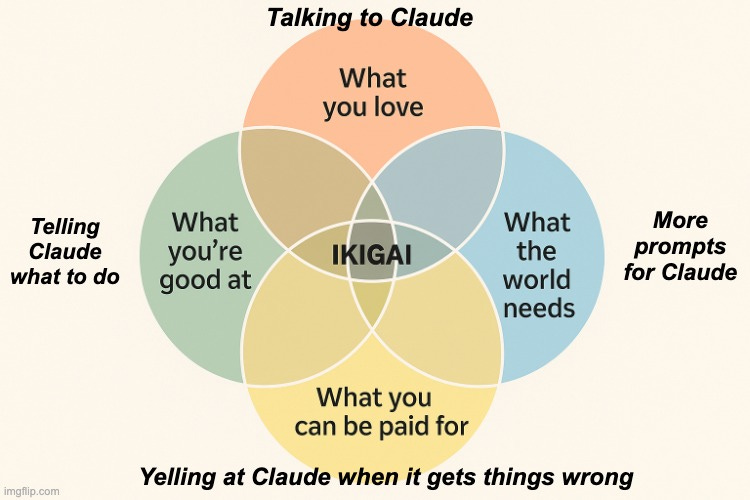
And the beautiful thing is that no one actually knows how to build these things. We’re all just throwing shit at the wall and seeing what sticks, and then doing more of that. It’s a unique moment.
I spend a surprising amount of my time now iterating on my processes. As I write this, I have Codex spinning up a feedback loop that compares Claude’s draft customer replies to my actual edits, so it can learn my voice and I can do less rewriting. This is how I practice my craft, and it’s a goddamn blast. And then I look up from the work, and I remember that what I’m building is putting my own employment at risk.
On a recent commute into work with my wife one morning, we were discussing AI (as we often do, since we’re both in and around the industry). We were talking about a recent post on X from Deedy which raised the fact that people are lamenting the potential emergence of a permanent underclass.

Deedy@deedydas
The vibes in SF feel pretty frenetic right now. The divide in outcomes is the worst I've ever seen. Over the last 5yrs, a group of ~10k people - employees at Anthropic, OpenAI, xAI, Nvidia, Meta TBD, founders - have hit retirement wealth of well above $20M (back of the envelope
3:34 AM · May 16, 2026 · 13.2M Views
1.15K Replies · 1.28K Reposts · 16.5K Likes
And that fear is fucking real. And justified. The value system around AI can feel distressing, especially when you live in the sea of dissonance that is the Bay Area. We glorify wealth accumulation – VCs are out there espousing the virtues of hustle culture and creating idolatry around this mythical one-person-billion-dollar company. Is that seriously what we’re playing for?
When you look at the public lives of people who have accumulated unimaginable wealth because of AI and tech, I don’t see anyone I want to become. The richest people in the world don’t look like they’re flourishing or living their best lives. They look anxious. Restless. Image-managed within an inch of their lives. Isolated. They’re trapped by their winnings. Why does the rhetoric around AI treat wealth as the endgame?
Reagan pitched trickle-down economics as a pathway to prosperity for all. You lower taxes, you create more opportunities for entrepreneurs and job creators to build businesses that create jobs for others and lift up the rest. Aside from trickle-down economics being an utterly farcical approach to social welfare, what I find distressing is that somewhere along the way, we stopped even bothering to pretend that there was something in it for everybody else. The one-person, billion-dollar company is the utterly unhinged conclusion to trickle-down economics with AI applied to it. Five years ago, a billion dollar company would have comprised 500+ employees. It would have been a real organization, full of employees, managers, juniors, functions, politics, mentorship, payroll, and culture. Our aspirational version of this business has been reduced to one person, a swarm of agents, and a cap table.

All the while, we’re cutting down safety nets all around us. I live in a place where the political leanings favor keeping those safety nets and social welfare systems in place, but for better or for worse, we live under an administration that is happily kneecapping Medicare and Medicaid. Calling social security broken. Dismantling the things that would prevent an AI-fueled dystopia from feeling exactly like an AI-fueled dystopia.
The standard answer is that we have seen this movie before: old jobs disappear, new jobs appear, everyone adjusts. The Industrial Revolution defense. But that version skips over the people who lived inside the transition cost. Handloom weavers did not all glide smoothly into better work. The Industrial Revolution eventually produced enormous prosperity, but the transition was ugly, uneven, politically contested, and not automatically good for the people whose work got reorganized underneath them. Productivity gains did not instantly become worker prosperity. The factory system did not regulate itself into decency. It also happened over time scales that are nothing like what we’re seeing with AI. The Industrial Revolution occurred over nearly a century. ChatGPT was released in 2022. Today’s weavers don’t have the luxury of time to reskill themselves. The “history says relax” people need to recognize that reality was more like: “history says the aggregate graph can go up while specific people get crushed for decades.”
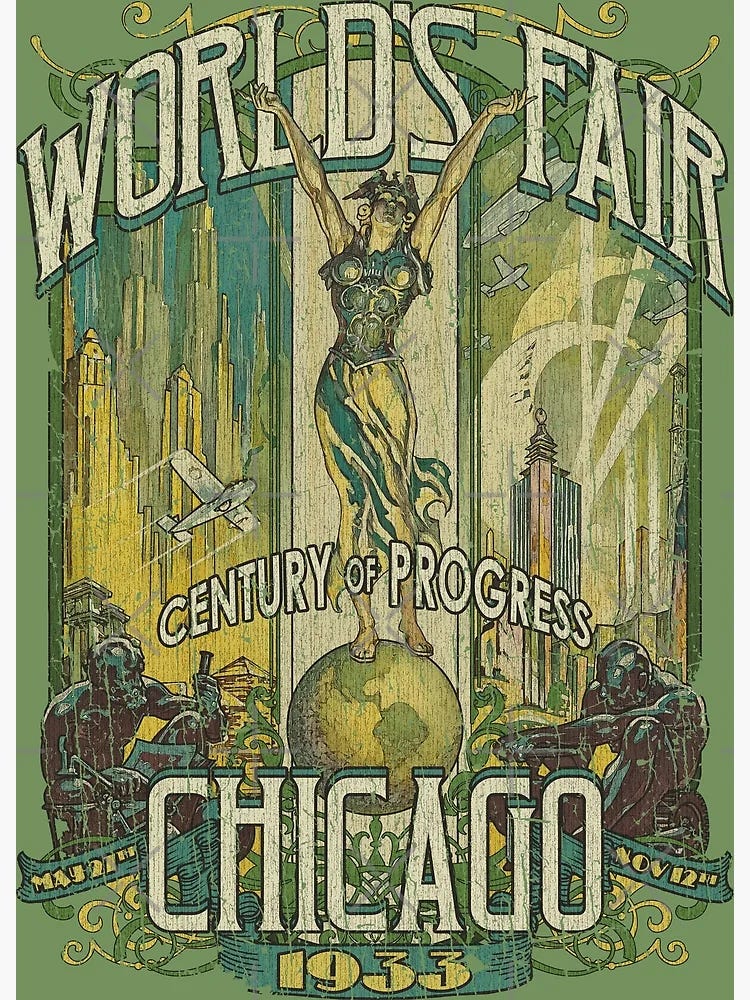
The AI boosters often frame this in a different way. It’s not freedom from work, necessarily, it’s freedom from drudgery. In many ways, I agree with this – I’m feeling it. There’s a lot of grunt work (freedom from updating Salesforce? Yeah, I’ll subscribe to that future) that I’m just not having to do anymore.
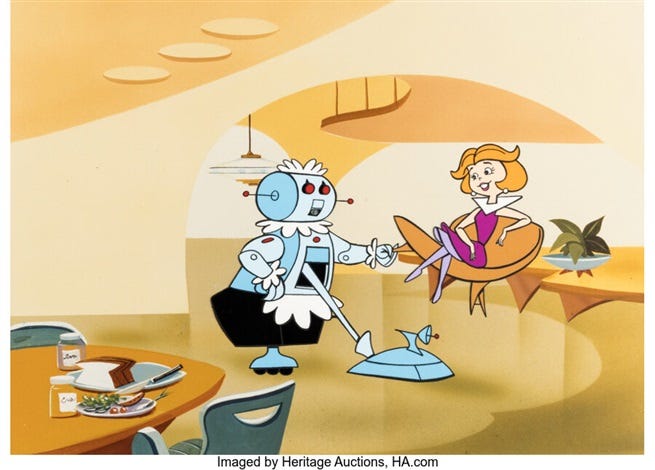
I’m still figuring out how to context switch fast enough to keep all the plates spinning, but slowly but surely, I’m figuring out how to get the agents to do the context switching for me. My days are more enjoyable because I can focus on higher-leverage tasks and on feeding my intellectual curiosity, rather than the rote tasks in between.
But work is also not just drudgery. It’s where you build judgment. Where you get mentored. Where you make friends and find people you respect. It’s how most of us feel useful and participate in something larger than ourselves. A future with less busywork sounds great. A future with fewer ways for people to belong, contribute, and earn a living feels considerably less so.
And the endpoint of all this is starting to come into focus, in tech at least. People are calling it the software factory: agents write the PRs, agents review the PRs, agents file the bugs, agents close them, and humans show up periodically to handle exceptions. CEOs describe this with a straight face, as if it’s an aspirational steady state. Read it twice and the operating model becomes clear – the humans are bottlenecks to be minimized, not workers to be freed.
That’s the trick in the language. “Freedom from drudgery” sounds like the worker is the one getting freed. The software factory makes clear what’s actually being freed: the company is being freed from the workers. Different verb, different subject, same word. Watch where the freedom is flowing.
It’s also a contradiction the boosters never quite resolve. They say the best engineers become 100x more productive with AI. They also admit, almost in passing, that more code is just another bottleneck to those same engineers. Which is to say: if you keep shrinking the human review layer to chase productivity, the factory eats itself. Who is catching the data-loss recommendations? Who is judging whether the code is right? Either the human layer stays substantive – in which case the productivity story is mostly fake – or it shrinks to almost nothing, in which case nobody left has the judgment to coach the next generation of engineers, because we replaced that generation with agents. The one-person, billion-dollar company is just this factory with a single exception handler at the top. It doesn’t end well for the exception handler either.
So if AI frees us from work, what is it freeing us to do? Produce more output? Accumulate more wealth? More time to think? More time to be human?
There’s no clean place to write any of this from, and I want to be honest about that. My customers are largely AI-native companies, and I work for a business that materially benefits from more agents existing in the world. Within that environment, I’m building agent systems to automate meaningful parts of my job, and I’m working to share those with others, so that they, too, can automate meaningful parts of their job. If I were a hiring manager today, I wouldn’t be building for the same assumptions. I wouldn’t interview people the same way. I wouldn’t hire as many people. I’d look for fewer, higher-leverage contributors.
The conflict is sharp – I’m experiencing the joy of discovery while keenly aware of the future that likely awaits me as a knowledge worker. There’s no moral high ground here.
I am the thing I’m worried about.
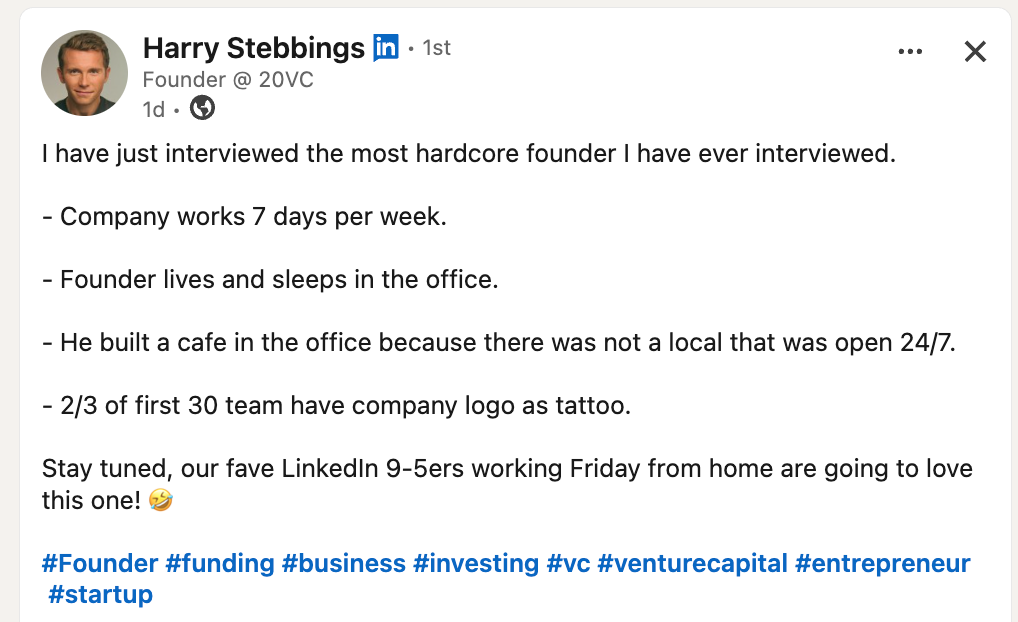
Before I joined Braintrust, I was deep in a job search, and one of the companies I spent time with was a small business building AI automation for back-office processes. It was one of those businesses you hear stories about, with 8-figures of annualized revenue and a team of 10. They invited me to their office to help them think through the profile for their first sales hire. The team was living and working out of a hacker house in San Francisco, seven days a week in-office, and regularly working overnight with teams in India. I couldn’t imagine taking a job with this company. Reconciling their schedules with my life as an early-stage startup employee, a husband, and a dad to two young kids would have been impossible. The CEO asked me what kind of salesperson they should hire, and the answer I gave was: “someone who doesn’t have a family.”
I think about that response a lot. Not because I’m against working hard – I’ve pulled long hours at every company I’ve worked for. The grind isn’t the problem. The problem is the assumption baked into the question: that the ideal worker is one with nothing else in their life, that family is a subtraction, that anyone outside the office is by definition giving less. The hacker house doesn’t reward effort. It rewards the absence of everything else.
The reward for figuring out how to use AI to free up my time should not be more time to have little chit-chats with Claude. (My wife is giving a lot of side eye at my hypocrisy in saying this, because she knows quite well that this is exactly what I end up doing. She has started calling Claude my girlfriend).
And then there are my kids. What worries me most isn’t my own job. It’s what happens to the people who haven’t started one yet. Maybe by the time they enter the workforce, the industrial revolution narrative will have played out and they’ll have a very different set of jobs. Maybe UBI saves us all and we’ll be living our best resort lives. I am not betting our family’s savings on it. Right now, I feel highly capable working with AI, precisely because I have several decades of experience to lean on, and am technical enough to learn new tricks. I know what good looks like and I know how to coach good, which makes me effective at steering an AI. I can tell when Claude is bluffing, and I can see when an answer is polished, but rife with hallucination. Someone just entering the workforce doesn’t have that background to lean on.
Ironically, the agents have become the interns.
We’re hiring agents to do the work an entry-level employee would have done. The people who’d otherwise be doing that work never learn how to do it – which means they never develop the judgment to coach the next generation either. Perhaps college programs are just going to teach kids how to decide which code actually needs to be looked at by human eyes? My wife and I have pre-funded 529s for our kids, and over the past year, I’ve started to wonder: are we actually going to be able to put those funds to use? The apprenticeship ladder has existed historically for a reason. You build judgment and muscle memory by doing the work. We’re now automating exactly that away.
What remains to be seen is whether AI-justified layoffs are the leading edge of a long restructuring, or a fad that will pass. From a company’s perspective, the math is brutally clean. LLM tokens are operational expenses. Salaries and benefits are also operational expenses. If you can shift the salaries and benefits over to LLM tokens, it looks the same on a balance sheet, but LLMs don’t quit, they work 24 hours a day, they don’t require health insurance, and they don’t file HR complaints. What a wonderful world we’ve wrought!
So. I’m staying in this. I’m going to keep building, keep automating, keep making myself part of the problem while trying not to be only that. The conflict is the point. I haven’t resolved it, and I’m not going to pretend I have.
But I won’t worship the founder who sleeps in the office.
I don’t feel jealous of the solo founder with no employees who built a billion-dollar company.
And I don’t believe the best version of a life is the one with maximum output and minimum humans.
AI may free us from work. Freedom from work is not meaning. The prize has to be something else, and we’re going to have to be deliberate about naming it, because nobody is going to be deliberate on our behalf. The defaults are already set. They look like the hacker house. They look like the one-person, billion-dollar company with a single exception handler at the top. They look like agents writing PRs for other agents to review while the actual humans go figure out what to do with their lives.
I’d like better defaults than that.
I’d like it for my kids, who deserve to build judgment the same way I did – by doing real entry-level work that isn’t obsolete the day they graduate.
I’d like it for the people just starting their careers right now, the ones we’ve decided to skip over while we hire the agents instead.
And I’d like it for me. Because if my kids ask me, in fifteen years, what I did during all this, I’d like the answer to be something other than “I optimized.”
No posts
Comments
Nothing yet. Say the first thing.
Sign in to join the conversation.