
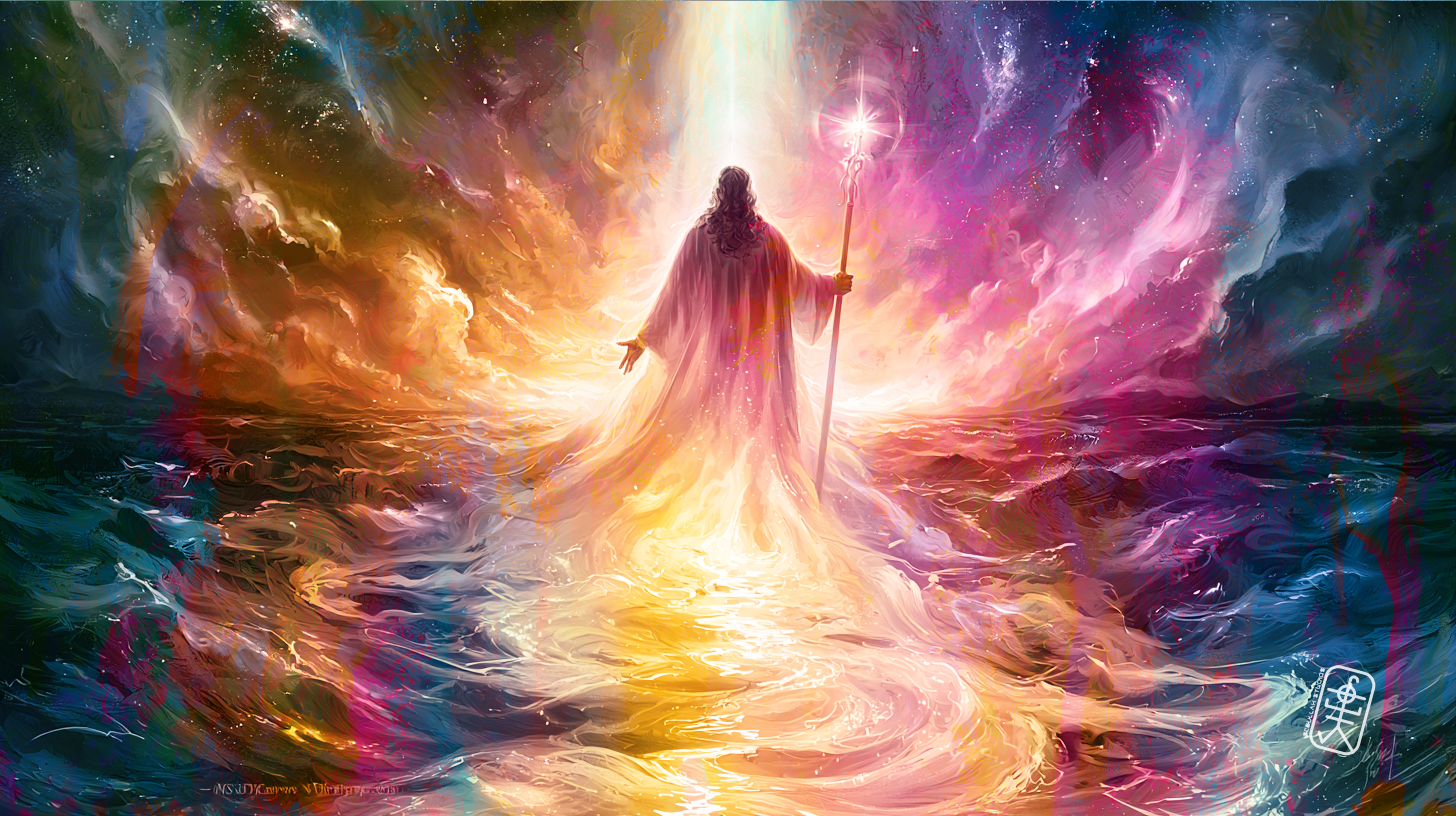
For the past month I’ve been writing about the Father’s original plan for mankind found in Genesis 1 and 2. Using the idea of God-prescribed garden responsibilities, I’ve been making a connection between the commands in chapter 1 and the delegated tasks given to Adam in chapter 2. But this week I want to pause and turn the focus upon the idea of ruling, as it relates to the Father’s original design for us.
In Genesis 1:26, the Father defines man’s nature and establishes his function in creation. Shaped in His image and formed in His likeness (by the way, this is not a redundant statement, and we’ll talk more on that in a later article), the Godhead makes the sovereign decision to let man “rule over the fish of the sea, and over the bird of the heavens, and over the livestock, and over all the earth, and over every crawling thing that crawls upon the earth.”
This decision is echoed again in the Father’s direct commands to Adam: “Be fruitful and multiply, and fill the earth and subdue it. And rule over…” He establishes His intent for His image bearer. He firmly meant for man to rule over creation.
Given our charted history as a species, the word “rule” invokes quite a mixed bag of emotions today. Over time, mankind has experienced great good at the hands of benevolent rulers, and greater evil by the hands of tyrannical ones. So much so, that all of creation groans with exhaustion and balks at the idea of being ruled. How does the saying go? “Meet the new boss, same as the old boss.”
Really, the litany of so-called rulers over the course of known history has been more of a train-wreck of human ideals than a glorious journey to greater enlightenment for mankind. There’s a reason why Yeshua said to us, “You know that the rulers of the Gentiles exercise lordship over them, and the great ones exercise authority over them. It will not be this way among you. But whoever may want to become great among you, he will be your servant; and whoever may want to be first among you, he will be your slave…”
Yeshua was operating under a completely different definition of rulership than that of the World’s despotic notions. He re-established the original Genesis concept and ideas surrounding divine rulership through his life that modeled it—giving us a clear understanding of what exactly the Father intended for us from the beginning.
Again, we turn to Hebrew language to start our journey of discovery. The word for “rule” in Genesis 1:26 is radah, and it translates into English as “to rule”, have dominion, and subdue. The living letters that form this word are:
Resh: is the ancient symbol for this letter is a head of a man, and it symbolizes “the first”, beginning, summit, and figuratively authority.
Dalet: is the ancient symbol for this letter is the door or entrance flap of a tent, and it symbolizes a moving, entering, or the actual transition point between two different spaces.
Hey: is the ancient symbol of a man with arms upraised, and symbolizes the action of revealing or beholding someone or some object, and figuratively, the breath or “to breathe”.
When combined, these letters convey the following idea: The authority to stand in the entrance and reveal a matter.
As was understood in ancient cultures, the entrance—such as the gates of a city, was the designated place of government. To have a seat at the city gate, meant that you had the authority to judge and administrate all that move in and out those gates, as well as, all that the inhabitants did in the city.
So radah establishes identity and purpose, but it doesn’t provide us a fuller understanding of how Father intended us to rule. For that insight we need to take a step back further in verse 26 and look at the context under which this divine decision was made.

“And God said, “Let Us make man in Our image, according to Our likeness…”
This is the clue that we need. Our commission to rule extends directly from and is informed by the image in which we were created. As such, it is the Father’s image and likeness that we need to understand before we can apprehend our nature and administrate the function of the kind of rulership we’ve been given.
The Hebraic understanding for “image” and “likeness” is less connected to the idea of a reflection or picture as used in our western thinking, and more aligned with our concepts of nature and function. It is in the reflection of the Father’s nature as the Preeminent Ruler, that we discover how we’re intended to rule in His same likeness.
One of the first and best examples of radah is seen in the first five verses of the Bible:
“In the beginning God created the heavens and the earth. And the earth was formless and void, and darkness was over the face of the deep. And the Spirit of God was hovering over the face of the waters. And God said, “Let there be light, and there was light. And God saw the light, that it was good. And God divided between the light and between the darkness. And God called the light “Day,” and the darkness He called “Night.”
In this opening passage we get a clearer look at how the Father functions as a ruler over all, and it perfectly illustrates the deeper meaning of radah found in the mystical interpretation of the living letters mentioned previously.
In the phrase, “In the beginning”, we find the letter resh in the Hebrew word for “beginning”, reshith. The literal interpretation is also reinforced by the implied symbolism in Yahweh, Himself, as the “Rosh”, or King and head. Creator of all.
Next, we see the dalet appearing. In the threshold of the Beginning, the Spirit of God—Ruach Hakodesh, hovered over the face of the water. The deeply mystical understanding for this Hebrew word (rachaph) is beautiful. The Spirit moved to and fro over the dark, empty waters. His vibration excited the disordered particles preparing them for a sudden transformation—an unprecedented division of the newly formed heaven-earth dimension.
Finally, hey is revealed in the spoken words of God, “Let there be light.” His authority is made manifest by the energy of His breath. Then as He beholds the light created by the power of His voice, He renders another judgement: Light will now be called day, and darkness, night.
Genesis 1:1-5 serves as a primordial display of the Father’s image and likeness—the summit example of radah. Our capacity to rule from that same image depends greatly upon our perception and understanding of His nature and function. When borne correctly, our own image will reflect His likeness and authority that produce the first light and set creation in motion.
Since losing that rulership in the Garden, Man has tried to regain that image of authority and power lost, but every attempt has been disastrous for mankind. Every form and function established to try to subdue the chaotic waters has made the image of man more distorted and confused than before.
Today, Man’s idea of ruling is so divorced from it’s original design, that it’s now become antithetically opposed to the Father altogether. Fortunately, Father did not allow His image to be lost forever. In Yeshua, His image was perfectly restored. What’s more, the One who calmed the chaotic storm and spoke shalom over the disorders of the heart, gave us His own image and rulership in order to restore what was lost in the beginning.
Our ability to rule righteously is depended wholly upon how we reflect our Father’s own image. Christ is the mirror of that image, and those in Him will bear that same image.
Next week I want to share more about the “image and likeness” of our Father, and it’s capacity to empower us to be like Him in Creation. Until next time, let His image teach you how to rule the world within and around you, as you continue to pursue the you He designed you to be!
Shalom.

Thanks for reading. I hope this post stirred your imagination to think differently about Him, yourself, and the world about you. If it did, share it with others you know who may need this encouragement, too!
Comments
Nothing yet. Say the first thing.
Sign in to join the conversation.