
This is the fourth essay on the German R&D system and its performance. All essays stand alone, but together give a coherent image.
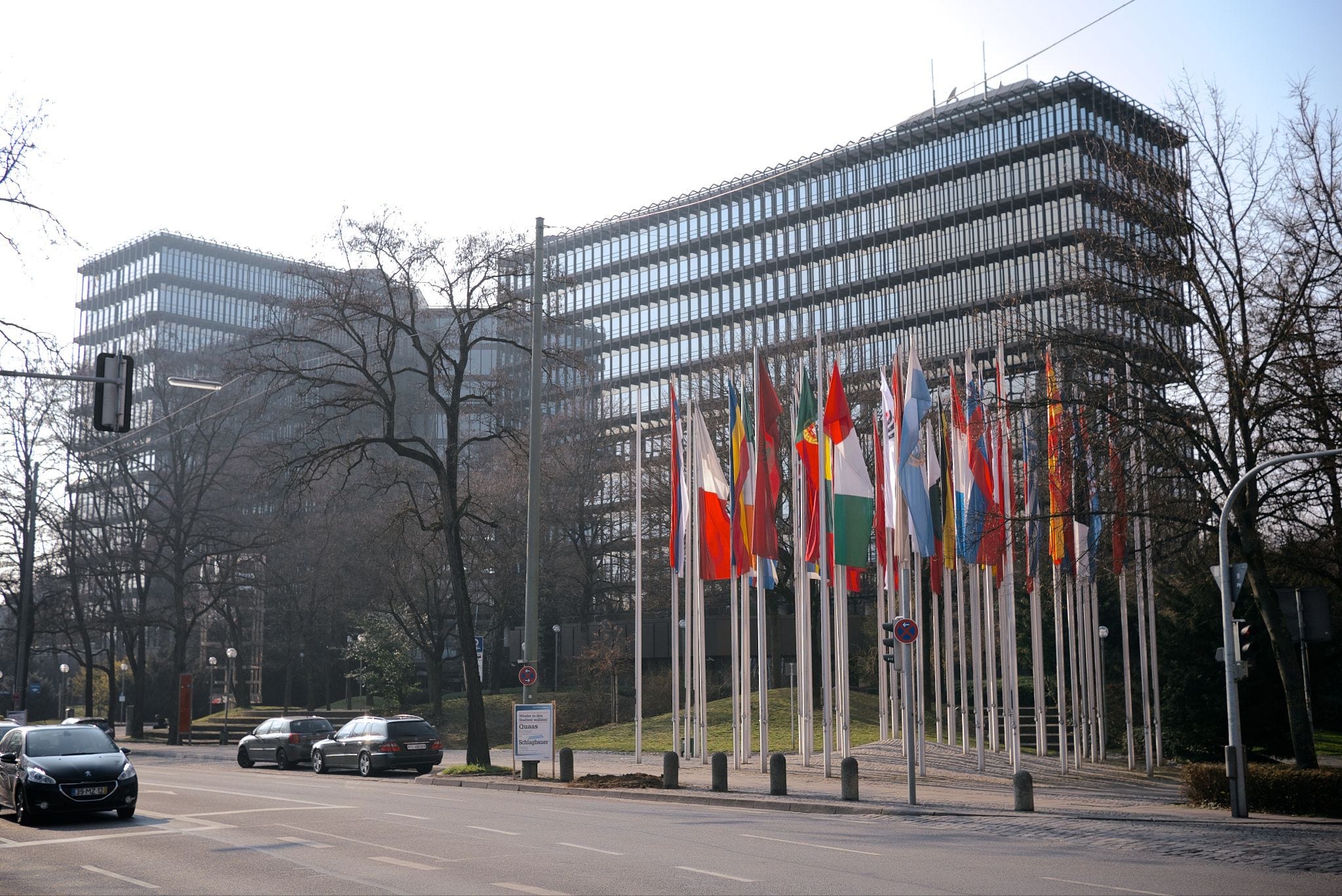
Germany files a great many patents. Its corporations appear near the top of every European league table. Its domestic patent office, which sits in a stone building near the Englischer Garten in Munich, recorded 62,050 applications in 2025, up roughly 5 percent from the year before. If one asks whether Germany still invents, the answer is straightforward: It invents on a scale that few economies have ever matched.
The harder question is what it invents. And whether the answer to that question has changed over time.
A patent is a description of an invention that grants exclusive rights for a fixed period in a defined jurisdiction. By describing and patenting an invention, patent seekers disclose the inner workings of their innovation to the public.
Why seek a patent in the first place? Because not every invention can be kept secret. Pharmaceutical firms patent intensively because they cannot manufacture a drug without disclosing its molecular structure, and because regulatory approval requires public clinical trials. Semiconductor architectures are patented because they can be reverse-engineered from the chips themselves. Mechanical inventions are patented because the geometry of a machine is visible to anyone who buys one.
Software, by contrast, can often be hidden inside running services, and is correspondingly under-patented. Manufacturing process know-how — the tacit, accumulated knowledge of how to make something at scale, at yield, at cost — is seldom patented because it cannot be inferred from the product.
The patents of an industry draw a (partial) map of where the inventing is happening within that industry. Comparing these patent maps within each industry, who is filing what, where, in what classes, and at what rate can still reveal strengths and weaknesses.
Why is this partial map insufficient on its own? Some patents are filed defensively, to keep competitors from working in adjacent territory, and never produce anything commercially. Others are filed by firms whose inventions turn out, in retrospect, to have anticipated nothing. Only a small fraction of patents prove to be the foundational documents of entire industries. Subsequent inventors cite, and cite, and cite them again, until the citations themselves become a measure of how consequential the original filing was.
This last fact creates a problem for anyone trying to gain insight from a country’s recent patent output. A patent filed last year has had no time to accumulate citations. To know which of last year’s German patents are truly important, one would have to wait perhaps a decade, until citation counts had stabilized and the patents that turned out to matter had distinguished themselves from the patents that did not. For recent filings, one has to make do with rougher signals. The most useful of these is composition: which fields are being filed in, by whom, and at what rate. The signal does not prove that the patents are any good. But it shows where a country is placing its bets, and where it is not.
Unfortunately, not in the fields where Germany’s best science happens. The Organisation for Economic Co-operation and Development, in its 2022 review of Germany, observed that the German fields with the strongest breakthrough patenting are not the same fields as the ones with the strongest scientific linkage. The fields where German basic research institutes are pursuing frontier research — in immunology, single-cell biology, causal machine learning, and quantum information science — are not the fields in which Germany’s industrial patent system is producing breakthroughs.
Instead, the industrial patent system is strong in automotive subsystems, industrial machinery, precision instruments, and electrical engineering.
At the European Patent Office in Munich, applications crossed 200,000 for the first time in 2025. The largest field, by some distance, was computer technology. The fastest-growing was digital communication. Third, behind these two, was electrical machinery and energy, lifted by an extraordinary surge in battery-related filings. The Patent Office’s own annual summary singled out four areas as strategic: artificial intelligence, batteries, semiconductors, and quantum technologies. Germany, taken as a whole, accounted for 12.1 percent of applications. This figure is a useful benchmark because it shows what an average German performance looks like across all fields. Any field in which Germany files above 12.1 percent is a field in which the country is over-represented relative to its own baseline. Any field in which it files below that line is one in which Germany is under-represented.
The fields where German firms file at a rate that exceeds the country’s overall European weight are precisely the fields one would have guessed without looking at any data. Transport: 17.6 percent of the European total, well above the German baseline, the legacy of more than a century of automotive engineering radiating outward from Stuttgart, Wolfsburg, and Munich. Measurement: 16.2 percent, a field that sounds technical and is, encompassing everything from industrial sensors to medical instruments to the precision optics that make semiconductor lithography possible. Other special machines: the dense, unglamorous, hugely profitable middle of German Mittelstand engineering, the firms that make the machines that make the things. Organic fine chemistry: the field that BASF more or less invented in Ludwigshafen in 1865 and has never relinquished.
The fields where Germany under-indexes are equally legible. Computer technology: 9.6 percent, against an overall weight of 12.1 — a gap of more than a fifth, in the largest single technology field in Europe. Medical technology: low. Biotechnology: lower. The sharpest single contrast in the dataset is the one between transport and computer technology. In 2024, German transport filings at the European Patent Office numbered 1,910; in 2025, they fell to 1,737, but Germany still owned roughly one in every six transport patents filed in Europe. In computer technology, the German numbers moved the other way: 1,558 filings in 2024, 1,719 in 2025, a healthy increase. The trouble is that the field grew faster than Germany’s share of it. The country added patents for computer technology and still lost ground.
The domestic data tell the same story. The German Patent and Trade Mark Office reported that applications in 2025 rose from 59,261 to 62,050. At the same time, four of the five largest technology fields grew: transport by 3.9 percent, electrical machinery and energy by 7.5 percent, measurement by 2.6 percent, and computer technology by an arresting 10.9 percent. The optimistic reading is that the system is far from frozen. Computer technology is the fastest-growing of the major German fields. Electrical machinery and energy, which encompasses the battery and grid technologies that will define the energy transition, is growing faster than the average. Germany is not, in any literal sense, filing the same patents it filed in 1995.
And yet, at the top of the domestic applicant table for 2025, we find: Bosch, Mercedes-Benz, BMW, Audi, Volkswagen, Porsche, Schaeffler, GM, Ford, ZF. The 10 largest filers at the German Patent and Trade Mark Office are carmakers and their suppliers. Together they accounted for roughly 30 percent of all applications. If the country’s inventive renewal were genuinely broad-based, the table would include companies founded in the last 30 years performing well in software platforms, semiconductors, biotech, digital-infrastructure; the kinds of firms that dominate the equivalent tables in other advanced economies.
AI as an outlier proves that rule.
The European Patent Office reports that German AI filings rose in 2025 and that Germany leads Europe in the field. But two caveats apply that bound the claim. The first is the trade-secret problem raised earlier: AI is a field in which much of the most valuable invention is held outside the patent system, in the form of training data, model weights, inference architectures, and the deployment know-how of the firms that operate foundation models at scale. So even when looking at publication data first, it’s not looking too good.
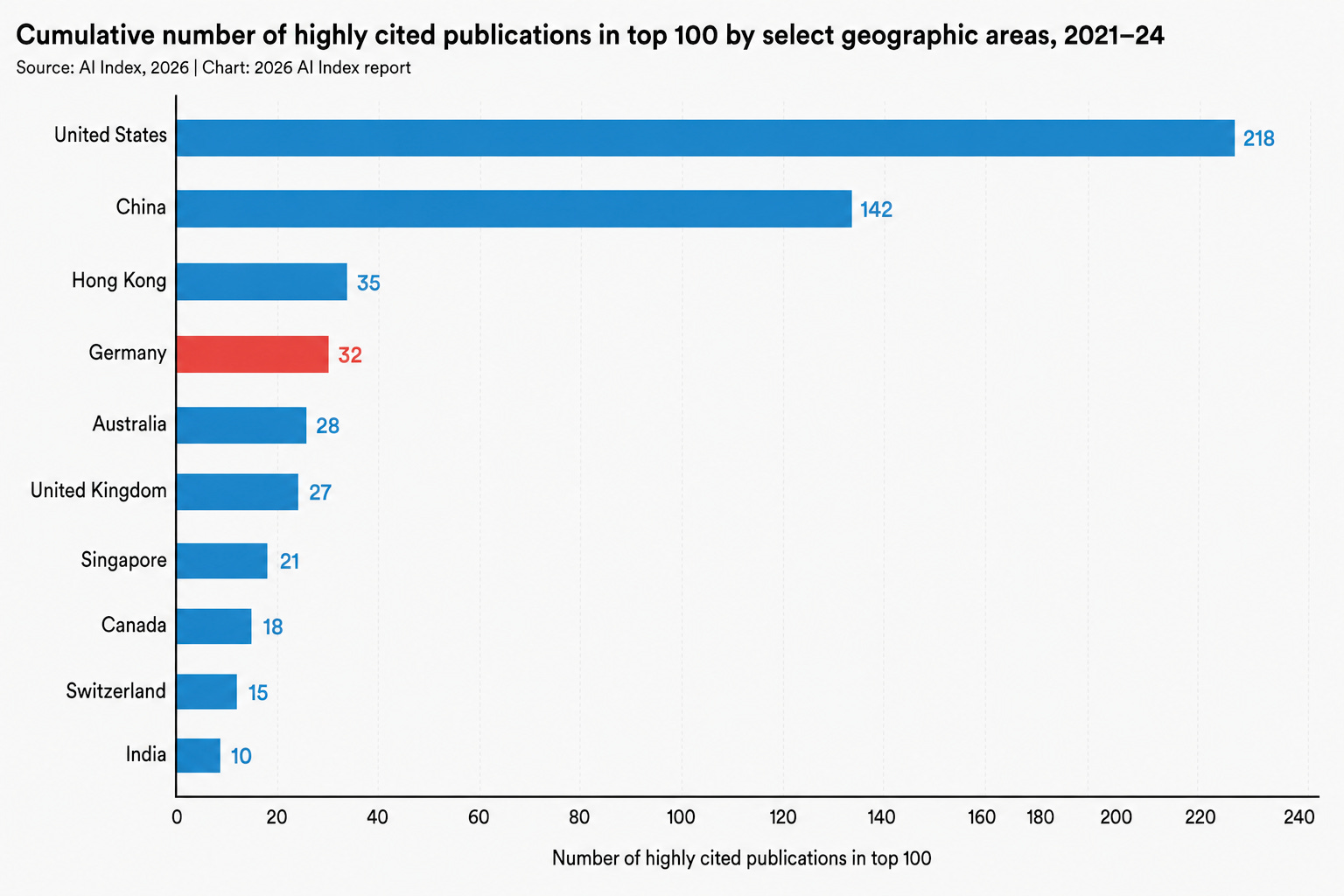
Germany appears in the Stanford AI Index’s count of highly cited AI papers, but not as part of the frontier. From 2021 to 2024, U.S.-affiliated authors appeared on 218 of the top-100 highly cited AI publications counted by the Index. Chinese-affiliated authors appeared on 142. Germany appeared on only 32.
Not being part of the frontier matters more in AI than it would in many older technologies. In machine tools, chemicals, or automotive systems, a country can sit one layer below the frontier and still build world-class firms by adapting, integrating, and refining. AI is less forgiving. The frontier model is not just one product among many. It becomes an input into software, cyber defense, scientific discovery, robotics, military systems, and industrial automation. If the best models are not developed locally, they probably won’t be readily available. The gap between the frontier and the second tier becomes an operating constraint. Firms without access to frontier models build on weaker tools, receive capabilities later, and shape fewer of the standards around which the next economy forms.
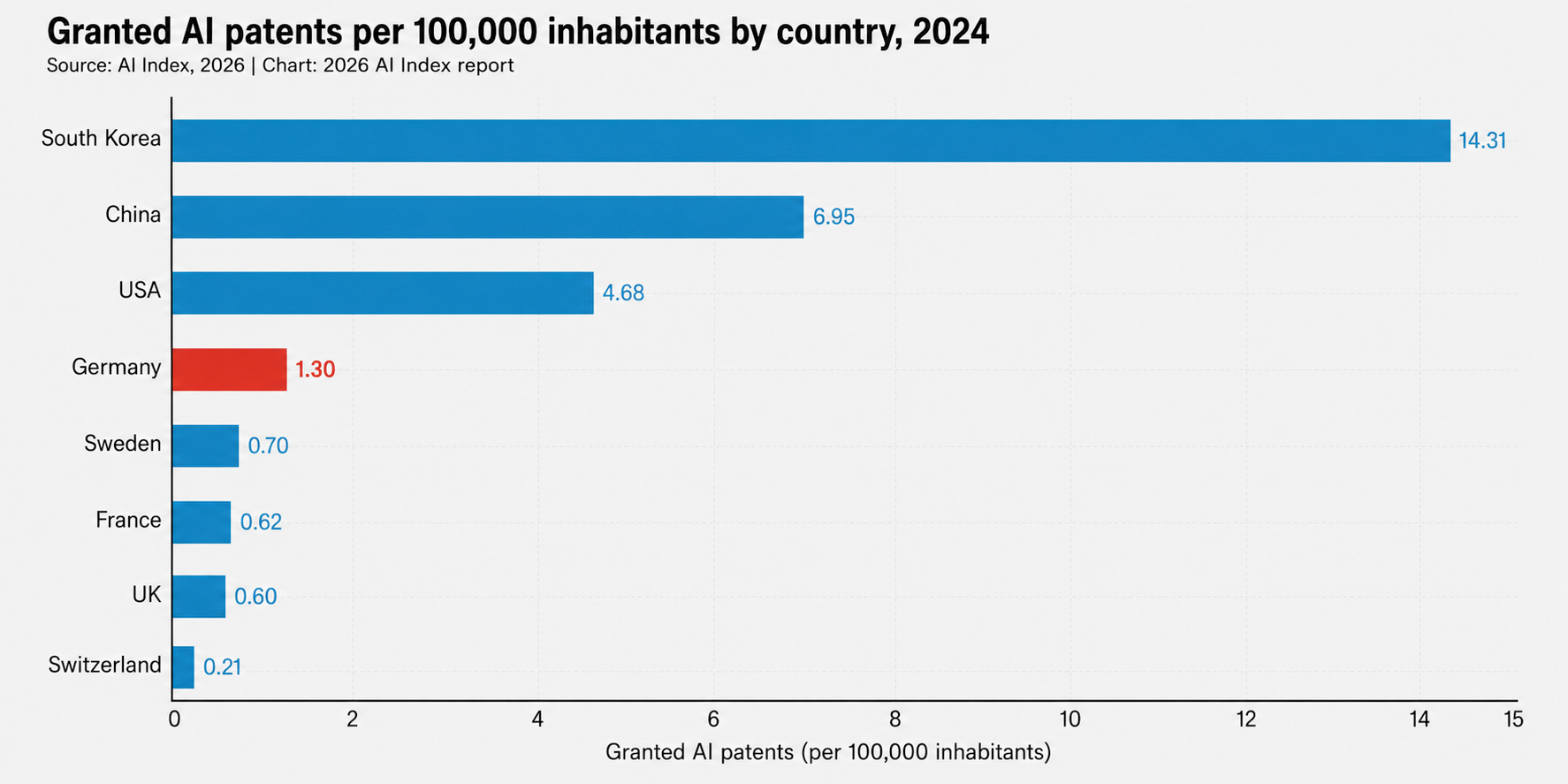
Within the patentable subset, the second caveat is therefore geographic. Germany leads Europe, but Europe is not where the AI frontier is being set. The Stanford Artificial Intelligence Index found that China and the United States accounted for the great majority of granted AI patents worldwide, with no European company appearing in the global top five applicants. The same pattern appears elsewhere in the AI stack. The Index reports that the U.S.-China model performance gap has effectively closed, while the United States still produces more top-tier models and higher-impact patents, and China leads in publication volume, citations, and patent output. In notable model production, the United States released 59 models in 2025 and China 35; Europe was far behind. Germany’s European leadership in AI patenting, then, is more a sign of individual capabilities rather than a frontier position.
The American patent office is less a portrait of American industry than a magnet for the world’s most aggressive technology companies, including many that are not American. In fiscal 2025, the largest recipients of newly granted U.S. patents were, in order, Samsung, LG, Taiwan Semiconductor Manufacturing Company, Qualcomm, Toyota, Huawei, Apple, Canon, IBM, and Alphabet. Samsung alone received more than 10,700. Of the 10, two are Korean, two are Taiwanese, two are Japanese, one is Chinese, and four are American. They are concentrated in chips, wireless networks, cloud computing, consumer electronics, and artificial intelligence — the technological substrate of modern global computing. The United States Patent and Trademark Office is where the world’s most ambitious technology firms come to protect their inventions in the world’s largest market.
Switzerland’s patent economy is not built around one national champion industry. It is a dense cluster of high-margin niches: medicines, diagnostics, industrial automation, consumer-product engineering, food science, and the small accumulations of technical advantage that allow a small rich country to produce, per person, more international patents than anywhere else on earth.
Meanwhile, the centre of gravity of the German patent system remains where it has been for 50 years: in Stuttgart, in Munich, in Wolfsburg, in the engineering departments of the firms that built the country’s 20th-century export economy.
Why is that?
The institution that files the most patents in Germany is not a university or a corporation. It is a public research society named after the 19th-century Bavarian glassmaker Joseph von Fraunhofer. The Fraunhofer Society does contract research. Companies would bring problems; Fraunhofer institutes would solve them. The work is predominantly funded by the industrial clients themselves. As they also receive public funding, many research projects contractually require the disclosure of inventions and, therefore, patenting. In 2024, the Fraunhofer Society filed 439 priority patent applications. This is the largest figure of any public research organization in Europe, and one of the largest in the world.
The Helmholtz Association, named after the 19th-century polymath Hermann von Helmholtz, is structured differently. Its eighteen centres operate the country’s big scientific infrastructures: the DESY particle accelerator in Hamburg, the Forschungszentrum Jülich supercomputer, the German Aerospace Center, and the German Cancer Research Center in Heidelberg. Helmholtz’s annual budget is more than twice that of Fraunhofer’s, because particle accelerators cost more than industrial-contract research. In 2024, it filed 451 priority patent applications, a number not far above Fraunhofer’s despite the budgetary disparity. Most of these patents originate in the centres oriented toward applied work: the aerospace center, the Karlsruhe Institute of Technology, and the energy centres.
The Max Planck Society, by contrast, operates 86 institutes covering everything from astrophysics to anthropology to medieval Latin. It is generally regarded as the world’s most consistently excellent organization for fundamental scientific research. Thirty-nine of its scientists have won Nobel Prizes. In 2024, it filed approximately 80 patents.
The result, taken in aggregate, is best seen as a barbell. The institution most exposed to frontier science produces the most papers and the fewest patents. The institution most exposed to industrial demand produces the most patents and few papers. In between, where the transfer from basic to applied research is supposed to happen in this linear system, the universities produce a ridiculous small number of papers and patents: The top 10 of Germany’s most research-intensive technical universities, combined, produced fewer Nature Index publications than the Max Planck Society alone, and only about 6 percent more than the Helmholtz Association alone; about 876 patents a year, in 2024, across 165 institutions, or somewhere around five patents per university per year.
The Technical University of Munich, the country’s best-performing institution in this respect, files over 50. By comparison, the University of California system, taken as a whole, files around 540. The Massachusetts Institute of Technology files around 200. Stanford files around 180.
It is tempting, surveying these numbers, to conclude that German universities are simply bad at producing patents; to look for explanations in the regulatory regime, or in the technology-transfer infrastructure, or in the absence of a German equivalent to the American Bayh-Dole Act. The German equivalent, in fact, exists. It was enacted in 2002, when the Bundestag abolished the privilege that had given university professors personal ownership of their inventions, and transferred patent rights to the universities themselves. The reform was modeled on Bayh-Dole, which is widely credited with catalyzing the American university patent boom of the nineteen-eighties and nineteen-nineties. With the reform, the share of European academic patents filed directly by German universities rose from a quarter in 2000 to nearly half by 2019. Total German academic patent output, however, stayed roughly flat. The reform reallocated intellectual property without expanding the underlying productive capacity.
David Teece, an economist at Berkeley, published a paper in 1986 that explained, more or less in advance, why the German Bayh-Dole reform would not work the way its drafters hoped. Teece’s argument was that a patent, on its own, is rarely worth very much. To capture the value of an invention, one needs what Teece called complementary assets: manufacturing capacity, distribution networks, regulatory approvals, sometimes also entrepreneurial talent and venture capital and the willingness of an academic environment to treat firm formation as a normal career path. The American university patent system works because the American economy already contains the complementary assets, and the transfer of ownership makes it possible for them to be applied to academic inventions. In Germany, in 2002, the ownership transferred, but the complementary assets did not appear. The technology-transfer offices remained small and variably professional. The German pension funds, which collectively manage hundreds of billions of euros, were prohibited by regulations dating to the nineteen-nineties from making substantial venture-capital allocations. The taxation of employee stock options remained punitive, taxing options at exercise rather than at sale and producing dry-tax problems for employees of startups that subsequently failed. The academic culture continued to treat the founding of a company as an unusual career move, not a normal one. The patents arrived. The firms to commercialize them did not.
There is a phrase that circulates in German policy discussions, deployed in white papers and political speeches and the Sunday op-ed pages, that captures what the country believes is happening to it. “Wissen made in Germany, Profit made abroad,” it goes — knowledge made in Germany, profit made abroad. The phrase is consoling because it locates the problem downstream, where remedies are easier to imagine: better technology-transfer offices, more venture capital, looser stock-option taxation, a few more start-up campuses with English-language MBA programs. The patent data, examined for what they actually say, suggest that this is wrong. The country’s research and its inventive output are operating, to a significant extent, on parallel tracks. The frontier science is happening, in selected fields, at Max Planck institutes and Helmholtz. The patenting is happening, in different fields, at Fraunhofer and at the Mittelstand and at the automotive supplier complex. The bridge between them, the channel through which fundamental discoveries flow into patentable inventions is thin at best and in some fields absent.
Wolfgang Maennig and Andreas Eckert, in their 2021 study of pharmaceutical anchor patents, found that German universities held zero of the patents underlying the medical breakthroughs of the previous decade. American universities held 3.8 per cent. The German non-university research institutes did not, in pharmaceuticals, compensate.
Germany has individual points of excellence: the Baden-Würtemberg cluster, anchored by the Max Planck Institute for Intelligent Systems, which is among the most consequential AI research environments in Europe. It has BioNTech, in Mainz, whose founders proved in 2020 that a German biotech firm could deliver a global-scale therapeutic breakthrough. It has Helsing, in Munich, the defense-AI firm that has raised more than a billion four hundred million euros since 2021. It has Black Forest Labs, in Freiburg, founded in 2024 by ex-Stability AI researchers and valued at four billion dollars by the end of 2025. It has, in other words, specific points of frontier capability, in specific fields, anchored by individual institutions and firms.
It doesn’t have a system capable of producing frontier technology at scale. The patenting institutions are designed to extend the existing industrial base. The frontier-science institutions are cut off and unable to hand off research. The universities, freed in 2002 to own the inventions of their professors, lack the complementary assets that would allow them to commercialize what they own. The result is a patent portrait of a country that has continued, with great industrial competence, to improve the technologies it already has. Germany must decide whether its future economy will be a continuation of the old one or something new.
Thanks for reading! When you’ve made it this far, you probably work in this space and know someone else who could benefit from the piece. Please consider sharing it.
No posts
Comments
Nothing yet. Say the first thing.
Sign in to join the conversation.