
This review contains spoilers for the film Project Hail Mary (2026)

When Dr. Ryland Grace opens his eyes at the start of Project Hail Mary, he is 12 light-years from anything that means anything to him. He does not know his own name. He does not know what year it is. He does not know that the two corpses across from him used to be his crewmates. The opening scene deliberately alienates the viewer from the place where Grace wakes up: artificial lighting, plastics, upside-down camera angles.
Grace has woken up in a foreign semantic room.
The literary concept of semantic rooms holds that meaning does not float free of its setting. A word, an object, a gesture, or even a character takes its identity from its location. Outside of literature, we can feel a semantic room only when we step into a foreign one, where we clearly are not a part of the regular inventory, as when visiting a police station, a tomb, or a hospital.
Outer space is the foreign semantic room par excellence. It is a vacuum in two senses: physically, it has nothing in it, and semantically, it has nothing of us in it. Every human is, by definition, artificially there. Project Hail Mary eases Grace into his environment, namely, the spaceship. First, he looks around, trashes the place, gets drunk – what else are you supposed to do in an isolated prison box, surrounded by the hostility of outer space and no memory of what you’re supposed to do?
Only when he remembers his purpose does he start to adapt. He cuts his hair and beard, wears proper clothing, and starts to interact with the instruments provided in the spaceship to fulfill his task. He was sent to Tau Ceti, a solar system affected by extraterrestrial microbes called Astrophage that feed on solar energy. Earth’s sun is also infected with these microbes, but unlike Earth’s sun, the central star in Tau Ceti doesn’t lose energy. Grace must find out why.
But he isn’t the only lifeform tasked with saving its entire species. Upon arrival, he discovers another spaceship, containing another sentient and obviously intelligent life form. The much larger alien ship is steered by a much more apt pilot than Grace: when the human tries to withdraw from the alien spaceship inelegantly and quite funnily, the alien spaceship follows with plain grace. The humor underlying the scene defuses a potentially hostile first contact between humanity and alien life. This becomes a central theme.
Grace, a former junior high school teacher, treats the universe the way he treats a classroom of 13-year-olds: with light irreverence and the conviction that nothing is too serious to nickname. He calls the alien microbe Astrophage. He calls his unfathomable interstellar colleague Rocky. Naming and joking work as acts of semantic settlement. Each pun, each affectionate insult, each laughable pet name is a small flag planted in unclaimed territory. Humor is how Grace tells the universe that it now belongs, at least in part, to him or he to it.
Another mode of familiarizing the audience and Grace with the semantic room of the spaceship is technology. The tube between the two spaceships and the automatic translation and shared ‘science project’ are all bridges between two foreign spaces; some of which are physical, others not. Without the laboriously assembled vocabulary spreadsheet, they cannot share a thought. Technology is what allows two species, evolved across an unbridgeable chemical gap, to occupy a shared space. Technology is what makes the room habitable enough for meaning to take root in.
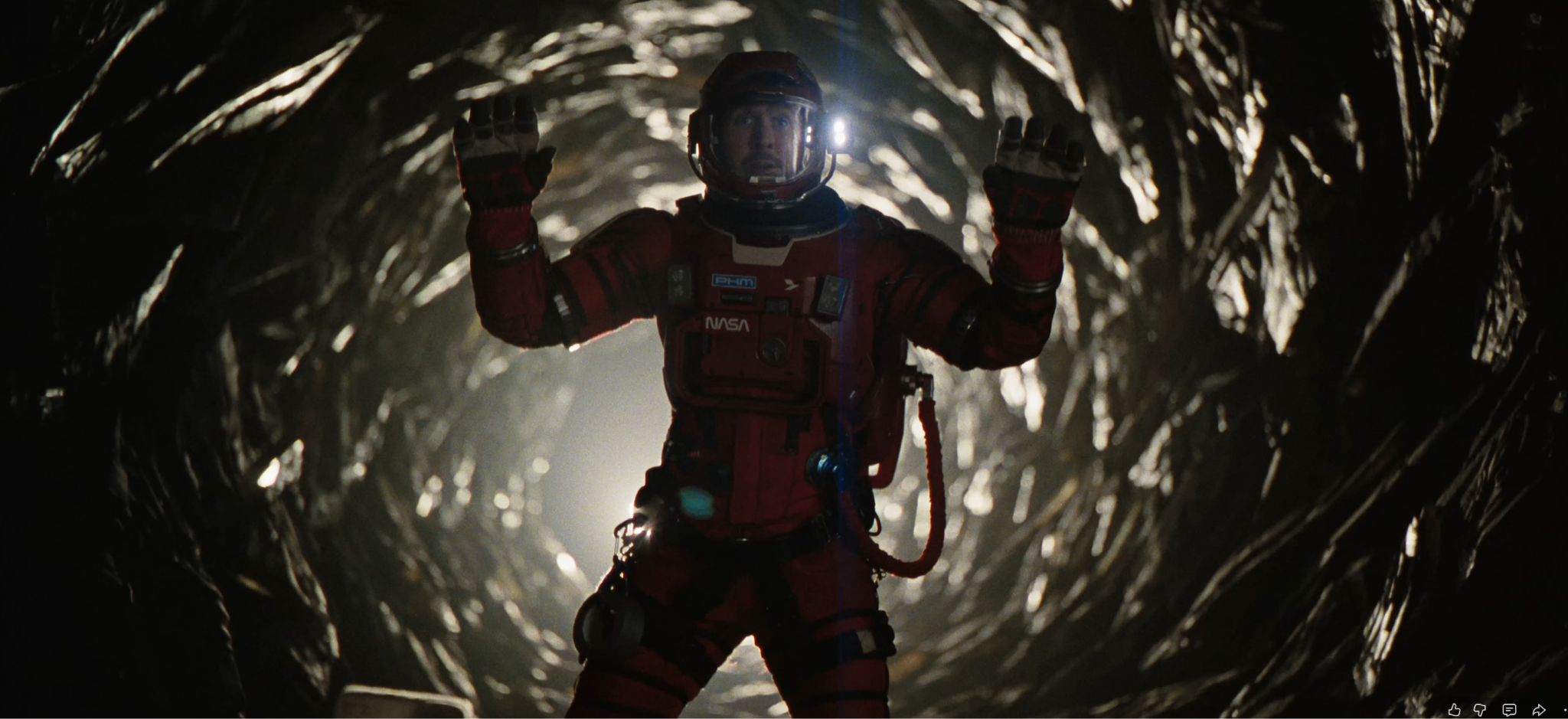
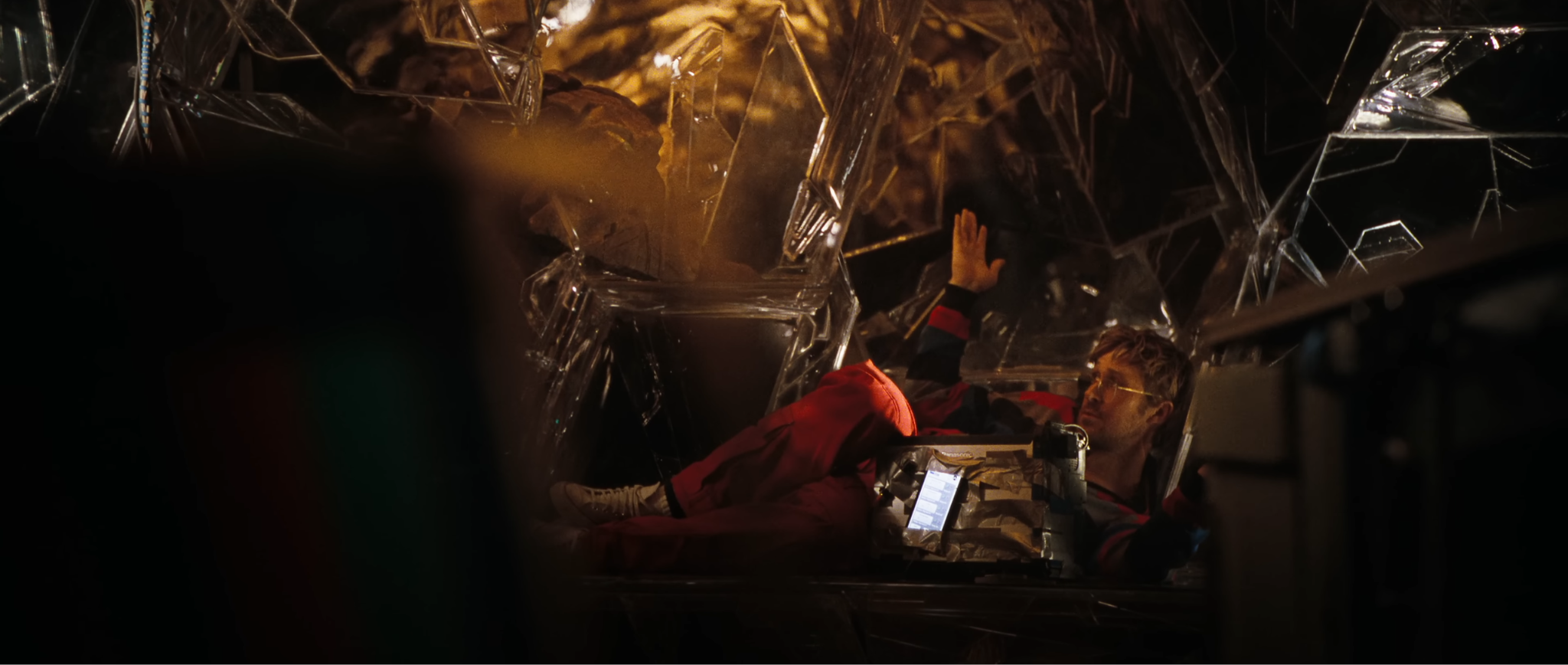
Inside this now-familiar room, Grace runs experiment after experiment. He notes which Taumoeba strains survive what conditions and which die. He revises his hypotheses out loud, often correcting himself with the embarrassed patience of someone teaching a class while learning the material. Science here works as a method for converting the unknown into the known and therefore familiar. Each experiment shrinks the foreign part of the room and grows the familiar part. By the time Grace engineers a strain that survives the right environment, the Tau Ceti system is no longer alien to him.
Grace, in the foreign room, becomes more of himself than he ever was at home. The film’s quietest move is to show that what blooms in a foreign semantic room is the essence of humanity: caring, humor, sharing knowledge.
Grace ends the story not on Earth but on Erid, in a terraformed pocket of a planet he was not built for, teaching Eridian children science. He converts another planet into a space where he actually belongs, doing the most familiar thing he knows.
This is what reading the film through semantic rooms allows us to see. Project Hail Mary tracks how we humans at our best carry our world with us, in love, in jokes, in tools, in method. If we advance in unknown territory bearing the best we have, we can make the galaxy a familiar space.
No posts
Comments
Nothing yet. Say the first thing.
Sign in to join the conversation.