
Coal tar is a thick, dark, foul-smelling byproduct of steelmaking. Decades ago, it was mostly a waste problem for someone else to deal with. One company built its entire existence around refining it into useful chemical products, and has spent the years since quietly becoming one of the largest players of its kind in the world.
Today, that same company is trying to become something else entirely: a supplier of materials for lithium-ion batteries, the kind that power electric vehicles. It just commissioned its first battery-material plant. It’s targeting a market worth billions of dollars globally by the end of the decade. And its stock is trading within a whisker of its all-time high, at a market capitalization north of ₹37,000 crore.
This week’s case study isn’t a hidden gem nobody has noticed. It’s the opposite: a business the market has already noticed enthusiastically, and the real question is whether that enthusiasm is pointed in the right direction. Let’s work through it properly, without the name attached yet.
The company’s core, decades-old business is refining coal tar, a byproduct of the steel and coking industry, into a range of specialty chemical products. Two of the biggest categories here are:
Coal tar pitch, a key input used in aluminium smelting
Speciality carbon black, a refined carbon product used in tyres, plastics, and coatings, where the company describes itself as running the world’s largest facility of its kind at a single location, and sits among the top handful of global producers in this category
This is genuinely unglamorous, deeply technical, commodity-adjacent chemical manufacturing. It has also been the engine funding everything the company is now trying to become.
Over the last couple of years, the company has been deliberately layering new businesses on top of this core.
The most ambitious is battery materials. It recently commissioned its first facility to manufacture anode material, the carbon-based component used inside lithium-ion battery cells, built entirely on in-house technology. It’s also developing lithium iron phosphate (LFP) cathode material, targeting a total production capacity of 40,000 metric tons annually over time, with an initial 2,000 metric ton milestone expected within the next few quarters. Alongside this, it has signed a technology licensing deal for silicon-carbon anode material and taken a stake in an international battery technology company to help validate its materials in real-world use.
Separately, the company has revived a well-known, long-dormant Indian tyre brand, entering passenger and eventually commercial and off-highway tyre manufacturing, a business that contributed a modest amount to revenue this past year but that management is targeting to scale meaningfully over the next several years.
Three very different businesses, sitting under one roof: legacy carbon chemicals, ambitious battery materials, and a revived tyre brand.
The legacy carbon and chemicals business sells largely to industrial customers: aluminium smelters, tyre manufacturers, and other industrial buyers of specialty carbon products, both domestically and through exports. This is sticky, technically demanding, relationship-driven B2B selling, not something a customer switches on a whim.
The battery materials business, by contrast, doesn’t have a real revenue base yet. Its customers, if the strategy plays out, would eventually be battery cell manufacturers and, indirectly, the electric vehicle industry, a market still being built out in India and one that currently depends heavily on imported cathode and anode materials.
The tyre business sells into a consumer and OEM tyre market that’s entirely different again, competitive, brand-driven, and unrelated in its dynamics to either of the other two segments.
Speciality carbon black and coal tar pitch sit in a global industrial commodity chemicals space, where scale, technical quality, and cost position matter enormously, and where the company already has a genuinely strong, well-established position.
Battery materials is a completely different competitive landscape: capital-intensive, technology-dependent, and currently dominated globally by established players, particularly out of China. India’s own battery cell manufacturing capacity is still small relative to global leaders, and the company’s stated ambition, to eventually support a meaningful share of a fast-growing but still nascent domestic EV battery supply chain, is a genuinely long-horizon bet rather than an near-term earnings driver.
The core business has been performing well. For the year ended March 2026, consolidated revenue from operations came in at roughly ₹4,660 crore, EBITDA reached about ₹1,006 crore (up close to 19% year-on-year), and profit after tax rose to approximately ₹755 crore, up 36% over the prior year.
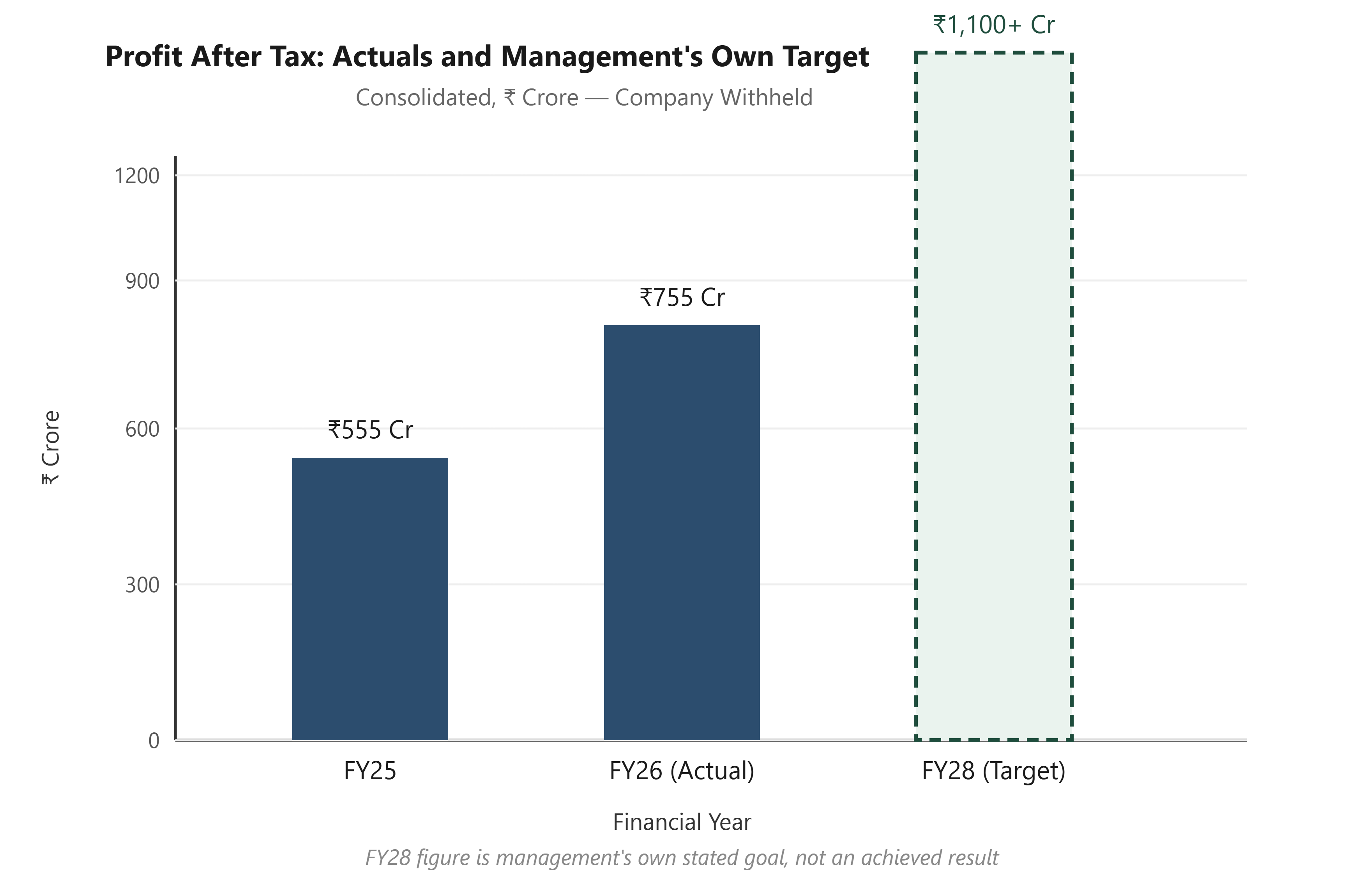
Management itself has set a public target of more than doubling profit after tax from roughly ₹555 crore in FY25 to over ₹1,100 crore by FY28. That’s a genuinely aggressive multi-year target, and it’s worth treating exactly as what it is: a stated management goal, not an achieved result. A large part of hitting that number depends on the newer businesses, battery materials and the revived tyre brand, actually scaling as planned, on top of continued strength in the core chemicals business.
The balance sheet here is genuinely conservative for a company undertaking this scale of expansion: reported debt-to-equity sits at a low level, around 0.16, meaning the business is largely self-funding its growth rather than leaning heavily on borrowed capital.
This matters directly for how you should think about the capital allocation question we discussed a couple of Mondays ago. This is a profitable, cash-generative core business choosing to reinvest heavily into two entirely new, unproven growth bets, rather than paying out that cash to shareholders or sitting on it. That’s a genuine strategic choice, and the payoff, if it comes, is likely years away. The dividend yield here is close to negligible, at 0.11%, which tells you plainly where management believes the money is better used right now.
Current Return on Capital Employed sits at about 22%, with Return on Equity around 18%. These are healthy figures for an industrial business of this scale, and they largely reflect the strength of the established chemicals and carbon black operations.
The number worth watching closely in coming years isn’t this current ROCE. It’s the incremental ROCE on all the fresh capital being poured into battery materials and tyres specifically. If those new businesses eventually earn returns comparable to, or better than, the existing 22%, this reinvestment will have been a genuinely value-creating bet. If they earn meaningfully less, and it takes years to find out either way, today’s healthy blended ROCE will gradually get diluted by capital sitting in businesses still finding their footing.
Two unproven, capital-intensive new businesses layered onto one established core. Battery materials and tyres both require years of execution before they can meaningfully move the overall numbers, and both carry real risk of underdelivering against management’s own stated targets.
A globally competitive, capital-intensive battery materials market, currently led by scaled international players, that the company is entering from a standing start.
An ambitious profit target (more than doubling PAT by FY28) that depends on execution across multiple new fronts simultaneously, not just steady growth in the existing business.
Valuation already reflects a fair amount of optimism. The stock trades close to its 52-week high, at a P/E near 47, a multiple that assumes meaningful success in the newer growth bets, not just continuation of the legacy business.
Commodity and cyclical exposure in the core business. Coal tar pitch and carbon black demand are tied to steel, aluminium, and tyre production cycles, which move with broader industrial activity.
At the current price, the company trades at a market capitalization of roughly ₹37,400 crore, a trailing P/E of about 46.8, and a book value of ₹93.3 per share, implying a price-to-book multiple close to 8 times.
That is a growth-stock valuation, not a value one, for a business that is still, by revenue, overwhelmingly a coal-tar and carbon-black chemicals company today. The market appears to already be pricing in meaningful success from the battery materials and tyre expansion, years before those businesses have proven their unit economics at scale. If that success arrives roughly on management’s own timeline, the current multiple may look entirely reasonable in hindsight. If it arrives late, or falls short, this is a valuation with real room to compress.
This is a financially strong, conservatively leveraged industrial chemicals business, using the cash generated from a genuinely dominant position in an unglamorous core category to fund two ambitious, unproven bets in battery materials and tyres. The strategy is coherent and the balance sheet gives it real room to execute. But the valuation already assumes a good part of that execution succeeds, on a timeline that stretches out to FY28 and beyond.
The core business, on its own, looks like a case study in quiet compounding. The two new bets layered on top are where the real uncertainty, and the real upside if it works, actually sits.
So — which company is it?
Comments
Nothing yet. Say the first thing.
Sign in to join the conversation.