
July 2026.
This is embarrassing.
I have one of my favorite authors on the other side of a videoconference, and we can’t get the sound to work.
I’m staying in Newport Beach, California. Construction next door makes it impossible to record from the condo, so I’ve rented a small podcast studio. The owner is helpful and collaborative. The equipment is top-notch. Professional microphones, cameras, monitors, lights. I paid $220 for the session.
The studio is designed for live discussions between people sitting in the same room. I’m using it for a remote interview with Alex Hutchinson, bestselling author, adventurer, athlete, and one of the best science writers in the world.
If you’ve ever worked in television or broadcasting, you know that equipment failure reveals character quickly. The crew is already panicking and doing everything possible to solve the problem. Yelling at them doesn’t help.
Bill O’Reilly famously demonstrated the alternative in a viral outtake. After struggling to understand a line in his teleprompter, he went ballistic on the production team.
“F*** it! We’ll do it live! We’ll do it live! F***ing thing sucks!”
In the studio here, it has been over ten minutes. The studio owner has checked cables, software settings, audio inputs, and outputs.
Inside, I feel like Bill O’Reilly.
I have enough experience to know that lashing out at the studio owner will accomplish nothing. She wants this to work as much as I do. I’d also embarrass myself in front of Alex, who is waiting with a relaxed smile.
Still, the f***ing thing sucks.
I finally give up and suggest that I’ll conduct the interview on my phone. This feels absurd after renting a professional studio, but I care about the conversation and don’t want to waste any more of Alex’s time.
We log out of the studio system.
That’s when things get worse. We discover that I can’t run this Riverside session properly on my phone.
We reboot everything and log back into the studio system.
The sound works!
Rule one of IT support: reboot.
I relax. I’ve been looking forward to this interview for weeks. I’ve been reading Alex’s latest book, The Explorer’s Gene. It’s outstanding.
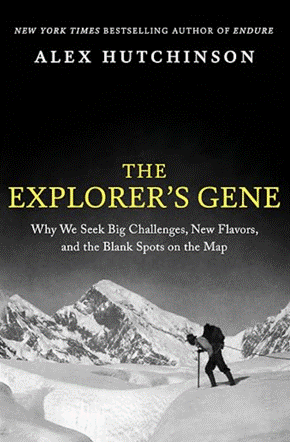
Few writers combine scientific rigor, intellectual honesty, and storytelling as naturally as he does. He writes with Malcolm Gladwell’s narrative instinct, the rigor of a trained scientist, and a desire to untangle nuanced ideas without flattening them.
A central theme in the book is the tension between exploring and exploiting. Exploiting means relying on a familiar option that has worked before. Exploring means trying an uncertain alternative that might produce a better result or teach you something.
“Alex, apologies again for the delay,” I say. “We weren’t exploiting an existing studio setup. We were exploring a new one.”
He smiles. The joke is nerdy but it signals that I’m genuinely interested in his work. As much as I’m comfortable networking in the world of high finance, talking with bestselling authors gives me impostor syndrome.
Alex starts with a recent personal story that he has not published.
July 2025.
He and his wife want to take their two children on a backpacking adventure on Vancouver Island. They choose the North Coast Trail, a remote route near the northern tip of the island.
The trail has few people, minimal infrastructure, and difficult conditions. Hikers pull themselves up slippery mud cliffs using ropes.
“This sounds fun,” Alex remembers thinking. “We’re going to put ourselves through a real challenge.”
The trip lives up to that expectation.
About halfway through, the family camps on a remote beach. They are roughly three days of hard walking from any place where a boat might reach them. The beach is narrow. The Pacific Ocean stretches out on one side. Dense rainforest climbs steeply up the mountain on the other. A few other hikers have pitched tents along the same beach.
After the family turns off the lights and settles into sleeping bags, someone scratches at the outside of the tent.
“Hey,” the person says. “I’ve got satellite service. There’s been a massive earthquake off the coast of Russia. There’s a tsunami warning for the entire northwest coast of Vancouver Island. There’s probably a tsunami heading our way.”
The children, nine and eleven at the time, hear the warning and become scared. Alex is scared too.
He tries to stay composed without lying to his children.
“I’m going to figure out what we need to do,” he tells them. “You stay in the tent here with Mom.”
Eventually, he reaches a conclusion. They have no route to higher ground. There is nowhere else to go.
A thought slips in: they might be about to die.
Another camper finally reaches someone in civilization and receives an update.
Any wave reaching Vancouver Island is expected to be about a foot high.
It might get someone wet. It’s unlikely to wash away the campsite.
The experience forces Alex to confront the central question in The Explorer’s Gene. Why choose the remote trail? Why pass on other routes with better infrastructure? Why increase the difficulty, especially with his children involved?
July 2026.
“I was going to look really stupid,” he tells me as he concludes the story and imagines the headline. “Author of exploring book washed to sea in a tsunami.”
He pauses.
“I’d be dead, so it wouldn’t matter.”
The family had planned for the risks they understood. Earlier that evening, they saw a bear about thirty feet down the beach, calmly searching through seaweed. They carried two cans of bear spray. Bear attacks are possible and extremely rare. Alex had considered the risk, looked at the probabilities, and prepared a response.
The tsunami risk belongs to a different category.
It is an unknown unknown, a risk that never entered the family’s planning. Alex had no mental model for it, no probability estimate, and no established response.
“When you head into the unknown,” he tells me, “you inevitably face situations that are outside your control.”
Humans also feel drawn toward the unknown but dislike uncertainty. The Explorer’s Gene examines that tension through neuroscience, genetics, psychology, mathematics, history, and Alex’s own adventures.
The book also helps explain his career.
Alex begins competing as a runner in high school and eventually represents Canada as a middle- and long-distance runner. In parallel, he studies physics, completes a PhD, and conducts postdoctoral research.
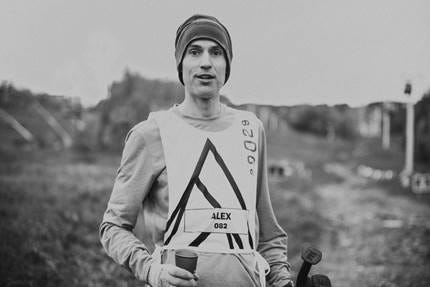
In his late twenties, he returns to school for a master’s degree in journalism. The early assignments are not glamorous. He attends accounting conferences and covers dog fashion shows.
He brings two unusual areas of expertise to journalism. He knows how to think like a scientist and has spent years pushing his physical limits as a runner.
He begins reading and writing about endurance science. He studies what researchers know about fatigue, performance, training, and the limits of human effort. He discovers an entire scientific field that he barely knew existed as an athlete.
Readers respond, and his book Endure becomes a bestseller. Endurance science becomes, in his words, “the niche that ate my career.”
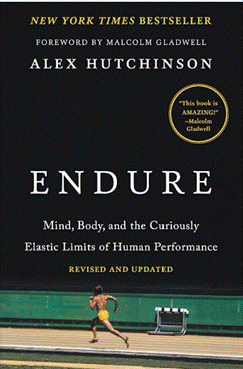
Alex’s work occupies the intersection of IQ and EQ, science and art, physiology and psychology. He can discuss VO2 max, lactate thresholds, motivation, fear, and internal monologue in the same chapter.
The origin story of Endure begins in my hometown of Sherbrooke, Québec. During a 1,500-meter race, a timekeeper gives Alex incorrect splits, making him believe he is already running beyond his limits. The mistake breaks the mental barrier that has been holding Alex back and leads to a huge personal best.
After Endure becomes a success, Alex reaches the career destination he has pursued for years. He has become the science-of-endurance writer.
The obvious professional choice is to write Endure 2. The existing audience is large.
But he wants to keep learning and move beyond his endurance-science niche. He wants to wake up without knowing exactly what he will discover that day.
So he spends the next several years doing something “very meta,” as my son would say: he explores exploring. He studies why humans feel compelled to open the closed door, climb the next ridge, or venture outside an established field of expertise. The research takes him into neuroscience, genetics, psychology, human migration, probability, and the mathematics of decision-making.
That exploration becomes The Explorer’s Gene.
My own studio experiment produced fifteen minutes of technical failure while one of my favorite authors waited patiently on the screen. Alex remained calm, friendly, and curious while the studio owner and I searched for a solution. He handled uncertainty the same way he writes about it.
Alex’s career shows what can happen when curiosity survives success. He reached the summit he worked toward for years, then followed a larger question into unfamiliar territory.
Read The Explorer’s Gene and Endure. Alex Hutchinson has a rare ability to make rigorous science clear, absorbing, and useful. His books may change how you think about curiosity, effort, risk, and the limits you have quietly accepted.
For my next interview, I plan to use the laptop on my desk. Even explorers should know when to exploit the setup that already works.
Share Sebastien Page's The Psychology of Leadership
No posts
Comments
Nothing yet. Say the first thing.
Sign in to join the conversation.