
Spring 2000.
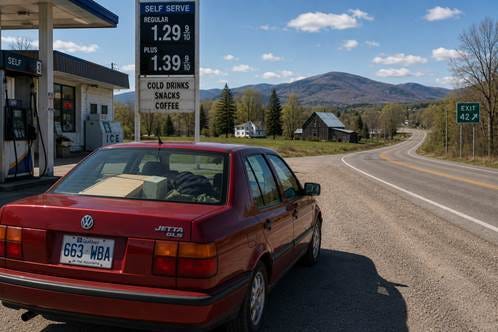
I’ve just crossed into Vermont in an old red Volkswagen Jetta. In the trunk, I have a small desk taken apart into several pieces, an aging computer, and some clothes. That is nearly everything I own.
The road signs change in shape and color. Kilometres become miles. Sortie becomes Exit. Everything looks familiar and foreign at the same time.
The sun is bright. Low mountains stretch across the horizon. Farmhouses sit far back from the highway, surrounded by trees and weathered barns.
I feel a lump in my throat. I am leaving behind my family, my friends, and Anne, my girlfriend and future wife. She is staying in Sherbrooke to finish her master’s degree.
I feel nostalgic for a part of my life that just ended.
I also feel tremendous excitement.
I’ve obtained a temporary visa. I’m heading to Boston to complete a research project for my master’s degree in finance.
I’m auditioning for a new life. State Street has agreed to let me work on a quantitative investment research project. The internship is unpaid. A job offer at the end remains a long shot. I will have to prove myself. I want a career in finance in the United States.
I have borrowed money from my father to cover basic expenses. My budget is tight. I found a cheap room in Allston-Brighton through a classified listing. I’ve never seen the room. I’ve never met either roommate.
A little over an hour after crossing the border, I stop at a gas station near Littleton, New Hampshire. It’s a small place with a few pumps, faded advertisements in the windows, and a pay phone mounted near the entrance.
I call one of my future roommates.
“Bobby, how are you?”
“Yooo.”
He sounds stoned.
Very stoned.
“I’m on my way. I just wanted to make sure you knew I was coming and that the room is ready.”
“Yeah, man.”
Something in his voice suggests a suburban teenager trying to sound like a gangster.
“Okay. I’m really looking forward to meeting you.”
“Sure. Peace out!”
The line goes dead. I stand beside the pay phone holding the receiver. My first American roommate sounds rude, uninterested, and potentially troublesome. I get back into the Jetta and continue toward Boston.
Two months later.
My initial assessment of Bobby has held up well. He spends most of his days smoking pot in his bedroom with a group of friends. They play the Tony Hawk video game for hours. They also record terrible rap songs using some kind of game console or electronic device. They take the music very seriously.
Bobby appears to have no job. I suspect he sells pot.
My other roommate, Manny, is a hairdresser from South America with full sleeve tattoos. Our schedules rarely overlap. I’ve never had a full conversation with him.
The apartment occupies part of an old house in a worn-down section of Allston-Brighton. The floors tilt. The pipes bang. The narrow hallway smells of stale smoke, damp carpet, and whatever Bobby’s friends heated in the microwave.
Rats live somewhere inside the walls and occasionally come out.
Anne is back in Sherbrooke. I have no family nearby and few connections at work. The person directing my research project is extremely busy. We meet every couple of weeks for thirty minutes.
At this point, I’m largely on my own. I work constantly. I teach myself how to code. I read research papers, textbooks, and anything I can find on quantitative investing. I am trying to build a systematic model that can beat the markets. The project fascinates me. I become obsessed with it.
But I need to find a better place to live.
I find another listing. The potential roommates seem friendly and responsible. They have jobs. Their house is clean. Nobody mentions a recording contract.
My landlord is out of town when the final rent payment for my room in the rat-infested Allston-Brighton house comes due. I’m moving out, so I need to find a way to get the money to him.
I walk into the living room. Bobby is sitting on the couch.
He offers to deliver my rent payment to the landlord.
“I got this, bro, no problem.”
“Are you sure?”
Something inside me tightens. This is a bad idea.
“Yeah, man,” Bobby says. “It’s all good.”
I hand him the money.
Research shows that sometimes, we trust strangers even when we know it’s not the best choice, because treating someone as untrustworthy feels rude. Asking to pay the landlord directly would have signaled that I considered my roommate dishonest. I do not think particularly highly of him. I also want to establish some kind of relationship in a country where I have no friends.
Familiarity adds another bias. In a 2024 experiment, participants trusted low-trust friends 60% of the time and low-trust strangers 36% of the time. My roommate is not a friend per se, but he is familiar. I never would have handed him my rent money if he had been, say, a stranger supposedly tasked with collecting our rent. I’m generally a skeptical person. I don’t trust people easily.
A few days later, Bobby moves out. Disappears.
My rent money goes with him.
Loneliness distorts judgment. It inflates the value of acceptance while lowering the standard of evidence we demand from those who offer even a fragile sense of belonging.
The larger gamble, fortunately, worked. After Allston-Brighton, I shared a house with a famous children’s musician who reminded us to do the dishes, two friendly computer programmers, and an IT support specialist. Nerds, like me. We got along. The research internship became a job, then a career. I found my footing, built lasting friendships, and Anne and I went on to create a life together in the United States.
Trust people—but don’t give your rent money to wannabe gangsters.
EndnotesDunning, D., Anderson, J. E., Schlösser, T., Ehlebracht, D., & Fetchenhauer, D. (2014). “Trust at Zero Acquaintance: More a Matter of Respect Than Expectation of Reward.” Journal of Personality and Social Psychology, 107(1), 122–141. Across six studies involving 645 university students, trust frequently followed a norm of respect. In Study 6, 54% trusted an anonymous partner, 22% chose a coin flip, and 24% kept the money, although participants estimated the stranger’s chance of reciprocating at 42.8%, below the coin’s 50% probability.
Bao, X., Zhang, M., & Chen, X. (2024). “The Influence of Partner Trustworthiness and Relationship Closeness on Interpersonal Trust in Individuals With Attachment Anxiety: An ERP Study.” International Journal of Clinical and Health Psychology, 24(3), 100494. In a 60-participant experiment involving real friends and strangers, participants trusted low-trust friends 60.3% of the time and low-trust strangers 36.3% of the time. Participants with high attachment anxiety relied heavily on relationship closeness regardless of the partner’s trustworthiness.
No posts
Comments
Nothing yet. Say the first thing.
Sign in to join the conversation.