
Last week’s issue had a chart showing the top 1% of AI spenders outspending the median company by more than 600X. This week I’ve got a similar-shaped chart but a different question behind it. Not who’s ahead but what the ones ahead are actually doing differently?
On February 6, 2026, the volume of tokens generated by AI agents on OpenRouter passed the volume generated by humans typing prompts. By August 7, agentic usage hit 7.3 trillion tokens, a 14x increase in about a year, while human-driven usage barely moved, up to 1.4 trillion.
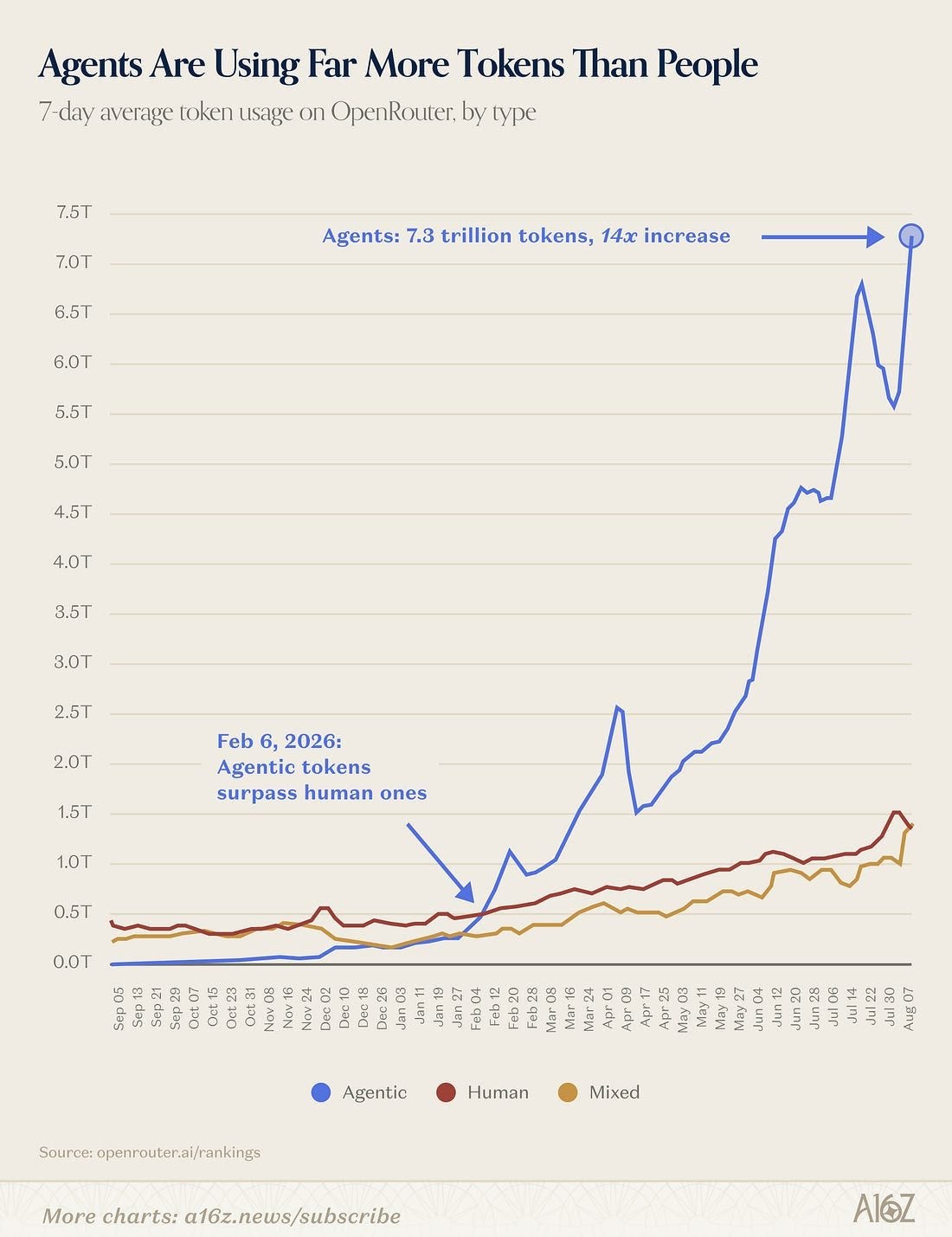
That crossing point explains the chart below. On August 12, a16z published data showing the top decile of enterprises by AI output growing 17.1x since April 2025, versus 2.1x for the typical enterprise (a gap that’s still widening). In tech specifically, the top decile hit 32.5x against 2.8x for everyone else.
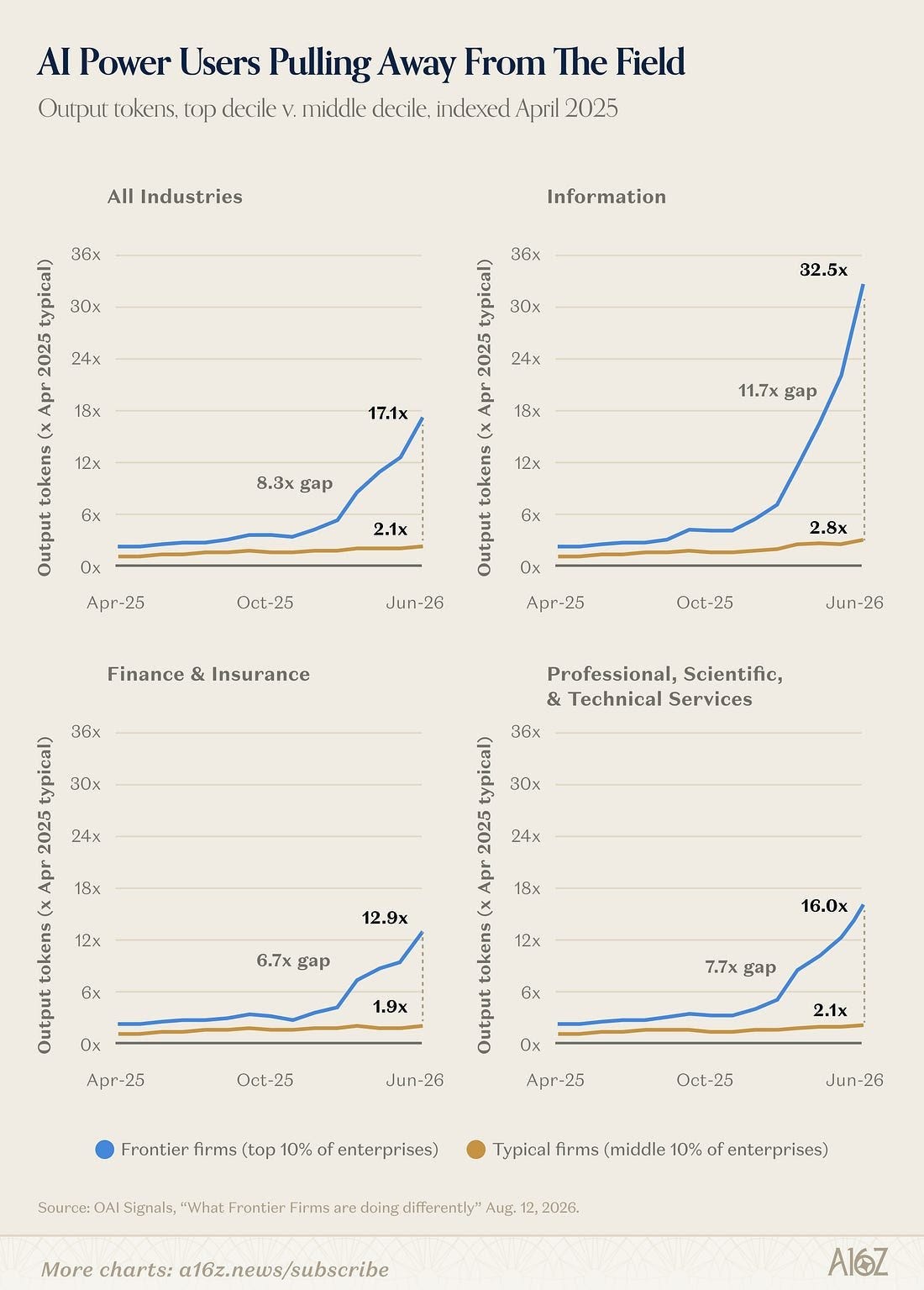
Shanu Mathew posted that chart on X with a line I kept thinking about this week: “the gap between AI power users and normies is huge and growing … people who get increasingly capable with agents are building systems that compound.”
Why it matters: I've spent 25 years telling companies a great customer experience compounds, each good interaction building on the last. These charts say AI adoption works the same way and it's part of why our focus right now is on bringing insights to life across the entire enterprise. Democratizing insights only works if people can easily ask for them in the places they already work … a Slack channel, a CRM, whatever tool is already open, instead of having to go find the report and dig through it themselves. That's the kind of compounding we're building toward at PeopleMetrics. Not a bigger AI budget. Insights that are there the moment someone actually needs them.
For months now, Elon Musk has been making one argument on repeat, most recently on Dwarkesh Patel’s podcast.

Genius Thinking@GeniusGTX
Elon Musk says the AI boom hits a WALL this year when we run out of power to run the chips. He says the whole industry is about to learn a hard lesson in hardware. Chip output is exploding, but electricity is nearly flat everywhere outside China. So the two lines cross this

Genius Thinking @GeniusGTX
Peter Diamandis says we'll speedrun every science fiction movie ever written in the next decade. Moon bases, nuclear plants on the moon, 500,000 data center satellites in orbit: 8 predictions he made: 1) Longevity escape velocity arrives in 2033
4:03 PM · Aug 21, 2026 · 803K Views
280 Replies · 576 Reposts · 4.1K Likes
His argument is the AI industry is about to hit a wall and it won’t be chips, it’ll be electricity. Not because we’re running out of power but because the demand for it and the ability to actually deliver it are growing at completely different speeds.
U.S. data centers are expected to need nearly double the power they use today by 2028, climbing from roughly 80 gigawatts to 150. That’s the demand side but the supply side is the real problem. The substation transformers that actually get electricity from a power plant to a building now have a lead time of about 160 weeks. You can forecast 150 gigawatts of demand by next quarter, you can’t will 3 years of transformer manufacturing into 6 months. OpenAI has reportedly started calling that gap the “electron gap” in conversations with the White House. This is a real bottleneck.
Why it matters: Every AI roadmap I’ve seen this year assumes compute is the constraint … more GPUs, bigger models, bigger context windows. Musk’s argument is a reminder that the real constraint whether the local utility can get you a transformer in less than 3 years. At PeopleMetrics we’re planning for a world where AI just keeps getting more capable and more available … and this is a good reminder that the word “just” is not a certainty.
On August 19, Moderna and Merck announced that intismeran, a cancer vaccine built to treat one specific patient, cleared a major trial in melanoma. Moderna’s stock rose as much as 177% that day, the biggest single day gain in the company’s history.
Here’s the part that matters. This isn’t a vaccine sitting in a warehouse, it’s built fresh for each patient. An algorithm looks at that patient’s specific tumor and figures out exactly which mutations their own immune system is most likely to recognize, then a vaccine gets built around that, in about 6 weeks. In an earlier trial using the same approach, patients who got it were 49% less likely to have their cancer come back or spread.
Nikita Bier posted this week that cancer vaccines are “now being discovered with AI.” I’d put it differently. AI didn’t discover this vaccine, doctors had already proven that targeting a tumor’s specific mutations works. What AI did is make it possible to do that for one person at a time, cheaply and fast enough to matter. That’s a smaller claim but it’s still super impressive.

Nikita Bier@nikitabier
With cancer vaccines now being discovered with AI ($MRNA), it seems that the US government might actually grow its way out of its budget deficit. It feels like we're in the early innings of the healthcare system becoming unburdened by many terminal illnesses.
11:13 PM · Aug 19, 2026 · 2.01M Views
1.61K Replies · 996 Reposts · 16.7K Likes
Why it matters: There’s a lot of real anger at AI right now … the jobs it’s replacing, the sense that it’s mostly building wealth for a small number of people. I get it and a lot of it is fair. But this is the story that actually makes the case for AI and it’s the one I think will ultimately win over most people. AI making a spreadsheet run faster or a deck look better is a nice efficiency story. AI cutting someone’s odds of their cancer coming back in half is a different category of argument entirely. If AI is going to earn the benefit of the doubt from people who are skeptical of it right now, it’s going to be because of stories like this one, not because it made someone’s job a little easier.
AI isn’t a productivity tool anymore. It’s reshaping who wins and who gets left behind, as companies and as a country. Signal #1 showed the gap between AI’s power users and everyone else … and that gap is becoming the difference between companies that compound and companies that stand still. Signal #2 showed the real constraint isn’t software, it’s electricity and if we don’t solve that as a country, there will be significant consequences.
I could have written this whole issue on the data center fight alone. Most of the country seems to be against building more of them and I get why. The noise, the land use, community concerns, etc. But there’s a real case on the other side too. Jobs, tax revenue and the fact that nothing in signal #3 happens without somewhere to run the compute.
Here’s what’s easy to lose in a fight over transformers and zoning permits. Signal #3 wasn’t about a stock price. It was about a vaccine built for one person’s tumor, cutting their odds of the cancer coming back nearly in half. That’s not a productivity gain, that’s a longer life. If this technology keeps compounding the way signal #1 says it will, that’s not the ceiling, that’s the floor. Longer lives, better lives. Diseases we assumed were permanent … gone. Humanity doing things we genuinely can’t imagine yet.
That’s the actual bet. Get the electricity right. Spread the gains past the top decile. Do that and this isn’t a story about more efficient companies. It’s the best thing that’s ever happened to the human race.
See you next week.
No posts
Comments
Nothing yet. Say the first thing.
Sign in to join the conversation.