
This week, four of the biggest names in AI got into a public debate about trust and power. Gavin Baker is a well known tech investor, Sholto Douglas is a researcher at Anthropic (the AI company behind Claude), Dario Amodei (Anthropic’s CEO) and Elon Musk showed up too … mostly for comic relief.
Here’s a recap …
Gavin Baker (the investor) said he’d been told that Dario has privately said Anthropic might be the only private company left in the world at some point. In what Baker called an “Anthropic maximalist vision,” it’s just Anthropic and governments.

Fireside Alpha@firesidealpha
Gavin Baker reveals that Dario has said internally that Anthropic may be the only private company in the world at some point, based on Baker's trusted sources "Internally, Anthropic is very confident. I have been told by multiple people I trust that Dario has said that Anthropic

Fireside Alpha @firesidealpha
Gavin Baker @GavinSBaker says open source is "awesome" for AI infrastructure names because it shifts the economic value from the frontier labs to the infrastructure, and it is already 80% plus of all tokens processed. "A misconception that a lot of people have is that open https://t.co/YVsn9NVexT
9:27 PM · Aug 14, 2026 · 848K Views
89 Replies · 43 Reposts · 604 Likes
Sholto Douglas (the researcher at Anthropic) called that completely false. His argument: Anthropic is actually afraid of the opposite outcome … one company or a small handful of companies controlling everything. He said the AI market right now is the most competitive it has ever been with every major tech company racing to make models cheaper and better.

Sholto Douglas@_sholtodouglas
Completely false. I like Gavin's takes, but whoever he heard this from is lying so that it fits the narrative some people so desperately want you to believe. The same people will try to convince you Anthropic has no moat, and a sentence later that it might become so powerful


The All-In Podcast @theallinpod
Gavin Baker: Anthropic Believes They Could Be the ONLY Company Left in the World “I would certainly discourage Dario from saying that ever again to anyone.” @GavinSBaker: “Internally, Anthropic is very confident. I have been told by multiple people I trust that Dario has said
3:12 AM · Aug 15, 2026 · 699K Views
146 Replies · 133 Reposts · 1.94K Likes
Then Elon Musk jumped in …

Elon Musk@elonmusk
@_sholtodouglas The most entertaining outcome is the most likely, especially if ironic
4:41 AM · Aug 15, 2026 · 207K Views
372 Replies · 408 Reposts · 4.5K Likes
And Sholto joked back …
Sholto Douglas@_sholtodouglas
@elonmusk we gotta keep it entertaining to keep the simulation going
4:43 AM · Aug 15, 2026 · 14.3K Views
10 Replies · 4 Reposts · 207 Likes
Dario himself then responded directly to Baker with two long posts that got 8.5 million views. He made two arguments. First, on regulation … he said the policies Anthropic has pushed for are written to help smaller AI companies compete, not to protect Anthropic’s own position. Second, on tone … Baker had accused him of being too negative in public. Dario disagreed, and pointed out that he wrote his book Machines of Loving Grace specifically to make the optimistic case for AI.

Dario Amodei@DarioAmodei
1/2 Thanks Gavin for an especially thoughtful exchange. I don't usually spend much time on social media but I wanted to engage here because it really brings out the heart of an important conversation. First, on regulation, I think that “either concentrate it in the hands of a

Gavin Baker @GavinSBaker
@_sholtodouglas Sholto, thank you for setting the record straight. Larger issue is that multiple very serious people in Silicon Valley have heard some variation of this and believe it to be true. And the reason it is believable to so many is that it is consistent with Dario’s public messaging
10:44 PM · Aug 15, 2026 · 3.14M Views
752 Replies · 622 Reposts · 6.59K Likes
Why it matters: What actually concerns me here is not the debate itself, it is Baker's specific description of the endgame. "There's Anthropic and then there are governments, and that's it." I do not run Anthropic and I do not run a government. I run a company that has spent 25+ years competing in a market full of other firms and if that vision is even partly right, businesses like mine are the ones left out. Sholto and Dario's whole defense is trust what we do, not what we might become. That is a reasonable position if you already hold that much power. It is a much harder position for everyone downstream, who have no real say in whether that trust turns out to be deserved. So the lesson I am taking from this is not really about Anthropic. It is that PeopleMetrics and the many thousands of businesses like ours, cannot count on anyone else's promise to behave responsibly, including the biggest AI companies in the world. We have to keep proving, on our own, that the work we do is worth paying for, regardless of who ends up controlling the infrastructure underneath it. That is not a hope, that’s the plan!
Three separate reports came out this week and together they show how much money is being bet on AI, how that money is actually being raised and how fast the underlying growth estimates keep changing.
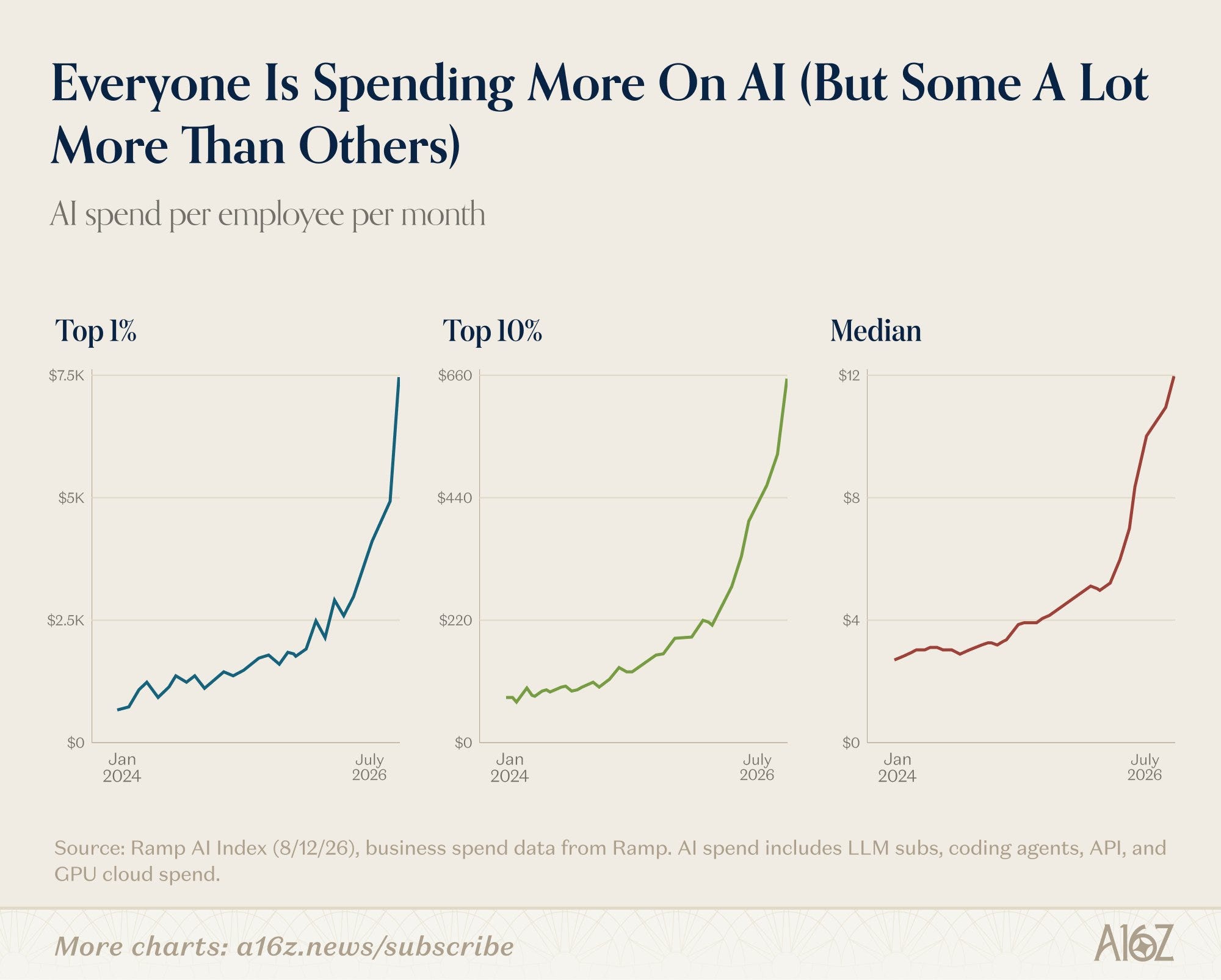
First, the spend gap. Ramp’s AI Index tracks how much companies spend on AI per employee per month. As of mid August, the median company spends about $12 a month per employee. The top 10 percent of companies spend $660. The top 1 percent spend $7,500. And a16z (who published the chart), put it plainly: the top 1% of AI spenders are now spending more than 600 times as much as the median company … and that gap has widened sharply just in the last few months.
Second, how is that spending is being financed? On August 10th, Nvidia announced agreements with 6 of the largest private capital firms, Apollo, Blackstone, BlackRock, Brookfield, Goldman Sachs, and KKR, to raise more than $500 billion. The reason? So Nvidia’s own customers (including OpenAI) can buy Nvidia chips without putting the cost on their own balance sheets. Jensen Huang has described GPUs as a new investable asset class, like real estate or toll roads. In practice, the 6 firms are packaging this as debt and pension funds and insurers may end up holding it.
A markets analyst who goes by Hedgie Markets pushed back on the toll road comparison directly:

Hedgie@HedgieMarkets
🦔Nvidia announced agreements yesterday with the six biggest names in private capital, Apollo, Blackstone, BlackRock, Brookfield, Goldman Sachs, and KKR, to raise over $500 billion so its own customers can buy Nvidia chips. These are memorandums of understanding, with final terms

3:03 PM · Aug 11, 2026 · 94.8K Views
100 Replies · 405 Reposts · 1.55K Likes
His argument is a toll road still earns money in 30 years but a GPU is close to worthless in 5 years. He compared it to Lucent and Nortel during the dot com boom/bust. These two companies lent their own customers money to buy equipment in the late 1990s and both later filed some of the largest corporate bankruptcies of their era. His summary: the vendor keeps its sales numbers up and the risk ends up on whoever holds the debt.
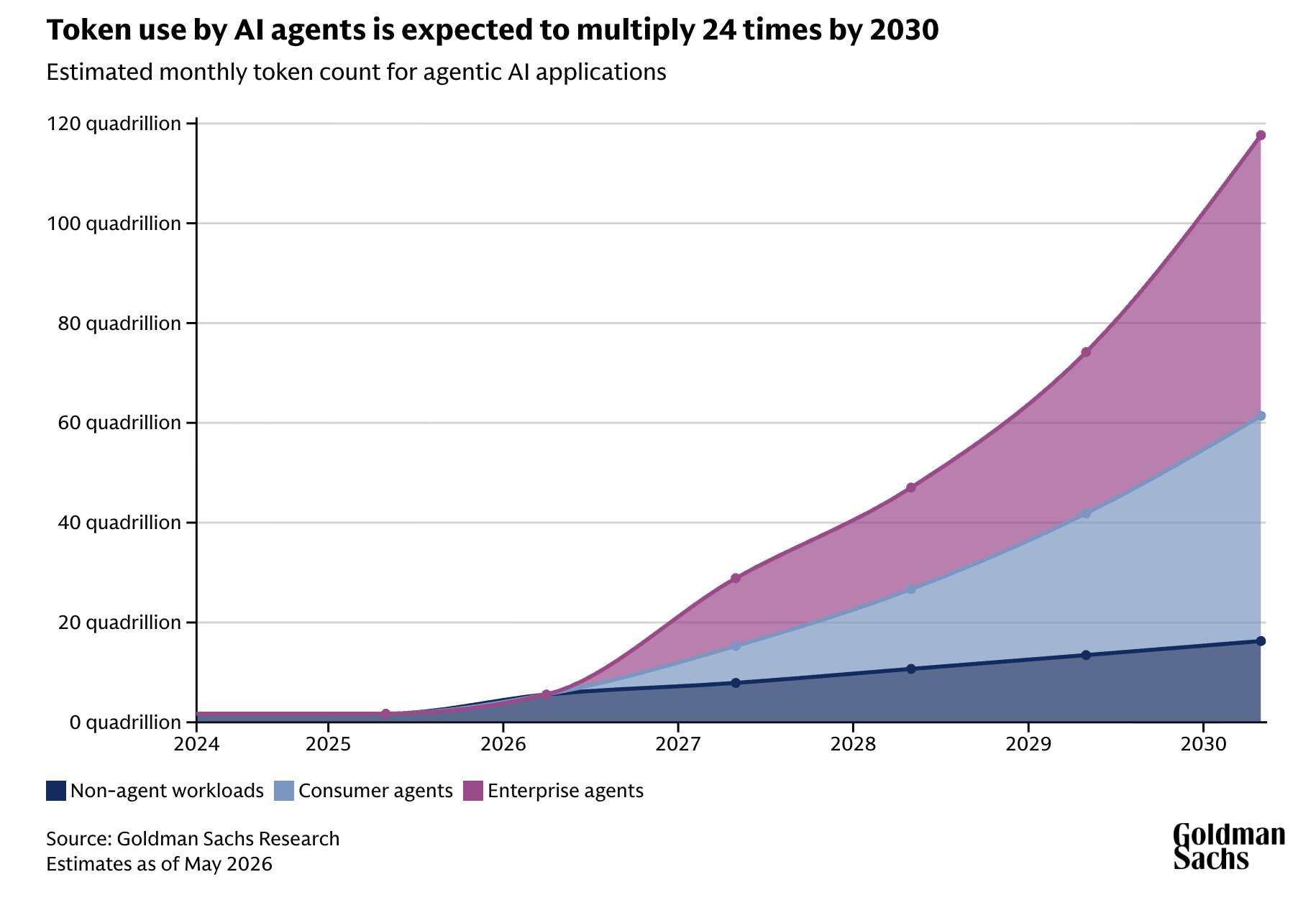
Third, what is all this spending being bet on? Goldman Sachs estimates that monthly token use by AI agents will grow 24 times by 2030, driven almost entirely by enterprise and consumer agents rather than the kind of chat use most people are familiar with today. Investor Glenn Solomon added useful context this week: last year, Dell estimated that monthly token inference would reach about 1 quadrillion tokens by 2028. Dell’s current estimate for the same year is 57 quadrillion tokens, a 57 times increase in a single year! Goldman’s own projections run even higher than that.
Why it matters: What stands out to me across all 3 of these is that a small number of companies are placing enormous bets, the financing behind those bets is structured so the risk lands somewhere else if the bets are wrong and the growth estimates used to justify the bets have already been wrong by 57 times in a single year (in the direction of underestimating demand). I do not know whether that means the projections are still too low or whether the market is due for a correction. What I do know is that PeopleMetrics is closer to the median company in that first chart than the top 1% and most of the businesses we work with are too. The decisions worth paying attention to are not just how much the largest companies are spending. It is who ends up holding the risk if the growth does not arrive on the schedule these charts assume … and making sure that is not us!
A designer named Jordan Dworkin built an interactive piece this week called Ordinary Abundance and even though it never mentions AI once, it might be the most useful thing I read all week. It walks you through a single evening in an ordinary apartment, a sitting room, a kitchen, a bathroom and next to each ordinary object it places a quote from someone in history encountering that same thing for the first time. It’s really awesome.

Guy Benson@guypbenson
Nearly every single human who’s ever lived — literally ever, in the history of this planet, including many alive *right now* — simply could/can not fathom the comfort, convenience & abundance we take for granted. For gratitude & perspective, read this:
ordinaryabundance.com
Ordinary Abundance

10:48 PM · Aug 14, 2026 · 700K Views
52 Replies · 361 Reposts · 2.77K Likes
A few examples from the article. In 1806, Thomas Jefferson wrote to celebrate the smallpox vaccine, a disease that had been killing an estimated 400,000 Europeans a year. In 1858, a book on the telegraph called it “a perpetual miracle, which no familiarity can render commonplace,” at a time when a reply from far away could take weeks. In 1871, the inventor of surgical anesthesia was memorialized on his own gravestone for ending an era when operations were performed on fully conscious patients. In 1880, a crowd in Wabash, Indiana stood in what a witness called “bated breath” the night their town became one of the first lit entirely by electric light. And even in recent history, in 2003, a woman in rural Iowa described her family’s first indoor bathroom by saying it made her feel like the wealthiest person in the world.
Every one of those examples predates AI by decades or centuries and that is exactly why I included it as a signal. We spent the first 2 signals this week on a lively current argument … who has too much AI power and who is taking on too much risk? This piece is a reminder that every major leap in ordinary comfort looked exactly this uncertain while it was happening.
Why it matters: The anxiety running through the first 2 signals this week, who holds the most AI spending power and who can be trusted with that much influence, comes from looking only at what is directly in front of us. This piece is meant to allow us to step back and see the big picture. The person who first heard a vaccine could stop smallpox, the person who experienced anesthesia for the first time so surgery no longer meant staying conscious through the pain, the person who first saw electric light in 1880, none of them knew how it would turn out. It looked uncertain and unproven to them the same way AI looks uncertain to us now. All of it eventually became something people do not think twice about. I am not saying that guarantees AI turns out well. I am saying the discomfort of not knowing how this settles is not new and it has never stopped real abundance from arriving before. That is the frame I want to carry into how I think about where PeopleMetrics is headed, not certainty that it works out … but confidence that this kind of uncertainty is normal and not a sign that something is wrong.
Every signal this week came back to some version of the same argument: who has too much and who does not have enough? Baker’s version of it was Anthropic and governments, and that is it. The money story was a chart showing the top 1% of AI spenders outspending the median company by more than 600X and a $500B financing structure built so the people funding the boom are not the ones who bear the risk if it goes wrong. Even politicians are talking about AI this way right now, some people having far too much and others being left with far too little.
I do not think that framing is wrong exactly. But it is incomplete and the third signal this week is the reason why. Look back 100 years to 1926. A little more than 50% of American homes in cities had electric light. But in the countryside, more than 90% of families were still lighting their homes with kerosene lamps. Penicillin had not even been discovered yet (that happened two years later in 1928) and it would not reach widespread use for another decade after that. In 1926, a routine infection could still be fatal. Most American homes (especially outside cities) did not have indoor plumbing. Compare that to 2026. Whatever inequality exists today, the person at the bottom of it in a developed country has access to more clean water, more medicine, more light and more comfort than the wealthiest person alive in 1926. We are living inside an abundance that would have been unimaginable to them and most of us do not think about it for a second most of the time. Me included.
So here is the question I keep coming back to. If the distance between 1926 and 2026 is that large, what will the world in 2126 look like? I do not think we can actually picture it, the same way someone in 1926 could not have pictured penicillin or a phone that fits in a pocket or clean water reaching every home automatically. A lot of what gets built between now and then will come from the exact technology we spent this whole issue arguing about. I am not sure what those advances will be in 100 years or how fast they will arrive. But I am confident that in 2126, when my grandchildren and great grandchildren (people I have not even met yet) are the ones experiencing this world, it will be unimaginably more abundant than it is today. And my guess is AI will have a great deal to do with that.
See you next week.
No posts
Comments
Nothing yet. Say the first thing.
Sign in to join the conversation.