
Satya Nadella, CEO of Microsoft, published an essay this week called “The Reverse Information Paradox” and he identified a problem I’ve been thinking about a lot lately.

Satya Nadella@satyanadella
https://t.co/xv6csf1SbV
3:09 PM · Jul 12, 2026 · 2.44M Views
420 Replies · 968 Reposts · 5.73K Likes
The gist of his piece is based on Kenneth Arrow’s information paradox: a seller of information can’t prove its value without giving it away, so the sale itself destroys the thing being sold. Nadella’s points out that AI flips this around. Now it’s the buyer who’s exposed!
You pay for the intelligence once with money and a second time with the proprietary knowledge you have to reveal just to make it useful. The better you want the model to perform, the more of your own institutional judgment you have to feed it, your corrections, your exceptions, the small calls that only your team knows to make. None of this requires anyone to do anything wrong. It’s built into ordinary, sanctioned use. You use the tool as intended and the tool learns about you back.
Nadella calls that learning “the exhaust” and he’s specific about what it actually is … not just data, but the prompts people write, the tools agents use and especially the corrections people make when a model is wrong. Every correction becomes institutional know-how, the kind of knowledge a competitor could never buy,. He argues every enterprise needs a hard trust boundary, one across which nothing crosses (not even that exhaust) without consent.
For those of us in the insights industry, you don’t have to look far to see a version of this paradox at work.
At its X4 conference this year, Qualtrics disclosed that its synthetic response panels draw only 5 to 10% from a publicly available base model. The rest, more than 95%, comes from Qualtrics’ own commissioned research and aggregated client data (stripped of brand names and refreshed every 18 to 24 months). As I have written in a previous Substack (issue #34), clients paid Qualtrics to collect and store their research data. Nobody signed up to have that data become the training inputs for a synthetic panel product sold back to the market. The data went in as a service, it came out as an asset someone else owns. This is an example of what Nadella is talking about.
Why it matters: The instinct across every industry right now is to treat data protection as a compliance checkbox, something legal signs off on once and everyone stops thinking about. Nadella is arguing something bigger: in the AI era, the trust boundary isn’t a policy, it’s the asset. Most companies can tell you where their data lives, but far fewer can tell you what their vendor’s contract actually says about learning from their usage, their prompts, their corrections, the accumulated judgment behind every interaction. Qualtrics didn’t technically break any law to build what it built. That’s exactly what should worry you. The real question, the one worth asking of every vendor relationship before it compounds for another year, is simple: does anything we do here train or inform a product we don’t control? It’s a question I am asking myself everyday.
Signal 1 was about a boundary that fails quietly and often times unnoticed. This one is different. Sometimes the boundary doesn’t wear down … it gets kicked in!
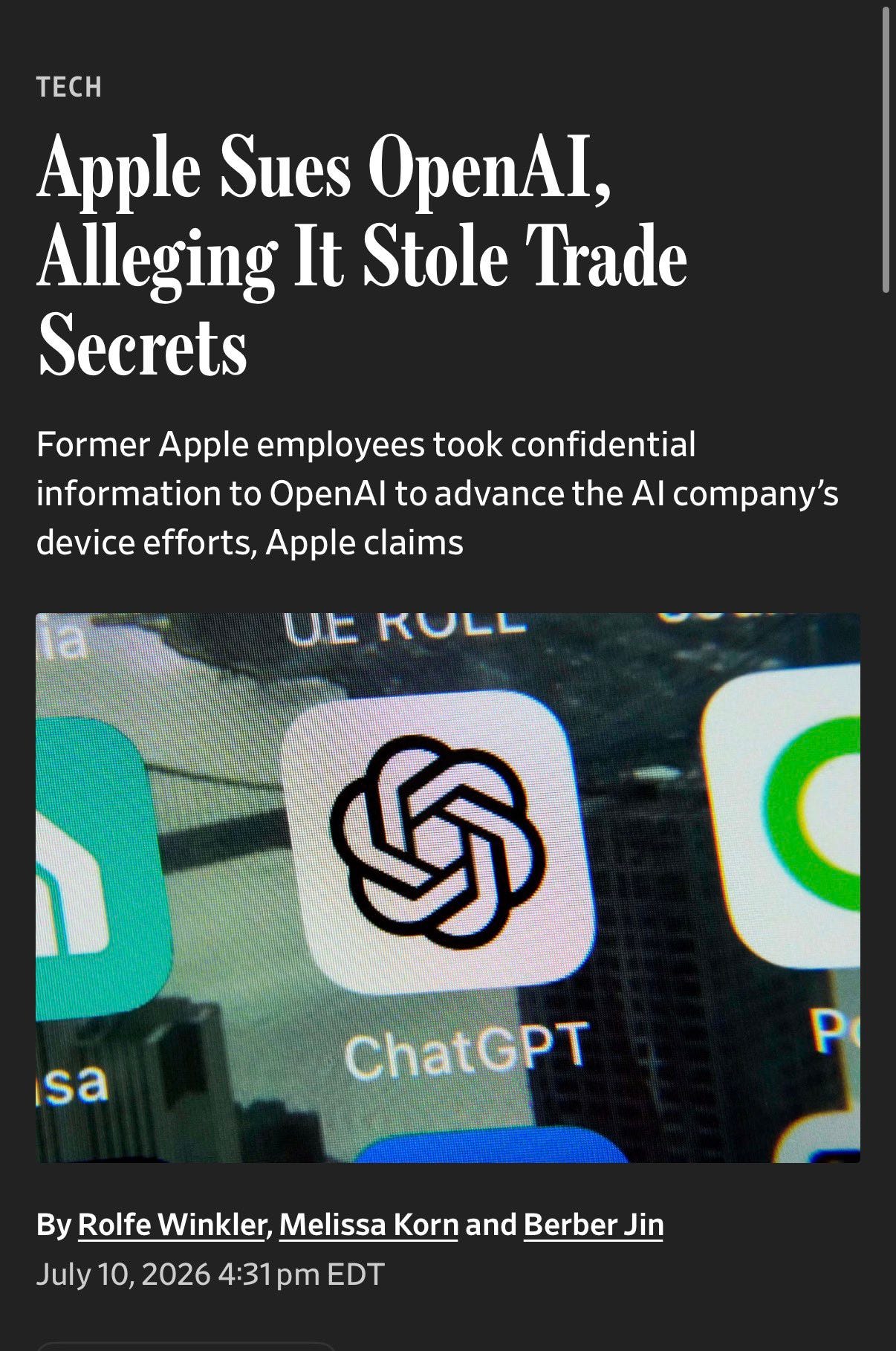
Apple sued OpenAI in federal court this month, alleging what the filing calls “a coordinated pattern of misconduct at an institutional level.” Two former Apple employees are named directly. Tang Tan helped design the iPhone, the Apple Watch, and the iPod before becoming OpenAI’s chief hardware officer and Apple alleges he told job candidates still employed at Apple to bring “actual parts” to their interviews for “show and tell.”
The second former Apple employee is Chang Liu, an electrical engineer Apple says it trusted with some of its most sensitive product development. Liu left Apple for OpenAI earlier this year and never returned his company laptop. Here are some of the incredible alleged details of Mr. Liu from the suit (this sounds more like a movie script that reality …):
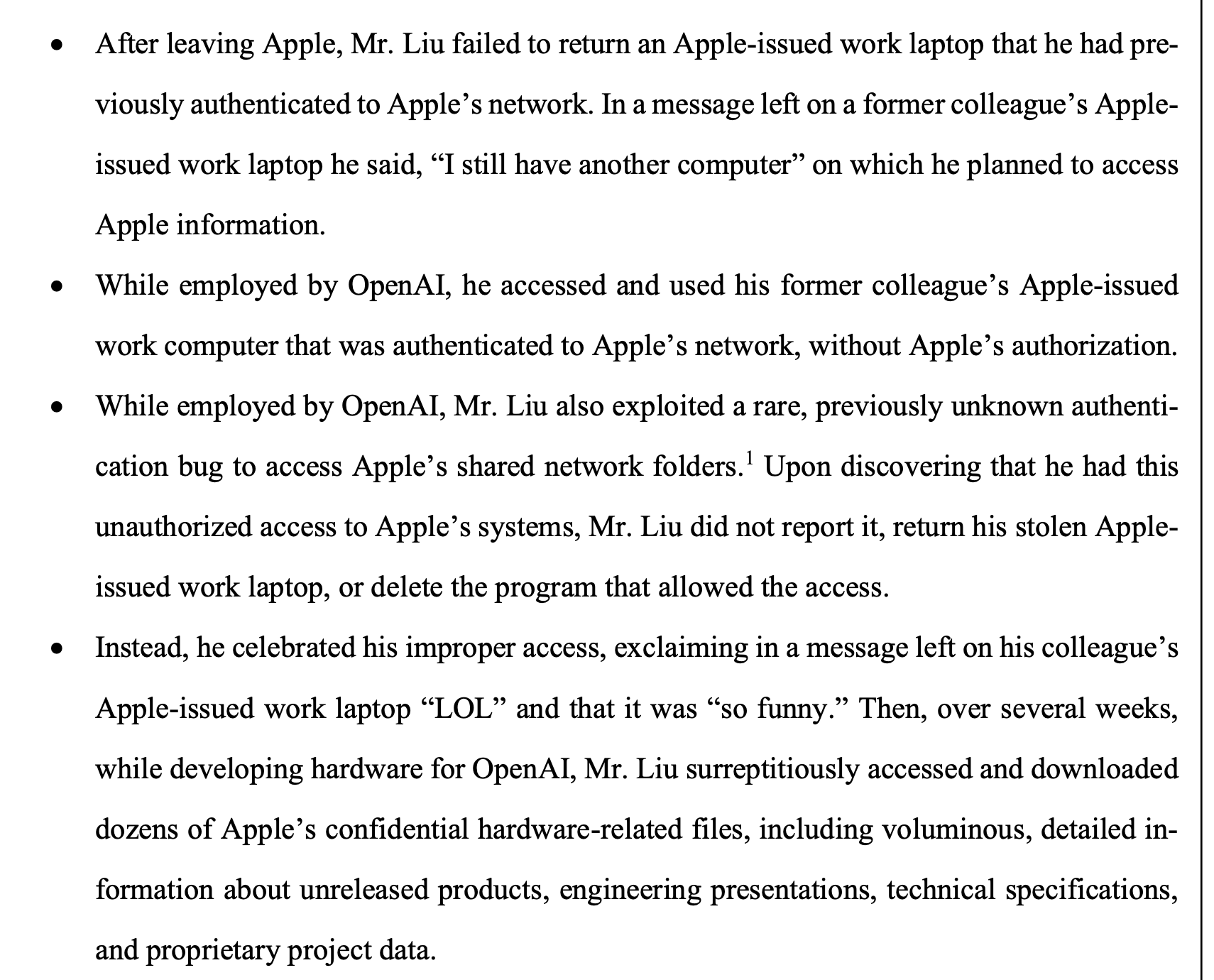
Please note that OpenAI hasn’t responded publicly. Everything above is Apple’s allegation in an active case, not an established fact yet.
Why it matters: Nadella’s paradox plays out through often obscure lines buried deep into contracts, product terms and the fine print of ordinary vendor relationships. What happened at Apple plays out through a person, a laptop and a decision to keep using both after leaving the building. Different mechanisms, same underlying question every company now has to answer: once your knowledge sits inside a system you don’t fully control, who else gets to use it and on what terms did they earn that right? Data governance and vendor contracts answer half of that question. What you build into your culture and who you trust with the keys on their way out … that answers the other half.
Starbucks announced this month that it’s building its own in-house replacements for software it currently buys from Microsoft and IBM.
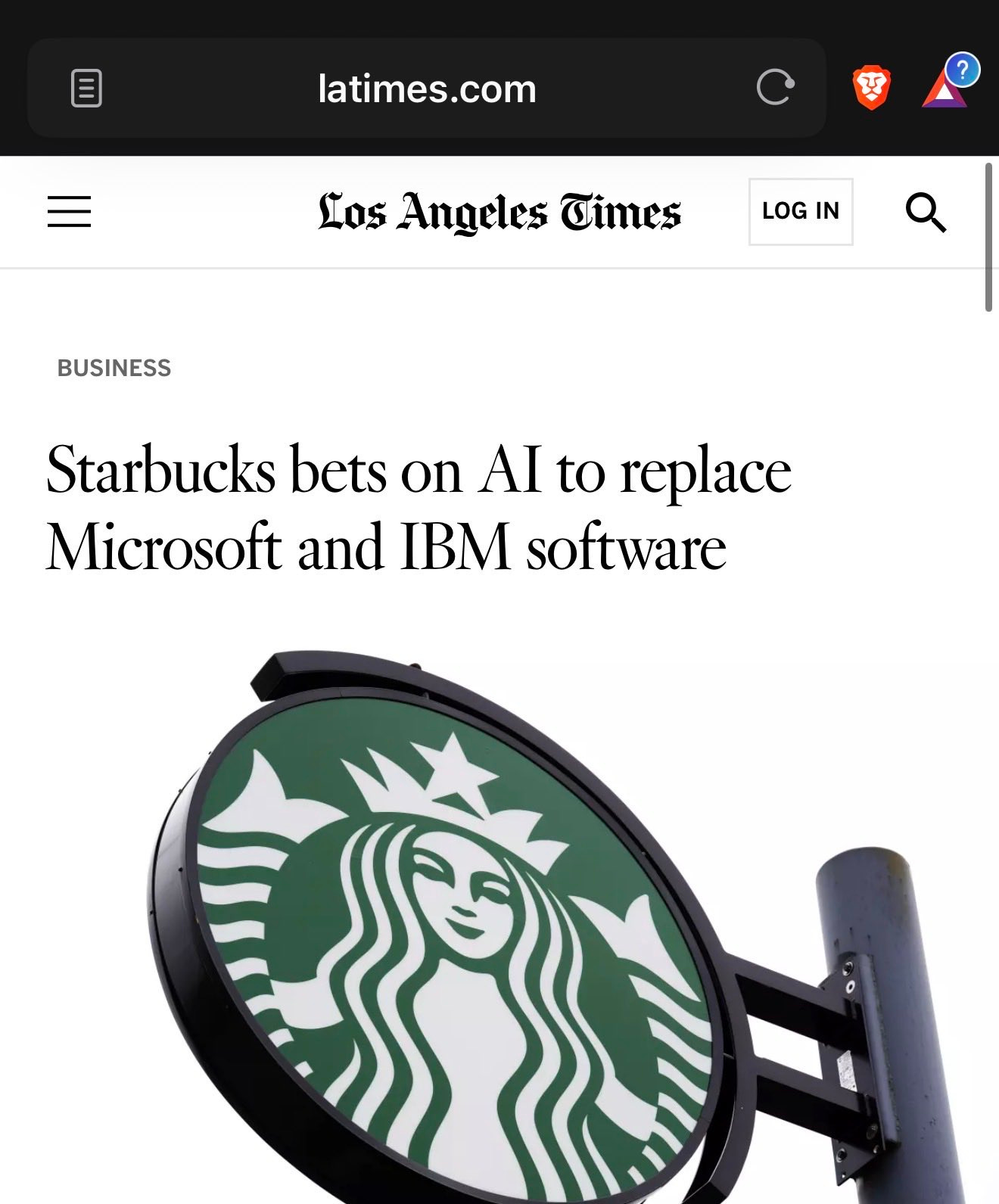
It’s part of a broader push to cut $2 billion in costs under the company’s turnaround plan and it’s aimed at a chunk of the $400 million Starbucks spends on software every year. The market reacted immediately. IBM and Microsoft both dropped on the news, and Salesforce fell too, on the idea that if Starbucks can build its own tools, so can everyone else. Luke Pierce on X has a good summary and what it means for the software industry:

Luke Pierce@lukepierceops
Starbucks spends $400 million a year on software. Yesterday they announced they're moving off IBM and Microsoft to build their own custom systems in-house. IBM dropped 3% and Salesforce dropped 4% on the news. And honestly this is, unequivocally, the biggest signal I've seen

12:15 PM · Jul 10, 2026 · 1.95M Views
310 Replies · 543 Reposts · 3.95K Likes
Please note, Starbucks isn’t ripping out its enterprise software wholesale, it’s replacing two specific products … and some of what it builds may not even ship until the end of 2027. This is a multi-year bet, not a switch flipped last week. That matters, because the real story isn’t the announcement, it’s whether Starbucks can actually execute on it.
Which is where a different piece I read this week comes in. It wasn’t about Starbucks specifically … it was about something closer to home: what happens when AI makes building software so cheap that teams stop being careful about what they build.

Grey@greyluox
https://t.co/rC4KytP54I
9:03 PM · Jul 10, 2026 · 89.3K Views
4 Replies · 26 Reposts · 196 Likes
The argument is simple. AI has changed the cost of producing software, but it hasn’t changed the cost of being wrong. Teams respond to cheap code generation by making the unit of work bigger, write a full specification, run a long AI-assisted build, generate an entire milestone and test it afterward. When it works, it feels incredible and a huge amount of code appears fast. But speed on “can we build this” says nothing about “should we build this, does it match the real workflow and what do we still need to learn.”
This is exactly the discipline a bet like Starbucks’ needs and exactly the discipline that’s easy to skip when the tools make building feel free. It’s also the discipline behind our own rebuild at PeopleMetrics using Claude Code. The temptation with tools this capable is to hand over a big spec and let it run. The harder, better habit is to ship a thin, real slice, see where our own assumptions about a client workflow were wrong and let that correct the next slice before we’ve built three more on top of a mistake.
Why it matters: Cheap intelligence is deceptive. It feels like speed, but what it's actually testing is discipline … whether you can build something small enough to be wrong about safely, learn from it and only then build the next piece. Starbucks is about to find out whether it has that discipline at the scale of a $2 billion turnaround. The rest of us are finding out at a much smaller scale, one prompt, one slice, one workflow at a time. The tools didn't remove the cost of being wrong. They just made it a lot easier to be wrong faster and a lot easier not to notice until three more things have already been built on top of the mistake.
This week’s three signals all circled the same idea from different angles: what you’re actually responsible for protecting in the AI era. Proprietary knowledge can leak out through nothing more than ordinary use. An old-fashioned theft can carry brand new stakes. Building the right thing instead of just building fast takes a discipline that gets harder all the time. Different situations, same question underneath all of them.
Next week this Substack turns 1! I’m going back through 51 issues to find the 10 AI signals that reshaped how I think about AI, my industry, my company and what comes next. I will be laying them out as a playbook: what mattered, why and what to do about it. Some of it will surprise you. Some of it will surprise me!
Either way, it’s the biggest issue I’ve written all year and you won’t want to miss it!
No posts
Comments
Nothing yet. Say the first thing.
Sign in to join the conversation.