
On June 30, an account on X called Yum posted a list of nine companies that had quietly moved their AI workloads onto Chinese models.
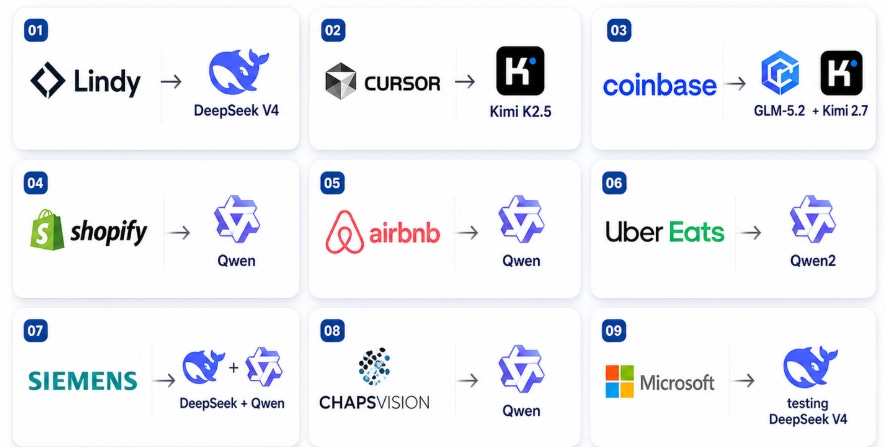
The post ended with a line that summarizes this issue:”it’s becoming a procurement story.” The bottom line is once the price gap gets big enough, loyalty stops being part of the decision. Lindy’s CEO told CNBC the switch to DeepSeek dropped his AI bill so fast it barely resembled the same expense line. Coinbase’s CEO said routing engineers to GLM and Kimi by default cut the company’s AI spend nearly in half. Shopify replaced an OpenAI pipeline with a self hosted Qwen3 system and reported a 75 fold drop in cost per unit, with better results.
Two days before that post, Xiaoyin Qu laid out her own case for the same shift, and buried in it was a reason that had nothing to do with price.

Xiaoyin Qu@quxiaoyin
American and European enterprises will ditch OpenAI and anthropic and adopt Chinese models. Here’s why: 1. They can host Chinese models under their own GPUs so it’s still compliant and they would argue they have more control. 2. they will post train with their own data on top
2:29 AM · Jun 29, 2026 · 1.06M Views
288 Replies · 530 Reposts · 3.17K Likes
She argues that enterprises no longer fully trust Anthropic to handle their data the way they were promised. Anthropic’s newest models shipped with a mandatory 30 day data retention policy and a no zero retention option (even for enterprise customers who had that agreement elsewhere in their contract). Microsoft reportedly restricted its own employees from using it while legal reviewed the terms. It’s worth saying that the alternatives carry their own version of this problem. For example, Anthropic told the Senate Banking Committee this year that Alibaba’s Qwen lab ran millions of exchanges through fake accounts to distill Claude’s capabilities,. That lab and others like it are now running Airbnb, Shopify, Coinbase, and Cursor’s production traffic. Without a doubt, nobody in this story is the clean choice.
But price matters for sure. I did some of my own research on LLM pricing and the numbers in the chart below are hard to ignore.
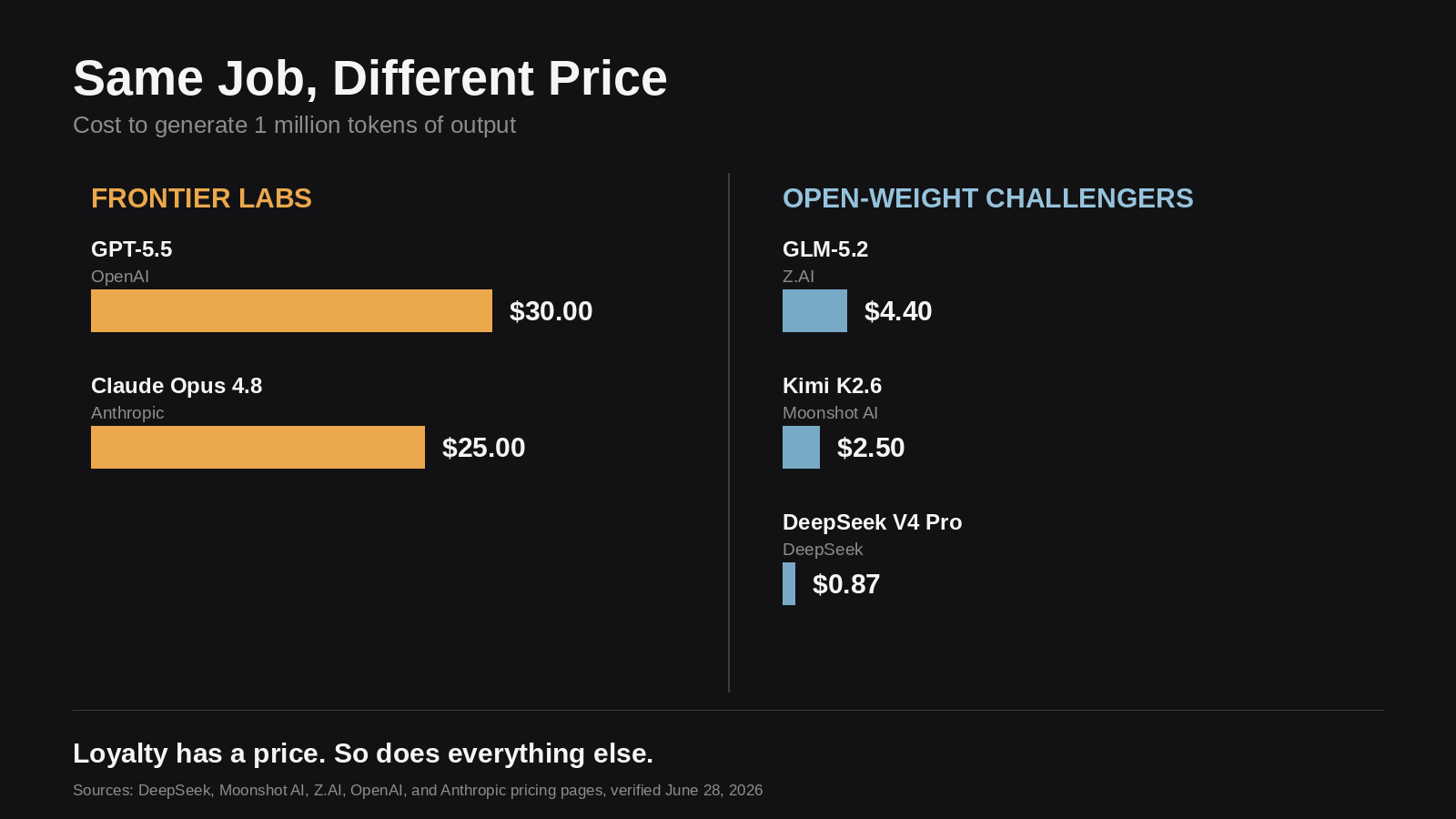
Why it matters: Pricing power only survives as long as the alternative is meaningfully worse. That’s the whole story here and it’s not really an AI story. It’s what happens in every category once a challenger gets close enough. Anthropic and OpenAI have been charging what they charge because for a long time nothing else came close on quality and companies will pay a premium for the best available option even when the premium is steep. But a 57X price gap only holds if the difference in output justifies it. The moment Chinese labs closed that gap to something a company can point to internally and say this is close enough for what we need, the premium stopped being defensible. Companies often don’t leave a category leader because they’ve fallen out of love with the leader. They usually leave because someone finally gave them a real reason to compare. In this case, it’s the Chinese models.
This week, Ramp’s lead economist Ara Kharazian published the first paper to link real AI spending data to real workforce data at economy wide scale. He used Ramp’s own corporate card records joined to Revelio Labs’ employment data across 21,599 companies.

Ara Kharazian@arakharazian
We can finally say AI isn't killing jobs. A new paper from me, @tryramp, and @RevelioLabs uses firm-level spend and workforce data across 21K U.S. businesses to measure AI's impact on jobs. Firms that adopt AI heavily grow headcount 10% over two years following adoption. Low

1:01 PM · Jun 30, 2026 · 811K Views
165 Replies · 595 Reposts · 2.7K Likes
Here’s what the data shows. Companies in the top 1/3 of AI spending per employee (the high intensity adopters) grew total headcount by 10.2% over the two years after adoption. Low intensity adopters saw no statistically significant change at all (not a decline, just flat). And the group everyone assumed would get hit first is the one that grew fastest! Entry level headcount at the heaviest AI spending companies grew 12% over that same time period, outpacing the company wide number.
I want to be careful with this because this is correlation, not a controlled experiment. Companies that were already positioned to grow, better capitalized, more willing to make big bets, may simply be the same companies willing to spend heavily on AI. It’s also worth naming that Ramp has a stake in this story. They’re a corporate spend platform measuring their own customers and a paper showing AI spend correlates with growth is a good promotional message for more of that spend.
Why it matters: Companies making a real, sustained financial commitment to AI are seeing hiring growth. Companies dabbling, spending just enough to say they’re doing something, are seeing nothing at all. That split matters because it suggests AI adoption isn’t a dial you turn up gradually and expect gradual results from. It behaves more like a threshold. Half measures don’t show up in this data as half of a result. They show up as no result!
This one matters to me personally. My son Ben starts his sophomore year of college this fall, and for two years now, I’ve been the one showing him headline after headline warning him about his future. The message has been … don’t count on lots of entry level job opportunities by the time he graduates. This is the first real data I’ve been able to hand him that argues something different. It’s not that AI spares entry level jobs, it’s that the companies actually building around AI are creating more of them!
A Reddit post from a developer opened with a confession most builders would edit out.

Four shipped iOS apps and 5 more in active development. Total revenue across all nine: $0. Total users: his wife and one person in Finland he suspects downloaded the app by accident. Every one of these apps is real, built with SwiftUI, StoreKit, widgets, the full native toolkit, using Claude to write the code. He says writing the product requirements took longer than getting a working build. That part used to be the hard part (it isn’t anymore).
What makes this signal worth your time isn’t the confession, it’s the line right after it. He says the barrier to building and the barrier to getting users were never actually the same barrier. They just both felt impossible at the same time, so nobody noticed they were separate problems. Now that AI has dissolved one of them, the other one is standing there fully exposed and it turns out it was never going to be solved by better code.
Why it matters: I recognize this problem because we’re living inside a version of it right now. PeopleMetrics is in the most active building stretch we’ve had in 25 years and it’s happening because of exactly what this Reddit post is describing. Claude Code and the tools around it have made it possible for our team to build things in weeks that would have taken quarters two years ago. Enterprise survey engine, interactive customer avatars, incredible infographics, customer reels and my colleage Rich Fryzel even built a 10 minute film recently using AI tools. Simply incredible. None of that was on the roadmap 2 years ago because none of it was buildable at a cost that made sense. Now it is.
But the Reddit post is right that dissolving one barrier just exposes the one underneath it … and for us that barrier was never really engineering. The actual question, the one that doesn’t get any easier just because building got easier, is the story behind the data and what form of output will make that story land the way a 40 page PowerPoint report never did. That’s a judgment problem, not a production problem. It always was. Building just used to be hard enough to hide that fact from us.
So the shift I’m watching inside my own company isn’t build versus don’t build. We’re building constantly now. It’s a shift in where I spend my own attention. I used to worry about whether something was technically possible. Now the only question that keeps me up is whether it’s the right thing to have built at all, for this client, about this exact problem, in the form that will actually change what they do on Monday morning. That’s a harder question than it sounds like and no model update makes it easier.
Every signal in this issue is really about assumptions that quietly stopped being true. Frontier labs assumed customer loyalty would survive a big enough price gap. It didn’t. Leaders assumed any AI investment was better than none. The data says otherwise … only real AI commitment showed ROI and job growth. Builders assumed shipping the product was the hard part. It turned out to be the easy part all along.
I want to close somewhere more personal, because the person I often think about most while writing this newsletter is my soon to be 20 year old son who I mentioned earlier in this issue. If anyone reading this SubStack is in collage or has college aged kids, I hope this is helpful for you.
Ben, I know you’re going to read this, so here it goes …
The Ramp and Revelio study in Signal #2 is genuinely hopeful news. Companies that are taking AI seriously are hiring more people, not less. Firms in the top 1/3 of AI spending grew entry level hiring 12% over 2 years, faster than any other part of their workforce.
That’s not just a hopeful stat, it’s a filter you can actually use. When you’re looking at employers, don’t just ask if they use AI. Everyone will say yes. Ask if it’s changed how they actually work, whether it shows up in how teams are structured, how people are rewarded and how decisions get made. The companies worth targeting are the ones rebuilding around AI, not the ones that added a chatbot and called it done. That difference will be visible if you know to look for it, in job postings, in how people at the company talk about their own work, in what the interviewer brings up unprompted.
Here’s the second thing … and I won’t soften it. Being fluent in Claude, ChatGPT, and whatever comes next isn’t optional anymore. It’s not a line near the bottom of a resume. Companies are rebuilding how they operate around these tools and the people they hire need to walk in already AI fluent, not learn it on the job. An employer needs to picture, instantly, how you’d multiply what a small team can already do. That’s the bar now.
But AI fluency is the floor, not the ceiling. It gets you in the room. Watching my own company build faster than we ever have this year, the thing I noticed is that the tools took the hardest looking problems off the table and left the real one exposed. Building isn’t that hard anymore. Knowing what’s actually worth building, what a client needs before they’ve said it themselves, still is. Learn the tools completely. Then spend just as much time on talking with customers, prospects, colleagues, etc.
I don’t have this fully figured out for my own company and I won’t pretend to for you either. But after a year tracking this closer than almost anything else in my life, here’s what I believe: the future belongs to whoever shows up already AI fluent, already able to spot who’s serious about this and still takes the time to learn what AI is not good at … relationships, customer pain points, empathy, etc.
That’s buildable, starting this semester. It isn’t luck.
Now, get after it!
No posts
Comments
Nothing yet. Say the first thing.
Sign in to join the conversation.