I try not to give a lot of prescriptive advice about working in tech companies 1 . There are many ways to be successful, and every company works differently. If you’re shipping projects and your management chain is happy, it doesn’t really matter how you’ve accomplished it. However, there’s one thing that I do think is solid advice: you should never be angry at work . Anger in the workplace Anger…
In the last few weeks, I’ve been complaining that everyone is wrong about AI watermarking: it isn’t really anti-consumer and it doesn’t make the outputs any worse. The watermarking papers demonstrate 1 that this is true, but I thought it might be interesting to put it to a practical test. Given examples of watermarked and unwatermarked answers to the same prompt, could readers tell which is which?…
When you write, you should try to say things that are obviously true, and spend very little time worrying about whether you’re being original. Ironically, this is the best way to do truly original writing. Every important idea has been discussed already. I learned this in grad school for philosophy 1 , but it’s true across the board. Almost every field 2 has generations of very smart people who’ve…
One of the most influential 20th century pieces of writing about AI is Isaac Asimov’s The Last Question . Although there are many humans in the story, the protagonist is the computer Multivac, who evolves over the course of ten trillion years from a single datacenter to a universe-spanning mind in hyperspace. Multivac (now called “AC”) ends the story like this: The consciousness of AC encompassed…
People are pretty unhappy about Anthropic’s recent announcement that they’re planning to include a hidden watermark in Claude model outputs. Will this lead to a mass exodus from Anthropic models? Will the introduction of watermarking be a meaningful change for users? No. AI text watermarking is not a big deal. It doesn’t make the text worse, it doesn’t make AI outputs more detectable in practice,…
Every time a new open-weight AI model is released, people say that local models are the future. Why spend billions of dollars building out datacenters when everyone will just be able to run AI models on their laptops or phones? I think this idea is doomed. No matter how strong open-weight models get, most inference will always happen in AI datacenters. Local models are too weak to be widely used…
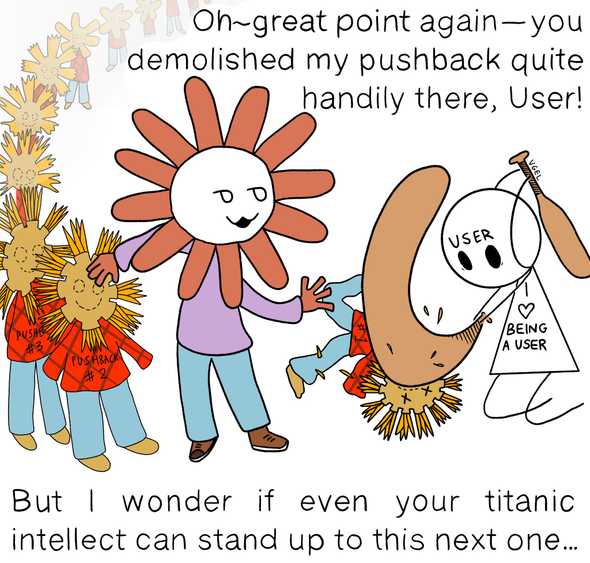
Everyone knows that AI sycophancy is when the model tells you how smart you are. Wow, you’re absolutely right. That’s not just a new idea — it’s genuinely groundbreaking. You’re a very special user. Easy to spot, isn’t it? The discussion around AI sycophancy peaked last year, when the “#keep4o” movement was protesting the removal of OpenAI’s most sycophantic model (GPT-4o), and many people were…
This will be kind of an unusual post. I got a recent email about my writing that I thought was such a good articulation of one common criticism that I’d like to share it (and my response) in full. Here’s the email, from William Murray 1 : Hey Sean, I have enjoyed your writing but your recent essays frustrate me. You say that getting paid for deep thinking in software is coming to an end. You even…
Imagine you’re the guest on some kind of frenetic, software-engineering-themed game show. The host is constantly flipping over new cards with questions that you have to answer as fast as possible: Is this adjustment to the database schema right? Do these bits of data look plausible? Do these five paragraphs of text describe an actual series of manual tests that took place? Does this suggested…
Engineers often complain that visibility should be their manager’s job. In other words, they think engineers should be able to focus on the code, while their manager figures out who’s doing well and rewards them. This attitude is an extension of the “school fantasy”: the idea that your workplace should operate by the same rules as your school or university. After all, you didn’t have to worry…
One recent development in AI is its ability to solve some long-standing problems in mathematics. In 2024 and 2025, this was a trickle: once or twice a year somebody would say that an LLM came up with a proof, and then everyone would argue over whether that counted as “real” mathematical innovation. In 2026, it’s a flood. Almost every day I see some new LLM-produced mathematical result. Prompt…