Image Credit: DallE When AI Tutors Fake Critical Thinking: From Cognitive Harm to Institutional Liability Ryan James Purdy, Purdy House Publishing and Consulting Timothy Cook, M.Ed., The Cognitive Privacy Project Working Paper | April 2026 Introduction Canvas and OpenAI want you to see the following conversation as the future of education. In promotional material shared by Leah Belsky, OpenAI’s VP…
Key Takeaways The natural impulse after Tumbler Ridge is to find a single point of failure. The harder truth is that multiple institutions, each making defensible decisions in isolation, compounded into catastrophe. OpenAI flagged the shooter's account eight months before the attack, banned it, and then watched her open a second one. Twelve employees recommended contacting Canadian police.…
The People Behind the Exclusion: Three Insurance Roles Rewriting Education's AI Rules Ryan James Purdy | Purdy House Publishing & Consulting Key Takeaways: Three roles inside the insurance industry, actuaries, lawyers, and underwriters, are becoming the most consequential decision-makers in education AI governance. Almost no one in education knows who they are. Exclusion language is not coming. It…
Key Takeaways The OECD's Due Diligence Guidance for Responsible AI, published January 26, 2026, lists "independent assessment processes" as one of the mechanisms for meaningful stakeholder engagement, but provides no definition, methodology, or criteria for who can conduct one or what the output looks like. Self-attestation, organizations assessing their own compliance, carries low evidentiary…
Key Takeaways The OECD's January 2026 Due Diligence Guidance for Responsible AI explicitly identifies stakeholder engagement and remediation as where existing AI governance frameworks fall shortest. My own mapping of the guidance extends this to human oversight documentation, vendor supply chain management, risk assessment, and impact assessment, all areas where most educational institutions and…
Image Credit: Christopher Katsarov, The Canadian Press / Ana Luisa O.J Key Takeaways Every sector in Canada is adopting AI right now without a single enforceable federal rule to guide them. That is not a trust problem. It is a governance failure. The Minister's office has produced committees, consultations, and voluntary codes. None of these are law. None of them give any organization in the…
Key Takeaways: The 2026 International AI Safety Report identifies an "evidence dilemma" at the heart of AI governance. Education is living that dilemma right now. 95% of GenAI implementations are delivering zero return according to MIT NANDA research cited in the WEF's January 2026 paper. The cause is governance failure, not technology. Both reports independently conclude that governance…
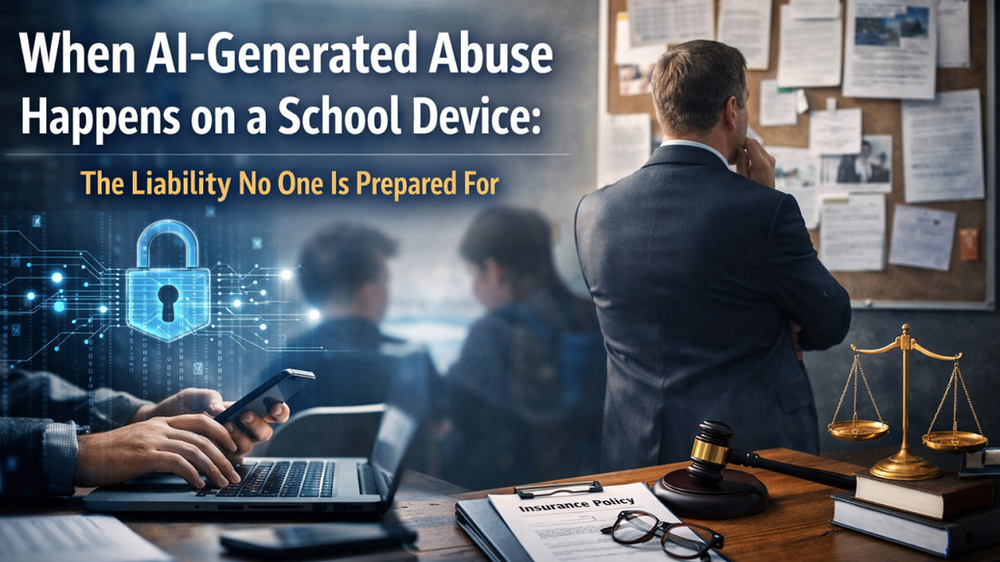
Content note: This article discusses AI-enabled sexual abuse imagery involving minors (non-graphic). Key Takeaways UNICEF (February 2026) reports that across 11 countries, at least 1.2 million children reported their images being turned into sexually explicit deepfakes in the past year. The prevalence range across surveyed countries was 0.4% to 4.3%, with schools explicitly named as "frontline…
I just published Memorandum No. 8 in the AI Governance in Education Series. It's called The Fractured Application of AI Governance: A Classification Failure Across Five Frameworks, and the Case for Holistic AI GRC. This one goes wider than education. The argument is straightforward: the phrase "AI governance" is being used across five major international frameworks to describe five fundamentally…
Key Takeaways: The World Bank identifies "Competency" as one of four essential AI foundations, but focuses on worker skills, not institutional governance capacity. The gap they're missing is who governs AI in education, not who uses it. 37% of teachers already use generative AI for work tasks according to OECD data, yet 45% of US high schools have no AI policy and no plans to develop one. Adoption…