
I am working on a reflection, not yet finished, on the complexities of marking a harvest festival in a time of burning forests and stolen harvests, that will be shared in the coming days — which will come in its right time, not set by neopagan or post-Norman reckonings of the time the festival falls. But I would still like to share something for the day that it is. So for today, I am sharing this bit from my book, The Silver Branch and the Otherworld:
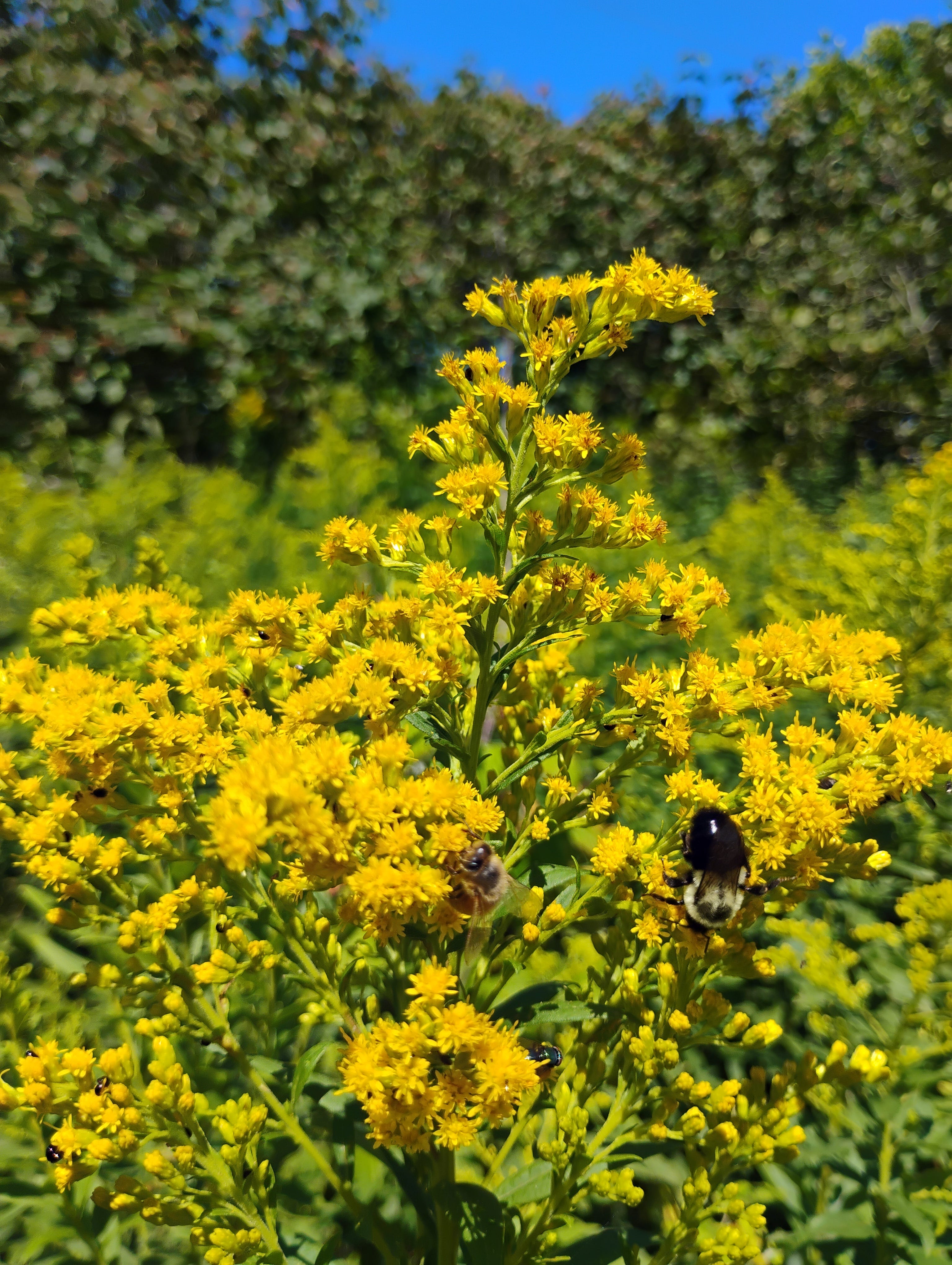
The sun blazed brightly at noon, but as the day progresses, the Tansy and Yarrow dance in the cold wind that blows from the West, bringing in rain. In the fields, St. John’s Wort is fading, giving way to Goldenrod. In the early mornings, bears gorge on Blueberries in the fields up the road, while in the forest the Blueberry’s strange Otherworldly cousin, Ghost Pipe, blooms, and across the ocean in my ancestral homeland the hillsides are purple with Heather. The Rowan is laden with berries.
Today is Lughnasadh (meaning “assembly of Lugh,” modern Irish - Lúnasa,) the ancient fire festival that marks the harvest of the first fruits and grains and the beginning of summer’s dying into winter. Between now and Samhain, flowers will give way to fruit and seeds, the leaves of all but the evergreens will die and fall away, and plants will sink their energy and their consciousness down into their roots. This is a time for celebrating and giving thanks for the harvest – but also for taking stock of what is at hand, what must be preserved and put away. What must be let go, and what must be planted in autumn to bring forth new life in spring.
The seanchas, the old lore, the stories and genealogies and histories and laws that made the Irish a people, tells us that the festival that marks the day was begun by Lugh, sun bright, long armed, many skilled King of the Tuath Dé, to honor his foster mother, Tailitu, of the axe, of the plain, of the great labor, who died of exhaustion after clearing forests to make way for fields of grain.
Lugh was a great warrior and magician who played a key role in helping the Tuath Dé liberate Ireland from Balor of the Baleful Eye, whose gaze corrupted everything it landed on. (John Moriarty notes that the gaze of our contemporary culture which commodifies everything it sees is the modern equivalent of Balor’s Baleful Eye.)
Tailitu herself was a woman of the Fir Bolg, the People of the Thunder God, a people who lived alongside the Tuath Dé. Both suffered under the oppression of Balor’s people, the Fomorians, who demanded sacrifice and tribute. It was the ancestral forest of her own people that Tailitu cleared that it might bring forth plentiful harvests of grain – grain which would be taxed by their oppressors.
This story gives way to another old name for this time of year – Brón Trogain, Brón means sorrow. Trogain is an Old Irish word with three primary meanings, and in applying each to the name of the season, we can gain another layer of understanding.
Brón Trogain means “sorrow of the land. Why does the land grieve? Ask her. This season, She tells me: She grieves for the dying that must happen each season that fruit and grain might fall to the ground and become the source of new life in spring. She grieves for the destruction of the forests that came before the fields. She grieves that her children live in bondage under the rule of people who do not respect them or her.
Brón Trogain also has an association with the Raven. The modern name for Raven is “fiach dubh” – black debt, which I connect with the grim price paid when battle, physical or metaphysical, becomes the cost of defending sovereignty. A scavenger on the battlefield, Raven reminds us that we owe our life and our very flesh to the living world around us. A nineteenth century German dictionary of Old Irish connects the word Trogan (of which Trogain is the genitive form) with the Gothc German word Rabenweibchen, meaning “wife of the Raven.” While Irish tradition has no references to the Raven’s wife, there is a prominent and powerful Irish goddess connected with the Raven. The Raven is the bird of the Morrigan, who many today think of as the Irish goddess of war, but I think of more as the dark face of the sovereignty goddess, who reflects the grim price her people pay for their freedom. While there is no traditional lore that I am aware of connecting her with this time of year, when I reflect on this meaning of “Brón Trogain,” I feel her grief for the blood that has watered her fields instead of rain, for the loss of life, for the indignity of bondage, or the deaths of the Sacral Kings who had given their lives for her and for her people, and for the lack of true Sovereigns in the generations since they perished.
It brings to mind Seamus Heaney’s devastatingly beautiful “Requiem for the Croppies,” (2001) which mourns the Irish who died fighting for independence in the uprising of 1798. They knew that English forces would not afford them a proper burial, so they filled their coat pockets with Barley so that the places they fell would not be unmarked. The last of the rebels were slaughtered at Vinegar Hill in Wexford that June. Speaking as the voice of those fallen ones, Heaney wrote:
Text within this block will maintain its original spacing when published
Terraced thousands died, shaking scythes at cannon.
The hillside blushed, soaked in our broken wave.
They buried us without shroud or coffin
And in August... the barley grew up out of our grave.
The green and gold of the Barley that year were the colors of a harvest of sorrow that nevertheless brought forth new life. And it is from Barley that uisce beatha, “the water of life,” known in English as whiskey, is distilled over a peat fire whose smoke carries the ancient exhalations of the forests and meadows that became the bogs where the peat was formed (and where sometimes offerings to the gods were left and preserved – butter, wooden carvings, bodies of the dead.) The juice of the Barley brings warmth in winter.
Finally, Brón Trogain means “labor pains.” It may seem paradoxical to speak of birth in a season when things are dying back, but late summer is the season when plants are focused on bringing forth fruit and seed.
Most modern Pagans think of Bealtaine as the season of fertility, but more properly speaking, it is attraction and pleasure and flowering and pollination that we experience in spring – it is autumn that the forest and field are fecund. Fecundity and fertility are the maturation of the friskiness of spring. Lughnasadh is the time of fruition.
_______________________________________________________
My writing here is freely shared. And if your harvest leaves you with a bit to spare or share, your spending some of it on a paid subscription or on a class or consultation with me would be greatly appreciated — especially in a time when more and more of those my work does connect with cannot afford to pay. You can also make a one time gift through https://buymeacoffee.com/seanpadraigodonoghue or https://account.venmo.com/u/Sean-ODonoghue-53 Thanks to the generosity of community, I’ve found a safe and warm and dry place to be in this season and am no longer facing homelessness — and I still need and welcome help to continue doing my work in this world.
No posts
Comments
Nothing yet. Say the first thing.
Sign in to join the conversation.