
“Everyone says forgiveness is a lovely idea, until they have something to forgive.”
– C.S. Lewis
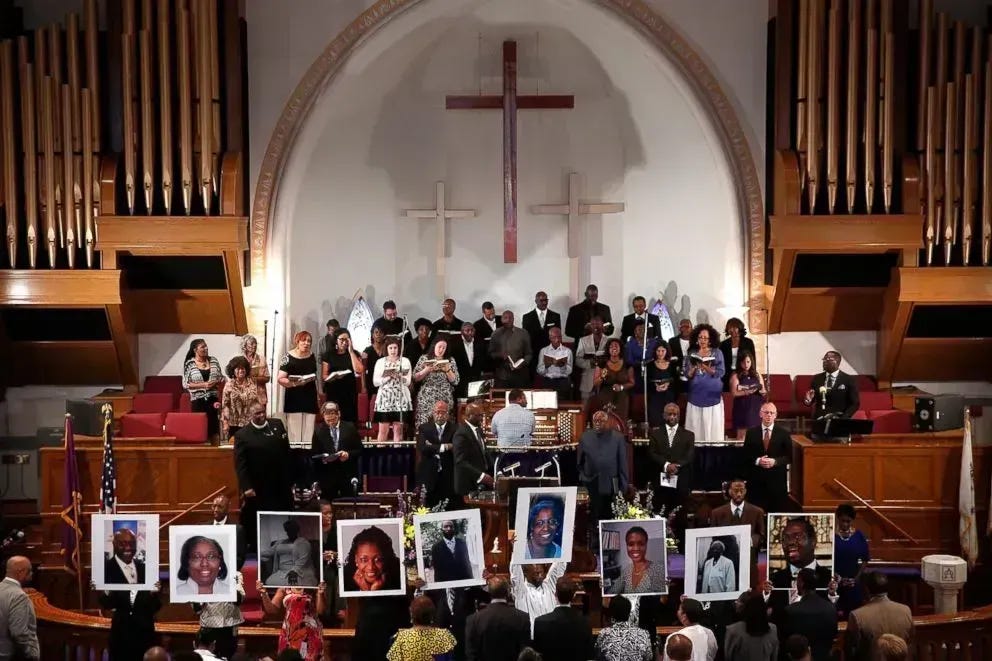
Two days after nine people were murdered during a Wednesday night Bible study in Charleston, their killer appeared on a video screen at a bond hearing.
His name was Dylann Roof.
He was twenty-one. He had walked into Emanuel AME Church, been welcomed into its fellowship, and warmly included in its Bible study. He stayed for nearly an hour. Then, as the group prayed, he pulled out a concealed handgun and opened fire.
At the hearing, Roof said almost nothing. No explanation, and no remorse. Then the judge invited the families to speak.
Nadine Collier, whose seventy-year-old mother had been killed, told Roof through tears that she would never speak to or hold her mother again. Then she said, “I forgive you, and have mercy on your soul.” Felicia Sanders had survived by hiding with her granddaughter and playing dead while her son lay nearby. She reminded Roof that they had welcomed him and said every fiber of her body hurt. Anthony Thompson, whose wife had led the Bible study, said, “I forgive you, and my family forgives you,” then urged Roof to repent and give his life to Christ.
Roof stared right past them. He was not sorry and has never indicated otherwise.
They forgave him anyway.
Most of us will never carry the burden of a courtroom like that one. But nearly all of us know a smaller version of the wound. Someone hurt us badly, then went on with their lives as though nothing had happened. The apology we are owed will likely never come.
What are we supposed to do with that?
When the Charleston families forgave Roof, the media moved quickly to turn it into an inspiring story. But not everyone was willing to go along.
Roxane Gay published a New York Times essay titled “Why I Can’t Forgive Dylann Roof.” She respected the families, but she objected to how quickly others converted the murder of nine Black Christians into a story that allowed the nation to feel morally settled. Some crimes, she argued, are beyond forgiveness.
She was pointing at something many of us carry, but very few of us speak openly about.
When forgiveness is demanded from wounded people on a timeline that suits the onlookers, it stops being compassion and becomes pressure. It becomes a form of real life theater, and one more crushing weight placed on the shoulders of people who are already carrying more than they are able to lift. But God never asks the injured to minimize what happened so everyone else can feel better and go about their lives.
But the Charleston victims minimized nothing. One said her body hurt. Another openly called Roof to repentance. Nobody asked that the charges against him be dropped. A federal jury later convicted Roof on all thirty-three counts and sentenced him to death. He also received nine consecutive state life sentences.
Forgiveness and justice stood in the same courtroom, and neither one canceled out the other.
Forgiveness is not forgetting, calling evil good, minimizing the hurt, or restoring trust to someone who has given no reason to trust them. It neither removes consequences nor requires returning a relationship to what it once was.
It is also not the same thing as reconciliation.
Forgiveness can begin in the head and heart of one person without the other’s participation. Reconciliation cannot. Reconciliation requires acknowledgment, repentance, and evidence of change. Without those things, setting firm boundaries may be wise and trust may remain unwarranted. The relationship may never be restored, but that doesn’t mean your forgiveness wasn’t complete.
So why forgive when the person refuses to own what they did?

Paul writes in Romans 12:
“Beloved, never avenge yourselves, but leave it to the wrath of God, for it is written, ‘Vengeance is mine, I will repay, says the Lord.’”
On the surface, this lands as a restriction: Do not take revenge. But it also carries a promise.
The wrong done to you matters enough to be placed into the hands of a Divine Judge who sees it clearly and weighs it justly. You do not have to keep your heart locked in a mental and emotional courtroom, rehearsing the case day after day, to preserve moral clarity. God already has the record, and because he is just, he will set it right in his own good way and in his own good time.
A grudge is the heart’s attempt to keep an unpaid account open. It says, I will remember and rehearse this until somebody makes it right and gives me what I am due. Underneath the grudge is a haunting fear:
If I let this go, will anyone account for what was done to me? Will anyone remember the harm this has caused me?
Romans 12 answers that fear. You do not have to carry the burden of being the final judge of what was done to you. Someone whose motives are purer, whose perspective is wiser, and whose ways are higher than yours... is.
Lewis Smedes wrote in his book, Forgive and Forget:
“When we forgive evil we do not excuse it, we do not tolerate it, we do not smother it. We look the evil full in the face, call it what it is, let its horror shock and stun and enrage us, and only then do we forgive it.”
First, then, you tell the truth about what happened. Then you decide what must be done with the debt that remains.
The cross of Christ is our prototype. God, in Christ, neither minimizes evil nor pretends it is harmless. He absorbs it into himself. Christ died for us while we were still sinners, not after we became worthy. It is not our repentance that leads God to be kind, but rather God’s kindness in Christ that leads us to repent.
Scott Sauls Weekly is a reader-supported publication. Subscribe for free, or become a contributing subscriber and receive a bonus long-form essay each month.
While being crucified, Jesus prayed for his perpetrators, none of whom had repented of anything: “Father, forgive them, for they know not what they do.” The nails were still piercing through his body, and the soldiers still mocking him while flippantly gambling for his clothes. Jesus refused to be triggered by their evil posture toward him. He would not let hatred take root in his heart and have the last word.
As with Jesus, so with us: when we choose to forgive, the debt does not just evaporate. It has to go somewhere in the same way water does when the water balloon gets punctured. For the injuring party who repents, the final judgment has been carried by Christ. For the one who refuses to repent, injured parties can entrust the matter to God, who always judges justly and who will balance the scales of justice, if not in this life, then in the world to come.
In either case, it is not our place to make the offender pay.
This is why a Christian can forgive without minimizing the hurt. We are not saying the wrong was insignificant. We are, to the contrary, saying it was significant enough to place the matter in God’s hands.
Forgiveness almost never happens in one decisive moment.
You forgive someone, then their name comes up in conversation, and before you know it, the tightening returns to your chest. So you make the choice to forgive again.
This doesn’t mean your first act of forgiveness was insufficient or that it failed. Relational pain does not disappear all at once. A wound that took years to inflict is rarely healed in an afternoon, especially when there has been no remorse, no repentance, and no repair. Forgiveness is the practice of entrusting the debt to God each time you are tempted to demand payment yourself. This is more for your sake than it is for your offender’s sake. As Lewis Smedes has written, “To forgive is to set a prisoner free and discover that the prisoner was you.”
Often, forgiveness looks ordinary. You tell one trusted friend, pastor, or counselor the truth about what happened. Little by little, you stop rehearsing the argument as you lie awake, because every rehearsal keeps the case open. You pass up opportunities to damage the person’s reputation. You pray for them, badly and reluctantly – which is still prayer and, over time, makes it harder to keep seeing them as a monster. And you give more of your mindshare and attention to the people who are for you and not against you.
Then the memory returns, the anger rises, or you imagine the apology that never came. Each time, you release the debt to God again.
But releasing the debt does not mean giving the person access to your life. If the person is dangerous, keep your distance, seek help, and take whatever practical or legal steps are needed to protect yourself. Forgiveness never requires you to remain in the path of further harm.
Nearly two years after the bond hearing, at Roof’s state sentencing, Nadine Collier came to court in a white suit – a color she chose because a chapter of her life was closing. She told him she would not open that book again. Then she said once more, “Have mercy on your soul.”
She died this past April, at fifty-eight. Her mother’s killer had offered her nothing.
You may never receive the apology you are owed. That is a real loss, and it deserves to be grieved. The person may stay defensive, rewrite the story with themselves at the center, or die without ever telling the truth about what they did to you.
But if your freedom depends on their apology, they still have their hurtful hands around your life.
Their apology may never come. Their repentance may never happen. The relationship may never be restored. Even so, the debt can be entrusted to the One who judges justly, forgives freely, and knows what it is to be wounded by people who may never be sorry.
Their refusal to repent may close the door to reconciliation.
But it does not get to close the door to your freedom.
Have you ever had to forgive someone who never apologized, and what helped you release the debt without minimizing the harm?
Comments
Nothing yet. Say the first thing.
Sign in to join the conversation.