
Prefer video? You can watch this essay’s companion teaching here.
In the spring of 1935 a man stood in the lobby of the Mayflower Hotel in Akron, Ohio, a few steps from the bar, and felt a hauntingly familiar pull.
His name was Bill Wilson. He was a stockbroker from New York, sober about six months, and he had come to Akron to close a business deal that had just fallen apart. He was broke, embarrassed, and alone in a strange city, and the lobby bar was open. He knew exactly how the next few hours would go if he walked toward that bar. Some part of him wanted to anyway.
What Bill Wilson did instead is the reason a worldwide movement exists.
He did not pray harder. He did not grit his teeth and promise himself he would finally beat the drink this time. By his own later account, Wilson had already learned that sheer willpower was not enough and never had been. So instead he walked away from the bar, found a telephone, and started making calls, because he had discovered something curious about himself: the only thing that reliably kept him sober was finding another alcoholic and trying to help him.
Bill Wilson did not keep sober from a position of strength. He had no position of strength to speak of. He needed the other drunk as much as the other drunk needed him. Those phone calls eventually led him to a hungover Akron surgeon named Bob Smith, and out of that conversation came Alcoholics Anonymous, which has since carried millions of men and women to sobriety.
In the moment of his greatest weakness, the thing Wilson reached for was not the strongest part of himself. It was the weakest. He went looking for someone as broken and scared as he was, because he had discovered that his own brokenness, honestly faced and openly talked about, was somehow the very thing God could use to keep him sober and to help someone else stay sober too.
Most of us spend our lives believing the opposite.
The competent help the struggling. The strong lift up the weak. The people who have figured life out are the ones qualified to guide everyone else. So we work very hard to become strong enough, disciplined enough, healthy enough, and mature enough to occupy the helping position.
As we do this, we also hide.

The pastor hides his doubt. The parent hides her exhaustion and her resentment. The executive hides the panic that wakes him before dawn most nights. The friend everyone leans on hides that he himself feels insecure, under-encouraged, and overwhelmed most of the time.
We assume the wound is what disqualifies us, so we bind it tightly, keep it out of sight, and offer people our competence instead. But the Bible keeps steering us in the opposite direction. Nowhere more directly than in Paul’s famous affliction. He says he pleaded with God three times to take it away. Whatever it was, a physical ailment, a humiliation, or some persistent torment that followed him through life, he wanted it gone the way any of us would. But the answer Paul received from God was not the answer he had hoped for:
“But [the Lord] said to me, ‘My grace is sufficient for you, for my power is made perfect in weakness.’ Therefore I will boast all the more gladly of my weaknesses, so that the power of Christ may rest upon me. For the sake of Christ, then, I am content with weaknesses, insults, hardships, persecutions, and calamities. For when I am weak, then I am strong” (2 Corinthians 12:9-10).
Notice what God does not do. He does not remove the thorn. He does not explain it. Instead, he reframes it. The very thing Paul experiences as limitation becomes, somehow, the place where the grace of God becomes visible.
Not around the weakness.
Through it.
The thorn is not the obstacle to Paul’s usefulness. It is part of the means by which God ends up making him useful.
This runs against everything we assume, because we think our usefulness begins where our weakness ends. But God seems to work the other way around. On the one hand, Scripture never romanticizes suffering. Paul does not call the thorn good, and Bill Wilson never suggested that alcoholism or any other addiction was a good thing. But on the other hand, God has always shown a strange tendency to work through the very places we spend our energy trying to conceal.
Henri Nouwen spent much of his life trying to help people, especially ministers and leaders, understand this. In The Wounded Healer he writes:
“Nobody escapes being wounded. We all are wounded people, whether physically, emotionally, mentally, or spiritually. The main question is not ‘How can we hide our wounds?’ so we don’t have to be embarrassed, but ‘How can we put our woundedness in the service of others?’ When our wounds cease to be a source of shame, and become a source of healing, we have become wounded healers.”
When our wounds cease to be a source of shame.
Scott Sauls Weekly is a reader-supported publication. Subscribe for free, or become a contributing subscriber and receive a bonus long-form essay each month.
Everything turns on that, because shame is what convinces us that our wounds disqualify us from being useful or fruitful. Shame whispers loudly that if people saw and understood the whole truth about us, they would no longer trust us, or respect us, or want to have anything to do with us.
But the strange testimony of Christianity is that the people most able to help others are usually the ones who know firsthand what it means to need help from others.
Most of us already know this from the receiving end. Think honestly about who has actually helped you in the hardest stretches and circumstances of your life. It is rarely the person who stayed above the trouble and spoke into your life from a safe, sanitary distance. It is usually the person who looked straight at and into your pain without flinching because they had known a similar pain from their own experience.
It’s the parent who lay awake over a child who had wandered off. It’s the fellow addict in your recovery program. It’s the widow who knows what the stages of grief and the first year living alone is actually like.
There is a kind of credibility that only comes out of having been there, and it cannot be manufactured by someone who hasn’t.
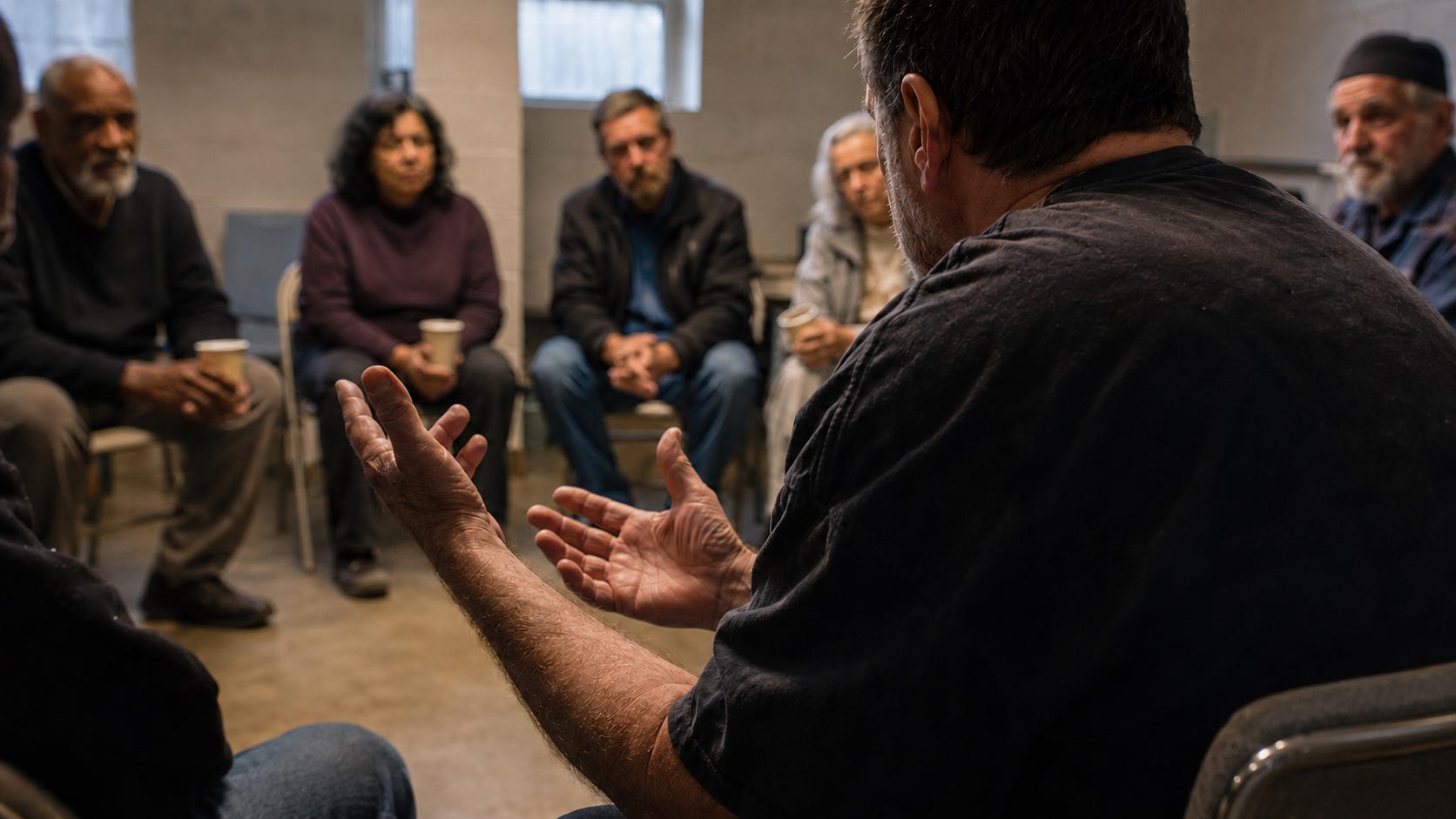
Which means the thing you are most tempted to hide may not disqualify you from being helpful and fruitful after all. The weakness you keep trying to outgrow or cover up may be the very place through which his grace becomes believable to somebody else. Why is this so? Because a person who has stopped pretending becomes a safer place for other people to stop pretending too.
Bill Wilson carried alcoholism to his grave.
And Paul carried the thorn.
Neither man became strong in the way the world talks about strength. But both became instruments of healing, because they finally stopped hiding.
That is still how grace gets transferred from one soul to another.
The hand that reaches out to a drowning man is usually the hand of one who was once in similar trouble. Maybe that is why God has grown so accustomed to doing his best work through busted up and broken down people. And maybe that’s why the likes of Bill Wilson, Henri Nouwen, and the Apostle Paul came not to despise, but to glory in, the mighty gift of weakness.
What weakness, wound, or struggle in your life are you most tempted to hide from others, and what difficult (or good) thing might happen if you stopped hiding it?
Comments
Nothing yet. Say the first thing.
Sign in to join the conversation.