
Greg Crabtree is my business finance guru.
If you’ve been reading this newsletter for a while, you’ve probably heard me fanboy him plenty of times. I met him once in 2019. Haven’t washed my hand since.
Greg arms readers with dozens of tools in his books, *Simple Numbers* and *Simple Numbers 2.0*. Among my favorites: the Thinking Model.
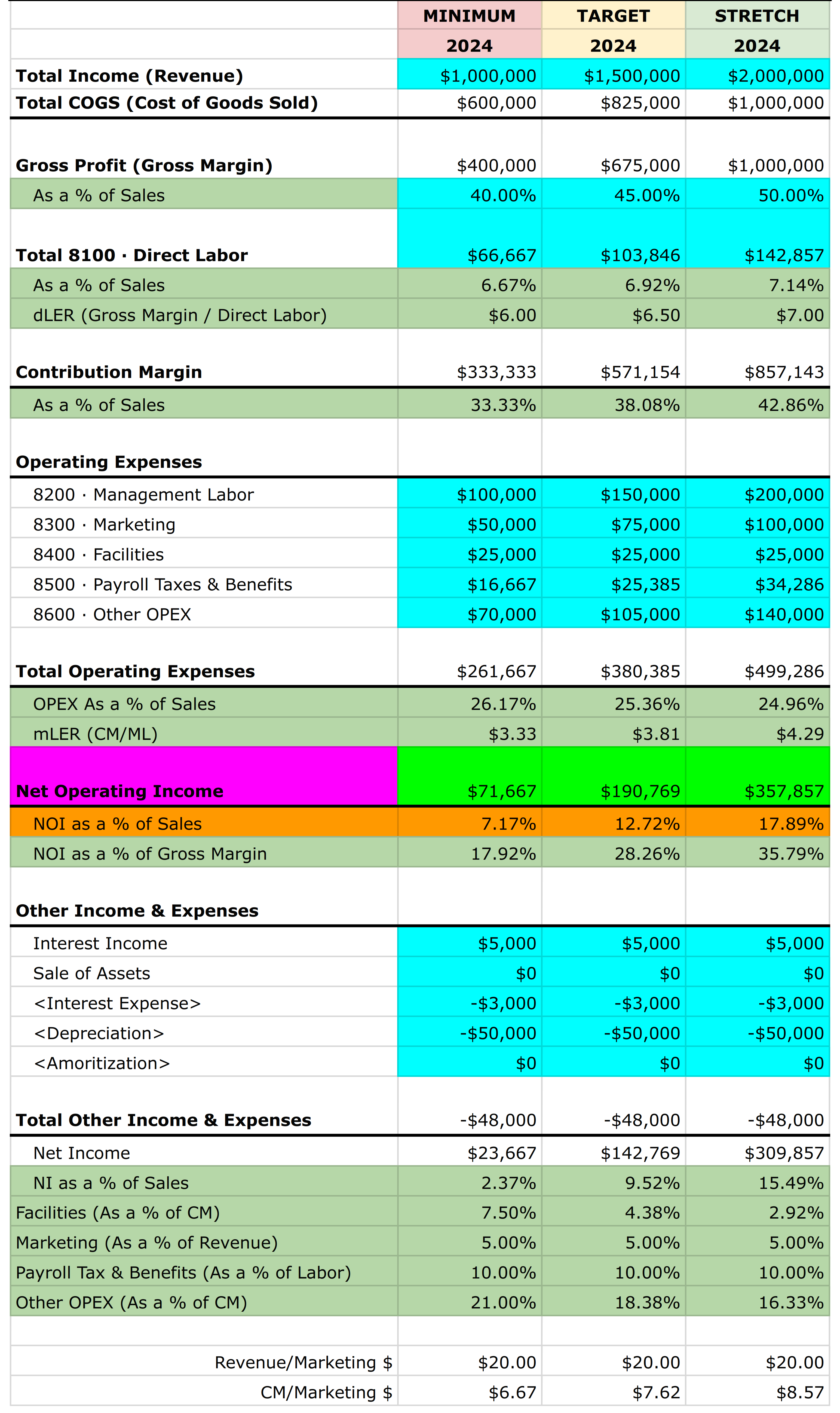
The Thinking Model is a very simple P&L model that forecasts your upcoming financial performance in three states:
Minimum: What would it look like if you keep doing what you’re doing?
Target: What would it look like if you execute on your growth goals and the market is average?
Stretch: What would it look like if you pushed your team and your growth goals to the max and got a nice assist from the economy?
Here’s what it looks like.
It answers the question owners and operators ask all the time: “What happens if...?”
What happens if I hire this person?
What happens if the economy does this?
What happens if I “fire” this customer?
In those moments, owners and operators wish they could see the future. With a Thinking Model, you get really close.
Once it’s built, you adjust any of the variables and look at the results. It’s really that simple.
1. Get your chart of accounts (inside your accounting software) in order like this: (1 hour)
Income
Cost of Goods Sold (COGS)
Direct Labor (Labor that “faces” the customer more than 50% of the time)
Management Labor
Marketing
Facilities
Payroll Taxes & Benefits
Other OPEX
Other Income & Expenses
2. Download the template (2 minutes)
3. Run a P&L report from your accounting software (2 minutes)
4. Plug in the variables (the blue cells on the template) (30 minutes)
When you have a question, an opportunity, or a crisis, copy the tab, play with the numbers, then look at the results.
That’s it.
Example: what would happen if I “fire” a customer who represents 15% of my revenue?
Adjust revenue (row 4) down 15%.
Reduce any expenses you could cut if you no longer had to service that customer. Maybe you’d be able to pull back labor in a certain way. (Rows 8 and/or 14) Make those adjustments.
Now look at the new model. What’s the impact on the bottom line?
You have a clear picture of what that decision will actually cost you. Or maybe, what it will make you.
My team and I use our Thinking Model often. It’s provided financial clarity for dozens of potential decisions.
Of course, the financial impact of a decision is only one factor to consider.
What I’ve found is that once I check this analysis off my list, my mind is free to focus on the softer factors: alignment with our overall goals, impact on people (team and customers), and my general “do I want to do this?” gut feeling.
So go ahead, give it a whirl. And let me know if the Thinking Model brings you some financial clarity.
As always, if you’d like to chat about topics like this, I’m here for you: scott@scottmonday.com.
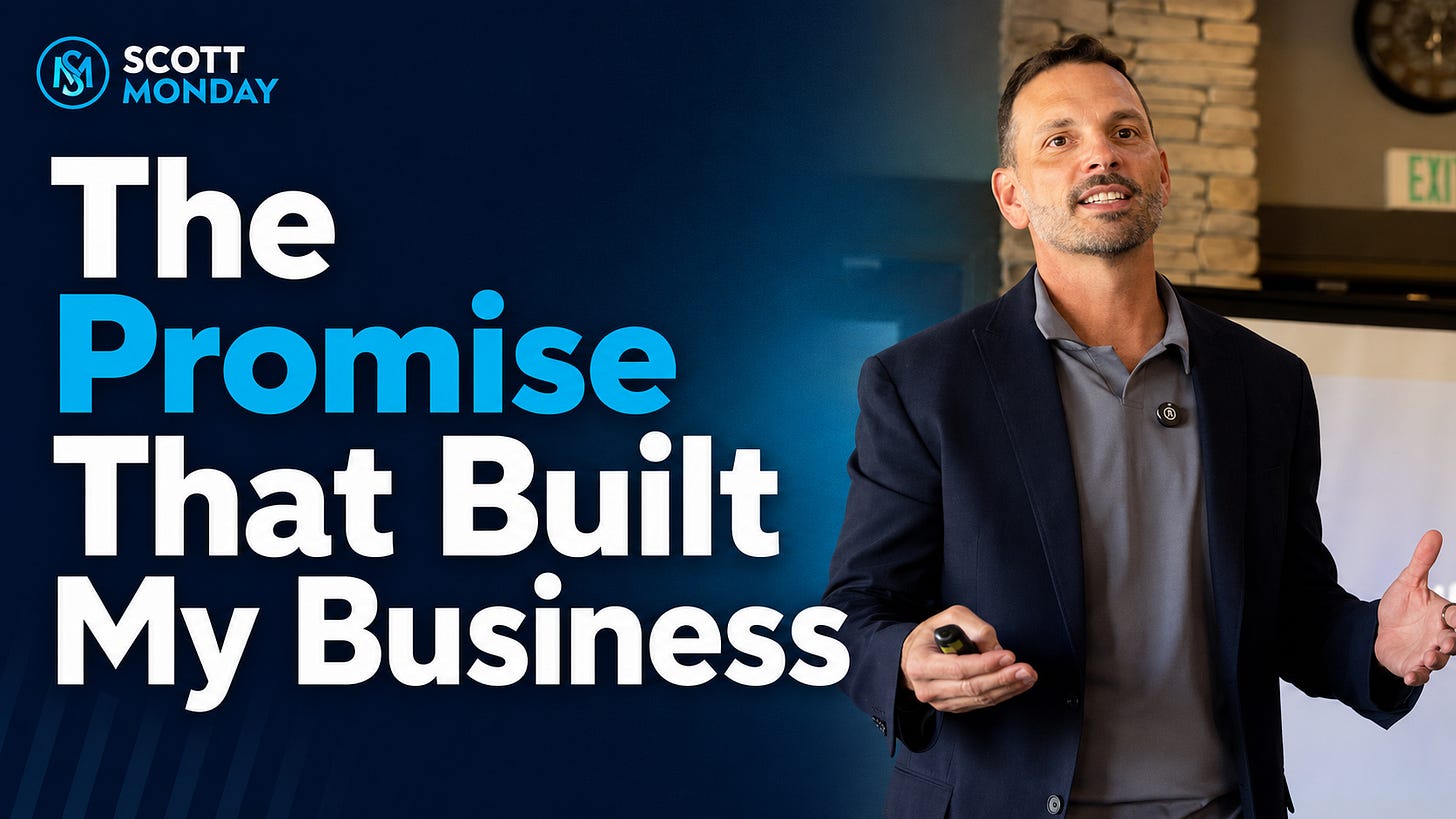
I recently shared my Audacious Guarantee talk with a local Rotary Club. I think it went well. I didn’t curse, which was a win. Check it out!
(Note to readers: For years I’ve ended the weekly newsletter by sharing a product, tool, or gadget I’ve been enjoying. Well, after 146 published newsletters, I’ve run out of things to recommend. So I thought I’d weave in an alternate ending section on occasion: Recent AI Impacts. In this snippet, I’ll share cool ways I’ve seen AI show up for my team or for me over the last few weeks. Newsletter nerd coefficient increasing by the week!)
Recent AI Impacts: Our newer business, Trinity Builder Solutions, is an accounts receivable generator. We do the work, bill for it, and then wait 30 to 90 days to get paid. That sucks up cash; thus, staying on top of A/R is critical. It’s also annoying. So I trained Claude Cowork to read my A/R report, generate follow-up emails to the accounting contacts at our customers’ offices, then build a weekly receivables forecast based on historic payment timelines and the replies that come back in. What used to take me two hours a week now takes 10 minutes. And it’s shortened how long our receivables sit out there. Cash is king!
Comments
Nothing yet. Say the first thing.
Sign in to join the conversation.