
Seventeen years ago, I wrote a blog post that started with a question:
I had seen a self-proclaimed sales guru touting a course while wearing a T-shirt that read, “I’m a sales bad-ass!”
Something about it bothered me. Actually, a lot about it troubled me.
Aggression was the foundation of an increasingly popular strain of sales advice in those days. Close harder. Objections? Annihilate them. Beat the competition. Take control of the dialog. Never accept a no for an answer.
My point in 2009 was pretty simple: Is that really the person any of us wants to buy from?
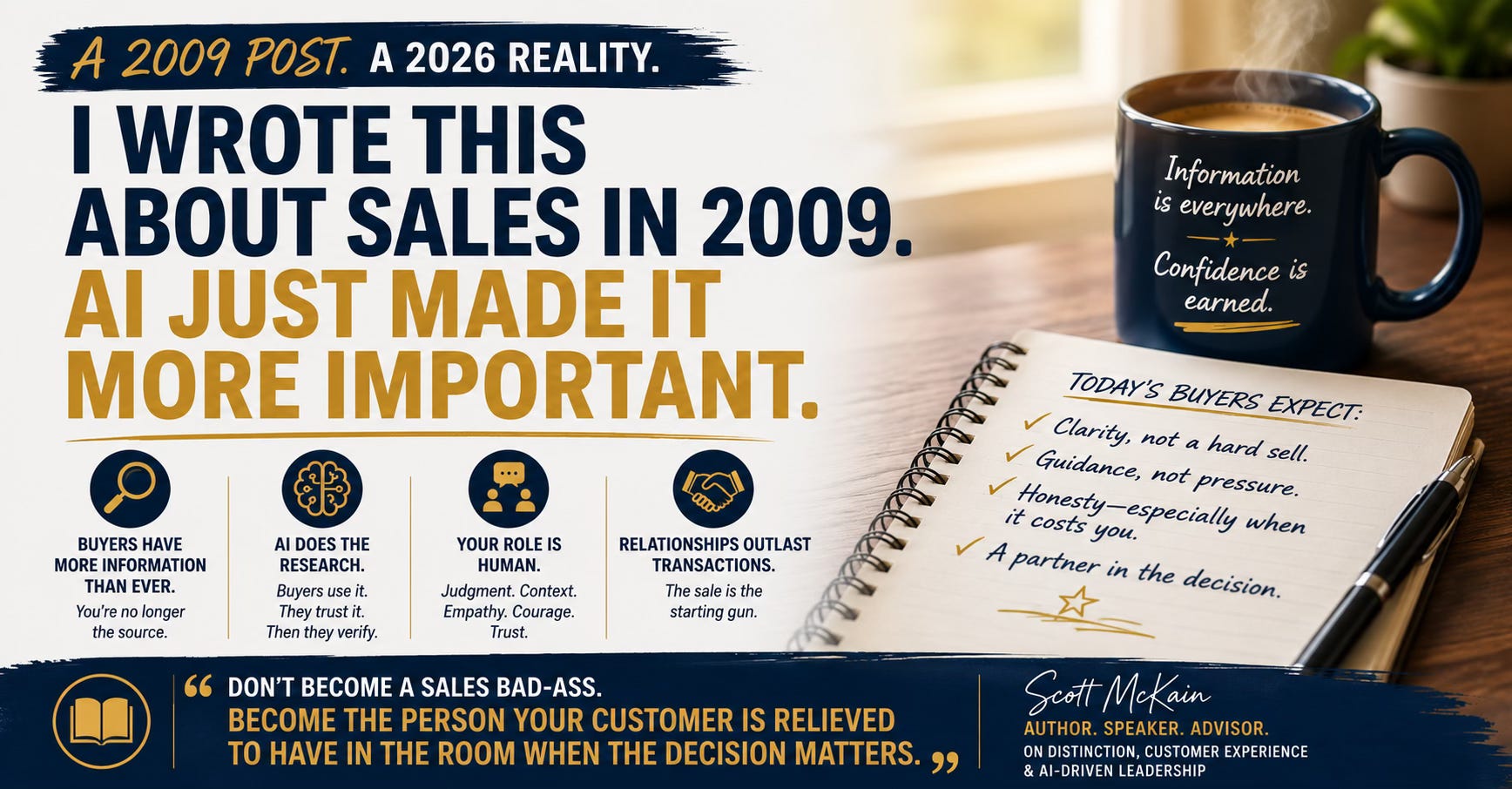
I still believe that. But seventeen years later, I would modify it slightly: Become the person you’d trust to help you decide.
That distinction matters more today than I could have ever guessed when I wrote the initial post. Artificial intelligence has revolutionized the game for sales professionals. And, oddly, it has made the concepts I wrote about in 2009 all the more crucial.
In that original article, I wrote: “The type of sales these ‘bro-sales’ guys are proclaiming is based upon a time when the salesperson had more information than the customer.”
That was becoming a reality in 2009. Today, it’s undeniable.
Back then, customers were discovering that they could go online and research products before talking with a salesperson. Now? Your customer may investigate you, your company, your competitors, your pricing, your reviews, your shortcomings, and your alternatives before they ever know they are considering a purchase.
They can watch YouTube reviews. Read Reddit threads. Study customer complaints. Compare features. Ask colleagues. Examine your executives on LinkedIn.
And now they can ask AI to synthesize all of it.
They can ask:
“Compare these three products for my particular situation.”
“What complaints do customers have about this company?”
“What questions should I ask this salesperson?”
“What am I missing before I make this decision?”
They can even ask AI to help them negotiate with you.
And here’s the fascinating part: that doesn’t mean the salesperson has become irrelevant. It means the wrong kind of salesperson has.
Recent Gartner research provides an extraordinary snapshot of what’s happening. In 2026, Gartner reported that 67% of B2B buyers prefer a sales-rep-free experience, and 45% had used AI during a recent purchase.
If you sell for a living, those numbers ought to get your attention. But another Gartner finding is even more interesting. The firm subsequently reported that 69% of B2B buyers prefer to validate AI-generated insights with a sales representative.
Think about those two findings together.
Buyers increasingly don’t need salespeople to get information.
But they still value excellent salespeople to make sense of information.
That’s a hell of a difference. And I think it says something crucial about the future of selling.
Yesterday’s salesperson controlled information.
The bad salesperson controls pressure.
Tomorrow’s great sales professional creates confidence.
Scroll through social media today and you’ll still encounter some of the same language I was complaining about in 2009.
Crush objections.
Dominate your market.
10X your pipeline.
Close anyone and everyone.
Become a killer.
Be relentless.
Notice the language. Crush. Dominate. Overcome. Close.
Here’s the question I was really asking in 2009 — although I don’t think I articulated it quite this way: Where is the customer in any of that?
If an objection is something to be “crushed,” what does that make the person raising it?
If a prospect needs to be “closed,” whose interests are driving the conversation?
If your primary objective is to 10X your revenue, what are you helping the customer accomplish?
And when our vocabulary always speaks of selling as winning, conquering, overcoming, dominating, and closing, we shouldn’t be shocked that customers think our interests may not be aligned with theirs. Great selling isn’t something you do to someone. It’s something you create with someone.
Here’s where my thinking has evolved most since 2009.
As mentioned earlier, I used to say: Become the person you’d like to buy from. Today I’d go further. Become the person you’d trust to help you decide.
Those aren’t necessarily the same thing. Because sometimes the most valuable thing a salesperson can say is, “I don’t think we’re the right solution for you.” Or: “You don’t need the more expensive option.” Or even, “Based on what you’ve told me, I think one of our competitors may actually be a better fit.”
That sounds like terrible advice if your only objective is closing today’s transaction. It sounds like exceptionally good advice if your objective is earning tomorrow’s trust.
It’s deceptively simple to claim that you put the customer first when doing so also maximizes your commission. The real test comes when the customer’s best interest and your immediate financial interest diverge. What happens then? That’s when your values stop being marketing language and become evidence.
There’s another sentence from my 2009 article that I’d change today. I wrote that sales were moving “from a transaction model to a subscription model.” That certainly happened in many industries. But the larger transformation is even more important.
Even when there’s no literal subscription involved, today’s transaction can produce — or destroy — enormous future value.
Reviews.
Referrals.
Renewals
Upgrades.
Introductions.
Reputation.
Advocacy.
Future purchases.
However, many are still teaching salespeople to celebrate “the close” as though the customer relationship has reached its ultimate objective. Yet, imagine proposing marriage and thinking the wedding ceremony represents successful completion of the relationship. That’s essentially what we’re doing when we treat “closing” as the ultimate measure of sales success.
The signature on the contract doesn’t tell us whether we’ve created a great customer. It merely tells us we’ve acquired one. What happens next determines whether we’ve earned one.
There’s another change we couldn’t have fully anticipated in 2009: The buyer has changed.
Forrester reported in 2024 that Millennials and Gen Z represented 71% of B2B buyers.
Think about the implications. We’re increasingly selling to generations that grew up with instant access to information, online reviews, social proof, digital purchasing, comparison tools, and algorithmic recommendations. Now add generative AI.
Imagine educating a salesperson in 2026 to sell to a consumer who researches with AI, checks Reddit, watches YouTube reviews, evaluates competitors online, and consults colleagues digitally, all with a sales philosophy born when the salesperson controlled access to the product brochure. That’s not tradition. That’s malpractice.
One of the three principles in my original article was this:
“There are NO secrets to sales success that ‘they’ — whoever ‘they’ are — don’t want you to know.”
Seventeen years later, I might believe that even more strongly.
There is no magic phrase that makes someone buy.
There is no psychological trick that guarantees the close.
There is no “secret objection destroyer.”
There isn’t some hidden sequence of words that transforms a reluctant prospect into an eager customer.
And if someone tells you there is, notice that the person making the claim usually has something they’d like to sell you.
There are certainly skills worth learning.
Great questions matter.
Listening matters.
Preparation matters.
Understanding the customer’s business matters.
Communication matters.
Negotiation matters.
Follow-up matters.
Product knowledge matters.
But those aren’t secrets. They’re disciplines. And discipline isn’t nearly as easy to sell online as a secret.
This is the question AI forces every sales professional to answer.
If AI can provide information...
If websites can provide specifications...
If algorithms can provide recommendations...
If customers can compare alternatives without speaking to you...
What are you FOR?
I believe the answer is increasingly clear. Here are seven aspects you’re there to provide:
You’re there to provide judgment.
Context.
Empathy.
Perspective.
Experience.
Courage.
And, ultimately, confidence.
Sometimes those two things will produce exactly the same outcome. Sometimes they won’t. And the customer’s ability to trust you may depend upon whether you’re willing to acknowledge the difference.
Looking back at what I wrote in 2009, there are phrases I’d change. There are examples I’d update. There are predictions I’d expand on. But I wouldn’t change the central belief.
The future doesn’t belong to the salesperson who can pressure someone into saying yes. AI can provide information. Websites can provide specifications. Algorithms can provide recommendations. Customers can compare alternatives without ever speaking with you. So when a customer finally chooses to spend their increasingly precious time with a human being, that human being had better provide something the technology cannot.
Judgment. Empathy. Context. Courage. Trust.
Don’t become a “sales bad-ass.” Become the person your customer is relieved to have in the room when the decision really matters.
Comments
Nothing yet. Say the first thing.
Sign in to join the conversation.